Where fishmen lounge at noon

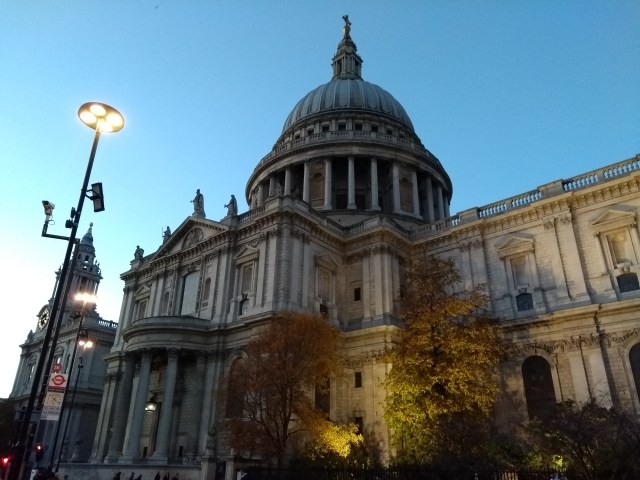
Last weekend I went to London to attend the UK-German Connection seminar, which facilitates the starting up of joint projects between foreign language assistants in each of the respective countries. Before this I’d only ever driven through or skirted the vicinity of the city on the way to somewhere else. As a result of my brisk pedal-powered departure from Fleestedt (which is south enough of the Elbe to be technically Niedersachsen) at 4.30 am, I had more or less a full day in the UK capital to myself.

“When one is tired of London, he is tired of life” is a quote from Samuel Johnson, famous for writing one of the first dictionaries of the English language. The fact that it’s stood the test if tune makes me strongly want to believe that it’s true. Delve not too far below the surface of this enigmatic epigram, however, and you might find an implied criticism of anyone who expresses even curiosity to venture beyond the city’s bounds. Yet I like to see it as: everything you could possibly hope to experience in the wider world can be found here, in due proportion, if you’re willing to seek it out. All that the globe contains in concentrated in this spot – a true Weltstadt.

And yet, London is also, well…London.  In spite of the hostile symbolism of the Houses of Parliament and the perpetual spin of post-millennial global capitalism finding constant renewal in the fickle-flitting sponsorship of the epitomising London Eye, we are all, in some essential way, at home here. So much of what we culturally consume originates from this locus. The novels we read, the TV we watch and even the board games we play (my initial thought on entering the city was that I was, in a very tangible way, inside Monopoly). Although ostensibly the environment’s a complete novelty, navigation is somehow a matter of confirming the internal map so vividly etched onto my consciousness by unavoidable saturation in television and books. When I turn a corner in the ‘unreal city’ (I add anecdotally with pride when a fellow literature student points out the church of St Magnus the Martyr, that he’s the patron saint of Orkney) I am hit not with foreign awe at the constructions of folk unknown, but with a welcoming wave of proxy familiarity.

IMG_20171124_161146816

It’s very hard not to be impressed though; and believe you me, I wanted to be cynical.

Cynicism comes easily, for example, on Edinburgh’s Royal Mile where screeds and screeds of tartan tat is touted daily and the superfluity thereof only serves to emphasise the total vacuity of it all. Unlike in the Scottish capital, London’s tourism is not so mercilessly concentrated in geography or season (August/the Festival) and thus here a sight more bearable. Edinburgh’s branding is painfully contrived and inauthentic, whereas London succeeds in the subtler cues of its sense of identity in the constant, but gentle insistence to “mind the gap” on its celebrated public transport infrastructure, the charming sixties-style typeface of said underground and the cohesive elegance of its street signage. I’d like to meet someone who thinks Lothian buses possess a similar spirituality, although I would have to admit Glasgow’s subway does have something special about it. Of course, barring logistics and layout, there is that factor of history that goes hand in hand with a city’s soul. Edinburgh has more of that than a lot of places, but here it runs alongside daily life, integrated in continual innovation, not lamented as a warped Romantic ideal.

Rewinding on the subject of tourists, my experience was not entirely unmarred by them. In a previous post I praised the universalistic, egalitarian, municipal spirit of Manchester for allowing me to visit all of its art galleries and museums for free. This point still stands, and I must say for the record that I remain fully supportive of the absence of admission fees, but to provide a counter I must say something about my visit to the National Gallery. Aiming to do a vaguely circular route that would use up the hour I’d allotted on my schedule, and having rushed through the Renaissance and Early Modern stuff, I pushed open the door to the 19th century and was arrested by Turner’s turbulent, stormy landscapes. However, before I was able to draw breath and examine these subtly crafted masterpieces in detail an atonal braying started up at the other end of the room. It was a class trip, and now having been on one or two myself from the other side, I know how draining these can be. This was almost physically painful. It had nothing to do with irritating kids and everything to do with the utterly dominant, patronising, nasal racket in which this educator delivered her excruciating lecture. I had to leave, but I could not escape.

In the next hall was Van Gogh. I had hoped that my experience with his Sunflowers would be if not spiritual, then at least warm and allow me to warmly reminisce about now cherished art lessons in primary school with one of my favourite teachers. All potential for this kind of nostalgia was obliterated by tourists smothering the works to take selfies. I still have these memories, and that especially poignant Doctor Who episode to keep Vincent alive in my consciousness, but to me it seems almost futile to have his paintings on display if that’s the only response they’re going to elicit.

My visit to the British Museum conjured further memories of that beloved TV series with its exhibition on the history of money. There was a small section on production companies having to print fake currency when they use it on screen. A clip from the first Christmas special of New Who was playing on loop in which the Doctor uses his sonic screwdriver on a cash machine to make it spit out a flurry of banknotes in order to create a diversion between him and the approaching killer Santa Clauses. The notes used have David Tennant’s face on them. Oddly enough, a love of Doctor Who is something I have in common with my equivalent German language assistants, Sina and Jule. I suppose the show is something you could name among things that are archetypally British, and I don’t mean this in a pejorative sense at all. Thinking about it, I would say it’s probably one of the best examples of British culture precisely because it rarely tries to be and it’s also a bit rubbish. Partly, this is why I also enjoy Public Service Broadcasting’s music. Anyway, I could go on for hours about the subject, so I’ll quickly move to the seminar.

To my complete surprise and delight, I met the German assistant placed in Orkney. Only the day before I’d been introducing my group to the stanzas of George Mackay Brown, so you can imagine my excitement. We’re going to do a project focussing on regional identity, particularly through language, and this will involve the usual strategies of letter exchange, but also hopefully artistic collaboration and a joint, multi-lingual blog to which the pupils will contribute.

Right now, it’s called “Opposite Sides of the North Sea”. It’s very much evolving. If it’s possible I hope we can learn about Plattdeutsch – a variety of German spoken in the North with some affinities to Dutch, and ultimately see each other’s countries not simply as undifferentiated monoliths closed unto themselves, but as moving conglomerates of distinct regions defined by interrelationships. Of course, somewhere along the line this needs to be translated – quite literally – so that hamburgisch/Orcadian secondary school pupils can understand it, but we’ve got a few months for that.

Posted in Life, Personal experience | Tagged , , , , , , , , , , | Leave a comment

Luther, Lyrik, Lieder und Leipzig

Trees increasingly denuded, the mulch on the path starting to settle, I find myself stumbling into the final third of November. Since my impromptu excursion to Manchester at the end of October, Hamburg’s schools have gone back, but of course, academic business could not fully be resumed without commemorating 500 years of Reformation in unique style.

Martin Luther Day began with an assembly of all the pupils in the hall, where the appearance of a special guest was announced. After a rather dry introductory film, one of the teachers walked out on stage dressed as the man himself in earnest monk’s robes. He paused dramatically and unfurled an authentically yellowed scroll. This document carried the pope’s lengthy response to the 95 Theses, which announces Luther’s excommunication. It was read out in full. Faux-Luther then took the parchment and held its corner to an atmospherically flickering candle stage left. Lifting the letter, now alight, he placed the pontificate’s denunciation in a glass (presumably to some degree heatproof) bowl, where it was left to burn as he vacated the stage to rapturous applause.

So, an odd, but interesting beginning to my second term at Immanuel Kant Gymnasium. I hasten to add that the day was not uncritically swallowed wholesale by the whole school. Many questioned the suspension of the normal timetable for a not uncontroversial religious leader who many saw as irrelevant due to their atheism/agnosticism/membership of other religions.

Regarding my school life, it seems again that I’m not entirely avoiding Britain on this ‘Year Abroad’ – next week I’m off to London as part of my participation in the UK-German Connection programme. Although I’m not sure of all the details yet, what it will basically involve is a parallel project that I create with a German language assistant working in a UK school. Currently I would like the project to address questions of regional, national and European identity as explored through literature. I am aware that this is probably definitely too ambitious, but I’m of the school who think it’s better to overreach and fail to fulfil all your objectives rather than be overly modest and achieve mediocrity.

In preparation for this trip, and inspired, partly by the German literature class I help in’s working on Theodor Fontane’s poetry, I’m reading Ein Sommer in London. I went in expecting a sort of sentimental sycophantic praise common of contemporary travel writing (this blog not excluded!), but I was refreshingly surprised to find this was not to be found. It’s humorous and keenly sceptical of British culture, even if the author clearly remains in the ‘Anglophile’ camp.

The top-grade English class are also reading about the capital, but in this instance of Airstrip One under Ingsoc. Here, the landmarks are somewhat different though. The pupils give pertinent responses, without the benefit of context, to the three slogans of the Party. Just war is given thorough scrutiny, detailed references to the German constitution’s obligations for citizens in a proudly post-dictatorship country are made and the benefits of wilful oblivion are measured in relation to Eastern Europe’s response to the refugee crisis.

Since I last wrote I’ve had the chance to go to a couple of Hamburg gigs, and one even further afield (Berlin). The Mojo is a fantastic venue; just about the perfect size and shape to support dazzling light shows and bone-resonating bass while still retaining a closeness and sense of collective experience. I saw synth-pop folktronica duo, Sylvan Esso there to Kick, Jump and Twist things off with intricate, syncopated electronics and crystalline vocals. The following week I caught Canadian hip-hop/jazz/electronica quartet BadBadNotGood in the same club, whose set was masterful and virtuosic without being alienating – keeping its human soul with tight funky grooves as a vital underscore to mind-blowing solos.

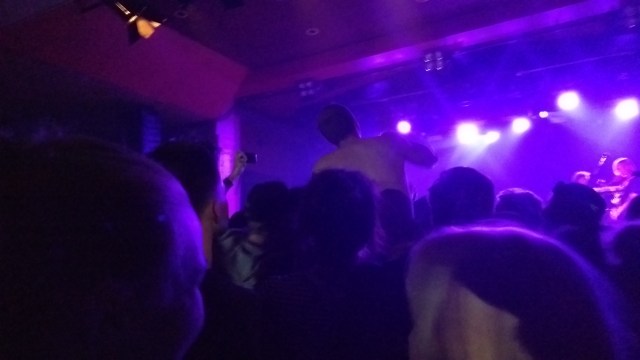
I went ridiculous lengths and suffered sleep deprivation to go and see Mac Demarco at Berlin’s Astra (incidentally Hamburg’s famous beer) Club. Was it worth it? Absolutely. It’s impossible not to love him. Even though a sizable chunk of his set was comprised of extended jams and faffing around, he still played all the songs you wanted to hear and the spontaneous nature of all the tomfoolery made it easy to forgive everything. The crowd was certainly on side. Occasionally literally, with topless audience members of both genders making successful stage invasions.

IMG_20171108_230125117

Hard to make out, but that’s Mac Demarco crowd-surfing in a drum case.

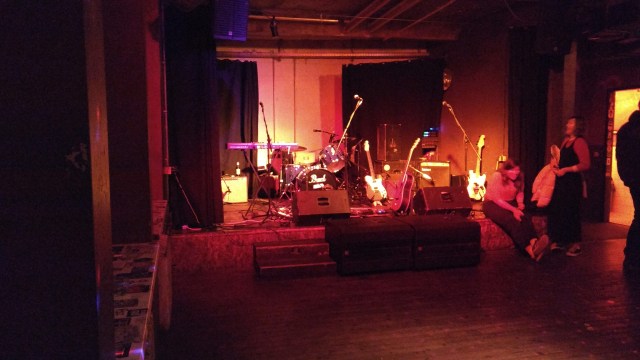
My latest gig was Girl Ray at Hafenklang, whose melodic basslines I adore, supported by the charming and articulate guitarist Fake Laugh. Tomorrow I’m seeing Public Service Broadcasting at Knust, who you’ve probably heard of if you follow this blog at all. Their use of the spoken word as opposed to sung vocals leads nicely into an experience of a different kind this past week.

IMG_20171114_203219139

Set-up at Hafenklang. Little did I know, that’s actually the frontwoman and bassist to the right.

Poetry slam is big in Germany. I can now tell you that first hand. On Thursday I attended a Städebattle between the rival cities of Hamburg and Leipzig. There were many reasons for me to want to go, not least that I’m due to study in the former in the spring of next year, but also because the event description made explicit reference to Plattdeutsch and Sächsisch, dialects I’m interested in as crucial facets of regional identity. Unfortunately, there were few direct instances of these languages during the ceremonious competition, nonetheless it was highly entertaining.

The evening began unusually, with the charismatic compere asking audience members’ Abi (Abitur – the exam Germans take at 16-19 [the age of examination is a subject of fierce debate and varies in different Bundesländer] which determines job prospects, university entry and it seems, crucially, status) scores in order to gauge whether they were fit to be judges of the performed poetry. This was bizarre, but also somehow typically German. At the end of it all, Leipzig, where Goethe went to uni after all, had a higher score by the judges reckoning, but Hamburg won the popular clamp-o-meter vote – unsurprisingly, in home territory. This I felt was justified as Leipzig were the better team, although Hamburg had some outstanding individuals.

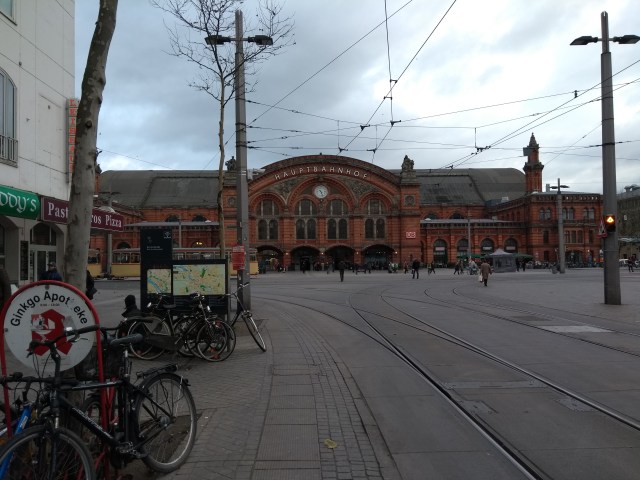
IMG_20171118_102649788

Ankunft in Bremen

To bring you right up to date, yesterday, in an attempt to see a bit more of this country, authentically this time and not just through going to English-speaking international acts, I visited the free Hanseatic city of Bremen – Germany’s smallest Bundesland and about an hour and a half by bus. The weather was quite poor, but I managed to spend an overcast late morning wandering through the Bürgerpark before the deluge began and I retreated to the shelter of a café for lunch. I explored the interior of St Petri’s Dom before venturing out to reach the Kunsthalle, which occupied the rest of my afternoon with its exhibition of modernist Max Beckmann, a show taking a critical look at Bremen’s colonial involvement and an impressive collection of fin de siècle and 1960s pieces. Just managing to snap a silhouette of the town’s iconic windmill blades before sunset, I boarded a slightly delayed Flixbus home.

Posted in Entertainment, Life, Music, Personal experience | Tagged , , , , , , , , , , , , , , , , , , , , , , , , , , , , , , , , | 1 Comment

A Free Admission

Midday in Manchester; streetlamps lit. The overcast gloom was a mental association, acquired thanks to Morrissey and co, satisfyingly confirmed as I was transported through a city whose psychogeography was already etched deep into my mind and which was later reinforced by Valette’s magnificently bleak canvasses. Names like Strangeways, Rusholme and Salford all held specific emotional resonances despite my never having visited them; but this was about to change thanks to the happy alignment of dirt-cheap Ryanair flights and two weeks school-free because of the Herbstferien. I trundle along on a Metrolink tram. Used to the depersonalised tannoy assertions of “Nächste Haltestelle x” in Hamburg, I’m warmed by the comparatively wordy announcements delivered in here in an authentic Mancunian.

Some part of me needed to justify this trip on grounds more solid than the convergence of variables. Although I regard myself tolerant and open to diverse cultures I’m not particularly travelled. How can one fully accept/reject or comprehend what you’ve never encountered first hand? It was a struggle for me to accommodate a visit to the UK within this philosophy – it seemed more motivated by sentimental notions nurtured in me through devotion to a band. Well, I thought to myself, it might be possible if I considered England foreign, but as much as I might like to, I don’t fully feel that, on a personal level, to be the case. I shy away thinking in terms of ‘foreign’ generally, preferring to think of people as citizens of their own nations rather than incomprehensible outsiders, of which I think the term carries connotations.

As Scots we know the English; they are not us, but they are not foreign. When we talk about someone who is foreign, it is usually because we can’t place where they’re from, but they give off strangeness in their speech or ethnicity. Besides this, culture can also make someone a foreigner, and this, unlike political institutions, can take generations to shift. Culture, in this context, I take to mean a guiding underlying ideology common to the majority of citizens of a particular place – not high art.  At the moment I believe Scotland and England share a culture in this sense, which is markedly distinct from a German or a French one. It operates tacitly, subconsciously affecting decisions, designs and our day-to-day interactions with one another; most importantly, it can only be noticed through comparison. This shared culture may be diverging, but it could take the next generation to determine this. Anyway, this is a topic for another day. In the end I managed to come up with two solid reasons:

  1. I might as well actually see some of the UK before I dismiss it altogether, and I don’t think being driven along the length of it on a school trip behind bus blinds really counts.
  2. I’ve not seen much of England apart from passing through on the way to other places and an anomalous weekend in Bournemouth.

Upon arrival I was immediately antagonistic. The ticket machine wouldn’t accept my banknote and the patriot in me screamed, “It’s legal tender!” at the bastard. Later, in an attempt at de-escalation it was suggested to me that this might be because of a shift towards plastic cash. The UK’s change had changed, I noticed as I was handed a shiny handful of new pound coins, the old having gone out of circulation this month in my absence.

Seeing with different eyes, I observed the ubiquity of self-service in a service-based economy. In Germany there is almost a total lack of this option, except for travel tickets. The supermarket is a stressful (items must be packed as quickly as possible and paid for with exact change) but less lonely experience. Perhaps forced contact with actual human beings in the purchasing of Lebensmittel helped me out in the long run by giving me confidence to visit restaurants and cafes on my own where I’d normally have been put off by the necessity of direct face-to-face interaction.

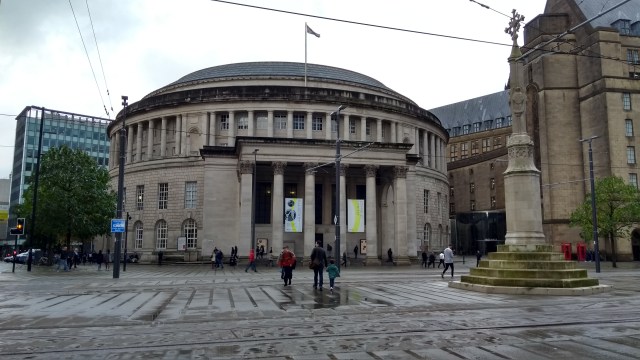
The first place I visited, once my tram finally reached the city centre after a protracted crawl through suburbia, was the central library. Its featured exhibitions were on the world of Harry Potter and its medieval precedents in terms of the subjects taught at Hogwarts for the 20th anniversary (meh), and the relationship between the twinned cities of Manchester and Leningrad to mark the Russian revolution’s centenary. Entirely free of charge and not requiring a card or membership to access, I was able to explore the vast reading room. Not wanting to spend too long in somewhere overtly academic, I managed to see the music section, which houses pianos in wee alcoves for anyone to play; this had me grinning from ear to ear and praising the great municipal spirit that permits such things. Later Mia told me they had rehearsal rooms for other instruments too, including drumkits and DJ decks – imagine starting a punk band in a library!

IMG_20171024_123237694_HDR

Then I saw the gallery. It was laid out in a pretty similarly to the National one in Edinburgh, with different time periods for different rooms, although there was probably more of a thematic distinction here as well. One of my favourite pieces was a Japanese feature garden kitted out with hidden synthesisers in the undergrowth playing ambient, sequenced noise. Early 20th century impressionist artist Pierre Adolphe Valette also caught my eye for his masterful depiction of Manchester’s urban gloom.

After nabbing a copy of the new Ibibio Sound Machine album in the Northern Quarter, I sat down for an indulgent strawberry milkshake with a slice of Victoria sponge. Waiting for what seemed like an inordinate length of time, I was presented with my milkshake. The wedge of cake was balanced on top of the drink, secured by two wooden skewers with just enough space to slot in a straw; a skirting of white chocolate was fused around the rim. Although the golden fork was a nice touch it didn’t really help me tackle the immediate problem with any more dignity. I had no companion to advise me, so was forced to set about the task with all the inelegance one might expect, and after all that the cake was dry and in some parts undercooked.

That night I saw Fickle Friends at Gorilla. They were supported by a Norwegian trio whose name escapes me, and Google’s not proving fruitful. Their exuberance in triggering samples failed to quite match the music they were playing but their clunky literal translations into English did amuse me. Fickle Friends had taken a different direction since I’d last seen them at Electric Circus in Edinburgh, which is probably a plus because their older material is so similar as to be virtually indistinguishable from track to track – luckily, it’s a good song though.

After a blissful night’s sleep in a (sorry Germany) proper double duvet, I visited HOME whose name kept making me think of that vapourwave artist every time I saw it, not helped by its insistence on all caps. In front of the entrance stood a strident statue of Friedrich Engels, co-writer of the Communist Manifesto who spent the best part of two decades in the city; this effectively signalled another exhibition exploring the 100-year anniversary of the Bolshevik revolution. This time there was more of a pressing focus on the present, examining the idea of when a dream of the future becomes the past. Probably the most affecting thing I saw was a photography display depicting Ukraine’s so-called ‘Leninfall’ from 2014 onwards – later I learnt that the statue outside was actually transported out of the country by artist Phil Collins, and was the source of some controversy. These images were conflicting to look at. I don’t pretend to understand exactly what went on there, but it seems pretty drastic to suddenly abolish 70 years of history in the space of a few months, even if a part of that was unimaginably horrendous manmade famine and when the population is up against an intolerable Putin-led Russia, who is unfortunately symbolically conflated with the iconography of Soviet communism.

Manchester’s main museum reminded me surprisingly of Stromness’s with its extensive natural history collection of taxidermy. I didn’t spend too long there before I moved to the Whitworth Gallery of modern art. My kind of modern art is the big installation sort, and with its vast space the Whitworth was able to play host to sprawling sculpture and immersive 3D concepts. A highlight was a room with two walls covered in clocks whose hands pointed to words like ‘euphoria’, ‘guilt’, ‘ecstasy’ and ‘depression’ instead of numbers. Above each clock was the name of a city, although alongside genuine place names were “fictional” metropolises such as Atlantis, Shangri-La and Babel.

As the afternoon drew to a close I met up with Mia, who I met in second year through The Student’s music section and who encouraged and inspired me to start my own radio show on Fresh Air while she was head of music there. Footage, where we met, feels very much like a student union and it’s located on Oxford Road, home to several universities and colleges on this street alone. Choked up from a lingering cold she talked about her masters in journalism and the opportunities to be had in and around Salford’s Media City, and I my work at Immanuel Kant Gymnasium, during which I had to account for the randomness of my appearance in Manchester. We moved to a restaurant and had the pleasure of sampling the niche cuisine of Nutella fries. Abhorrent? Perhaps. They tasted divine.

Mia helped me find the right trams and we said goodbye. I was off to another ‘pre-booked whim’ – Reggie Yates was launching his debut book about his career in documentary making so far. I’d been to a couple of book launch events before, the one that stands out though is probably Margaret Atwood’s for her novel Hag-Seed – a re-interpretation of Shakespeare’s The Tempest. In the front row and sat next to incredibly beautiful phenomenon of nature, also attending on her own, I spent the evening awestruck from several angles.

This was quite another experience. Reggie, and I’m calling him Reggie, not out of disrespect or lack of authorial prestige but because we all know him as that through his work on Radio One and CBBC, does not inspire the same goddess-like reverence as Atwood. He is essentially straight up, quick and to the point while never abrupt; he possesses a manner ideal for talking to difficult people about difficult subjects. This lies in contrast to Atwood’s supremely measured, dry wit and tantalising enigma, which one is never likely truly to understand.

Reggie’s certainly had a varied career and he was refreshingly candid when it came to questions of money, relationships and his own vanity. He stressed a dislike of industry jargon, but his natural slippage into the corporate shorthand he allegedly wanted to avoid made me question his commitment to reforming the culture. At the end of the event, and unlike at Atwood’s where we were handed out pre-signed copies of the book, we were given the chance to meet him personally and he’d autograph it there and then. This was done highly efficiently – you handed over your phone to a guy who would snap for the obligatory Instagram post and it was all over in about 10 seconds, most of which I spent spelling my name!

The most interesting aspect of the evening was probably meeting a guy in the queue who handed me a copy of his self-published novel in exchange for a review on Amazon. It reminded me of my younger, more naïve self who had embarked on something very similar in the past (although it must be said I never printed a physical copy). Anyway, he seemed nice enough, but I tried to advise him in the nicest way possible, after he revealed to me the number of downloads he’d had, to keep trying for publication through a literary agent or competition win as this was, as harsh as it may seem, the only real route to serious, or for that matter even moderate, success. I sat reading the book in the airport with mild amusement and frustration in equal measure (feedback: overuse of italics) as the passengers for flight number xxx to Kirkwall via Edinburgh were called to proceed to gate for immediate boarding.

Posted in Entertainment, Life, Music, Personal experience, Politics | Tagged , , , , , , , , , , , , , | 1 Comment

The return of Twin Peaks: a classic revived

maxresdefault

It is unusual for a writer to revisit his work after such an extended period of time away, and stranger still for him to successfully gather almost all of the original cast for the return. The only comparable example that comes to mind is the recent Harper Lee sequel to the acclaimed To Kill A Mockingbird entitled Go Set A Watchman, which was published, the year before the author’s death, in 2015 with an impressive 55-year gap between the two novels!

1989’s Twin Peaks was ground-breaking on several fronts, not least for its reticence to be shoehorned into any one genre. Lynch and his writing partner Mark Frost created something that was on the surface a crime drama, this morphed into something more like a soap opera, as the show became as much about the subplots of the inhabitants lives as the murder. Add to this mix quick-witted humour, sharp dialogue, cleverly drawn characters and increasing elements of horror and the absurd, and you have recipe that shouldn’t work on paper but which realises itself beautifully in practice. This is not to mention the show’s compelling dream-like soundtrack composed by Angelo Badalamenti. Lynch is also one of the pioneers of cinematic television, taking a broad arc rather than episodic approach to the series and incorporating extended establishing shots of the North American landscape.

Did we want a new series? We hoped for it, but we were equally concerned that a new incarnation could tarnish the legacy of the original. Did we expect it? Most didn’t. Twin Peaks seemed so rooted in its particular time and place that it was hard to imagine the small-town charms breaking through into the 21st century. Yet there was always a sincerity in the prophecies of the original that made it hard to ignore Special Agent Dale Cooper’s final threat of “I’ll see you in 25 years” in the concluding episode.

Instead of the microcosm of 1989, Lynch presents an American odyssey grounded in 2017. Unbound by the constraints of a network he is free to indulge in what is almost painfully slow and intricate pacing. The iconography of the original is persistent, and the motifs recurring – Lynch, so it seems, is ultimately the show’s biggest fan. There are moments of genius (episode eight in particular) but whoever embarks upon this mammoth voyage must be warned that these instances of ecstasy come at the cost of hours of borderline tedium. The viewer, as much as the director, must suffer for his art.

Posted in Entertainment, Review | Tagged , , , | Leave a comment

Lübeck: charmingly wonky

The weather this Sunday is disconcertingly mild for October, it seems stolen from a summer past or future, wrenched anachronistically into autumn. I cower in a room saturated with light. Creamy, lumpy walls that have a vaguely pebble-dashed texture encase me in their nondescript magnolia embrace. Sun streams in from a hunched over window – through this single portal a slice of serendipity filters into this wee attic flat in Seevetal.

Quarters are comparatively spacious, that is with slumming it in Edinburgh’s Buccleuch Street. The snows of Hamburg are yet to affront this fortress, but so far, the insulation seems sufficient.

Alas I must delineate the cons, for although I’ve finally had something of a success in the city’s hectic rental market, things could, as always, improve.

For a start, there is no kitchen. Well. There is and there isn’t. A plug-in hob rests on a shelf and there is at least a microwave; we’ve also been given the luxury of the use of a fridge-freezer.

There is no washing machine, which means that I must trek to the Harburg laundrette when I start to run out of clothes. The busses are frequent enough but not great logistically for weekends, when I’m going to have to crash or leave absurdly early.

Luckily administratively things seem to be heading in the right direction. I have a bank account and plastic, a sim card and university library membership. Hamburg’s library annoys me though. While I managed to withdraw the resources I needed, the process saddened me. It seems that you can’t take out books older than 10 years (most) from the shelves; one must order them and then they appear on a ledge next to your surname at some point the next day. To me that destroys all the fun of libraries, by which I mean the searching in old shelves, the smell of yellowed leaves and the discovery of the quaint, unexpected and most importantly, not directly relevant.

I must turn to matters less peripheral, to the reason I am where I am. The cause of my being at liberty to write such a tract are the Herbstferien, or October holidays. With no tatties to pick I’m free to explore the locality and reflect on my progress thus far, this greatly enabled by stable accommodation after a hellish Wohnungssuche and a rather gorgeous-looking, if a little impractical, bicycle.

The terms’ concluding fortnight has been an interesting one containing varied experiences, from correcting primary kids’ grammar to instilling considerable excitement about the world’s shortest scheduled flight. I finally managed to pick up and devour Lessing’s Emelia Galotti in a single night in preparation for a German literature class I’m helping with, only to be told the following morning that the students were on ‘Praktikum’ (some kind of work experience placement I presume). This particular edition, found filed in an entire wall of cute yellow Reclams, was purchased in the midst of a storm, which toppled several trees and left train tracks blocked, hence I had time to browse the Hauptbahnhof bookshop, waiting out the delay.

However, where some opportunities fell through others arose and I got to participate in one of the upper grade’s lessons concerning the theme of dystopia/utopia. Although the teacher was less than enthused, I was in my element. We watched a Black Mirror clip, Thomas More was on a PowerPoint slide and 1984 was set as holiday reading.

At the Immanuel Kant Gymnasium, the final week of term was known as Projektwoche. This meant that all five days were given over to a particular topic be it anti-bullying, health and well-being or drugs education. I chose to accompany the main class I work with on their HVV project, which stands for Hamburger Vekehrsverbund – the public transport system of the city. This, as well as the standard busses and trains, also includes public ferries on the river Elbe. In addition to learning the ins and outs of this system there were also many team building games, poster making and quizzes, which culminated in a class trip. Although I was not required to go on the main trip, which took the form of some kind of city-wide treasure hunt I believe, I did manage to help out on Friday, when the pupils went on an excursion to the Wildpark Schwarze Berge.

This safari park, contrary to most found in the UK (I think, though it’s not as if I’m a frequenter), was home to European native species only. While narrowing the field of exotica somewhat, this still allowed for the spotting of wolves, lynx, beavers and boar amongst other species. Our guide was very patient and knowledgeable, despite the inevitable interruptions cause by the intrusion of a wasp into the company of children.

Yesterday I began my personal exploration of the surrounding region by taking a train to the wonderful medieval town of Lübeck, lying northeast of Hamburg. The train station is subtle and refined and flooded by natural light, unlike grimy tiled Harburg’s insipid jaundiced glow and the Hauptbahnhof’s tenebrous interior. Once you step outside you realise you were housed in a building whose mock-medieval turrets will match the town to come. From here it’s only a short walk to the old gate, flanked by two chunky red-bricked towers topped by copper domes. The first thing you notice is how squint they are, emanating a markedly different vibe versus Berlin’s classical grandeur. It’s a sign of things to come – Lübeck’s charmingly wonky.

IMG_20171014_120757679

IMG_20171014_162621781

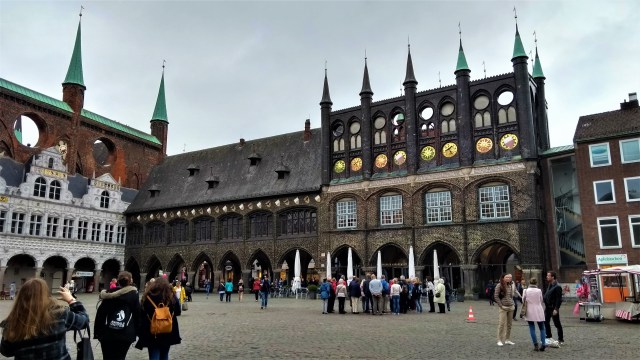
The market square is surrounded by municipal buildings with heraldry indented in their sides. As far as emblems go, a double-headed eagle guarded by a red and white shield isn’t half bad. Passing under the arches I discover, having done minimal research pre-departure, that this town is renowned for marzipan manufacture.

IMG_20171014_121947365_HDR

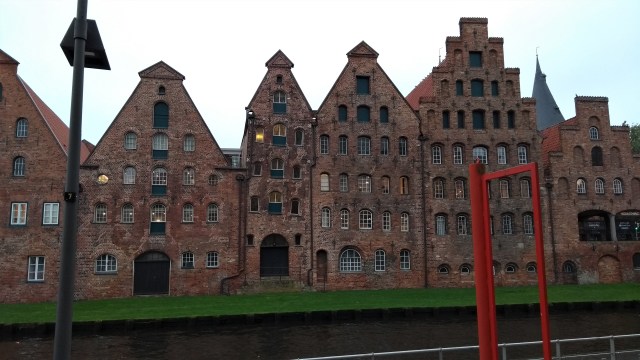
After a delightful (and most importantly, excellent value) lunch at an inexplicably Peter Pan themed restaurant, which plays the audiobook through speakers in the toilets, we wander down the many winding alleyways of Lübeck. Pastel coloured facades and higgledy-piggledy rooftops lace the descent to the dock, which resembles a sleepy sort of Speicherstadt but with more greenery and much less commerce. A quick peak in the door of one of the oldest municipal hospitals in the world and we’re ready to go home stocked with Süßigkeiten and Hanseatic pride.

Posted in Life, Personal experience | Tagged , , , , , , , , , , | Leave a comment

Ein Kölsch, bitte

I’m writing after the end of my first complete week in Germany, the country which will be my home for the year to come, and there is already a lot to tell.

This is how it went down:

Day 1: Edinburgh to Cologne

I fly from the Scottish capital, my home of two years and where I study German & English Literature at the university (the former part of my degree having a compulsory year abroad and the excuse for the whole adventure) to the most populous city on the Rhine to attend a four-day training course provided by the Pädagogischer Austauschdienst on behalf of the British Council, who organise a foreign language assistant exchange programme.

Arriving a little early, in order for me to be able to explore the city a bit before I’m whisked away to the relative seclusion of a place called Altenberg on the outskirts, I have some time to consider a couple of coincidences that seem to bode well for the year ahead. For a start, the notebook upon which I’m writing these reflections is a Leuchturm, not only made in Germany, but more specifically Hamburg, where I’m spending my assistantship. The second coincidence is relevant to Cologne; just the previous evening I’d had a last hurrah in Edinburgh with a good friend and after a delicious Thai meal we paid a visit to our regular craft beer paradise where they play B-movie horror films on low in the background. Anyway, I asked for a citrusy pale ale (it’s the kind of bar where that’s necessary, not solely pretentious by virtue of the regularly rotated selection of indie beers on tap) and I was presented with Kölsh – a beverage for which Cologne is renowned.

Day 2: A Tourist in Cologne

Only getting to the city in the early evening, I resolve to try and see as much of the sights as possible. The cathedral is impossible to miss and dominates the townscape (pardon the pun lol), it’s gothic architecture makes me feel oddly conflicted – I want to feel awe at what medieval society was capable of but knowing a bit of the history introduces something more complicated. It was only actually completed by 19th century enthusiasts when the middle ages were in vogue, and much of the structure is in fact a reconstruction after the intense bombing at the end of the Second World War. Adding to this, it’s hard to experience anything approaching spiritual when there is such an influx of tourist traffic, people taking selfies when a father instructs his children to kneel in prayer before a shrine etc.

Seemingly I have a knack for coming to Germany on open days, or that most of them fall in early September and that’s when I’m there. Today is Der Tag des offenen Denkmals and this meant that I got to explore the medieval Rathaus free of charge. Apparently, it is one of the oldest still in use in Europe. Part of it is highly modern, but the medieval sections are remarkably preserved. In some ways, it is reminiscent of the Reichstag building in Berlin in that it combines styles from different architectural eras. It evokes craftmanship, guilds and the hanseatic leagues.

I try to reach the cable car for a bird’s eye view over the Rhine, but it’s closed for repair and I only manage the botanical gardens. The chocolate museum seemed like a good deal for 9 euros and unlimited free samples in the guise of something educational, but the reality was about three pieces in total if you didn’t pay more.

Day 3: Arrival in Altenberg

Having walked around most of the city to the west of the Rhine, I decide to cross over to the east to kill a couple of hours before I travel, a bit counterintuitively, back to the airport where the rest of the language assistants are meeting to get the bus out to our training course. Apart from the rather grand Köln Messe/Deutz train station there is really not much there.

21767420_1434180533303921_1603066442_n

On arrival in the airport I feel awkward, but conversation soon starts flowing. I’m able to relate an icebreaker anecdote about my lack of appreciation for “Wurst mit brötchen” being exactly that, with sausage and bun being completely separate items – to top if off even the Senf came in a separate plastic pouch.

It takes a bit of faffing but once we’re all in the coach, given rooms and fed we get quite an extensive admin talk. After this we’re told (to at least my surprise anyway) that the bar opens at half eight, and there’s nothing else to do in this place (apart from view the cross-denominational Cathedral with, apparently, the largest stained-glass window in Northern Europe, which is admittedly impressive) other than to make use of the facilities on offer.

Day 4: The course properly begins

We are taught how to teach.

Day 5: Final day

Employing these very freshly acquired skills, we give lessons we spent the previous day preparing. There is a pub quiz and I feel inordinately proud of myself for knowing who Heidegger is.

Day 6: To Hamburg

Some (most) had overindulged the night before, but somehow I ended up in one of the more sensible teams, so got off lightly. We are bussed back to the Bahnhof and several of us catch the train to Hamburg. I am seated beside a Canadian; more of them seem to know where Orkney is than English folk! We both get off in Harburg, where I meet my mentor, who tells me that the city has more bridges than Venice.

Day 7: Zur Schule

I commute south to the school I’m placed in. Correctly identifying the three pop-art style images of the philosopher after whom it’s named, I meet the head teacher, who seems to warm to me. The first class I observe have a lesson in Hispanics in the United States; the primary school pupils who follow them all come to the front and compare heights with me and find the question ‘do you have a girlfriend?’ absolutely hysterical. I wish I could see the funny side with the answer I give them…

Day 8: Some of the city is seen

Confirmed: Hamburg does have many bridges. Its canals, harbours and warehouse district are beautiful. Even what could be ugly concrete facades are transformed by the citizenry into vibrant and engaging murals.

21698150_1434177223304252_223002879_n

Day 9: A stroll around Altona

Pick a tourist attraction that’s open on a Sunday or is free; go there. This happened to be the Altonaer Balkon, which gives a magnificent view of the harbour and commercial cargo vessels. I have to squint to make them out in glorious sunshine. However, after a trip to the train station to scavenge some lunch the sky breaks with a crack to unleash a thunderous downpour and I’m forced to retreat to base for the day.

Posted in Life, Personal experience | Tagged , , , | Leave a comment

The bleary pilgrim

Bundled into the Corsa. Beltless, unshaven and woozy. Despite its lack of a working radio I still love this car. The defunct Blaupunkt reads “SAFE” in all-caps instead of channel, or frequency. It couldn’t display track number; in this respect, alongside its winddown windows, it’s still very much in the analogue age with its cassette drawer only playing tapes – although I’m told they’re making a comeback too.

A drumstick air freshener swings erratically in vain from the useless volume knob, suspended by its elasticated cord. It attempts to mask a seemingly inerasable aroma; a legacy from the previous owner. It is within the cradle of this benevolent metal cage that my pilgrimage begins.

Now I’m sitting at the back of the kirk, pretty pleased with myself – I’m not even that hungover. Hours ago, I was spinning, loving life at a charity gig. I methodically determine the total sum of the previous evening’s consumption, then repeat it like a mantra in my head, thanking my luck that I wasn’t in a worse state. Mum arrives and I’m promptly told that I stink of drink. Not to worry tough, I’ve still got that chewing gum I purchased last night. As I slip the piece onto my tongue I curse myself for not reading the label properly at the till; not normally an impulse buyer, I am forced to endure its adolescent “bubblemint” flavour. Still, better than nothing, and should stave off the fumes.

The talk begins, and it’s a talk, not a service, with an update from the minister about the pilgrimage route’s official recognition from the local authority, and incidentally lack thereof, and the state of the interactive companion app’s development. I feel a bit of an imposter here on this soggy Saturday morning. The St Magnus way is a project part of commemorating 900 years since the patron of Orkney’s death at the hands of his cousin’s men. This eight-mile stretch I was about to embark upon was dedicated to that very same treacherous relative, Earl Haakon, who ruled the isles jointly with the aforementioned saint. It seemed appropriate that this excursion’s theme was forgiveness, as I felt a particularly heightened sense of the need for self-reconciliation as the walk progressed and my perception of reality became all the more acute.

Haakon is often cast as the villain of the piece when the story of St Magnus is related in a hastily constructed, morally black and white fashion to schoolchildren and adults alike. In place of the mythic archetype, Dr Sarah Jane Gibbon, Norse history expert, presented us with a Haakon who was a great deal more complex than the legend would have us believe. She pointed to how the original source, the Orkneyinga saga of Icelandic provenance, glosses over the decade or so of peaceful rule the cousins presided over before their fateful confrontation on Egilsay. Haakon himself did not wish Magnus to die; it was the verdict of the people that only one could live and it ended up being a cook who swung the axe that killed him. Magnus’s murder is the deed that has defined Haakon in the popular consciousness. However, he went on to live for many more years after event, during which time there is evidence of his pilgrimage. Haakon’s further rule is described as being a prosperous time for Orkney in the saga. While Haakon did not pay for what he had done in his lifetime, during the joint rule of his son, Paul and Harald, Paul was inexplicably imprisoned and maimed; possibly as retribution for his father’s actions.

The next part of the talk concerned Rognvald – the guy who commissioned the building of the cathedral. Unlike pious, quite Magnus, Rognvald was a man of action who was aware of his talents; something which survives in the Old Norse poetry he left behind. One poem in particular drew laughter for its description of Jerusalem, during his visit on crusade (something as a Viking he would have doubtless enjoyed), as an overcrowded tourist attraction.

Friday night had been a wash out. Roads were closed and diversions advised. The resultant new burns and streams that had sprung up overnight out of the saturated heath seeped into walking boots and through socks, making for a squelchy plod across the hills.

My thoughts turned to the lost language of Norn – a kind of Norse/Scots crossover that was spoken up until the 18th century in Orkney, Shetland and Caithness. The Scandinavian countries have distinct languages – Danish, Swedish and Norwegian and yet they are mutually intelligible, to the extent that a Dane and a Swede could understand each other without having to change the language they spoke in much. I consider the possibility of a parallel universe which saw Norn’s continued evolution instead of extinction and mull over Scotland’s rejection of its own independence. What if this linguistic kinship had been maintained? Would we then have welcomed the chance to join into the Nordic family of nations?

These liminal spaces hold great interest for me; particularly the transition between pagan beliefs and Christianity taking place in the middle ages, to which I was lucky enough to have the opportunity to devote study last semester in my late medieval Europe elective course. This topic manifested itself at the most interesting point of the day when we stopped off at Naversdale, Dr Gibbon’s house, and the site of a remarkable discovery. Whilst deconstructing a drystone dyke, her dad found a piece of stone with what looked like a runic inscription on it. These runes were then translated. It turned out that this was part of the Lord’s prayer in Latin, which had been phonetically transcribed into Old Norse; an astonishing example of popular religion in the 12th century.

As we reach the crest of the final summit we are greeted by a field of alpacas in what is quite a surreal scene. Sheep bleat inanely whilst a wind turbine’s blades chop through the air in an oscillating drone overhead. It’s all downhill from here.

Posted in Life, Personal experience, Politics | Tagged , , , , , , | Leave a comment

I am the Ferryman


Midsummer’s in ten days and I’m eking out all I can of this year’s solstice light, situated as I am just a couple more degrees north of Scotland’s capital where I’ve been studying these past two years at the university. I’ve just learnt that in September I’ll be moving to Hamburg, or “Hamboich” in the local pronunciation (I’m not a pro linguist and most likely neither are you so I’ve put down my best phonetic representation here!), where I’ll be assisting pupils at the Immanuel-Kant-Gymnasium in learning English through my British Council placement in the city. Having signed up to WG-Gesucht (Germany’s main flatmate/flat finding service) and made first email contact with my mentor at the school, I’ll be using the coming few weeks to plan for this part of my year abroad.

For me and for the UK it has been a week of significant changes. Although the end of my flat lease in Edinburgh lasts up until July I decided to apply for jobs here in Orkney too and I ended up getting employed in the Kirkwall office of the inter-island Ferry Services. I enjoy telling other people that “I am the ferryman”, but strictly speaking I do no such ushering of souls in person, rather I book people on the boats and sell tickets. In my first week I’ve learnt a lot and it makes a change of scene against a kitchen environment, although each have their advantages and drawbacks.

The political makeup of the country has obviously changed too this week, and I’m left unsure how to feel after the results of the general election came in. I see little cause for celebration even if the Conservatives were denied a majority. Looking across at the party they’ve been forced to appease to get votes through fills me with disgust and dread. Labour may gloat that they were able to defy their internal critics, but the hard truth is they weren’t able to win even if they are still trying to claim victory. With regards to Scotland, this seems to show a halt in SNP momentum and unfortunately the Tories have gained significantly. I maintain that independence is inevitable, but it seems that day has now been put off a good few years. In summary, and what I say here is not hugely original, it was an entirely pointless ballot where the debate, to a remarkable extent, ignored the issue with which it should have been most concerned: Brexit.

Barring all that, it’s nice to be home. I miss the coffee shops, the craft beer and the art school nights out, but there’s something unbeatable about the silence, the space, and the vast skies and seas. Here the nights are unpolluted by the sodium glow, daft singing drunk folk and the strut of oblivious heels ricocheting off the pavement and the stark stone streets.

People. There’s that too I’d have to admit. I embraced The Student this year. Metaphorically of course; I do like to keep that sort of thing to a respectable minimum if I can help it. I met many enthusiastic and talented people, and got the chance to write a lot of articles, which I think helped keep me sane. Hopefully I’ll be able to contribute remotely next year as a foreign correspondent (lol). Anyway here are some highlights if you haven’t had a chance to have a read:

Marking Marx’s legacy: squabbling over socialist’s statue

Public Service Broadcasting take a trip out of this world at the International Science Festival

Live From Orkney Radio

A less social pursuit this year at uni (in that for the most part I was talking to myself in a darkened room) was my flirtation with student radio. I presented a show entitled Flett-cetera on the Edinburgh student station FreshAir, which ended up sapping a lot of my creativity hence lack of blog. Here I talked about life in Orkney and local dialect, had guests on to talk about various cultural topics and read excerpts of poetry. My highlights were getting to interview one of my favourite bands at the moment, Happy Meals, and hosting a live session with The Motion Poets; you can have a listen to both of these below:

Aside from all that major stuff I’ve been watching the new Twin Peaks recently. Having only got into it last year I feel as if the wait for me isn’t enough to justify the intense satisfaction I feel when I see what appears to be the majority of the original cast returning to reprise their roles. The opening few episodes are just as sleek, charming and surreal as the series at its height and I would thoroughly recommend it to any past fans, or, to anyone who hasn’t watched the original, for them to go back and go through it from the beginning. It was ground-breaking TV back then and it continues to have the same power to confuse, bewilder, induce laughter and horrify in the here and now.

Musically I’ve been enjoying the new Toro y Moi single ‘A Girl Like You’ and the new Mac Demarco album, This Old Dog. In the former Chaz Bundick returns to his eighties synths away from the classic rock sound of his previous release ‘Omaha’ to delightful effect and this is of course accompanied by a lo-fi music video where the track finishes and then restarts to make the optimum four minutes twenty seconds mark; clearly, he is ignoring the cries in countless comment sections that vapourwave is dead. Certainly the kind of music that is literally just old 1980s tunes slowed down and pitched a few notes lower is over, but songs in their own right with a ‘wave’ vibe have proved more durable – the ‘chillwave’ label was artificially attached to Toro y Moi’s style by journalists in any case. It seems likely that the video released alongside the song is an ironic statement against those who liberally apply the vapourwave label, it does however revel in those retro sounds yet it somehow retains a simultaneous freshness.

Back to more serious matters. I’m hoping to get everything sorted for my year abroad within the next few weeks – the second semester of which I’m spending at the Universität Leipzig (Happy Meals say good things about the city, so it should be alright). Working 9-5 for the first time in my life is a bit weird, although I must say I do appreciate the more social hours after this free weekend. While politics has left me pessimistic, at least I’ll be getting out of the country fairly soon. I will definitely, and do miss Edinburgh, but I’m glad to be home and I look forward to next year.

Posted in Life, Music, Politics | Tagged , , , , , , , , | Leave a comment

New Who Review

A puddle perplexes companion Bill Potts (Pearl Mackie) in Doctor Who’s series debut, ‘The Pilot’. This strong opening episode should set the tone for executive producer, Stephen Moffat’s final year at the helm of the TARDIS.

After a year away from our screens, Doctor Who is back and finally, with the closure of Clara’s chapter (about whom fans’ views are mixed), we have the introduction of an intriguing new face to the time-travelling team. The episode’s name, although perhaps tongue-in-cheek, is appropriate because it seeks to establish all the fundamental aspects of the legendary science fiction character in a concise 50-minute timeframe. If this is indeed Moffat’s objective following the tying up of many loose ends in his last couple of series’ then he succeeds amicably in giving himself a positive fresh start.

We meet the Doctor (Peter Capaldi) having taken up a lecturing position at Bristol University of all places. More avid fans may know that this is not the first time the uni has been used a location for Doctor Who as parts of 2012’s ‘Asylum of the Daleks’, where a certain Oswin Oswald is introduced, were filmed around campus. Matt Lucas, who stars as the Doctor’s cyborg helpmate, Nardole (whose comedic quips largely fall flat), dropped out of Bristol in 1995 but received an honorary degree in February. The Time Lord’s lectures are proving popular, despite his teaching poetry when he is contracted to talk quantum physics, which he flippantly equates because of “the rhymes”. Canteen worker Bill is an interested onlooker; thus, their paths inevitably collide and he agrees to become her personal tutor.

The question of Bill’s sexuality, which was revealed in a misleading press release prior to the episode’s airing, was tackled pretty much head on from the start – the episode revolving around an instant attraction between her and an intriguingly melancholic woman. Capaldi’s doctor is never one to pry into the personal lives of those he travels with, so there is no cliched moment of recognition on his part, which plays out very fluidly and naturally.

On the pilot nature of ‘The Pilot’, exposition on is done well overall. The introduction of the TARDIS is highly amusing, with Bill mistaking the blue box for a ‘knock through’ and a lift respectively. Moffat’s comedic strengths shine through when Bill remarks with astonishment that because it is morning now, they must have travelled in time and the Doctor replies, “Of course not, we’ve travelled to Australia!” before flamboyantly revealing the Sydney Opera House behind him.

However, one aspect of the Doctor’s backstory was not handled so elegantly – that of the Time War and his exile from Galifrey. Making the trip to what was presumably the Time Lords’ home world just to make a half-formed point of exposition cheapens the Doctor’s origins, although admittedly it’s always nice to see Daleks, and the watery effect of the sentient puddle’s assuming the antsy battle-tank’s form was also aesthetically satisfying.

Pearl Mackie gives life to an interesting and outspoken character in episode one. If Mofatt restrains himself regarding overly complex plots and contrived resolutions, then this series looks set for success.

C9egq90XkAQFbv5

The trip to the Time War is gratuitous, although the leaky dalek visually impresses.


Posted in Entertainment, Review | Tagged , , , , , , , , , , | Leave a comment

A refreshing take on technology: Public Service Broadcasting’s upcoming concert

What do you think of when you hear the phrase ‘the modern world’? You might groan in despair at the current state of global affairs. Perhaps you’re perplexed by our times in which social interaction is framed by the shareable; a seemingly impenetrable stat-fest of quantifiable appreciation. Or maybe you cringe every time you hear that irredeemable corporate buzzword of ‘innovation’. You can lament the loss of a more innocent age, or surrender to the inevitable tide.

Some however, separate modernity and the modern and take a more positive view, preferring to optimistically focus on that heavily-laden concept we call ‘progress’. It is this idea that the band Public Service Broadcasting choose to celebrate on their soon-to-be-released single of the same name. Featuring the vocals of Glaswegian twee pop group, Camera Obscura’s Tracyanne Campbell, the song is a mission statement ahead of the duo’s forthcoming second studio album.

At a time when regressive politics abound and science funding is consistently below target, Public Service Broadcasting offer a refreshing outlook on the steady march towards societal betterment. They provide a counterpoint amongst the prevailing wind of apocalyptic rhetoric and self-righteous gloom.

The above song is a landmark, in that it is the first Public Service Broadcasting tune to feature original vocals. Most of their previous releases have used archive material from the BBC and other sources to give their ideas voice, which they then turn into compelling instrumentals, usually celebrating technology or human achievement in some way.

On Wednesday 12 April, the band will be performing the entirety of their last album The Race for Space, which takes the listener on a journey through the Space Race between the USA and USSR from an impartial perspective that looks at either side of the competition, and captures the spirit behind it in quite a beautiful fashion. The date of the concert is significant because it falls on Yuri’s night, or Gagarin day, and marks the anniversary of the launch of Vostok 1, the first manned space mission. Coincidentally, it is also the anniversary of the first space shuttle launch in 1981, which was planned to blast off on the tenth, but left two days late because of technical delays.

This is a track from said album The Race for Space, which came out in 2015, called ‘Go!’

‘Go!’ serves as a wholesome endorsement of what human beings can achieve if they put their minds to it. There is no real equivalent of such heroics going on today. However, I don’t really perceive anything approaching an unhealthy nostalgia here. While it was undeniably a Golden Era of exploration, by presenting a two-sided story over the course of the album, the band seek to distance themselves from the competitive aspect of the Race. Personally, I find their message uplifting, motivating and moving.

Below is a link to a track from the band’s debut EP, entitled ‘Spitfire’. Its focus is closer to home, although further back in time, historically speaking.

This is just a snapshot into the intriguing world of Public Service Broadcasting. Tickets are still available for their upcoming concert at Usher Hall this Wednesday 12 April, where they will be playing The Race for Space album in full accompanied by string quintet and the National Youth Choir of Scotland, as well as their usual wind ensemble as part of the Edinburgh International Science Festival.

Posted in Entertainment, Music | Tagged , , , , | Leave a comment