At the end of October, I drove through the marches of South Lanarkshire on the triple lanes of the M74 towards Gretna. SLC’s jurisdiction extends a lot further south than I’d appreciated.
After the renowned Tebay Services, the holiday proper began with the Tolkien Trail, starting at the Shrieburn Arms in the Ribble Valley. JRR Tolkien’s eldest son, John, was studying to become a priest here at Stonyhurst College, having been evacuated from Palermo during the Second World War. Tolkien visited while working on The Lord of the Rings, and it is these visits that lend the area its connection. The Balrog chapter from the Mines of Moria was composed at Stonyhurst, though in terms of the landscape, it seems clear that The Shire and its surrounding environs, including Bree and the Old Forest where the hobbits first encounter the Black Riders (before they are known to be Ringwraiths), are the most likely candidates to have drawn inspiration from Lancashire.
The writer’s other link to Lancashire is his serving in the Lancashire Fusiliers during the First World War.
You are taken through a row of houses making up a hamlet with a war memorial at its centre. In fact, there is Remembrance bunting in the form of giant poppies strapped to lampposts. Later in Clitheroe we’d see the same tributes illuminated, Christmas light style, bright red and luminous green leaf below. It is easy to mock the crassness of these displays, but they did invite one to reflect on the Great War origins of Lord of the Rings. Tolkien joined the British Army as an officer in 1915, and his regiment was the Lancashire Fusiliers.
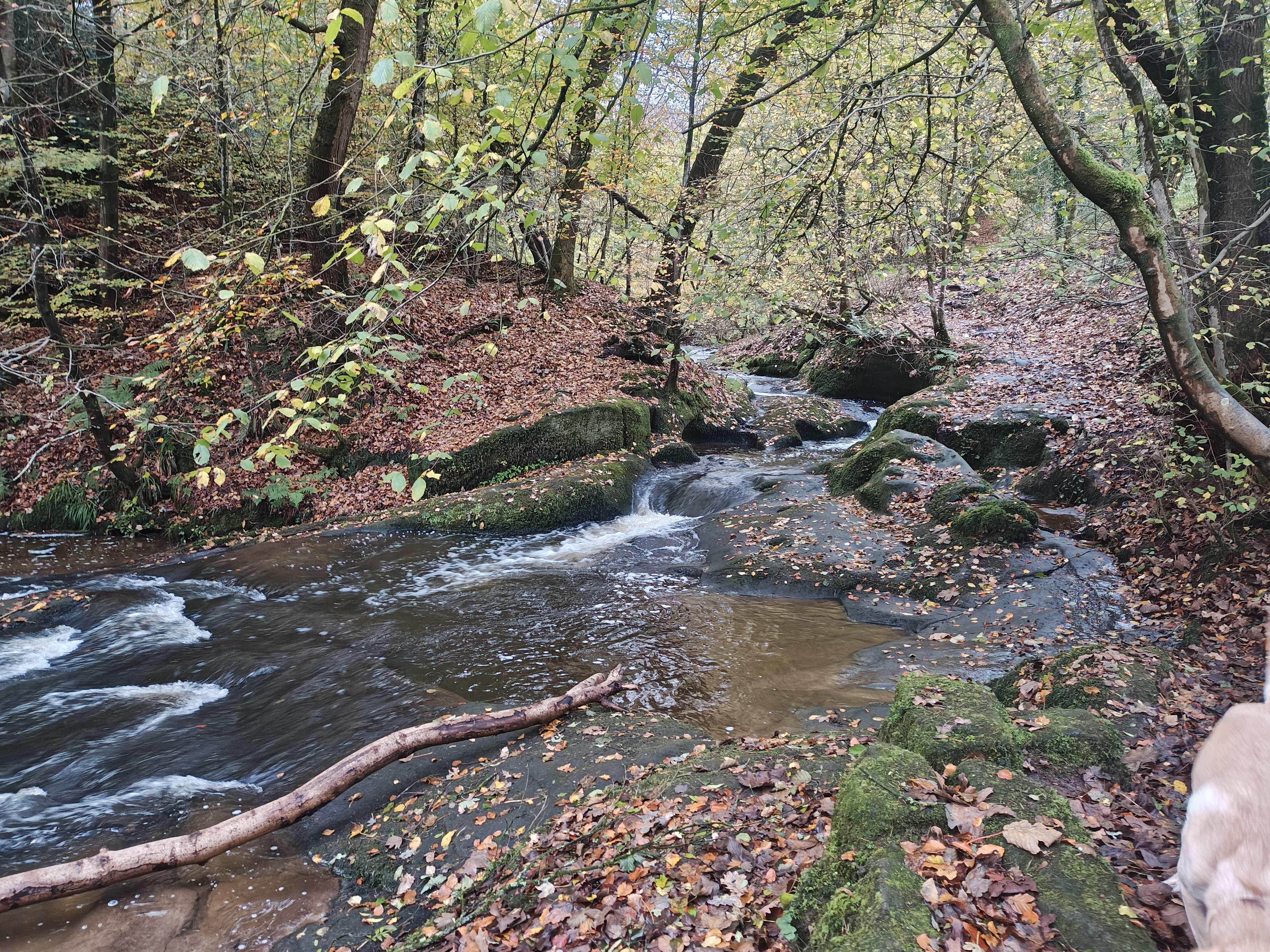
Taking a left turn, you find yourself in a steep-sided woodland valley carpeted by autumnal reds and browns. The perfect place for a medieval ambush. Moss and lichen grow thick on gnarled branches and twisted roots. Boots and trouser legs are quickly begrimed by cloying mulch and mud.
Back on solid tarmac, a gap in the hedgerow reveals a pristine trig point on top of what we find to be Doe Hill. A stile permits access over a fence. We could clamber over, but the dog was struggling. I lifted Sirius by the armpits and launched him over the top (he landed in a holly bush after bravely making the leap himself on our return).
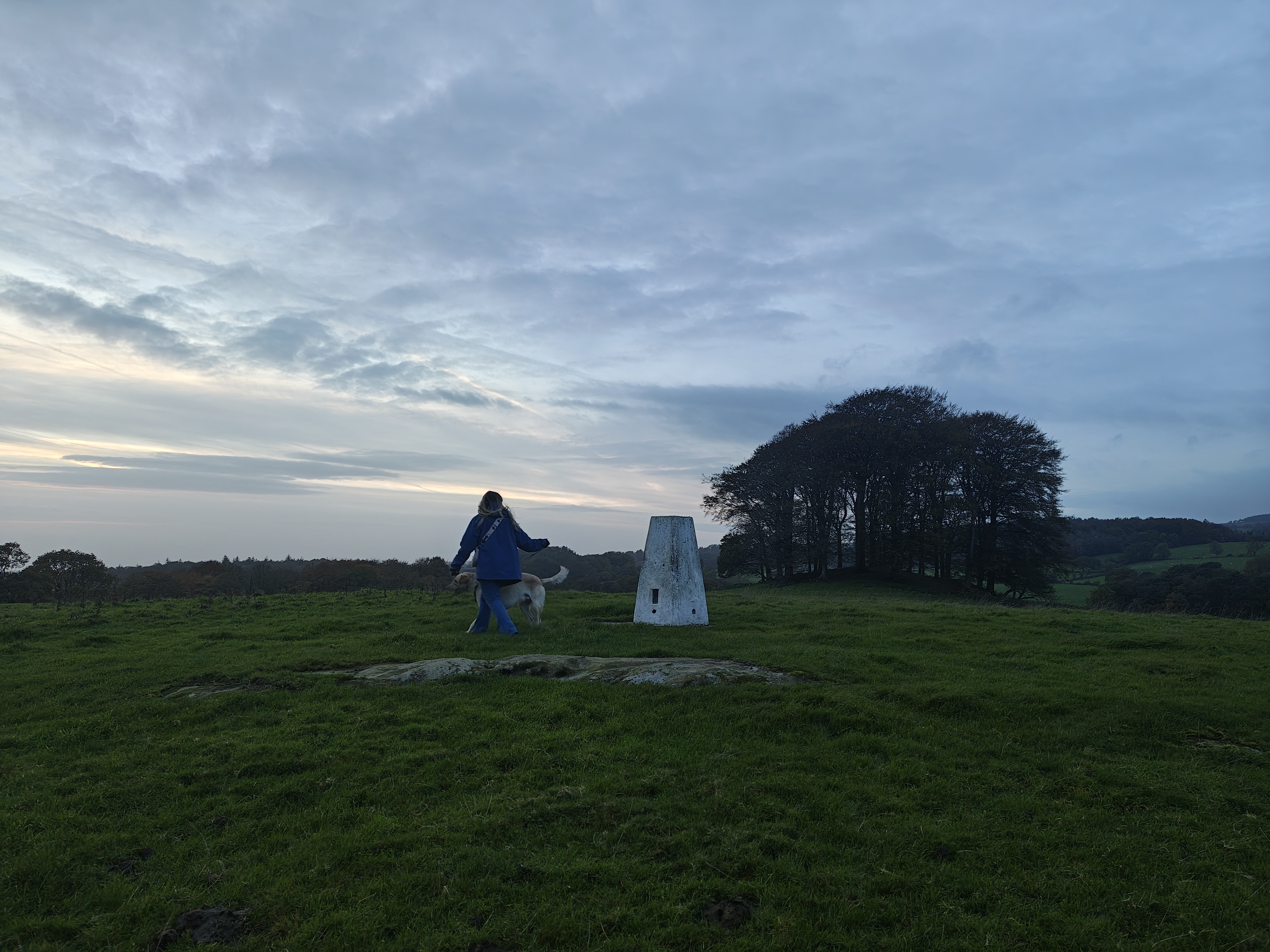
The sun was setting on our day. We regained the strong, welcoming scent of woodsmoke and the village pub we’d parked at.
A crisp pint (Guinness Zero for me), a Tesco stop and a twisty, narrow laned drive through darkness later, we arrived at our accommodation – The Throstle’s Nest in Bolton by Bowland, throstle being an alternate name for a thrush. The cottage was built in 1800 and is a listed building. It originally functioned as servants’ quarters and had another life as a dairy before being restored to a residence once more. Massive oak beams jut out across lathe and plaster ceilings in every room. On the first floor, the bathroom is situated at one end of the steeply pitched roof, meaning one beam runs right down the middle and necessitates much ducking and dodging.
We were here to see and climb Pendle Hill, a summit lovingly paid tribute to in a song by the band English Teacher from West Yorkshire, bordering Lancashire. In November last year we saw them at Barrowlands the night before our trip to Islay and Jura.
The previous evening Pendle Hill hadn’t been visible as we drove through unlit hamlets and kept a close eye on the road. Turning a corner, and with the track playing through the car speakers, we were met with the unmistakable silhouette as described – its “haunted asymmetry”, rolling then suddenly collapsing; a long ridge gently undulating then the plateau abruptly plunging like a crashing stock market. You can see why the song was written.
A tourist information leaflet at the cottage informs that a founder of the Quakers, George Fox, was “called to go up” by God in 1652. What he could see from the top inspired him to found a religious movement; from the vantage point, he felt that all the people below could be gathered together under the Lord.
Like him, we were called to go up. It seems that many others were too, as the carpark was full.
England has no right to roam as in Scotland, so the path was narrow and defined, “permissive” as opposed to an entitlement. This has the advantage of being easy to navigate at least.
You start in the village of Barley. It’s clear to see that they have capitalised on Pendle’s famous witches (accused of witchcraft, obviously), who were tried in 1612, predominantly, at the Lancaster assizes. Witchy paraphernalia abounds – the coffee shop is called The Cauldron, and even the local garage has a pointy-hatted broomstick rider as its insignia.
On the drive to Pendle Hill, we came across a sculpture of Alice Nutter (one of the many excellent names from the period which still survives today). She was among the women accused of witchcraft and pleaded not guilty to the charge. Nutter was convicted and sentenced to death by hanging.
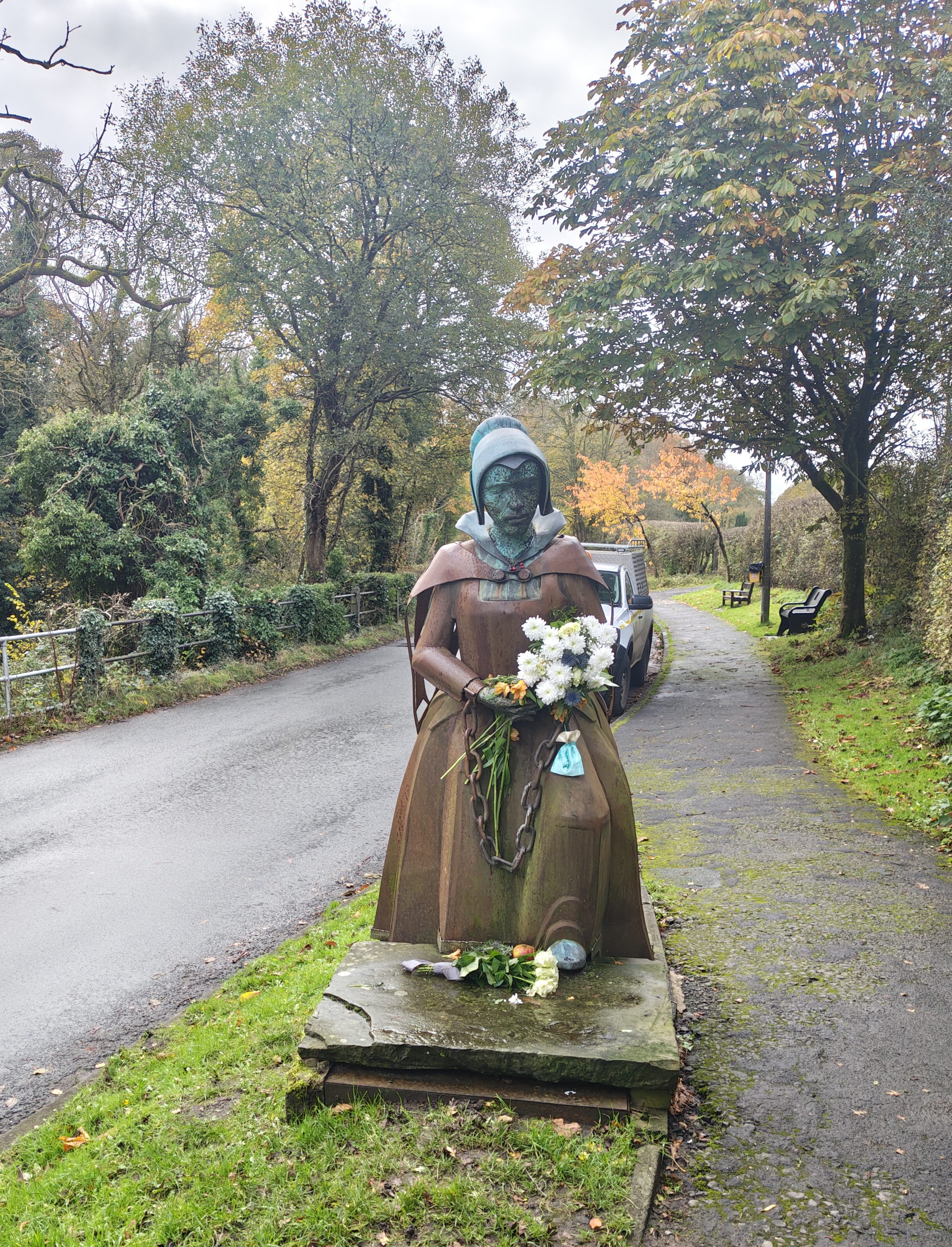
The sculpture is made of metal and is very steampunk. Fresh flowers lie at her feet.
From Barley, the trail wends its way alongside and across a charming beck. One section is rather loosely paved with slabs lifting up and your foot presses down (not the World’s Biggest). When you start ascending properly, the stones create a steep staircase, but at only around 300 metres of ascent from the starting point, it doesn’t last too long, and in about an hour we’re at the top.
The day is clear. The Ribble Valley is laid out in all its rural idyllic glory. Undulating hills, drystone dykes and sporadic clusters of sheep. In the midday sky, the sun is burning bright among greyish-white cumulus clouds and gives the impression of entering the kingdom of heaven, despite the crowds and boisterous kids.
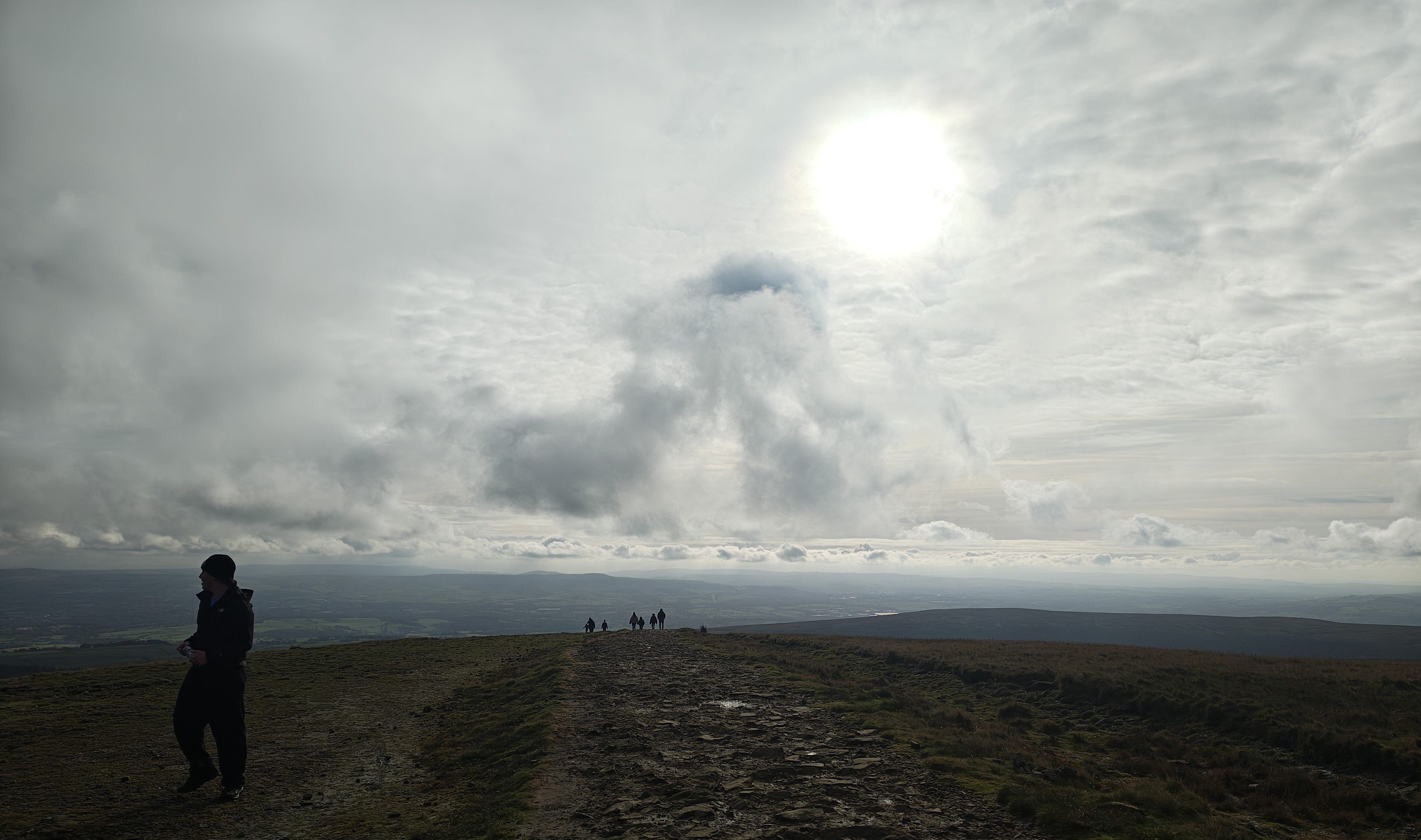
Having contemplated and measured, we begin our descent. A pub lunch is in prospect. As well as having gained the summit, we’ve gained a mighty appetite.
After a languor-inducing indulgence at the Barley Mow, we drive to Clitheroe, the main town of the Ribble Valley. On the way, we stop by St Leonard’s Church in the tiny village of Downham. In the low sun of late afternoon, its situation is impossibly ideal.
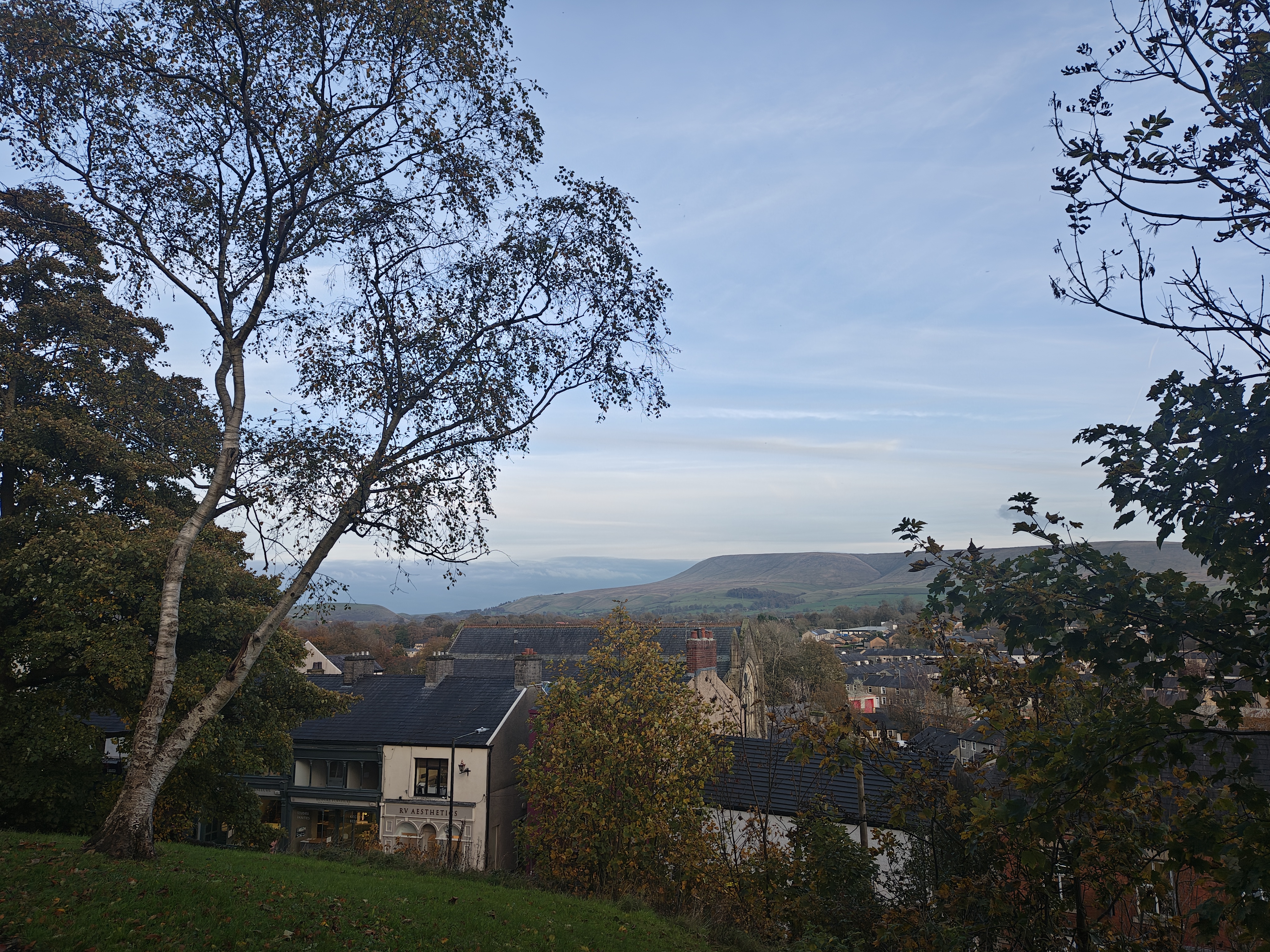
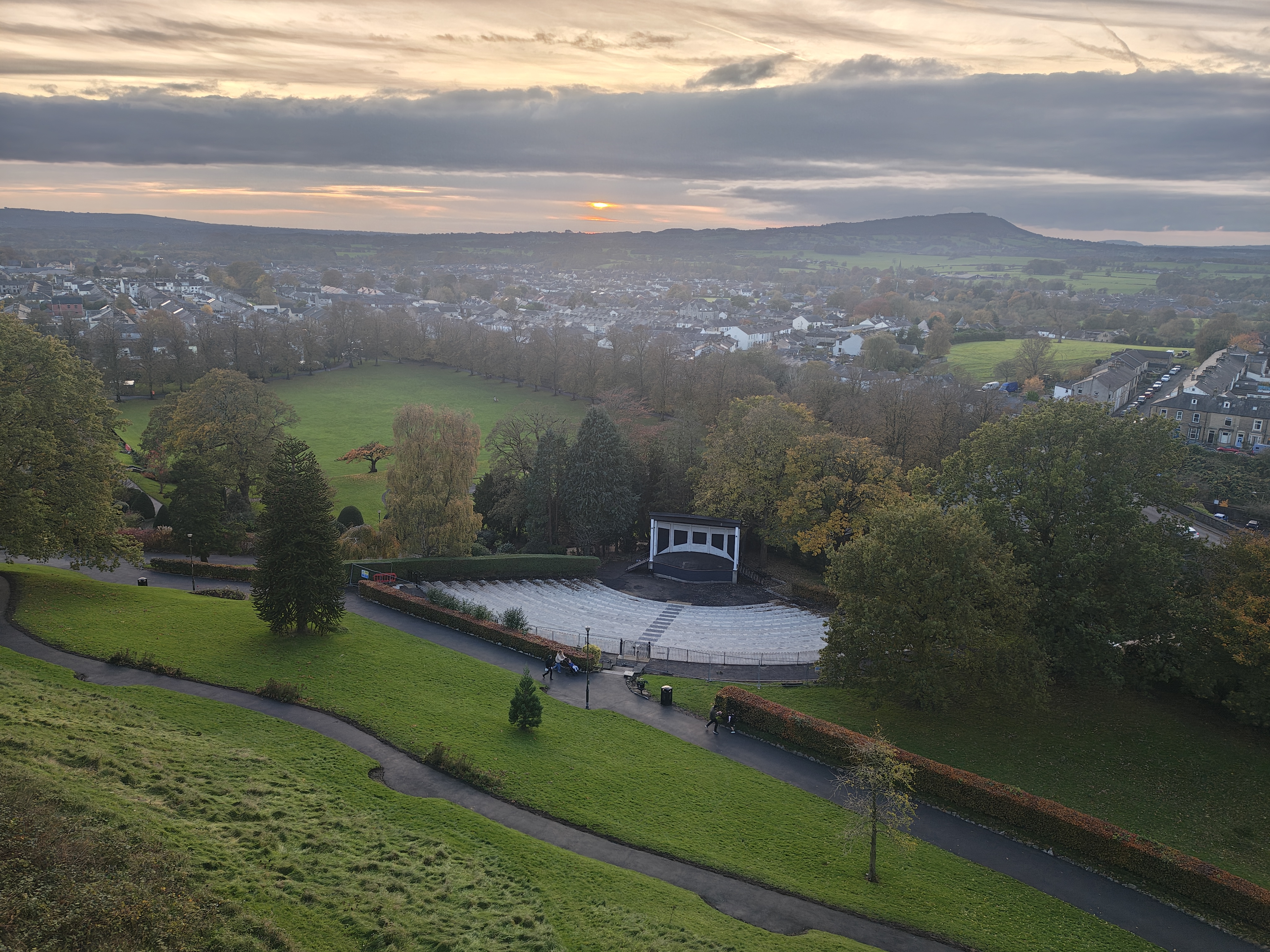
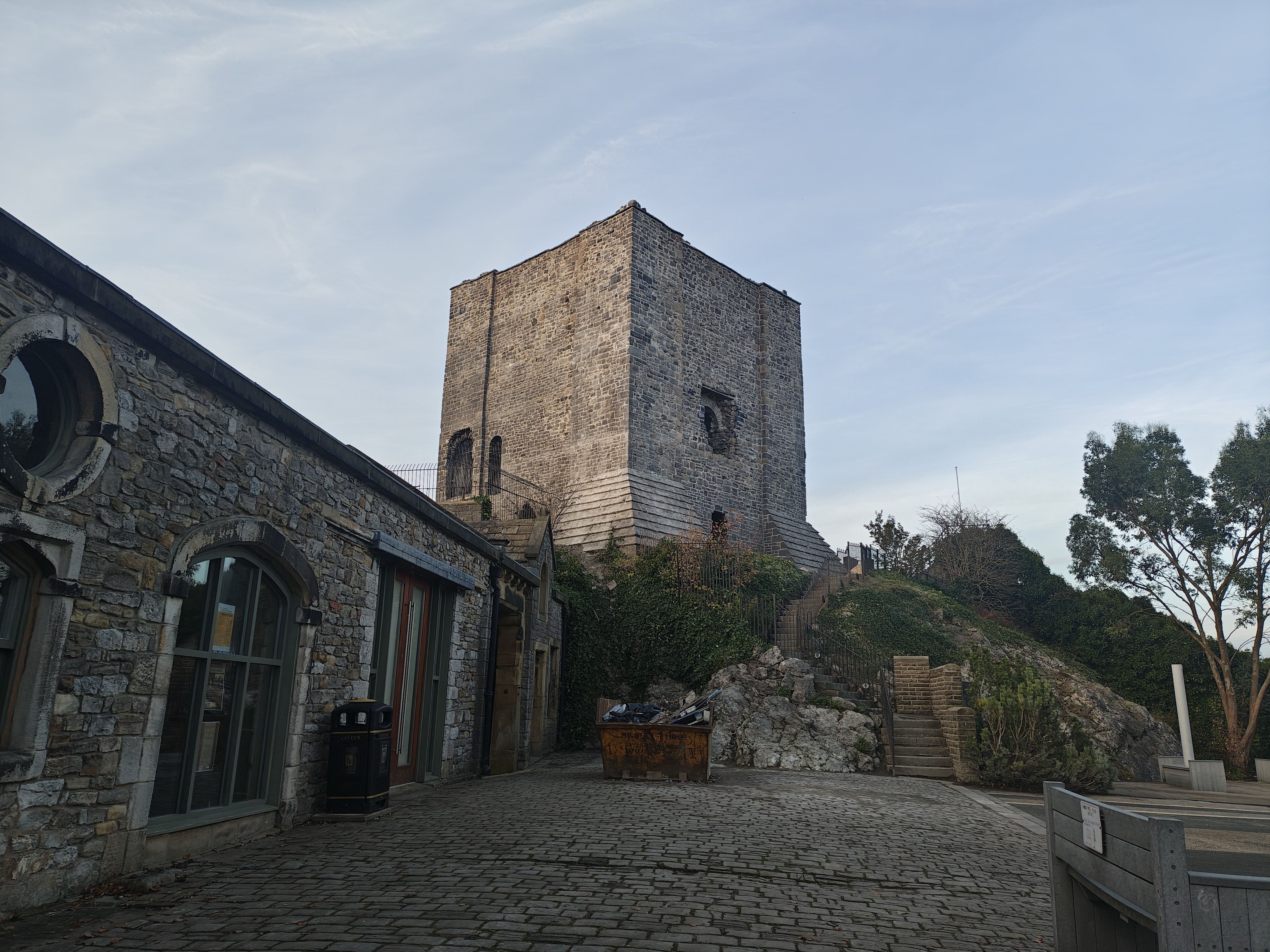
Clitheroe surprises us with its impressive castle and prospect of Pendle. At the foot of the mound is a labyrinth, which we navigate in the setting sun of a glorious day.