Fairy cows and ferry nous

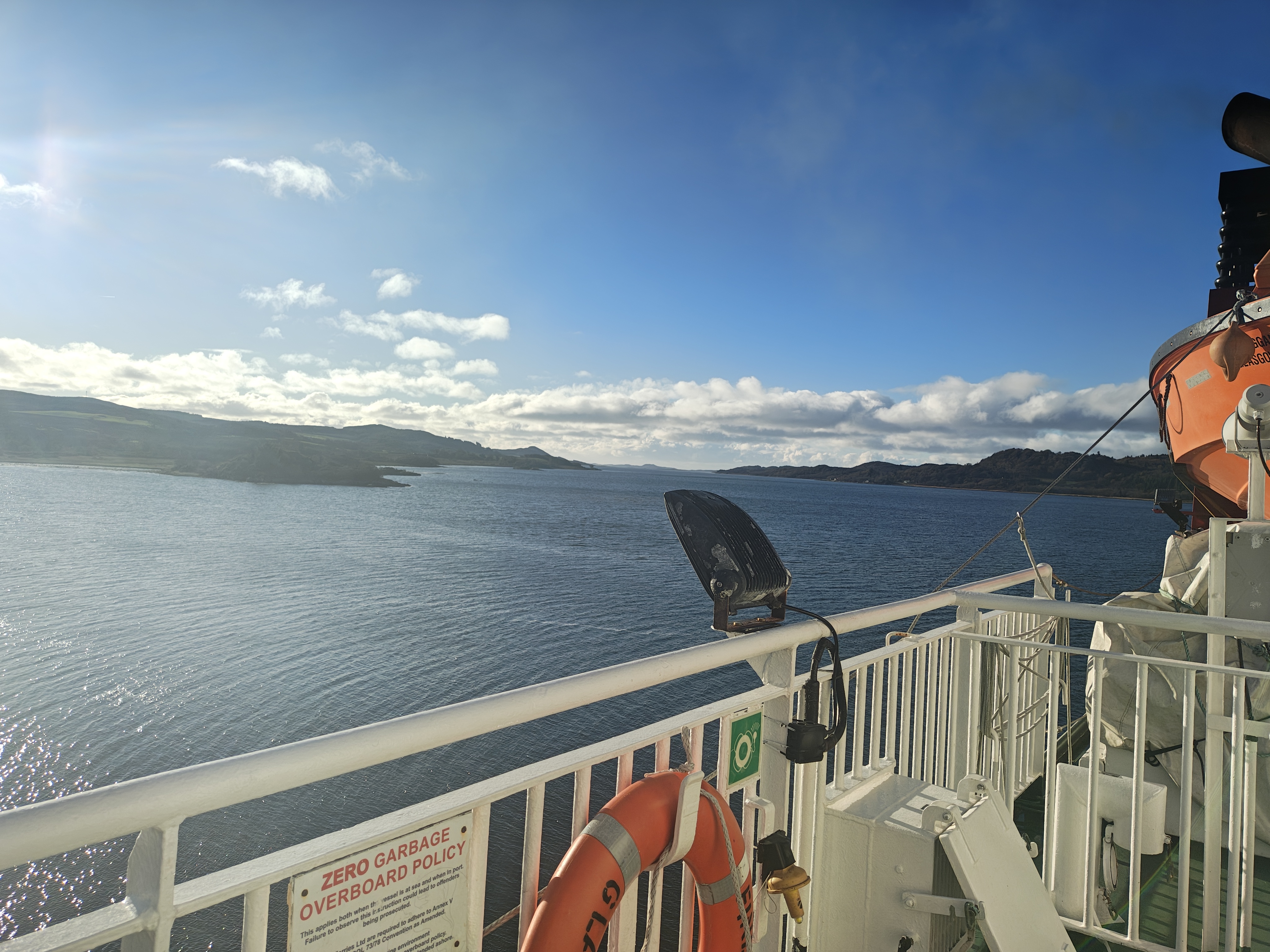
My first drive onto a ferry was not in Orkney but at Kennacraig. We were taking the boat to Port Askaig in Islay where we would be staying for three nights on a last gasp long weekend before the close of the year.

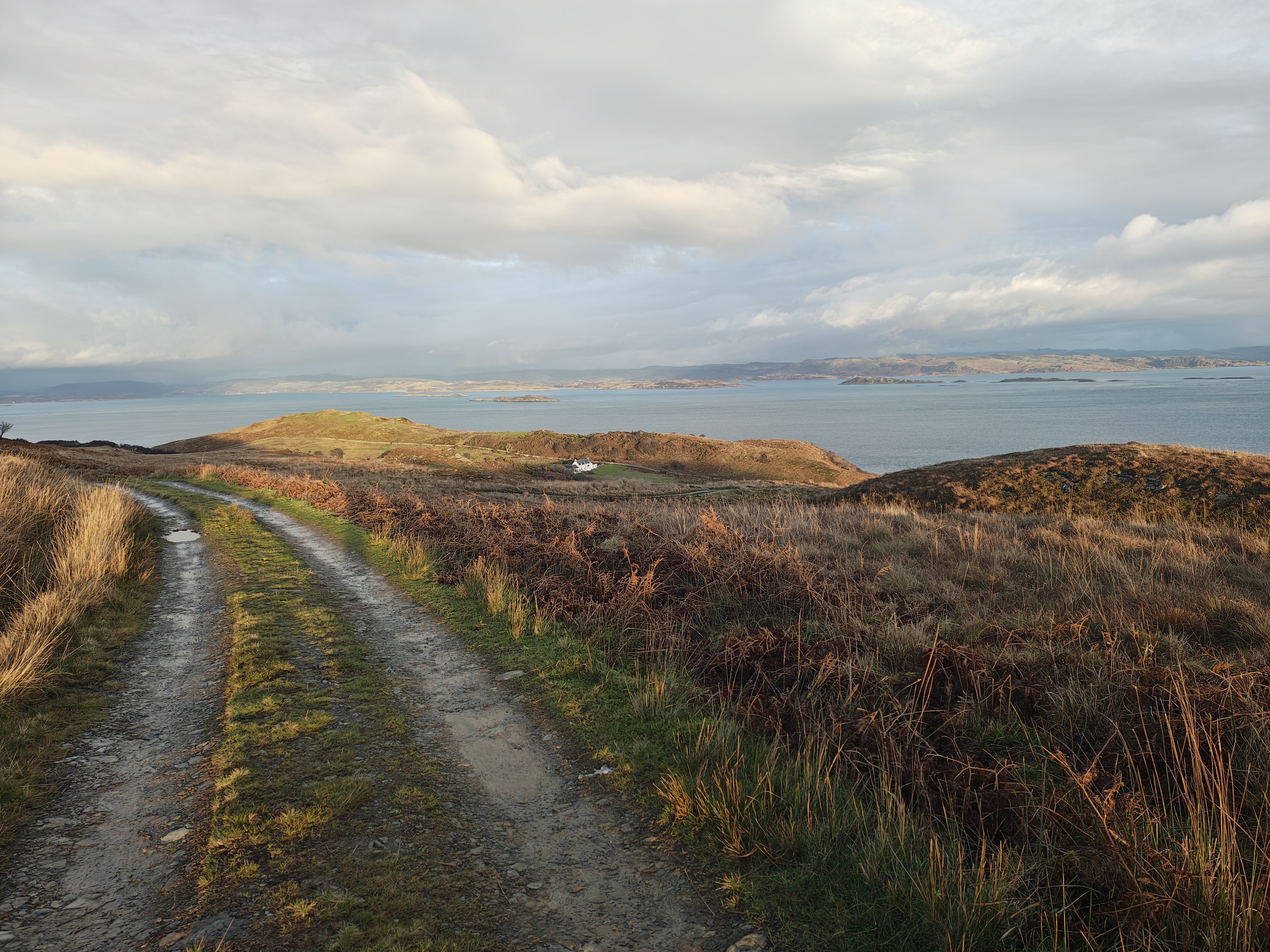
Much like the boat to Mull, the ferry traverses a sheltered stretch of sea, the first third being an estuary cutting into almost the full width of the Kintyre peninsula and the last third being the island’s sound, flanked by Jura to the north.

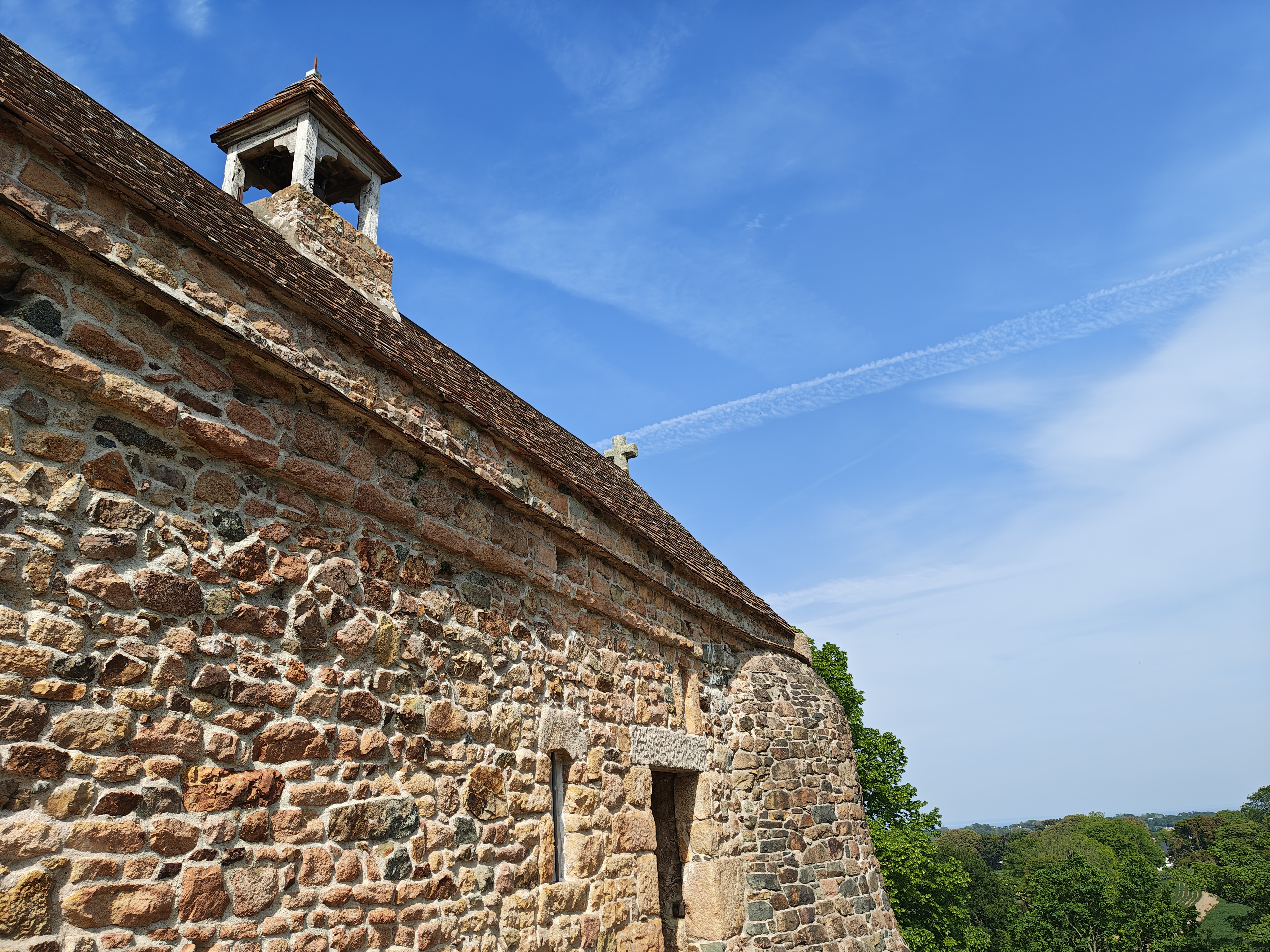
On disembarkation we were bound for the south of the isle to check into our log cabin accommodation. But before depositing ourselves there, a trip to Carraig Fhada lighthouse was in order, to make the most of the fast-fading sun. Pleasing parallels were drawn between our arrival in Jersey and Le Corbière of that late afternoon.

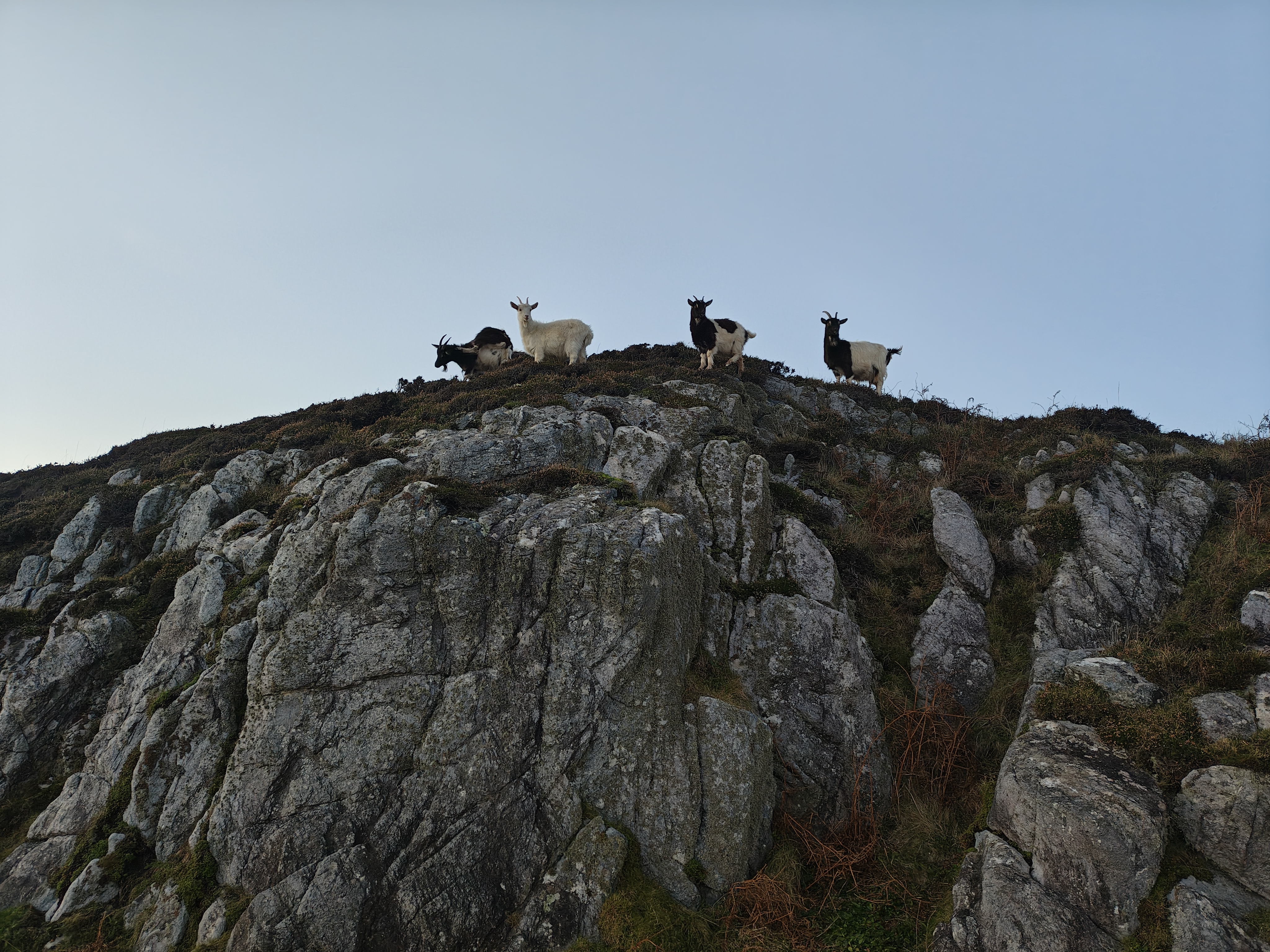
The lighthouse is not the typical round tower you would usually see, but a pleasing cuboid with an almost Aegean understated flair. Unexpected fauna populate the rocky beach foregrounding it – there is an abundance of free-roaming goats with impressively flamboyant horns.

Sirius, the dog, who is with us on this trip, worries them ineffectually and even squares up to the big billy goat, who is thankfully unbothered by his boyish enthusiasm.

Friday is our first full Islay day proper. This is really our first road trip and we share the driving. H— has been kind enough to allow me to be added to her insurance and to take control of the Vauxhall Moriva, known affectionately as Timothy. Although this holiday, he seems to have been rechristened “Timmo”. We’ve been watching the original Mad Max films and seem to be going through an Australian-inflected phase.

Perhaps arrogantly, I had assumed that this was tourist off-season and a distillery tour would be easy to hop onto at short notice. Not so. Laphraoig – our closest and most recognisable bet had only one spot free. Port Ellen, whose glass front exposed awe-inspiring stills and gadgetry, offered tours to people with too much money, starting from £750.

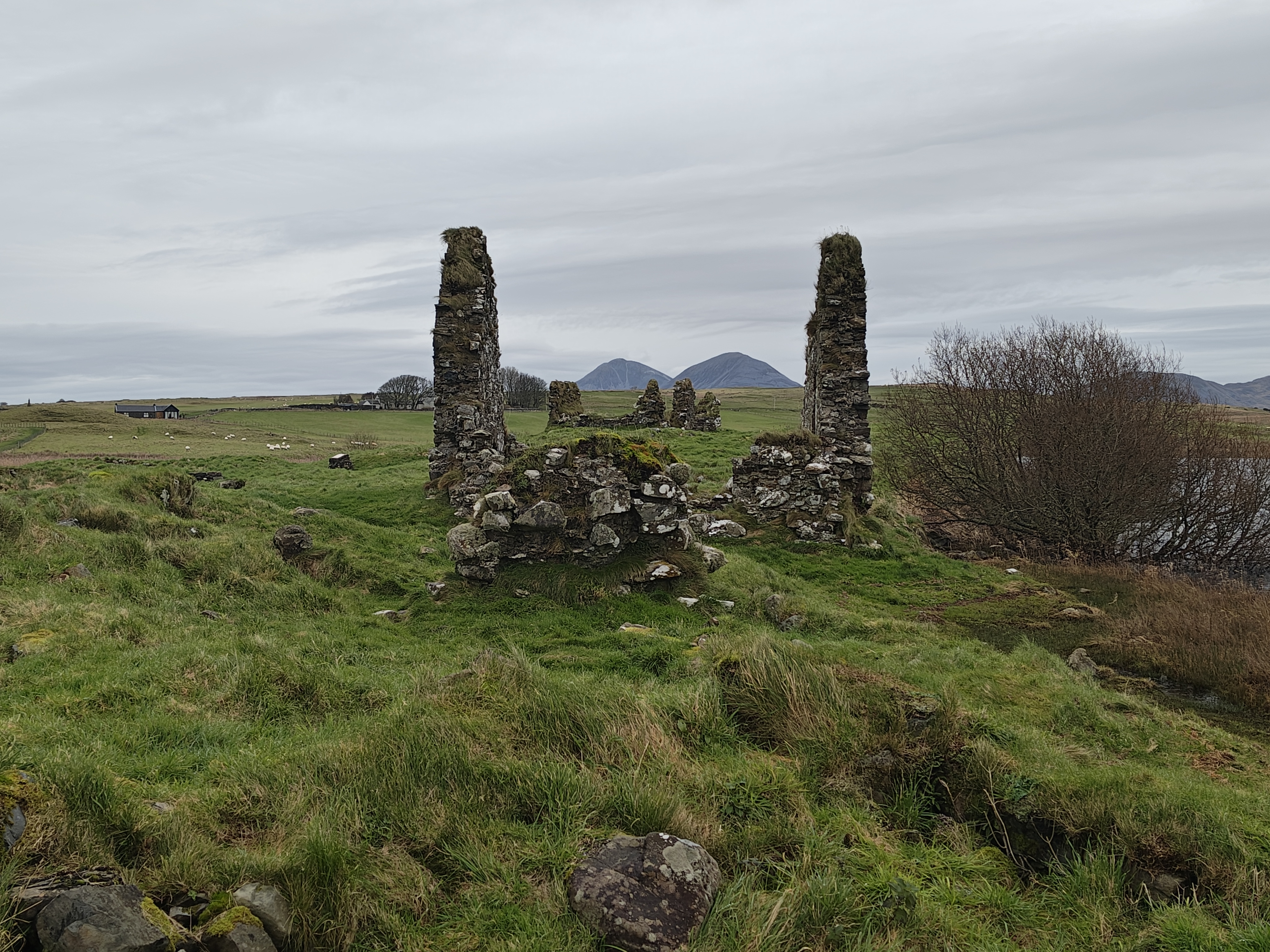
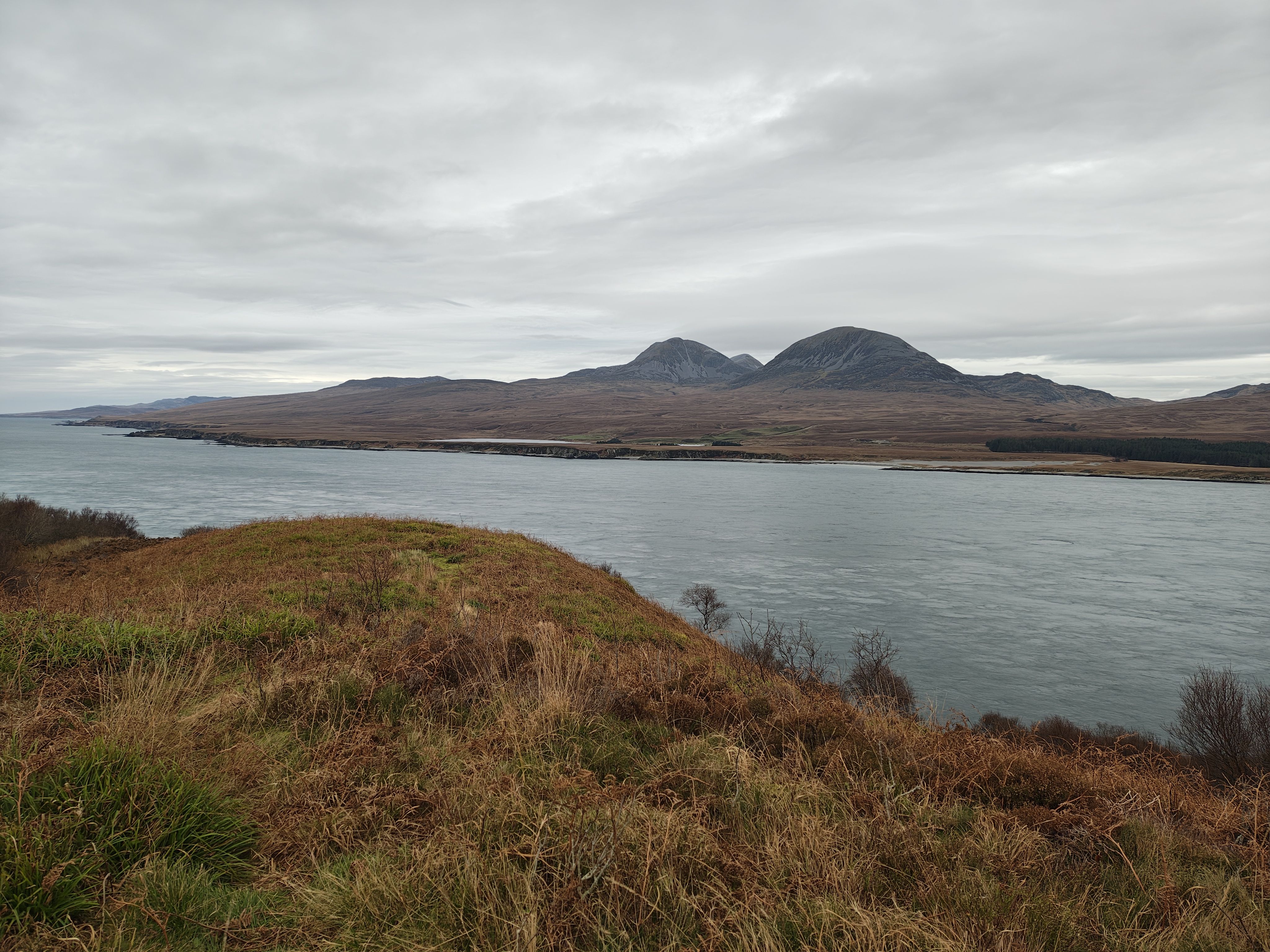
There was only one option open to us – Ardnahoe, located near Port Askaig and with a stunning view of Jura’s iconic Paps – two hills that dominate the landscape and which can be seen from anywhere on the east side of Islay. Much like I thought, the Hoy hills in Orkney’s West Mainland.

Before venturing to the very north, however, our first stop of the morning was Finlaggan, the ancient seat of the Lords of the Isles. This eyelet in the middle of a loch is accessed by a (modern) wooden causeway and is surrounded by an amphitheatre of heather-clad hills. The perfect place for a kingsmoot if ever there was one. Remaining are the ruins of a settlement inhabited up until the 16th century. The church still has medieval graves; the stone effigies of noble warriors are still clearly visible and covered only by a rain-bespattered pane of glass discreetly bolted atop. As we were to discover, these were not the sole medieval effigies exposed to the elements in Islay.

Packed lunches hurriedly consumed (i.e. stomachs lined), we descended from the Paps viewpoint to the Ardnahoe Distillery. We entered the seemingly deserted visitor centre. Our plans were almost dashed when the Geordie receptionist couldn’t see the booking. All the staff were out to lunch. No tour today.

Our hearts were teetering on the precipice. Were we to be defeated? Surely the last distillery in town would not refuse us?

The page refreshed. Praise be – our booking is there. We are the only two on the tour and are instructed to wait in the café for the guide.

Before we begin, yes, I am doing the whisky part of the whisky tour, toute seule. In my defence, I did the morning driving, AND this was implicitly on the proviso that a gin experience might be had in Jura the following day.

A few minutes later, our host appears. She is Rose from Chateau du Lait (Castlemilk). We are ushered into a small, windowless side room and given a potted history of the distillery. It’s pretty new – founded in 2016 by a Glaswegian who worked in the industry before starting his own venture. His ethos is to create something that people actually enjoy drinking. Sounds like a good plan to me.

There is also a brief overview of Islay’s whisky heritage with some amusing anecdotes about excisemen coming ashore and perennially dodged court citations. As a man of the law, I am bound to condemn such goings on, but I think enough time has passed to allow the faintest twitch of the lip.

The tour is relatively unscientific. Though started in 2016, they use a 100 year old machine to [insert process here]. Only one man knows how to fix it, and his arrival on the island is greeted with a reverent hush.

Next we got to what’s probably the best room, where the grains are fermented with yeast and water in four giant wooden barrels. Rosie lifts the lid at each stage. The liquid is fizzing with activity; almost boiling but with no mechanical excitation – only biological.

So far, so beer. Apparently, with each flip of the barrels’ lids a waft of overpowering aroma is produced. I say apparently because the trip began on my recovery from a bit of a nasty cold, the consequence of which was that I was almost totally deprived of my sense of smell for this frustratingly olfactory experience.

Next, the actual distilling process. Evaporation and condensation. Twice or thrice, I think. Here we get the classic stills as you can picture. Great copper kettles funnelled to a point. Leaning on them sort of feels wrong, like touching dalekanium, but lean we do. They are radiator warm on what has been a chilly day. Most enjoyable for me is the spectacular view of the Paps from the floor-to-ceiling window, which forms the distillery’s logo with the still nestled between.

Also highly enjoyable is the terminology. The condensers are known as wormtubs – a coil spiralling to a nub and dunked in two more massive barrels exposed to the heavens and constantly replenished with rainwater.

After this, the drams. A peaty one and a smoother sherry cask one, I think. I preferred the latter. Then a cask strength, which certainly was. I probably left the tour without the requisite knowledge to start a distillery of my own but it was a very enjoyable experience and a holiday highlight.

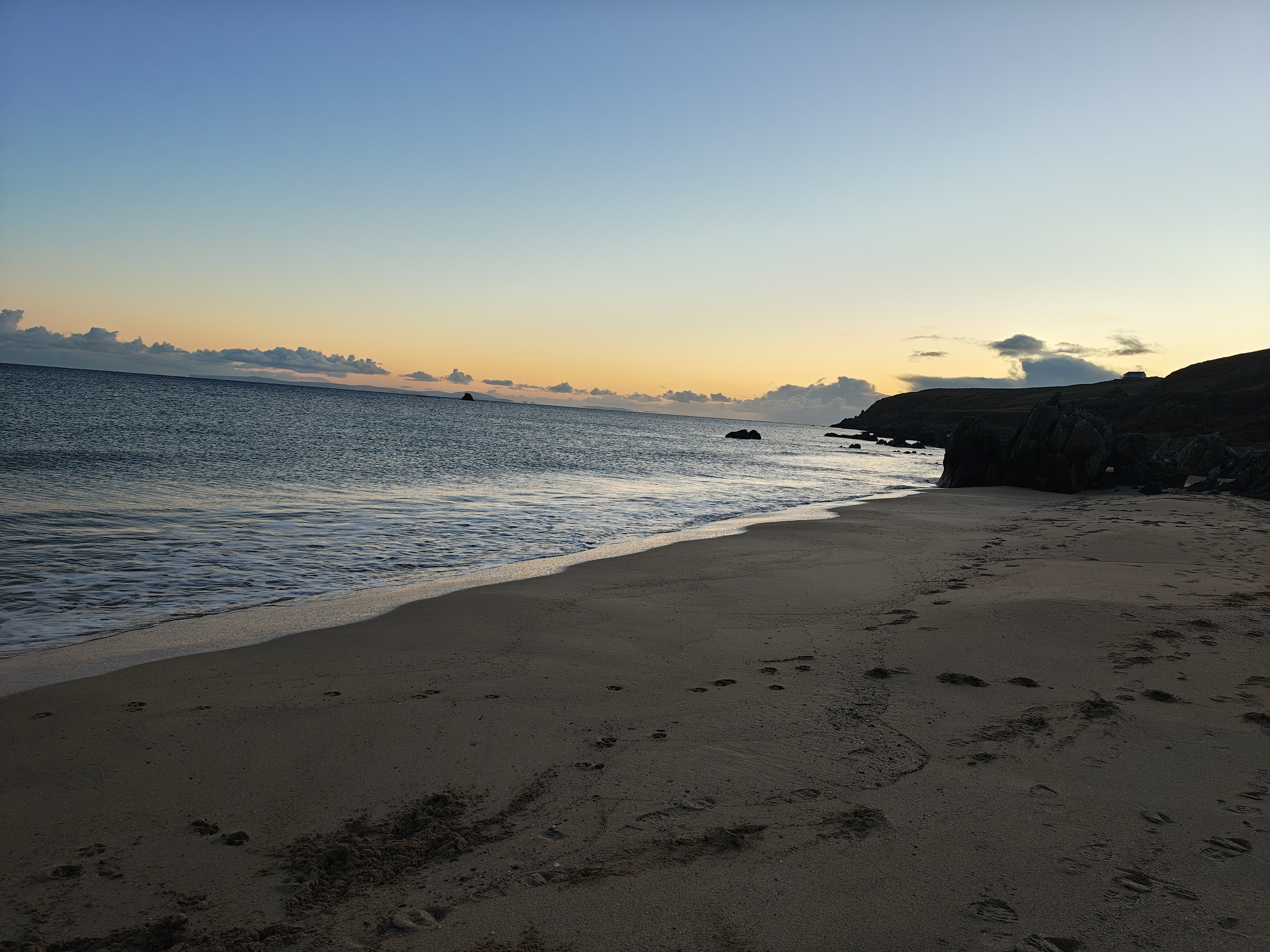
To round off the day we headed west to Machair Bay. All dunes, grass and sucking sand. A bracing stroll against the wild Atlantic. Nothing here between us and North America. Wind and wave were all we had to contend with for the majority of the excursion until the rain began to spit, then splutter and just before the car stab in hard, sharp pellets. Thus begins a night of heavy rain preceding the island Walk Highlands rates as having a 4/4 bog factor.

An 8.30 ferry takes us across the sound. Jura basically has one long road, and we drive half away along it to the foot of the Paps. It was hard walking. Bog all the way. Much dramatic leaping from grassy patch to patch. At one point, Sirius was fully submerged in a particularly deep slough.

To cut a long story short, we found ourselves on the wrong side of a river in full spate from last night’s rain, and our plan to summit had to be deferred to another day.

A pie and a toastie from the Antler’s Bakehouse revived me and H— respectively. We were ready to brave the next challenge – Barnhill, the house where George Orwell wrote 1984 from 1946 to 1948 while suffering from the tuberculosis which would eventually claim his life in 1950.

Barnhill is at the very north end of the island. To get there you need to drive to the end of the public road whose extremity becomes little better than a dirt track. It’s second gear all the way for the last few miles until you come to a big white sign saying NO MOTOR VEHICLES.

We dutifully did. So begins the four-mile walk along yet more dirt track to the remotest of literary residences. Of all my journeys to writerly shrines, this seems most like a pilgrimage.

Just as the sun’s decline casts the landscape in its most glorious gold we round the corner and behold the white harled homestead, perfectly situated in the embrace of the glen and overlooking its own private bay. It is the ideal writer’s retreat.

In comparison to its cultural significance, the conception of 1984 is of relatively minor note. Some texts do, however, enchant the landscape in which they came to be. For me, 1984 has that effect on this utterly secluded refuge from modernity. It is the same, or similar feeling I got when visiting the shores of Lake Geneva (Le Lac Lèman) and contemplating Mary Shelley’s Frankenstein.

H— and I ponder such writer’s retreats – Frankenstein famously being born out of one. Surrounded by stags and does, we consider the role of nature in Orwell’s vision, and the contempt he would no doubt have had for our contemporary world of social media and AI.

Before the ferry back, although the gin distillery is closed for the season, we stop off at a pub and H— samples the local Lussa – a hit. Back at the cabin, it’s pesto pasta followed by House of Guiness – a very enjoyable period drama/advert for the black stuff.

The final day squeezed in Kildaton Cross – an 8th-century Celtic stone crucifix within a kirkyard housing medieval graves and 20th-century headstones side by side; a book fair within a distillery (2 paperbacks for £2) and deep-fried oysters (only I partook).

Overall, Islay and Jura were fantastic off-season. While all the museums are closed in November, this is a small price to pay to have the place virtually to yourself. One tip would be to book the distillery tour in advance, and if you’re bringing a bike, Islay is doable and has the infrastructure, as does Jura, as long as you don’t have to go too far north.

Posted in Life, Personal experience | Tagged , , , , , , , , , , , , , , , , , | Leave a comment

“Victor, you’re the monster!” Guillermo del Toro’s Frankenstein reviewed

Mary Shelley’s Frankenstein; or, The Modern Prometheus is a novel that always brings me back. For me, it is the very best of what literature can be.

I first read it for a university class. In the end, I don’t believe we discussed it in the tutorial. Romantics, for a week or maximally two, would have been more poetry focussed, and more male.

The novel isn’t really the primary mode of expression for the Romantic era, except perhaps Goethe’s Leiden des Jungen Werther. By the time we get to Mary Shelley in 1818, the literary movement seems to have crystalised somewhat and is actually obliquely referred to in the novel itself.

In the second letter of Robert Walton, captain aboard a vessel trying to discover, implicitly, a Northwest Passage through the Arctic sea ice. Walton’s character is bound up with the poetic impulse, which in this era has much in common with scientific pursuit, as brilliantly expounded upon in Richard Holmes’s book The Age of Wonder. In particular, he makes reference to Coleridge’s Rime of the Ancient Mariner.

For Romantics like Walton, what is key is not the breadth of reading but depth:

 At that age I became acquainted with the celebrated poets of our own country; but it was only when it had ceased to be in my power to derive its most important benefits from such a conviction that I perceived the necessity of becoming acquainted with more languages than that of my native country. Now I am twenty-eight and am in reality more illiterate than many schoolboys of fifteen. It is true that I have thought more and that my daydreams are more extended and magnificent, but they want (as the painters call it) keeping; and I greatly need a friend who would have sense enough not to despise me as romantic, and affection enough for me to endeavour to regulate my mind.[1]

Poetry’s “most important benefits” are not easily discernible and cannot be accessed without delving deeper. One’s languages and vocabulary can only get you so far; to go further is the Romantic approach to poetry, to derive the deeper, less immediately accessible meaning.

The other occasion on which the word “romantic” appears is in the mouth of Frankenstein himself, and here it is really used as a synonym for “picturesque” in relation to Edinburgh,[2] which he visits briefly after a letter of introduction to the leading lights of the Scottish Enlightenment in furtherance of his project to create a female Creature. Edinburgh, by contrast, is a key location of Guillermo del Toro’s new screen adaptation of the novel.

Yes, instead of Geneva and its environs providing the stage for most of the action, del Toro’s Frankenstein (Oscar Isaac) lingers in the Athens of the North. Here, he is introduced to his benefactor, Heinrich – a character entirely unique to the adaptation, played by Christopher Waltz.

Whereas Shelley’s novel has Victor as the lone genius, del Toro’s protagonist assembles a crack team and is endowed with infinite resources by his patron. In a seeming nod to the heavily Frankenstein-inspired Poor Things, Heinrich makes a shocking request of his beneficiary. He wishes his brain to be transplanted into the body of the man Victor is assembling from the corpses of fallen soldiers.

Rejecting this as absurd and unconscionable on practical grounds, Heinrich has syphilis, infamously a disease that, in its late stage. affects the brain. Victor ends up in a physical confrontation, which leads to his addled sponsor falling to his death. While adding human drama and spectacle to the plot, this is just one example of many which rather confuse the clarity and purity of Shelley’s original story than enhance it.

It takes a long time for Frankenstein to make his Creature in this film, both in terms of screentime and diegetically – his work-in-progress sits slumped unnaturally on his laboratory table with its spine exposed to better access the lymphatic system, apparently key to achieving re-animation and, in del Toro’s case, perpetual animation.

Broadly, the film does take the same structure as the novel. We open on the arctic wastes. Unlike in Shelley’s novel, the Creature is almost instantly revealed. Surprisingly, the ‘Horisont’ is manned by Danish sailors, and a good 10 minutes of the film is exclusively in that language.

Another change is instantly apparent in the setting in time. Instead of a vaguely 18th-century setting – Shelley leaves it at 17—, the action is transplanted to the mid-19th (1857 to be precise). Gone, then, are Walton’s direct connections to the English Romantics and the Enlightenment throughline of Shelley’s work.

Not that this adaptation is really grounded in a historical time period or actual locations. Its characters are an American fantasy of the European aristocracy (I know del Toro is Mexican, I mean the continent). In del Toro’s adaptation, the only connection to Switzerland is Victor’s mother’s ancestral seat, and that is in reality only a nod. Victor’s childhood home is basically Versailles, and his father is vaguely Prussian, as can be deduced from the unsubtle uniform. Barring the fact that Victor is not of noble birth in the novel – his father is a syndic, a type of public officer bearer – neither is he identifiably Swiss. This seems to be an obvious omission in a novel so embedded in the Confederation.

See Chapter 6’s letter from Elizabeth:

The republican institutions of our country have produced simpler and happier manners than those which prevail in the great monarchies that surround it. Hence, there is less distinction between the several classes of its inhabitants; and the lower orders, being neither so poor nor so despised, their manners are more refined and moral. A servant in Geneva does not mean the same thing as a servant in France and England. Justine, thus received in our family, learned the duties of a servant, a condition which, in our fortunate country, does not include the idea of ignorance and a sacrifice of the dignity of a human being.  

The family arrangement in the film is reconfigured with Elizabeth (Mia Goth) being Heinrich’s niece and not Victor’s adopted sister, which does remove the strange incestuous tension and psychosexual subtext inherent in their relationship. All that it nicely reduced to Victor’s fancying his brother’s (William is aged up in the film, as is Victor) fiancée. Frankenstein of the novel has no hint of desire for Elizabeth. He weirdly appears to go along with the idea of his marriage to, effectively, his sister in fulfilment of his mother’s dying wish, despite both his father and Elizabeth herself giving him opportunities to extricate himself from the arrangement.

There is an amusing scene in Edinburgh’s St Giles Cathedral (whose interior is in fact Glasgow Cathedral!) where Victor none-too-subtly hints at his feelings to Elizabeth in a confession booth, notwithstanding the presence of such a facility being an egregious anachronism within the seat of the Scottish Reformation.

The character of Elizabeth in the film, instead of being the quasi-angelic and remote presence of the novel, is the film’s moral core in a way. One of the most striking differences is the aftermath of the Creature’s immediate genesis. Unlike the novel, where Victor’s reaction is instantaneous revulsion, del Toro’s Frankenstein keeps the Creature in the bowels of the colossal watchtower-cum-laboratory where he has been manufactured for an extended period. He attempts to teach him to speak, but the Creature can only utter one word, “Victor”.

Del Toro gives Victor a more explicit psychological motivation to create and treat the Creature as he does. There is a clear link between his mother’s untimely demise and his desire to create life/conquer death. There is also a rather obvious repetition of his father’s own brutality towards him, inflicted on the Creature during their lessons.

To me, this is another example of muddying the waters, where the novel is much clearer as a thought experiment. Shelley’s Frankenstein is motivated by science first and foremost, the Enlightenment drive to uncover the secrets of nature. Her Creature does not suffer his direct abuse and torment.

Del Toro’s Creature, by contrast, does not at first attempt to reason with Victor. Instead of their re-encounter taking place high in the Swiss Alps in a mountaineering hut, it happens on the wedding night, not of Victor, but his brother William. The Creature’s tale, the final third of the film, is told in the presence of the Danish Walton equivalent aboard the Horisont while becalmed on the Arctic ice.

For me, the most egregious thing is this speed-running of one of the book’s most fundamental thematic notes and plot points – the Bride of Frankenstein.

In the film, the Creature asks Victor to create another being of his nature of the female sex. Here Victor’s refusal is instant. The ‘race of devils’[3] line is said, and so begins the chase that has its fast-forward termination on the ice sheets of the frozen north. Couldn’t more time have been spent on the crucial nature of this betrayal out of the film’s two and a half hour runtime?

One of the novel’s most disturbing scenes is when, on the cusp of completing the task of creating a female Creature, Victor observes his living creation watching on, and he destroys his work.

As I looked on him, his countenance expressed the utmost extent of malice and treachery. I thought with a sensation of madness on my promise of creating another like to him, and trembling with passion, tore to pieces the thing on which I was engaged. The wretch saw me destroy the creature on whose future existence he depended for happiness, and with a howl of devilish despair and revenge, withdrew.[4]

Del Toro lingers on the macabre and introduces plenty of body horror, which suits the visual medium, yet he fails to adapt this most crucial of scenes. This is not to mention that he leaves out my direct connection to the novel – the location of the second creation is an unspecified island of Orkney.

To conclude, let us discuss the Creature himself. One element that del Toro introduces unnecessarily is the idea that he is immortal. Not simply more resistant to harm than an ordinary man, but immortal in a Captain Jack Harkness sort of sense. To prove this, in what is, in isolation, an impressive scene, the Creature attempts to blow himself up with a stick of dynamite, unsuccessfully.

Whereas Shelley’s Creature has more-than-human strength, speed and stamina, del Toro’s creature is to all intents and purposes a demigod. Prometheus, if you will.

Stylistically, this doesn’t really work. There is abundant cartoonish CGI of him literally ripping through dozens of Danish sailors, throwing them aside like ragdolls. A clear image of the Creature’s violence in Shelley’s novel is the black marks left on the necks of his victims of asphyxiation. A careful and powerfully employed image is here substituted with gratuitous computer-generated clobbering.

Besides stylistically, though, when you have an entirely artificial being imbued with intelligence but then also add in immortality, you have a whole host of moral questions that come up in addition to those already posed. Shelley’s Victor is on a quest to destroy his creation after he fulfils his promise to render his life a living hell and murders his bride. Here, we know that this is not possible. The Creature cannot make the same bargain to fly to the remotest corner of the earth and live out his natural end in the jungles of South America.[5] Thus, the ending self-immolation after Victor’s death from terminal fatigue is debarred.

What we have, instead of the Creature arriving too late and delivering his final speech to Walton, is a deathbed reconciliation with the Creature forgiving and Victor naming him his son.

It all feels so fundamentally unearned and lacks the pathos and finality of the novel. The film’s final frame is the Creature out on the wastes once more, and we are left to wonder what will become of him. The implication appears to be that he will return to the benevolent Father Christmas figure he adopted as the ‘Spirit of the Forest’ for the family he tends to following his escape from the lab. But why would he do so without any hope of reconciliation with humanity? An eternity of loneliness?

The story presents itself as if it were as wrapped up as one needs to be for an arctic expedition, but really, we are being set up for The Adventures of Frankenstein 2. In this age of the eternal revival, valuable IP cannot be allowed to die.


[1] Letter 2

[2] Chapter 19

[3] Chapter 20

[4] As above

[5] Chapter 17

Posted in Review | Tagged , , , , , , , , , , , , , , , , , , , , , , , | Leave a comment

Admitted and discharged

A historic week for the family Flett (the one commencing 8 September). It started with the 30th anniversary of my parents on Tuesday, was sandwiched with my qualification as a solicitor on Thursday and ended with the birth of the first of the next generation on Saturday 13th September 2025 at 3.22am.

Naturally, I was on a train to Aberdeen on Sunday morning. Two titles now acquired, uncle being foremost in my mind. One a seven-month anticipation, the other a culmination of five years’ work.

Laterally, in terms of the legal traineeship, though, it has been more a question of waiting out the time, meeting the requirements and allowing the two years to pass. Up until now, I have never really had a five-year goal. It makes me wonder what the next will be.

The gaining of my restricted practising certificate towards the end of last year and admission to the roll of solicitors (ceremonially confirmed this summer) felt like more of a milestone for me. This allowed me to do everything a solicitor does insofar as I am acting for my employer and not calling myself a “solicitor” while so doing. The formality is discharging my traineeship and the subsequent removal of the prefix “trainee” on my signature.

In terms of non-directly career-related active self-betterment, I have resumed French classes again after the summer break. This provides useful structure for my learning, but I do think I need to get serious if I want to make serious progress. There is only so far a syllabus can take you.

I also don’t want to let my German fall into abeyance. So perhaps I’ll see if there’s a conversational meetup I can join to get me up to scratch again and hopefully surpass where I was post completion of my degree.

Last year was perhaps the fittest I have been physically, with the Loch Ness Marathon in September 2024. I have resigned myself to the fact that a PB may well be out of my reach in the Great Scottish Run at the beginning of October, but I am having a much better time training for that than the 26.2 miles. No injuries/total exhaustion are a blessing.

As I was saying, I was on a train on Sunday morning. Terminus, Union Square, that between place of ages. A train at one end, a bus the other … and a ferry at a not-so-burdensome stretch.

I beelined for the Foodhall and picked up a pizzetta (the first knowingly eaten and called so) and ginger beer. No sit-down meal for me. A lift (in a red Tesla) from a grandad of less than 24 hours (the dad’s dad) to the maternity ward without delay. Well, there was some delay as a multi-storey car park was unnecessarily ascended and descended before I was safe in the passenger seat.

In no time at all, we arrive. Summerfield Ward, Room 7 is our destination confirmed by text 20 minutes ago. The atmosphere is hushed; the air itself pregnant.

Blue curtains shield what lies behind. The new being within knows not what lies beyond.

The blue veil marks the threshold across which all will change.

I am entreated to wait there for a moment. 22 hours into existence the baby tries to feed … it’s not happening this time, and I’m invited in.

A pink whisp-haired head pokes out from beneath blankets, at rest on a pale chest. I cannot hug one without embracing both; they are one and inseparable on first encounter.

I begin to investigate more closely after passing on my congratulations. Her lids are closed to the external world, but my proximate curiosity wakes her from her shallow drowse and L— flickers into life.

What eyes. Out of proportion to her tiny body. Curious and searching. Curious as I am to find out the who of this newly pressed talisman of potentiality. Tracking this way and that, the deep blue irises are restless to discover too, or so it seems.

Before we can be properly acquainted, the grandparents and auntie (dad’s side) make their way out, and I am ushered too. The feeding has been challenging and the attempt must be seen through. I decamp to a café, then to an Aldi to buy grapes to bestow on my return.

When I come back, the new mother is triumphant. Feed 1 complete.

A vomit and a change later I am passed the precious product of an arduous labour. She is so light and completely reliant on me, even to hold her remarkably untensioned head up.

My bag was left in the footwell of the Tesla, so the new father drives me to retrieve it and to check into my accommodation. After some outfit upgrades and a Wetherspoons meal, I went back to say goodnight, this time bearing gifts for the newborn (perhaps not yet age-appropriate). At the beginning of the week, I found myself in the Baby & Toddler section of Waterstones and picked up two classics, Spot the Dog by Eric Hill and The Tiger Who Came to Tea by Judith Kerr.

After 20 minutes with L—’s crown in the crook of my arm, I bid the new parents farewell and left them to establish their household.

Posted in Life, Personal experience | Tagged , , , , , , , | Leave a comment

Excursion sur les Côtes de Normandie, en Bretagne et à l’Île de Jersey

On the flight out, I had a window seat and could peer down at the port of Southampton and the Isle of Wight—the end goal of my August 2023 trek along the English leg of the Camino de Santiago from Reading Abbey. Going over Guernsey, I had a false alarm, having mistaken it for my ultimate destination, but soon, the sandy strip of Jersey’s “five miles by nine” came into view. The airport is large for its diminutive square mileage, but understandable given its population of over 100,000.

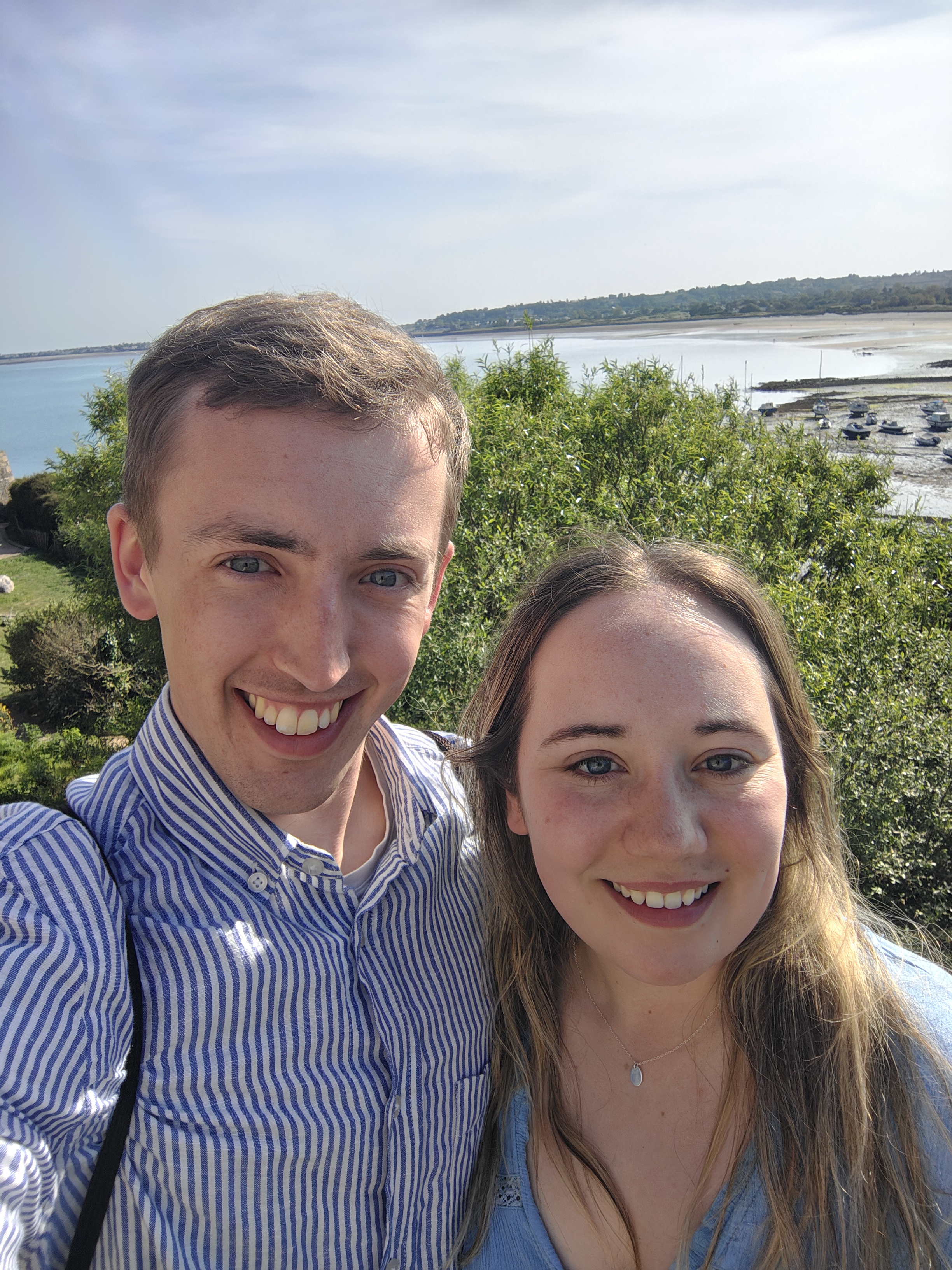
After landing, a half-hour walk took us to our accommodation in St Brelade, one of about a dozen settlements named for saints on the island. Having deposited luggage and sufficiently caffeinated, we set out for the itinerary’s first objective—the lighthouse of La Corbière.

Most of Jersey’s place names are in French. Well, in fact, a local language variant called Jerriais. Up until well into the 19th century, Jersey was francophone. La Corbière is Jerriais for “the crow” and is cognate with le corbeau en francais.

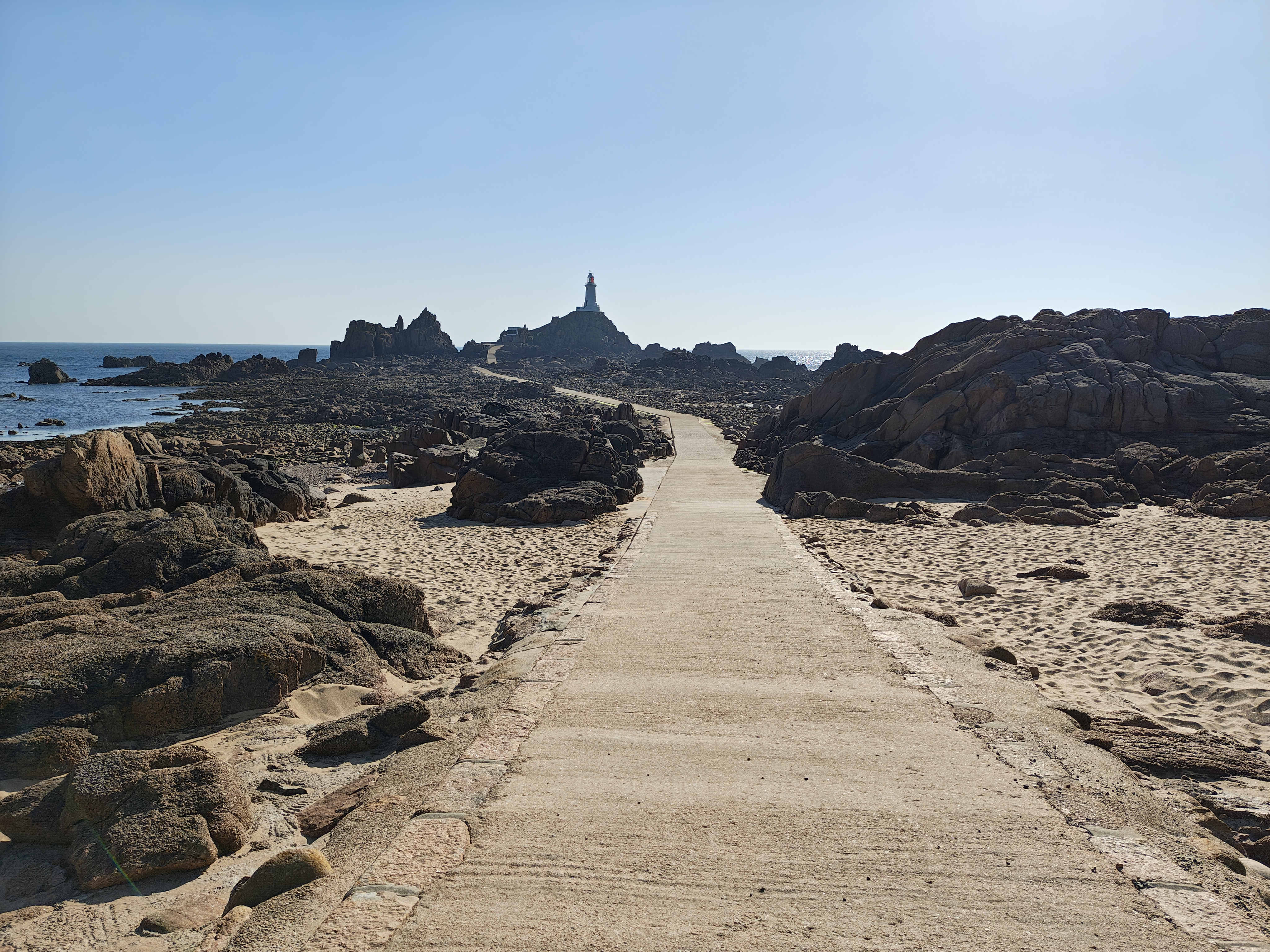
Le Corbiere is everything you want a lighthouse to be. Functional and beautiful, the rocks which enthrone it look particularly dashable upon as far as ships are concerned. It is actually situated on a tidal island and accessed by a causeway. My itinerary not having factored this into account, we were lucky to arrive at low tide.

La Corbière

Along the way to the lighthouse are scattered outcrops within which are nestled German pillboxes from the Second World War. These are the first signs of Nazi occupation during the 1940s that we came across and set out a recurring theme over the rest of our trip. The D-Day landings passed Jersey by, and the island was only liberated after the unconditional surrender of Germany, on 9 May 1945. They had recently been celebrating the 80th anniversary of this and bunting was ubiquitous wherever we went. According to Jersey law, the union jack cannot be displayed without equal prominence being given to its own flag, hence alternating patriotic triangles/rectangles. It seems to me that this is more of an all-year-round thing, with even the public transport being named “Liberty Bus”.

By the time we start to head back, stomachs are rumbling and a slice of toast is required before venturing out again to La Brise at St Brelade’s Bay, another item on my list. The view is gorgeous, the salmon burger less so, but I enjoyed my first sip of Liberation Ale on the panoramic veranda.

On day 2, we hire bikes at St Aubin, pronounced like Oban according to our host, but no ferries these days, unlike its namesake – the capital, St Helier, which has taken over as the main port in modern times. The American émigré distributing the velos suspects us of being colleagues. He is not corrected as such; we just happen to share the same accommodation and have not requested that a second bed be made up.

It was to St Helier we were bound, at least at first, and we stopped on the seafront to enjoy some Co-op bought pastries. Sadly, a seagull snatched H—‘s pain au chocolat from her grasp before she could take a second bite. This was a low light from a day whose challenges were only about to begin.

On the outskirts of St Helier is the power station La Collette, and also a snack van where we sampled by far the best coffee of the trip at Henri’s.

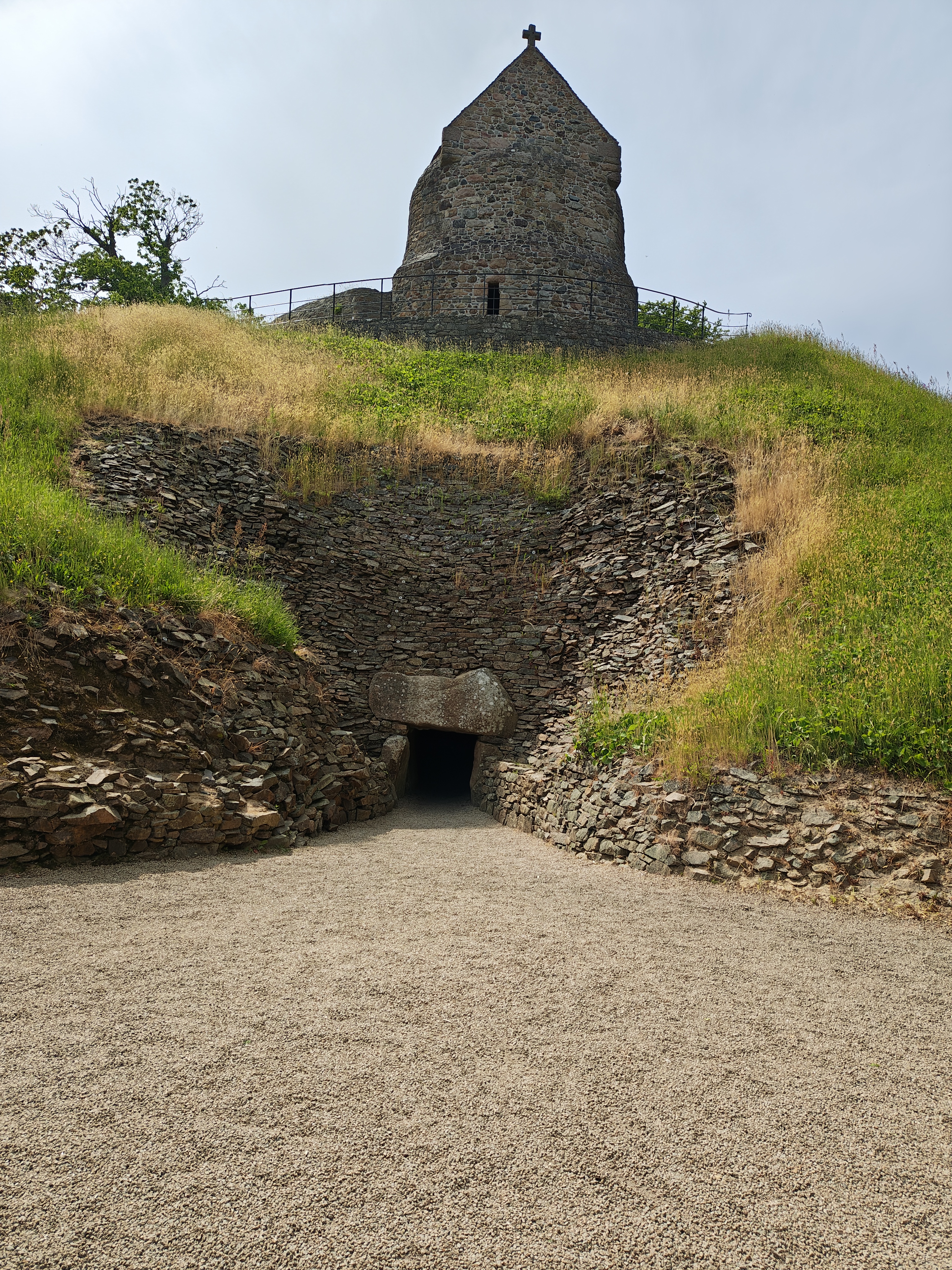
Next stop was the Neolithic chambered cairn/passage grave and late medieval chapel of La Hougue Bie. This required a deviation from the cycle path and onto the winding, narrow lanes inland.

A clue was perhaps in the name La Hougue (meaning hill) that inclines would be involved. As the afternoon wore on, I began to feel slight guilt that I had strongarmed my companion into a cycling holiday (at least partly) when she hadn’t ridden a bike in a decade or more.

By the by, the summit was accomplished anyhow. Now for some more strongarming – we were convinced to get Jersey Heritage passes for a week. With me paying full at £48 and she half at £26 (student discount for continued veterinary studies at Liverpool, obtained sans carte). This was perhaps sore to part with, but in the end was just about worth its value as we ended up doing everything on the pass except the country life museum…or something of that ilk, which was essentially a petting zoo, so I am not too upset about that.

I may be biased (well, I am certainly), but Maeshowe for me is much superior. The Hougue is higher, I will grant it that, but inside the cairn is comparatively chaotic. It does not give off that eeriness evoked by Stenness’s symmetry and lacks the monoliths arranged cathedral-like and purposeful.

A bonus was the exhibition of a coin hoard discovered in 2012. 70,000 Roman coins were buried on the island in the first century AD. One theory was that these were interred for tax avoidance reasons; different millennia, same problems, amarite?

From La Hougue Bie we set out east, not quite catching Mount Orgueil castle’s last entry and thereafter taking in St Catherine’s Bay, pristine and strewn with scallop shells. Two were retrieved as souvenirs before we left for the breakwater, Jersey’s easternmost point.

We had now put about as much distance between us and our accommodation as possible, and the sun was beginning to set. The pedal back to St Helier was probably the most challenging of the trip, involving some significant gradients and the busiest roads we were to encounter.  We made it back, however, and collapsed into a pizzeria just before the kitchen closed. A slow winding up through an unlit cycle path in forest-shrouded darkness later, and the Airbnb was achieved.

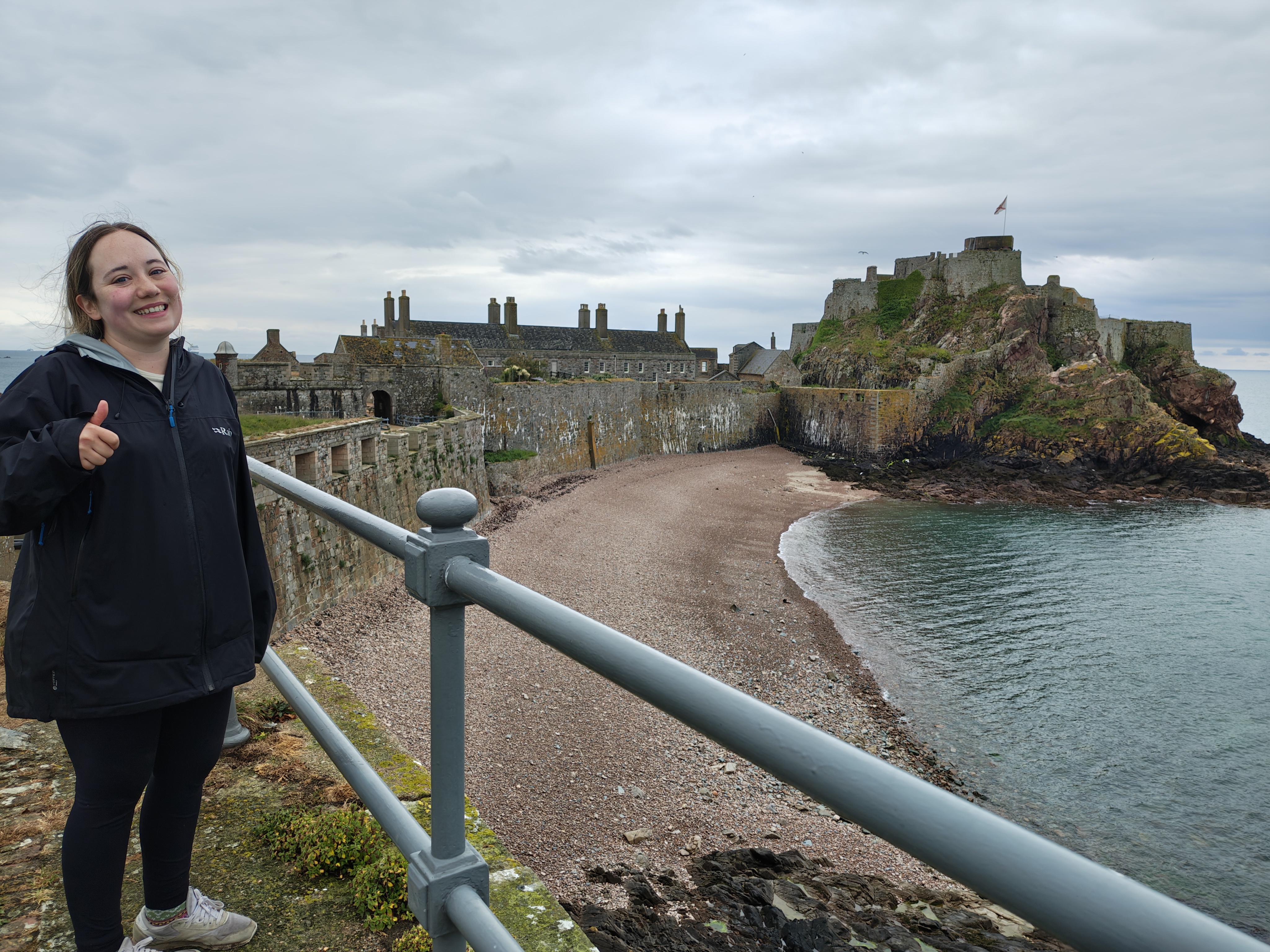
Wednesday was the worst weather day, but largely confined to the morning, and less travel was required as the capital was mandated by the itinerary. Elizabeth Castle was stop number one. Again, this was accessed by tidal causeway or, more significantly, by amphibious bus/ferry if the tide was in. Driving down the beach, its wheels retracted and a propeller began to spin, carrying us across the waves to the late 16th-century-built fortress. It was named for Elizabeth I of England, and Walter Raleigh served as its first governor, though he stayed there only 13 weeks.

On arrival, we were told that the musket demonstration would start in a quarter of an hour. A redcoat in full dress gave us the lowdown and fired warning shots across St Aubin’s Bay in anticipation of a French force landing in an attempt to take the island from the British in 1781.

As well as featuring its own WWII era defences, Elizabeth Castle has, sitting at the start of the breakwater, the hermitage of St Helier for whom the town is named. Specifically, it has a medieval chapel constructed on top of the rocky outcrop from which the 6th-century saint devoted himself to prayer and fasting, alongside providing a community function in warning islanders of any approaching raiders. It is said he succumbed to such a raiding party in 555 AD when they beheaded him, giving rise to St Helier’s double-axed coat of arms.

Elizabeth Castle

After finishing Dickens’s A Tale of Two Cities on the flight over, I began Victor Hugo’s Hunchback of Notre-Dame, which remained my companion for the rest of the trip. At the museum that afternoon, before buying some reblochon at the Normandy market, accepting only Euros, I discovered that Hugo was briefly a citizen of Jersey. He had come to the then-French-speaking island as an exile from the Second Empire of Napoleon III. His stay was short-lived, however, as he was swiftly booted out and had to commence a further exile in Guernsey after publishing a critical piece on Queen Victoria.

The next morning, we killed an hour or so in the excellent Jersey Maritime Museum, which features a hyperabundance of animatronic contraptions and interactive exhibits,  and then departed on a DFDS ferry for St Malo, Brittany. I am introduced to the card game cribbage, which I consistently lose at for the remainder of the trip.

Coming into port, we have little time to linger as we must make la gare in time for our train to Caen, which will be used as a point de depart for our stay in Normandy. The lady at the desk is very proactive in explaining the delay to us when we arrive in rapid French and advises us not to stray too far when it increases to 25 minutes. Luckily, it’s a regional service that stops a while at every station, so it makes up the time, and we get in before 10. Not many places are open for food at this hour, but in another turn of fortune, there is a kebab shop round the corner where we have our first experience of cuisine a la Normande. With our level of hunger and travel fatigue, this ends up being a culinary highlight!

On Friday, we pick up a croissant at the boulangerie before boarding the train to Bayeux. Today we will take in the tapestry and, I hope, manage to commemorate my great, great uncle’s involvement in the D-Day landings of 1944.

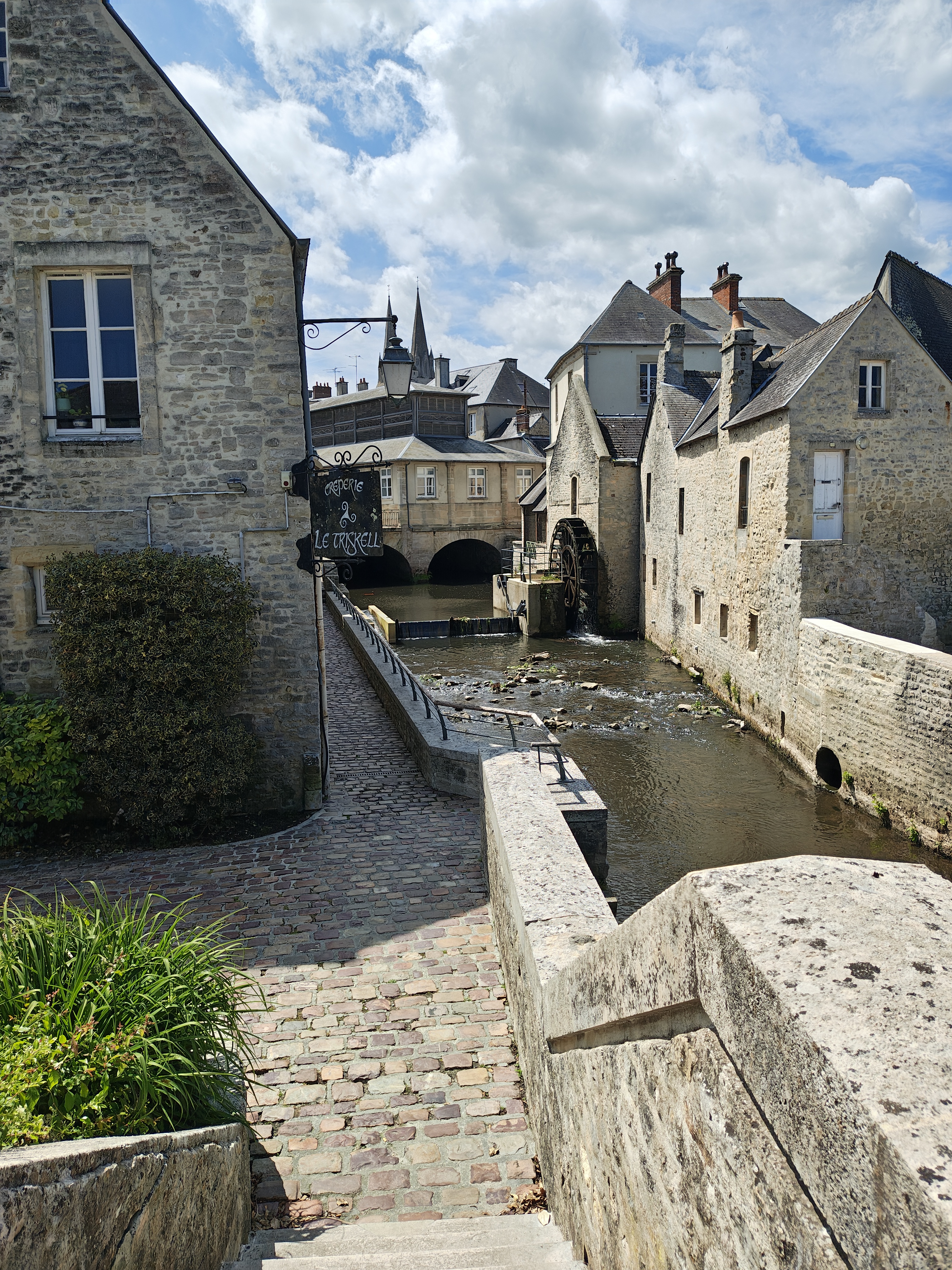
Arriving in Bayeux, the first thing you see upon leaving the train station are two Norman cavalrymen astride a roundabout on the short walk into the historic town. Already, the high medieval tone is set. Paired with Lübeck in Germany, it rivals its Teutonic counterpart for charm and beauty, though here is more Harold and Hastings than harbours and Hansas.

I encounter French customer service at the ticket booth for the Bayeux Tapestry when my attempt to pay over the asking price for the ease of change is scoffed. We pick up our two audio guides en anglais and begin the tour. The contemporaneous depiction of the story of the Battle of Hastings remains a powerful piece of Norman propaganda that leaves you thinking that perhaps William the Conqueror did have a point. It has been theorised, nevertheless, that it contains subversive messages, woven in under the radar, about the brutality of the fighting – beheaded horses, ransacked corpses, etc.

It is in Bayeux that we discover that Normandy is a cider region and have two glasses with, respectively, a crepe and a galette for lunch, dining out on the street below the streaming sun. Having accomplished the tapestry, we plan to catch a bus to the beaches of the debarquement. The scheduled bus never arrives. A minor crisis precipitates until I check my phone and find that my ancestor is, in fact, according to the Commonwealth Graves website, buried on the outskirts in the specially dedicated military cemetery.

The first thing you see as you approach on foot from the town centre is the sandstone monument to the 1,800 Commonwealth soldiers, sailors and airmen whose remains were untraced. Their names are inscribed under their regiments.

Across the road is an arc of headstones of simple white marble. 4,648 in total. The ends of the arc are flanked by two enclosed shelters, each containing a folder with the name and address of the interred. Flicking past Fletcher, we find Lance Corporal John Norman Johnston Flett of Quoyloo, Orkney, who died aged 25 on 19 July 1944.

Our final full day in France sees us depart Caen by Flixbus for the Mont St Michel. As someone who is interested in pilgrimage, this seemed like an appropriate continuation of my Camino journey, which ended, as stated above, in Southampton.

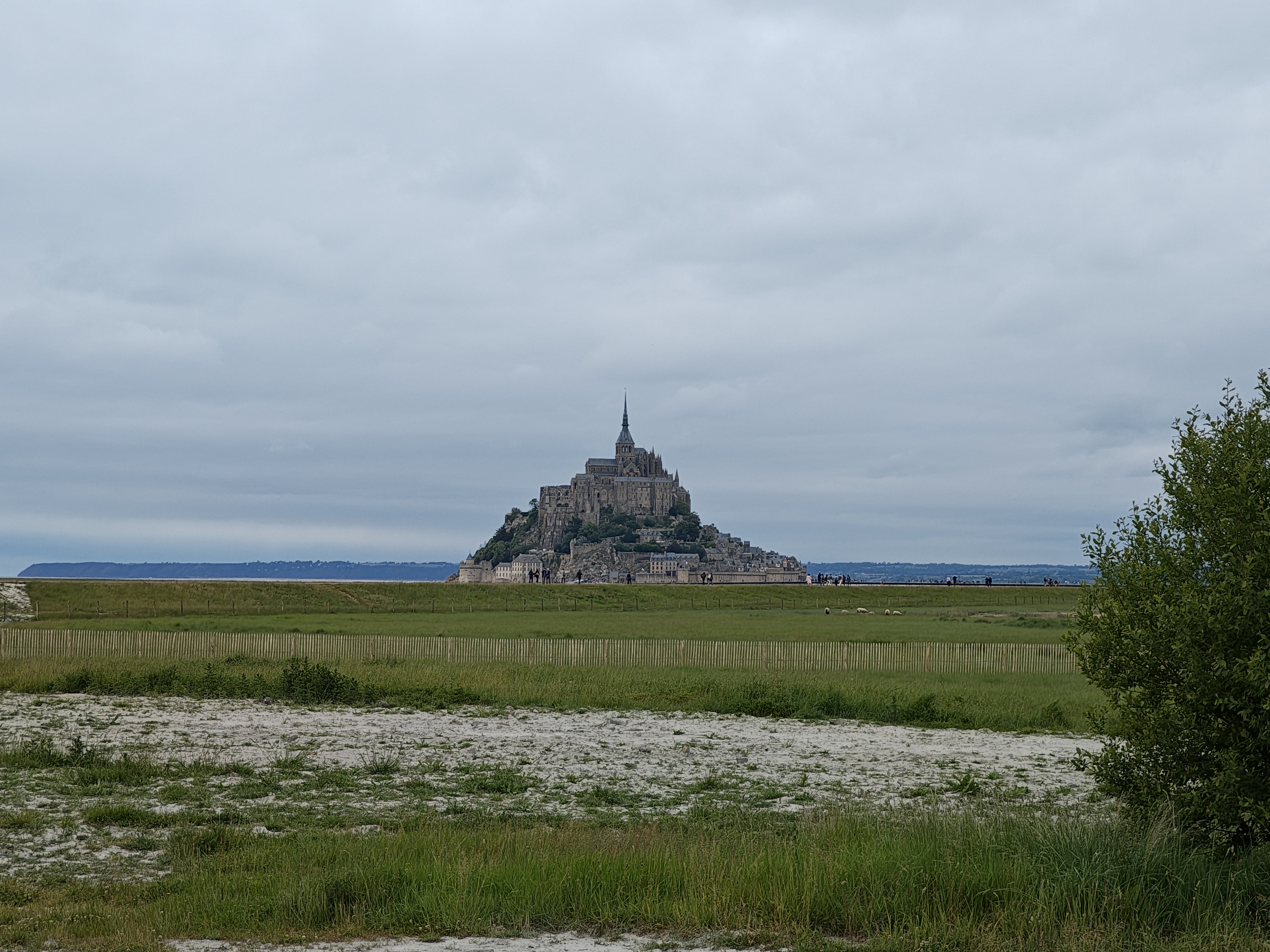
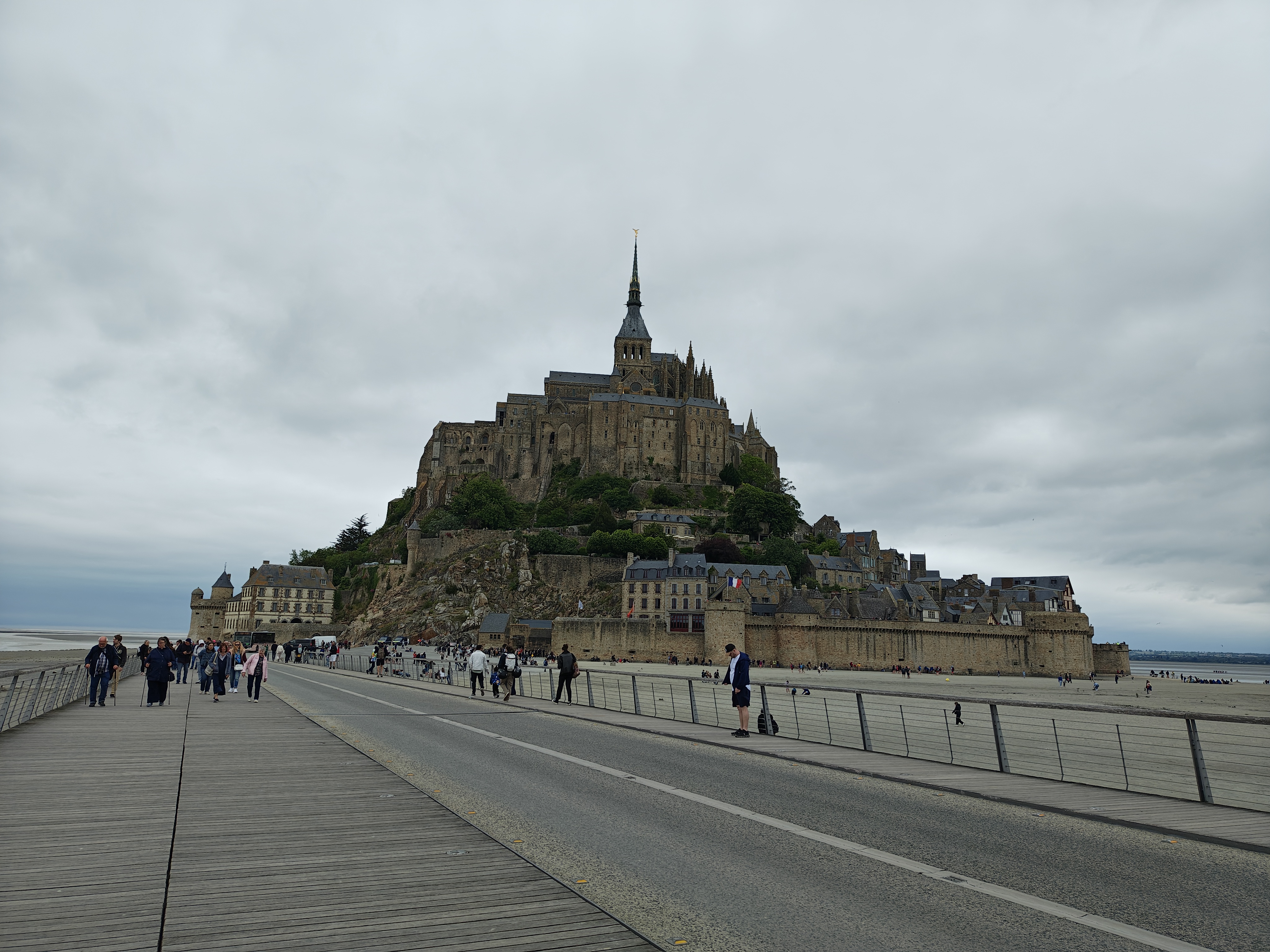
The Mont St Michel is not a port, however, but is situated in a pristine estuary landscape whose lack of features makes the Mont all the more impressive, standing alone on the flats, a walled city carved into the granite tidal island with the dizzying abbey spire at its apex.

A shuttle bus is available, but who would, having legs to walk on, deny themselves the glory of the approach?

Le Mont throngs with tourists. Perhaps, in hindsight, scheduling this for a Saturday was a poor idea. Nevertheless, the bustle adds something to the chaotic yet picturesque density of the narrow streets within.

Forgoing the audio guide this time, we circulate through the abbey sans interpretation. By the time we’ve rounded the last bus to Pontorson is unobtainable. Milder panic than the Bayeux crisis descends, but we resign ourselves to the remarkably indirect route back to port via Rennes, and bag another regional capital while we are at it.

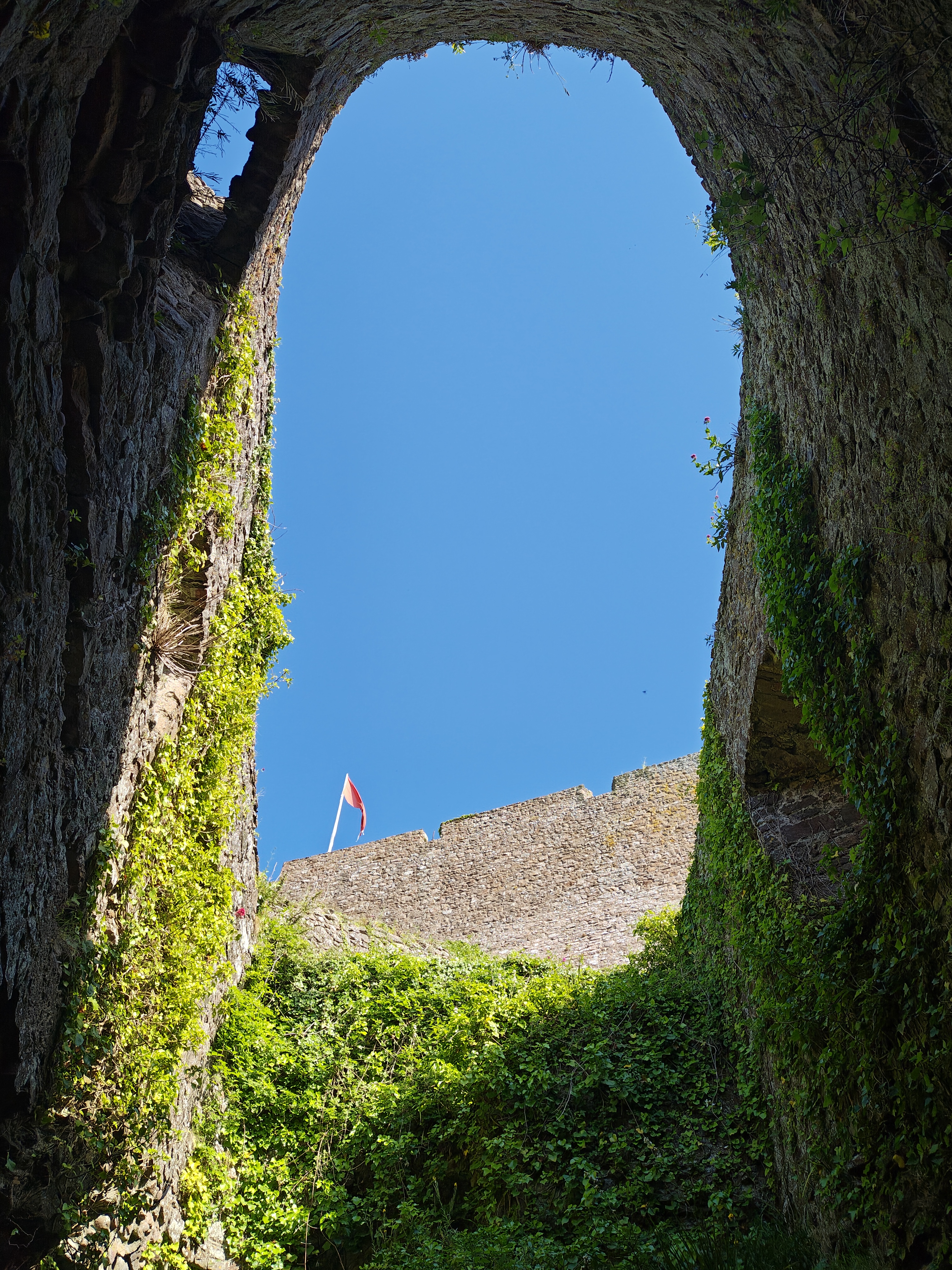
After a night in St Malo, we reverse our progress and return by ferry to St Helier, then fly home that afternoon, but not before making use of the full gamut of our Jersey Heritage pass and paying a visit to the interior of Mont Orgueil to top up our earlier exclusion.

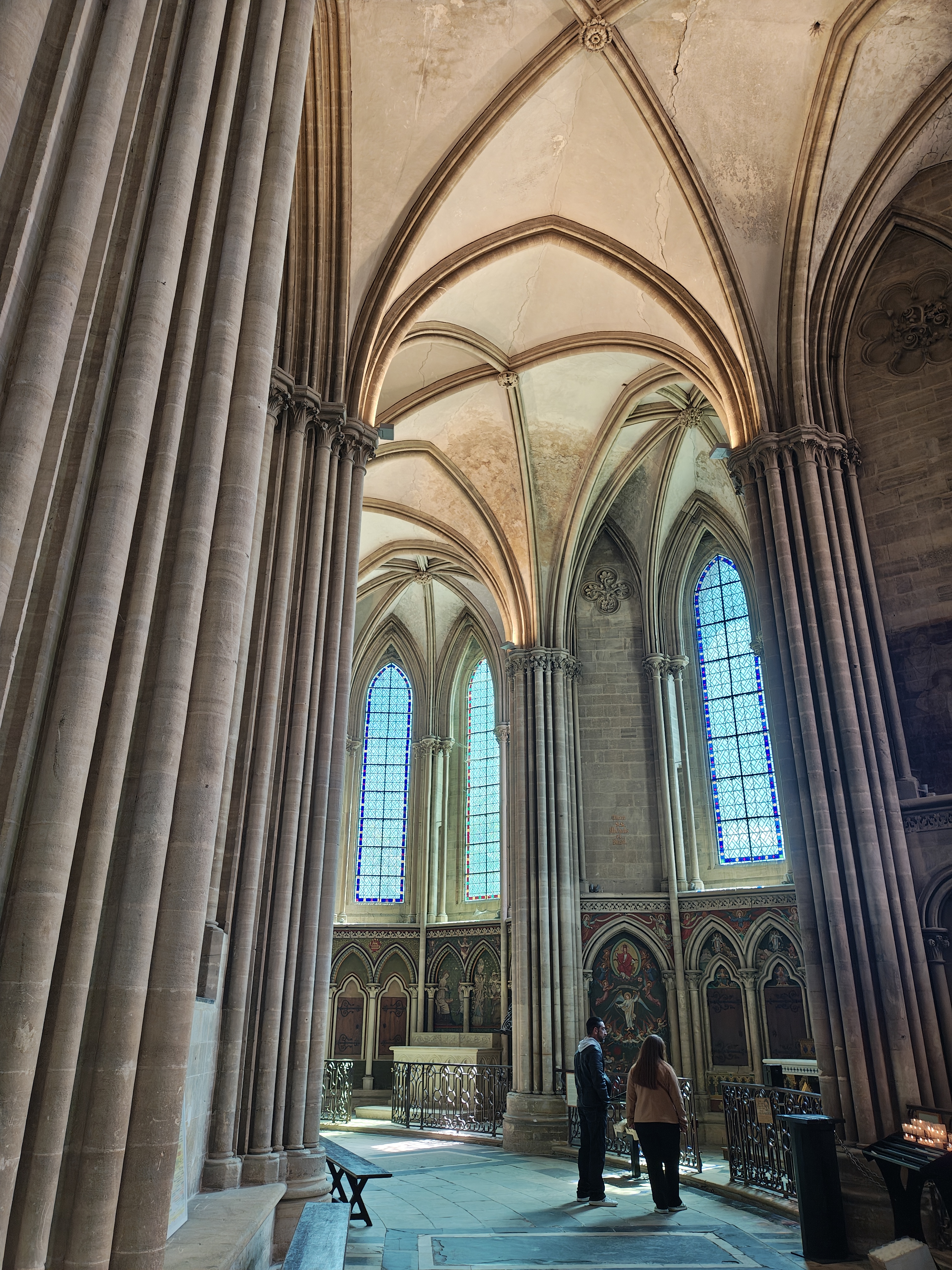
I would thoroughly recommend Bayeux as a pretty and authentic-feeling medieval town with an outstandingly ornate cathedral. As for St Michel, it is a must-see, but I would try to avoid the weekends if at all possible.

Jersey is a fascinating place with its own distinct culture, if having a bit of an unreconstructed affection for the British Empire.

If you can get past the sort of hyperreal UK-ism, there is a wealth of history to discover and beaches aplenty. If you’re looking to truly “get away from it all”, I wouldn’t pick Jersey, however, as its dense population and urbanisation don’t as such lend themselves to escape, albeit affording more choice than you’d usually get with an island holiday.

Posted in Life, Personal experience | Tagged , , , , , , , , , , , | Leave a comment

An update: professional and personal

Time for an update. Professional and personal.

I learnt in March that I am being kept on at the firm I’m working for after the end of the traineeship. That means that from September I will, at last, be able to call myself a solicitor and practise unrestricted in all of Scotland’s sheriff courts, plus I will get to continue in the job I already have for a not insignificant pay increase. It marks the closure of a chapter in my career and the gaining of responsibility (I can be sued in my own name for professional negligence and will inevitably have higher expectations placed on me) and identity (people kind of know what a solicitor is and don’t require the post-amble that comes with the trainee prefix).

At the end of the month I will be attending an “admission ceremony” at the Signet Library in Edinburgh. I will be “admitted” to the roll of solicitors. Really, this is of no practical effect until my traineeship is discharged in September (and I am on the roll anyway, just as one with a restricted practising certificate), but it is nice to cap off my long apprenticeship with some sort of occasion to mark it.

As for personal developments, I can categorically affirm that I have met, and am meeting with, someone who has given me her permission to be referred to by me as my girlfriend.

We met on Hinge at the end of October, and then on a Tuesday night at a cocktail bar once a certain level of rapport had been established.

Her name is H—. She is a vet of the equine variety, is from Motherwell and lives in Quarriers village.

We see each other at weekends and sometimes an evening midweek too. We enjoy books, walking, nature, gigs and cooking. I have had to become a dog person to a certain extent due to her adoption of a rather exuberant (to put it mildly) labrador puppy shortly after our own introduction. So far, he has only been capable of being tired out by a 10-mile walk from Paisley to Lochwinnoch (leg 2 of the Whithorn Way). It’s a new lifestyle, and far from an unpleasant one!

Later this month, I will be visiting Jersey and taking the ferry to France to explore Normandy/Brittany. In a fit of spontaneity, I asked H— whether she would like to accompany me. Dear Reader, she said yes. Goodbye solo traveller, hello couple’s sojourn.

No doubt I will be writing about my experience in the Channel Islands/Gaul in detail during and post-trip, so I will save divulging my motivations and aspirations for that entry. Suffice to say, I am very much looking forward to it – both part 1 and part 2.

Mostly out of my own interest, but partly due to this upcoming trip, I have begun a course at the Alliance Francaise (AF) in Glasgow that convenes on a Tuesday night. I decided to choose a B1 intermediate class with the goal of working my way up from there. Regular readers of the blog will know that I am a fan of French literature and culture, as well as languages generally. The highlights of last year’s book group repertoire were, respectively, Emile Zola’s Germinal and the short stories of Guy de Maupassant.

The Francophilia continues with our reading list for June and July, although in the case of Charles Dickens’s A Tale of Two Cities phobia might be more accurate. July’s text is Victor Hugo’s The Hunchback of Notre Dame which I found in an abridged A2 version within the library of AF at less than 100 pages to the full novel at over 600. For this reason, the French original is almost certainly too ambitious an assignment for the c. 6 weeks I’m allowing myself to get it read.

For having lived in the heart of the West End of Glasgow for nearly three years now, it is astonishing that I’ve not once frequented the Alliance Francaise or the Goethe Institut (which share the same building in Park Circus) when both are virtually on my doorstep. While I did go to a couple of events in the German film festival run by the Institut last year, that has really been the extent of my interaction.

I resolved to get a bit more serious about learning French at the beginning of the year, i.e. move beyond Duolingo. My first step towards this goal was attending a meetup in a pub in January. Most of the participants were Scottish, but there was at least a concerted effort to keep the conversation Francophone. I mostly listened and nodded. One thing I did pick up was that several of them had done or were doing these courses at the AF, so it was on their recommendation that I looked it up. Classes also suited the level of commitment I wanted to make and would provide a structure to things that mere conversation doesn’t lend itself to.

So far, I’m in week 2 of an eight-week block. The first was a bit scary, not knowing whether I’d picked the correct level and being exposed in the limited class size (small enough that you know you’ll have to speak, but big enough for that prospect to be a tad daunting initially). However, I’m enjoying it. It’s a good mix of 50-60 somethings and one or two other folk my age,  and the teaching is professional with a balance between fun and the discipline I’m looking for.

I’ll get two more classes in before gracing the coast of Brittany. Without a guide as I had on the shores of le Lac Léman, I will have to take charge of navigation and negotiation. With a companion, the stakes are higher if I fail or falter. Mais, je crois que je suis plus ou moins prêt pour le défi – c’est parti !

Posted in Life, Personal experience | Tagged , , , , , , , , , , , , | Leave a comment

Egoless autofiction or the self-erasing memoir: Nan Shepherd’s ‘The Living Mountain’

In The Living Mountain Nan Shepherd inverts her eye, but it’s not her mind we see but Mind itself. It is a theory of the mind from a particular mind mode. Mind minus ident and the idem from the idiosyncratic.

It is a book of perception. Perception and perceiving. It is not a lens through which to view the world but an endorsement of the unfiltered. It is a call to make conscious that which lurks, hums or bristles below consciousness. Not the unconsciousness internal that is the recess of the repressed but the body’s background; that which is ordinarily tuned out so we may engage with our assigned, necessary functions undisturbed and with minimal emotional or intellectual involvement. In Shepherd’s words:

“The body is not made negligible, but paramount. Flesh is not annihilated but fulfilled. One is not bodiless, but essential body.”[1]

Who is Nan Shepherd? It is hard to say. For a work so unique her own Self is hidden from us. There is a distinct voice but it is rarely personable or inclined to disclose much of her beyond what is necessary to bring her manifesto closer to clarity.

There is also little sense of Shepherd as a woman. Not that there need be, but there is a notable leaning-in to humanity in general as “man”, the general singular “he” invariably. Of course, this is a work first penned in the 1940s; a, thankfully, quite different time than our own. But can this be attributable solely to the era in which it was written?

It is not just the archetypal human being who is “he”. Most creatures are, which surely are divided in a roughly 50/50 split like us?

Crucially, too, is “the mountain” itself. When Shepherd speaks of the mountain, she does not describe a single peak but the entire range – “the plateau” as she calls it, which contains tops but in her conception represents a unified, unitary landscape. Shepherd’s relationship to and with the mountain appears to have a gendered aspect.

The book, indeed, has much latent, and frank, eroticism. The mountain’s maleness is one aspect of this. It reveals itself sporadically and urgently in places. Most vividly in the penultimate chapter ‘The Senses’, where she pronounces, unprovoked, “smells excite me”. She continues—

“On a hot moist midsummer day, I have caught a rich fruity perfume rising from the mat of grass, moss and wild berry bushes that covers much of the plateau. The earthy smell of moss, and the soil itself, is best savoured by grubbing. Sometimes the rank smell of deer assails ones nostril, and in spring the sharp scent of fire.”[2]

From the same chapter:

“after rain I run my hand through juniper or birches for the joy of the wet drops trickling over the palm, or walk through long heather to feel its wetness on my naked legs. […] The hands have an infinity of pleasure in them.”[3]

The Living Mountain is not a memoir. Its protagonist is the mountain or the mountain as experienced but the experiencer is almost invisible. The personal anecdotes are as impersonal as it is possible to be. People are to be observed, almost ethnographically and provide Shepherd with the technical vocabulary and knowledge that enhance her mountain worship. But she does not linger with them; human interactions are fleeting, even transactional. Yet she likens the mountain to a friend:

“often the mountain gives itself most completely when I have no destination, when I reach nowhere in particular, but have gone out merely to be with the mountain as one visits a friend with no intention but to be with him.”[4]

Though mentioning Buddhist pilgrimage at the conclusion of the book, Shepherd is an anti-summit sherpa. She eschews the peaks as incidental and not to be reified at the expense of the totality of the landscape. Note the use of the gendered personal pronoun here.

In the decade prior to Shepherd’s penning The Living Mountain memoir was turned to political ends in the works of George Orwell. Down and Out in Paris and London, The Road to Wigan Pier and Homage to Catalonia are all rooted in autobiography and deeply political. The Living Mountain is more treatise than memoir and in our age where over-disclosure is expected, refreshing and welcome. There is a lack of self-deprecation and irony; Shepherd is deadly serious. Her joys are sincere: worked at but not contrived.

Orwell certainly would have taken issue with Shepherd’s sentiment in this passage (he was virulently anti-bohemian!):

“Walking barefoot has gone out of fashion since Jeanie Deans trudged to London, but no country child grows up without its benediction. Sensible people are reviving the habit.”[5]

The Living Mountain is a political book, though probably not in a way that Orwell would have recognised. It is about how to be, how to observe closely, to trust one’s senses even if they do not accord with expectation (in this way the sky may be green, water essentially white and haze afford more definition than brilliant sunlight). Echoing, or rather anticipating, Jon Krakauer’s Into the Wild, it is also about respect for the brutality of nature with vivid descriptions of the discovery of hikers caught out in treacherous conditions and found days later abraded and frozen to death.

Shepherd wrote The Living Mountain during the Second World War. This context is not directly referred to and only seeps in at the edges of the text. The wrecked warplane, flying too low in the all-enveloping mist, and the redoubled forestry to supply the front with timber are two such incursions.

There is a plausible interpretation of The Living Mountain as Shepherd’s method of processing the horror and brutality of the total war. The mountain, here, is a synecdoche for the external, the beyond humanity. It bypasses and is distinct from the human day-to-day and interpersonal or political conflict. In a broader sense, it is the Not-We. The Not-We imbued with consciousness. God?


[1] The Living Mountain, p106

[2] The Living Mountain, p98

[3] The Living Mountain, p102

[4] The Living Mountain, p15

[5] The Living Mountain, p103

Posted in Review | Tagged , , , , , , , , , , , , , , , , , , , , , , , | Leave a comment

Eva an sich or The Living Treatise: Alasdair Gray’s ‘Poor Things’ revisited

January led me to Poor Things four years ago. Public health was very much the order of the day back then as Covid restrictions, about which and around which novels are now written (see Caledonia Road by Andrew O’Hagan) still loomed large over economic and social life. Public Health Officer is how Archie McCandless, one of several of Poor Things’ narrators decides to designate himself as opposed to a member of the medical profession more generally.

Poor Things is full of lavish anatomical images and crafted typography.

I return to the novel as a resident of the West End proper of two and a half years and Glasgow for 4.5. Since then it is unlikely to have escaped your attention that a film has been released directed by Yorgos Lanthimos that came out around this time last year. Coming back to Poor Things, then, I am more embedded in the city and the specific milieu of the immediate vicinity of 18 Park Circus, as well as attaining the temporal vantage point of the novel gaining a far wider reception than it ever would have had it not graced the silver screen.

The following is not written as a film review, though inevitably comparisons will arise, but as a re-evaluation of the text compared with my first encounter, bringing all the knowledge and insight I have gained since that first reading to a fresh and, as is my aspiration, more correct interpretation.

Why write a novel about late 19th-century Glasgow? Several characters in Poor Things have boasts to make about its status as the second city of the empire and its contributions to science, economics and, particularly, medicine. I think primarily, though, bypassing the self-justification ventriloquised through its cast, the reason is that Glasgow remains a 19th-century city. No amount of mutilation by motorway can erase this fundamental essence. And yet, there is a lost city; a suggestion of what once was. Glasgow is psychogeographically splintered. It is a collage to be re-assembled, the voids imaginatively filled in.

There is no denying Glasgow’s heyday now lies at least a lifetime ago. A million souls once scurried through these streets; the apex of Rome in 0AD. Glasgow now supports less than two-thirds that. The million souls were highly concentrated too, with 19th century Glasgow one of the most densely populated places on earth. The microcosmological potential is in stark contrast to the disconnectedness of contemporary experience.

Population and progeny are central concerns in Poor Things. A “poor thing” is a helpless creature, incapable of self-redemption, the object of pity more than empathy. The archetypal “poor thing” is a child. A being in need of nurture who left to its own devices, will shrivel and waste away.

Lost children and lost childhoods haunt these pages despite the ostensible levity and humour (and it is frequently laugh-out-loud funny). The most obvious of these is the product of Victoria/Bella’s posthumous caesarean skipping birth for reincarnation as Bella/Victoria’s second lease of life. An unwanted child’s brain grants the body of Victoria Blessington a neurological blank slate in what is the central conceit of the novel. Abortion and resurrection disturbingly combine.

The work most readily associated with Alasdair Gray, LanarkPoor Things is certainly more famous now but few would recall its authorship – also features a central character who undergoes a rebirth that severs the link between the new being and the past self. Each of the characters journeys to the new self by plunging. Lanark/Thaw slips in, feet first, representing a reluctance to be swallowed/rebirthed in quite a grotesquely literal sense. Victoria/Bella dives, pre-weighted with stones, headfirst with no “wish to return to the surface”.[1]

These stark images of childlike ignorance/innocence, rebirth and baptism borrow from and invoke a Christian tableau but Gray’s concerns are more akin to Miltonic innovations interpolated through Mary Shelley. There were no children in Eden. A child is not, in any sense, ideal. For Gray childhood is not primarily innocent, but vulnerable – a trauma factory from which most grown-ups never clock out.

Prelapsarian Eve in Milton’s vision is very much an adult human female with adult desires that are acted on without a hint of shame or repression. Eve had no childhood and manufacturing is an alien concept in the Garden of Eden. Milton is unequivocal that the knowledge she gains by eating the fruit is not carnal.

Milton in Paradise Lost is unfortunately constrained by the bald, bigoted statements of Genesis that leave little room for creative interpretation. Bringing forth in sorrow is the big one – God’s curse on women of painful childbirth. The 17th century was not quite ready to talk about menstruation, it seems, leaving later generations to challenge the lunacy (no pun intended) of Leviticus. Not so, Godwin Baxter of his creation, Bella:

Her menstrual cycle was in full flood from the day she opened her eyes, so she has never been taught to feel her body is disgusting or to dread what she desires. Not having learned cowardice when small and oppressed she only uses speech to say what she thinks and feels, not to disguise these, so she is incapable of every badness done through hypocrisy and lying – nearly every sort of badness.[2]

GB argues that BB exists for herself, freed from self-loathing, sexual repression and the burdens of having had a childhood. She is the Eva an sich, not Frankenstein’s bride – a treatise made flesh.

This is, however, only after Bella elopes with Duncan Wedderburn. Up until this point – a source of much of the novel’s comedy and delicious melodrama – Bella could very much have been created as Godwin’s bride.

A scene in the novel which does not make it to the screen in Lanthimos’s adaptation is where Bella announces her engagement to Archie McCandless by the fountain in West End Park (now Kelvingrove). Godwin is aged up in the Lanthimos version (played by Willem Dafoe), so it is quite ridiculous to view him and “Max” of the film as love rivals. In the novel, McCandless and Godwin are more like peers, although Godwin is slightly older having completed medical school (albeit denied graduation) whereas McCandless is still a student.

Godwin’s odd medical conditions are preserved in the film where he announces he must manufacture his own digestive juices and belches fantastical gas bubbles. In the book, he appears to be a kind of diabetic and eats only a proto-huel-like substance which disgusts McCandless with its awful smell and, in a moment of curiosity, briny taste. What is not preserved is his hideous voice; apparently so intolerable as to necessitate earplugs for prolonged periods in his company.  Loud, grating and high-pitched – he has remained in a state of perpetuated prepubescence. That is until he hears that Archie and Bella are to be wed:

Then came the most terrifying experience of my life. The only part of Baxter which moved was his mouth. It slowly and silently opened into a round hole bigger than the original size of his head then grew larger still until his head vanished behind it. His body seemed to support a black, expanding, tooth-fringed cavity in the scarlet sunset behind him. When the scream came the whole sky seemed screaming. I clapped my hands on my ears before this happened so did not faint as Bella did, but the single high-pitched note sounded everywhere and pierced the brain like a dental drill piercing a tooth without any anaesthetic. I lost most of my senses during that scream. They returned so slowly that I never saw how Baxter came to be kneeling beside Bella’s body, beating the sides of his head with his fists and quivering with human-sounding sobs as he mounded in a husky baritone voice, “Forgive me Bellla, forgive me for making you like this.”

She opened her eyes and said faintly, “What’s that supposed to mean? You aren’t our father which art in Heaven, God. What a silly fuss to make about nothing Still, your voice has broken, there’s that to be grateful for.”[3]

This vivid magical realism is typical of Gray. It is something that is not quite captured in the film, which exists in much more of a dream-like, parallel universe. Lanthimos ups the magic over the realism with Godwin creating a self-propelled carriage contraption and a bestiary of chimaeras as opposed to just the swapped-torso-ed Flopsy and Mopsy. Gray’s world is rooted in real-life locations and history, which makes these breaks with reality all the more stark. For Lanthimos, late 19th-century Europe is more of an incidental backdrop – an aesthetic. Unforgivably, Glasgow is entirely absent except in Dafoe’s amusing attempt to approximate Gray’s own peculiar accent for Godwin.

The scene by the fountain marks a distinct transition for Godwin Baxter from father/would-be-groom to the settled role of disinterested (in terms of designs on marriage) patriarch. In this scene, Bella does not know what might need to be forgiven. That only comes at the heart-rending end of Chapter 18: The Return where she asks, “Where is my child, God?”[4]

Godwin’s interest as a father is a cause of regret for him on Bella’s return. The love of one’s child is by default selfish and to the exclusion of all other children. It diverts his attention away from charitable work—

I wanted to win your love far more than I care for the scorched and broken victims of heavy industry.[5]

Bella’s answer has a lot of resonance today in a world where people are deciding not to have children because of perceived overpopulation and concerns over carbon footprint per capita. She exclaims, “Dear God, what a lot of good I have prevented, just by existing!”

Godwin’s initial mistake is to expect something back from Bella for the gift of renewed life he has given her. He hopes to obtain a direct return from his efforts in educating her scientifically (his veterinary practice) and culturally (through his grand tour), to create the perfect daughter/bride who complements exactly his unprejudiced eccentricity and who will not shrink from his unconventional physical form. Adoration in return for devotion.

There are some things parents cannot teach, however, and Godwin limits Bella’s education such that she must learn these things unregulated in the company of Wedderburn and worldly-wise cruise ship passengers. The core of Poor Things is the childlike moral revulsion which, ironically, we lose through our experience of being a child and learning that, regrettably, the world isn’t fair by the time we reach maturity. Bella’s moral revulsion has the potency of a child’s but she has none of a child’s impotence. With her technical training and total immersion in European high and low society, she has the knowledge and the impetus to effect transformative change. Godwin’s Ausbildung will be reaped by the world at large, the fruits his to enjoy at an abstraction, while he sips briny huel.

One other thing the film leaves out is the novel’s polyphonic quality. Poor Things, the book has a long coda including a letter in riposte from Victoria McCandless, wife of Archie, writing after his death. She denies the resurrection narrative, framing her story as one of selective amnesia to escape from a brutal husband and unhappy upbringing. Gray, as “the editor” is firm in his belief in McCandless’ account, in a lengthy series of “proofs” of the events he describes. Of course, as above, Lanthimos does not attempt to pretend that his work takes place in anything approaching the real world. It is a different artistic vision, but to my mind a poorer one.

Gray describes Victoria’s life after the events of Archie’s memoir. She continues in her idealism, setting up her own clinic, joining the Fabians, campaigning for and enacting social justice.

The First World War deprives her of her three sons and this experience causes her to confront her own attitude towards parenthood. She publishes a pamphlet (as her husband does) at her own expense called A Loving Economy. In it, she recommends a one-child policy because she believes that she has failed to mother her sons sufficiently. Had she done so, she concludes, they would not have considered their lives so “valueless” as to throw them away in sacrifice to the derangements of the ruling class.

Victoria strikes a strongly anti-natal note to conclude this endlessly curious novel. Amid the polyphony one gets the sense that there should be some other way between Malthusian cynicism, anti-natal resignation and blind effective altruism of the “more life = more good” school. Godwin touches on it, I think. The coveting of mere life “bios” is inadequate and often actively detrimental to social life; the only legitimate reason for creating new life is the promise and intention to transform bios into zoe – a life lived in dedication to the betterment of others[6]; the raising of poor things from helpless creatures to a station of dignity, autonomy and empowerment.


[1] Poor Things, p32

[2] Poor Things, p69

[3] Poor Things, p52

[4] Poor Things, p191

[5] Poor Things, p195

[6] Difplag of C. S. Lewis, Mere Christianity

Posted in Review | Tagged , , , , , , , , , , , , , , , , , , , , , , , , , , , , , , , | 2 Comments

Musical highlights: 2024

I can sign court documents in my own name now, have people swear oaths before me and (technically) represent you in a solemn criminal trial in front of a sheriff. What that is to say is that I am now a second-year trainee solicitor with a restricted practising certificate and notary public. Things appear to be progressing swimmingly in that regard. More importantly, though, I’ve done it all with the support of dependable friends who’ve listened, reassured, advised and encouraged throughout the year that has been 2024.

Internationally, I did not venture far this annum. I did not break out of the British Isles but ventured to Ireland in May on my Hiberno-Welsh Odyssey. Cardiff my furthest south and Shetland my northernmost extent.

In terms of gigs, I saw Beach Fossils, Say She She, King Gizzard and the Lizard Wizard, Honeyblood, Drahla, Alvvays, Ty Segall and Khruangbin. The venues were respectively St Luke’s, Assembly Rooms, Usher Hall, Stereo, Old Hairdresser’s, O2, QMU and the Hydro. As one might expect King Gizzard and the Lizard Wizard put on the most maximalist show, though I don’t think their 2024 offering Flight b741 quite reached the heights of Petrodragonic Apocalypse.

Khruangbin’s gig as part of their A La Sala tour was unexpectedly epic given their albums tend towards a median of mellow and measured. I should really have had an indication from the choice of venue, the OVO Hydro, which I’d never been to until this year. It was a theatrical journey with a backdrop comprising three noble arches in antique style and stately steps below – there was even an interval (the set split by a hyperreal thunderstorm serving as a white noise palate cleanser between the halves). Also very good were Say She She in the Assembly Rooms – a vocal trio of session musicians producing glitzy funk and soul with, of course, delectable vocal harmonies – and Ty Segall at the QMU (brooding, grungy psych-infused garage rock with striking dynamic versatility).

Honourable mentions for this year whose albums didn’t quite make the list are The Bug Club, Father John Misty, FLO, Ibibio Sound Machine and Kelly Lee Owens. Above all, however, the single that impressed me the most in 2024 would have to be ‘Holy, Holy’ by Geordie Greep. Black Midi split this year and guitarist/vocalist GG released a solo album. The lead single is an unhinged, through-composed odyssey of a song. Think Earth Wind and Fire’s ‘Groove Tonight’ spliced with Steely Dan’s precision and Santana’s crystalline guitar licks, all over a carnivalesque samba/bossa nova backdrop. It’s operatic, frantic, and transports you from tense, twitchy awkwardness to expansive melodrama and sickly obsequiousness. Or, one might say, “from the shores of Havana, in Moscow and Tokyo/in French Guyanese, in Cantonese/Everyone knows my name!”. Please, if you listen to one new song from 2024, listen to this:

As for albums I can recommend this year, I have eight. They are as follows:

8. Charm by Clairo

Softboy Summer 2k24 would not be complete without Charm by Clairo. This summer I was trying to dial down the intensity in an attempt to ease into my easy runs as part of my marathon training. Clairo is totally unhurried here while still compelling enough to keep you listening through the tracks. Melancholy longing with timeless, classic-sounding instrumentals. Her style reminds me of artists I’ve enjoyed in the past such as Tennis and The Shacks. ‘Add Up All My Love’ was the first song to catch my attention when I heard it by chance on the radio but I think my favourite is ‘Thank You’.

7. Three Bells by Ty Segall

An early standout for 2024 was Ty Segall’s Three Bells. It’s still rock and it’s still loud but here things are dialled back just a smidge. Most tracks are acoustic guitar-driven with electric interjections. The songs have a menacing, sludgy quality to them. The album is consistently engaging from front to back, but a good place to start is the catchy ‘Hi Dee Dee’ or the non-quite-titular ‘The Bell’.

6. My Method Actor by Nilüfer Yanya

Nilüfer Yanya’s song ‘the dealer’ from her 2022 album PAINLESS was probably one of my top tunes of that year. I felt similar things when I listened to the first single from her latest album My Method Actor, ‘Like I Say (I Run Away)’. Overall, the new album is more sedate and mature than previous work. This is the sound of an assured artist, in no rush to tell the story that needs to be told. This is nowhere more exemplified than on the track ‘Call it Love’ – a supremely cool but slightly uneasy meditation on the inadequacy of labelling a feeling. Another standout is ‘Mutations’ featuring some great strings towards the tail end over a shuffling, syncopated drum groove.

5. Loss of Life by MGMT

I really liked MGMT’s Little Dark Age from 2018. The title track was reaching for the anthem status previous hits such as ‘Kids’ and ‘Electric Feel’ obtained, and it achieved a cult following certainly. Loss of Life does not appear to have this ambition. It doesn’t grab you right away, but it rewards on repeated listens. Where Little Dark Age was tongue-in-cheek and ironical, Loss of Life is more straightforwardly melancholic. Actually, it is profoundly melancholic. The kind of album that has thought a lot about its subject matter and come to some rather bleak but verifiable conclusions. Not that there aren’t moments of hope – there are, on tracks like their duet with Christine & The Queens, ‘Dancing in Babylon’ and its heartfelt coda. The order of the day is darkness, nonetheless and my favourite tracks in that regard are the majestic ‘People in the Streets’ and the acoustic guitar-driven ‘Nothing to Declare’.

4. A Dream Is All I Know – The Lemon Twigs

The Lemon Twigs topped last year’s list for me. They followed up Everything Harmony in 2023 with another fantastic collection of songs in 2024 on A Dream Is All I Know. Once again it is tune after tune. This time, though, the tone is more upbeat. Gone, largely, is the luxuriant sadness of the last record apart from perhaps on the track ‘Ember Days’ – “When is it June for us/those whose permanent place is a dark alleyway?”

Instead, the main influence here appears to be the Beach Boys. It’s more 60s than 70s is what I’m saying. Less glam and gritty than wall of sound sweetness. The reason the Lemon Twigs land lower on my list this year is that there are definitely some tracks to skip if you are not in that saccharine frame of mind. The title tune is fabulous, however, as is ‘Church Bells’ which precedes it. I am quite partial to the closer too for its unabashed Status Quo/T-Rex stomp feel – ‘Rock On (Over and Over)’.

3. The Sunset Violent – Mount Kimbie

I adored and continue to adore Mount Kimbie’s 2017 album Love What Survives. The Sunset Violent is a worthy successor seven years later. At just nine tracks one does wonder whether more of an offering could have been put forward after all this time, but almost every single one of the tracks is saturated in the dark, scuzzy, melancholic and aloof vibes that made its predecessor so great. ‘Got Me’ is perhaps the only one I’d skip as it feels a bit tonally inconsistent with the rest of the bunch. If an album is only nine songs long, I really want to wallow in the darkness and I don’t need a (comparatively) light-hearted interval of a track. It’s too much of a gear shift for me, and from the plays on Spotify, I can see I am not alone in skimming over it the majority of the time. Mount Kimbie’s familiar collaborator, King Krule turns up a couple of times on the record and it benefits immensely from the expressive vocals of Frenchwoman Andrea Balency- Béarn. I really love the tracks ‘A Figure in the Surf’ and ‘Fishbrain’.

2. Brat by Charli XCX

I’m not sure it is possible to be living on planet earth and remain unaware of the phenomenon that was Brat summer. With Brat Charli XCX has come full circle. Starting out as a would-be pop princess, she took a handbrake turn and vroom vroomed her way quite a considerable distance from the mainstream. With the help of pioneering collaborators such as AG Cook and the late SOPHIE, she produced some of the most original pop music of the past decade. Perhaps in pushing to the fringe, she evaded the attention of the majority while garnering fierce adoration from the initiated. She is now inescapable and defined the Zeitgeist for a time like no other artist.

But what does Brat sound like, I hear you ask? It sounds like The Club, and I am deliberately employing those two capitals. Charli XCX is reaching for an archetype on Brat, which means that the songs in their elements will be absolutely and instantly familiar to the listener, but in their combinations and manipulations, they comment on and deconstruct the idea and experience of what it is to enter that sanctioned space of hedonism, figuratively (mostly) and literally. Emotionally, it is primarily confident and combative with a secondary face of vulnerability and insecurity. It is the chaos and disorder of the party mentality and its creative potential for connection and the unexpected. There is profundity, absurdity, anxiety and euphoria. You cannot listen to this album unchanged. Give it a spin from ‘360’ to ‘365’. You won’t walk away the same person!

While the most experimental of the tracks are ‘Club Classics’ and the closer, I have a soft spot for ‘Talk Talk’, which is full of longing and trepidation about approaching someone you’ve grown fond of in public.

1. Imaginal Disk by Magdelena Bay

I was only dimly aware of Magdelena Bay pre-2024. Tunes from their previous albums had been on my Spotify playlists in the past but for some reason, they didn’t stick with me. This seemed to change after being directed towards the single ‘Death & Romance’ by the internet’s busiest music nerd, Anthony Fantano. Its triumphant piano chords induct you into a strange universe that is realer than real before the confident countermelody of the bass cuts through turning what might be an expansive ballad into a tight piece of power pop that is both multilayered yet retaining room to breathe and grow.

Imaginal Disk is masterful at evoking a vast spectrum of emotion. The enigmatic vocalist does not appear to be of this world. It is an album of abstraction, with many of the song titles concerned with concepts more than the concrete and quotidian. That is, except for songs like the weird ‘Watching TV’ and undoubted banger ‘That’s My Floor’ – the best tune about going up in a lift since Pink!

An album highlight for me has to be the sublime ‘Image’, which is true alt-pop perfection in the mode of Kylie Minogue a la c. 2000. It winds down beautifully too, with the gorgeous penultimate track ‘Angel on a Satellite’. If you only have time to listen to one album from 2024, make it this!

Posted in Life, Music, Personal experience, Review | Tagged , , , , , , , , , , , , , , , , , , , , , , | Leave a comment

Substance as well as ethereality

York

York historically claimed authority over Glasgow as an archbishopric, but the Pope dissented, naming the city a special daughter of the Church. No intercessor needed between us and Rome.

It began on a frosty Thursday morning. On the train over every branch and blade was crystalised. The most mundane undulation transmogrified. Half an hour behind schedule we pulled into the city of the white rose.

The first recognisable establishment from the station was Pizza Express, a favourite haunt of the Duke’s, though that perhaps pertains only to the Woking branch.

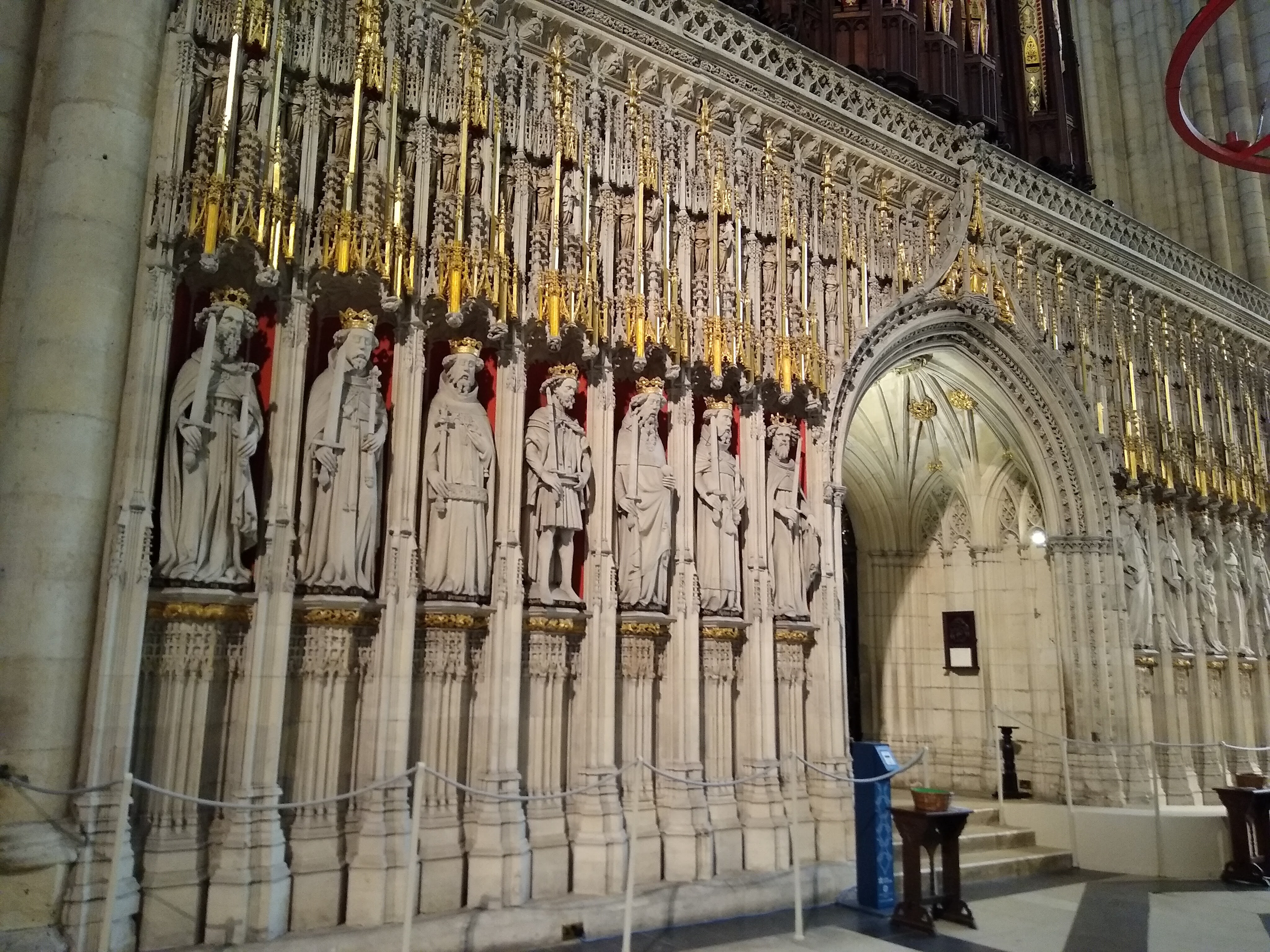
Number 1 on the agenda was the Minster. It’s £18 a ticket, which is a lot but your entry lasts you a year. There are free guided tours on offer but I decided to explore at my own pace. I take it clockwise from the west doors, heading initially to the transept, which contains a carved stone screen separating the nave from the choir. It has all the kings of England on it from William the Conqueror to Henry VI. I note the Shakespearean series from Richard II and scowl disapprovingly at the Edwards.

At the south end of the transept is the staggering (red) Rose Window, which survived a fire in the 80s, and before the choir is the octagonal chapterhouse.

The chapterhouse’s arresting geometry is reminiscent of the Basilica at Aachen. The sheer verticality and immensity of the space is astonishing. As one’s gaze is directed up and up you are rewarded at the full flexion of the neck with a view of the interwoven complexity of the central capstone, which is the focal point of each of the eight towering windows on every side. Every sill is fringed with dozens of carved gargoyles, each given a distinct personality with chisel and hammer seven centuries or so ago.

Mid-choir is the entrance to the crypt and the tomb of St William, patron of York. On the far wall, a mosaic proclaims, “Blessed are the peacemakers.”

Turning the southeastern corner, you come across the Cuthbert exhibition. The Cuthbert window is undergoing restoration currently, so in its place is the story of his life with accompanying illustrations in glass. A particularly amusing panel shows Cuthbert and a companion doing handstands. While the companion’s smock has fallen down to expose the undergarments, Cuthbert’s defies gravity to preserve his saintly dignity.

The museum in the undercroft tells of the city’s Roman past as an impregnable fortification. The present Minster is built on top of the remains of the fort, and there is evidence of reuse and upgrade in the visible architectural stages from Anglo-Saxon to Norman to English Gothic. Normans built with hollow columns filled with rubble whereas the later medieval Gothic style had solid columns that allowed visions to soar ever higher.

Outside the Minster, past the mason’s yard is a statue of the Roman Emperor, Constantine. He was proclaimed in York. As the first Emperor to convert to Christianity he made the slave religion the creed of the masters of the world.

By the time I had exited the cathedral, it was beginning to dim. Most sections of York’s walls were shut, but I did have time to explore the ruins of a medieval hospital in the grounds of a library before the light entirely faded.

Next on the agenda was the Shambles. To get there I had to walk through a Christmas market in full swing. Like Pilgrim, I was unmoved by the temptations of vanity fair. However, the Shambles’ quaintness did induce me to capitulate and I ended up getting a takeaway mulled wine from the mini pub on the street that supposedly inspired Diagon Alley.

At my accommodation for the night, they asked me if I was there for the snooker UK championship. Alas, no but I did watch another Trump victory before heading out for a solo pizzeria trip that brought my evening to a close. Not before Google Maps sent me along the aptly squelchy banks of the River Ouse to get there though.

Durham

Durham is built on what they call the “peninsula”. This is a strip of land almost completely enclosed by a hairpin bend of the River Wear. To reach this island from the train stations, you need to descend into the valley. What strikes you when you do are the weirs of the Wear. These are manmade steps assisting the river’s incremental descent and which salmon leap up in the autumn to spawn.

Crossing the Silver Street bridge you get your first full view of Durham Castle and Cathedral rising magnificently atop the crest of the valley and partially obscured by thick tree cover below. Nearly a thousand years of history have not detracted from the impression they leave on a mere mortal standing on the lowly cobbles beneath.

A fairly steep climb and you are at the top of Durham’s main market square. At first, you are confronted with the rear end of an equestrian statue – the image of Charles William Vane Stewart, an aristocrat of the first half of the 19th century who led a regiment of hussars against Napoleon and vigorously opposed trade unionism. The other statue in the square is, oddly enough, of Neptune – a monument to the abortive attempt to make Durham a seaport by re-engineering the Wear for the export of coal.

Onwards and upwards, though, to the summit of the hill and the main purpose of my visit – Durham Cathedral. This is truly a fortress of God. The power projection is self-evident. A building that compels a state of awe. A place of sanctuary for the outcast but also of dread for the unfortunate Covenanter POWs defeated at the Battle of Dunbar in 1650 by Oliver Cromwell’s New Model Army.

The great oak doors have at their centre a copper lion’s head. In its jaws is a ring with a handle for knocking on the timber, begging entry. If your calls for “sanctuary” are answered, so it is said, you had 37 days to make it to the nearest port and into permanent exile. Ecclesiastical jurisdiction provided a window of amnesty from the laws of the land.

A glass vestibule greets you, and in my case also a volunteer guide who informs me that entry is free although a donation is encouraged. Through the doors and staring down the nave there is a sense of vastness but also slightly discomfiting familiarity. The visionary masons who created this temple were the same as those who helped build up the great stone minster at Kirkwall to house the translated bones of St Magnus. Although the scale belongs almost to another order of magnitude, the similarities can be seen in the thick, round columns and Romanesque arches. Not squat exactly, but solid. Substance as well as ethereality. These two cathedrals have an earthiness, an of-the-earthiness which is perhaps lost in the dazzle of the spectacular York Minster.

I pay my museum entry, which includes a 10% discount for the café which is closed for refurbishment, and continue my tour, this time in an anticlockwise direction. I stop at the astronomical clock at the far end of the south transept and watch from the sidelines as a vicar of unknown standing in the Church of England hierarchy intones a midday prayer.  She is praying for the parliamentarians debating the Assisted Dying Bill today.

Before I really have the chance to come to terms with it, I am in the choir at the entrance to the feretory containing the earthly remains of St Cuthbert. I don’t rush in. There is a list of all the previous bishops on a board to consult first. One notable name is Thomas Wolsey, of Wolf Hall prominence, of which I’ve lately been enjoying the new series.

The south window opposite the feretory is a modern piece depicting the life and cult of St Cuthbert as well as paying tribute to the coal miners of Durham.

Inside the feretory, there is a pleasing lack of interpretation. It is an intimate space in unusual contrast to the vastness of its wider housing. Cuthbert lies below a great stone slab, simply inscribed with the word Cvthbertvs. I briefly stand over him and then take a seat on one of the surrounding wooden benches.

A strange series of events has brought me here. Immediately, the fantastic novel by Benjamin Myres, Cuddy. It begins with the saint’s death, moving to the monks who carried his casket the length and breadth of Northumbria for over a century, to the building of the cathedral, the imprisonment of the Covenanters, his disinterment in the 19th century to the present day.

Before the novel, Cuddy I walked the St Cuthbert’s Way which starts at Melrose Abbey and crosses the Scottish-English border from West to East, ending at Lindisfarne.

Ultimately, though, my relationship with Cuthbert began through my friend Charles Wright whom I met in student halls and stayed good friends with to graduation and beyond. In the early summer just before graduation Charles and his friend John embarked on the St Cuthbert’s Way. Always that bit more adventurous than me, he was camping along the route and eschewed hostels. I remember him telling me about the saint’s heroic feats of endurance. St Cuthbert would immerse himself in the ice-cold waters of the North Sea and pray for hours on end. He always sought greater isolation and more extreme tests of faith. Even windswept Lindisfarne was too tainted by worldly comforts for Cuthbert. He relocated to Inner Farne – an island off an island – to find the austerity he craved.

Charles passed away suddenly from a dormant heart condition on 7 April 2020. The national lockdown had been announced two weeks earlier.

Exiting the feretory, there is an entire window on the north side of the cathedral, finished in 2019, dedicated to Sara Pilkington, an art student who died from a cardiac condition in her final year of studies.

Posted in Life, Personal experience | Tagged , , , , , , , , , , , , , , , , , , , , | Leave a comment

The adders and slowworms of this morning’s breakfast table

Tuesday

Escape is my aim but my nostrils root me in greater Glasgow when two friends embark at Dalmuir harbouring a sharp scent of cannabis in the folds of their clothes, unfurling as they rise or shuffle in their seats.

Sooner than expected, though, the train leaves the conurbation behind, and we are in the autumnal Highlands. The full leafy spectrum is on display, from boldest crimson to chlorophyllissimo. Although delayed by 10 minutes, we reach Oban in time to catch the ferry. I bungee-strap my bike on the car deck and survey the crossing to Craignure in the mild mid-October open air.

Views from the train to Oban.

To be among the waves again is nourishing, although there really is minimal chop. The auburn-coloured canine is audibly perturbed and visibly agitated by the uneaten scotch egg in my backpack. I shift my position to minimise (his/her?) distress, although perhaps it is more torturous to be just beyond a lead’s breadth from a decent sniff? The dog is forbidden to eat while travelling, I’m informed. No snacks for Scooby this afternoon.

Listening to the Calmac announcements convinces me that there is at least partial truth in the factoid that the Highlanders, coming to English as a second language from the Gaelic, speak it in its purest form. My ear delights in how carefully each phoneme of the word “signal” is pronounced, alas to the detriment of any safety message being conveyed.

Aboard the MV Loch Frisa from Oban to Craignure.

Tobermory is 21 miles away. I aim to make it for 5pmish. It’s a comfortable start with (surprisingly, because there is a specific announcement just before disembarking regarding single-track roads) two lanes and gentle inclines until you reach the village of Salen (pronounced “sall-en” not “sail-en” like the witch trials). From then on, after a false sense of security afforded by the flat and winding shore of the seemingly endless Sound of Mull where several fishing boats have been inexplicably but picturesquely abandoned, you are driven up and down and up and down ad nauseum till one fantastic descent before the capital where it opens up to two lanes again and you can move to the lower grips of the handlebars for the full freewheeling thrill.

Hidden by hills hitherto in its natural harbour, Tobermory reveals itself with its unmistakable rainbow facades. My first encounter with Mull, not knowing it was Mull then, was with the town’s fictional alter-ego, Balamory. In a sense then, I had been here before and coming across Tobermory for the first time in the flesh was a recognition as much as a discovery. As for Mull itself, I first became conscious of it as a distinct entity on the BBC’s Autumnwatch where they memorably covered the rut of the stags (one seen from the window of a bus on Day 3) and the frolics of the otters (only glimpsed on road signs telling me to watch not to run one over).

Yet more steepness greets me as I get into the town proper. I wheel my steed up the last summit and ring the doorbell for the B&B which is to be my abode for the next three nights. My bike lodged safely in the back garden shed, I shower then make my way down to the main street to get my bearings and sustenance in the yellow of the primary coloured buildings featured most prominently on postcards of the harbourfront.

Wednesday

I choose to take my petit-dejeuner at 8.30 so as to dine with my fellow guests. This was requested off the back of my enriching encounter in Ferns with the motorcycling Dutch couple and the American solo traveller.

Retirees were to greet me once more. This time, Australians. They were on a three-week tour of the UK and Ireland and leaving the next morning for Skye by way of the Glenfinnan aqueduct to watch the Hogwarts Express puff across the valley. Their itinerary was to cover the North Coast 500. No time for Orkney regrettably as changing flights would have cost 1200 dollars. Perhaps next time?

The husband wasn’t a fan of personal injury lawyers or criminal defence. Commercial law, though, they’ll never stop needing that. I said that was the one area I didn’t want to go anywhere near. Cue a minute or so of awkward silence.

I said how I thought Mull was quite a big island – bigger than I’d anticipated; I would need to take a bus to get the boat to Iona tomorrow. Australia’s a big island, isn’t it?

This precipitated a long monologue about the vastness of Australia and, in particular, the pleasures and pitfalls of 4×4 desert driving in the outback.

When our host returned we got to talking about native and invasive species, snakes in Scotland and Mull’s anti-stoat campaign, whereas otters are seemingly beloved.

My first destination was Calgary Beach. The city in Alberta, Canada is named after here although there the locals pronounce it with two syllables instead of three according to Wikipedia.

It was a rainy start but luckily I had my waterproof trousers. I unnecessarily locked up my bike and rounded the bay watching waves transfer their energy, advancing left to right, traversing the extremities of my peripheral vision. Rippling and writhing like the adders and slowworms of this morning’s breakfast table before crashing, fizzing away to nonexistence, withdrawing stealthily and gathering strength for yet another assault.

I am reading Virginia Woolf’s The Waves and as I walk along the shoreline I think of her and the River Ouse, weighed down by stones to facilitate sinking. The lure of the embrace of the waves; freshwater for her, but the principle remains. My mind flicks back to a character in the Clayhanger novels by Arnold Bennett who attempts the same in Brighton. To be recommended – the novel, perhaps not the suicide method.

After Calgary, I was Ulva-bound, an island off Mull’s northwest coast. The road there wound up and up in multi-phased ascents, false summit after false summit. Several times I had to dismount and walk my bike up due to this demoralising progress; often my momentum was broken up by a car I had to let pass on the narrow track. The fruits of my labour were to be won, however, when I hit Dervaig and got to downhill gradients of 14 and 20%. I did have to exercise some restraint though because as well as rapid plummets were hairpin bends and blind corners – not that there is a huge amount of traffic in north Mull, but best to avoid head-on collisions if at all possible. Both brakes, front and rear required application.

Before Ulva, I came across the Eas Fors waterfalls. I threw my bike down on the grass and scrambled up to a better vantage point. An upper tier seemed accessible if all four limbs were set to the task and so I climbed. Mull seemed to be perpetually gushing from its hillsides but this series of cascades were its most vigorous and characterful, so well worth inadequately capturing on camera.

The place where you get the ferry to Ulva is imaginatively named Ulva Ferry – a subordinate entity, like Port Glasgow, I suppose. To get across you need to pay the ferryman £10 to board a craft that seems like it could have been created on Scrapheap Challenge. In fairness, there is no other way to reach Ulva if you don’t have your own boat, and it is a return.

I took my bike across but ditched it almost instantly as there are no roads, just gravel path and trodden track – a travel tip for Ulva. Most of the time on the island I spent on foot along the woodland trail – a welcome break from 2.5 hours cycling. I did not encounter a single resident, just wandering livestock and an abandoned tractor in the middle of the forest. After having got mildly lost for a few minutes, I regained the woodland path after a worthwhile coastal detour.

Arriving at the pier, the ferryman was on the mainland side. Finally, I did meet two locals, one astride a quad bike. I remarked that she was unlikely to be boarding the HMS Scrapheap Challenge on an ATV. They were heading to Gometra whose name seemed to me to be more suited to a dying star than an island accessible via a tidal causeway off the west coast of Ulva.

Sheep herds by the dozen (the population of Ulva is 11 according to Wikipedia)

Back on the mainland, I had 20 or so miles to go to complete my circuit of north Mull and regain Tobermory. After my chip shop tea, I settled down for an earlyish night before tomorrow’s 7am start involving a bus to Fionnphort and from there the ferry to Iona. My other option, due to Mull’s vastness, would be over 100 miles of cycling in a single day, which was not an appealing prospect.

Thursday

Bus 2 of 2 was driven by a chipper Edinburgh man easy to laughter and attempting to bring everyone into the joke with moderate to good success. A lady of about 60 in a silver jacket approaches. “Oh no,” he says, “She’s already complained, she might take a bit of talking down.”

The subject of her complaint was that they had recently merged the service bus and the tourist bus to the detriment of the residents. Today it was hard not to see her point as they had held the bus back to suit the visitors arriving from the delayed ferry who’d paid for Staffa and Iona tours rather than sticking to the schedule which would have allowed her to keep her appointment in Fionnphort. Annoying too for her to hear the running commentary of the driver for the benefit of the visitors when she just wanted to get from A to B. It was to our benefit though, and helped contextualise the landscape, giving colour and interest to territory seemingly untouched bar the incursion of this snaking single track.

Almost as soon as we stepped on the ferry at Fionnphort a disembodied voice announced, “We will shortly be arriving at our destination. Could all vehicle drivers please proceed to the car deck for disembarking.”

The boat is packed and no one wastes time after the first step on terra firma in marching up through the villages and following the unmissable sign – “To the Abbey and [somewhat apologetically] Nunnery”.

It is the latter of the two that one first comes across. These are true ruins, left as such, whereas the abbey itself is a working building used by the Iona religious community, reinforcing and updating the medieval fabric where necessary to keep it watertight and liveable in the modern era. The nunnery, in comparison, though is relatively new and was founded in around 1200. With its remote location, it has been well preserved, although no nuns have been here since the reformation. You can still sit on the cold stone benches of the chapterhouse and contemplate the austere life of those daughters of the aristocracy sent here in pursuit of prestige and the favour of God.

At the Historic Environment Scotland ticket office, I revealed myself to be a former member of staff and managed to negotiate a concession entry fee. In a similar manner to Skara Brae on the path leading up to the abbey you are encouraged to acknowledge the significance of the journey you are about to make as you put yourself in the shoes of countless pilgrims of yore coming to venerate the seat of St Columba, missionary in the kingdom of Dal Riata, converting the northern Picts and bringing Christianity to Scotland before it knew to call itself by that name.

A little in front of the abbey stands a small hill which the audio guide invites you to climb. Here once stood Columba’s writing hut where he penned hymns and correspondence from the spiritual centre of the British Isles.

The view from St Columba’s writing cell. In the centre is St Martin’s Cross and closer to the Abbey is the replica of St John’s Cross where it originally stood.

On the approach to the abbey, you are struck by the presence of two great stone crosses with elaborately carved biblical scenes and Celtic knot designs. In addition to the simple crucifix is the interposed ring creating four gaps between the beams. From these were hung wreaths and other adornments on liturgical feast days. The furthest from the abbey is the more striking, standing in isolation on the same spot it did during the middle of the 8th century when it was erected. It is dedicated to St Martin of Tours. The other cross, which stands in the shelter of the abbey courtyard is a modern reconstruction of St John’s Cross – the original is on display in pieces in the museum. It is astonishing to think that before Iona there is no record of crosses with interposed rings. The Celtic crucifix was yet to take its place in Christian iconography. This is where it all began.

Should you visit Mull and if so, how?

In sum, I would thoroughly recommend a couple of days trip to Mull for anyone in proximity to the West of Scotland. If you are comfortable with or at least undaunted by a lot of hills then take a bike, otherwise, a car is necessary to see all the sights, although you can get away with the ferry and bus if Iona/Staffa is the extent of your ambition. As the tourist campaign literature says, “a day is not enough” but two days is probably just about sufficient!

Posted in Life, Personal experience | Tagged , , , , , , , , , , , , , , , , , , , , , , , , , , | Leave a comment