Blog zum Semesterende

Do you know when an interior seems to suggest a certain lifestyle? Well here it’s in full effect and by here I mean this interim address post-student halls in Leipzig. I’ve found myself drinking herbal tea, reading niche German books and sketching in my notepad. This reminds me of Rousseau, indirectly accessed through Goethe’s Werther, who said that drawing (alongside dancing) was one of the first stages on the road from savage to civilised man. There seems an air of getting back to nature about this place, surrounded as I am by copious greenery and crucially, deprived of wi-fi. Perhaps it’s the oxygenation fuelling this creative outburst.

Yes, I’ve finished my exams and seem to have passed them all; some better than others. Germany seems to follow in the humanist tradition by continuing to value rhetoric as key component of education. What I mean is that four of six exams have been orally assessed, be it one-to-one or in the form of a class presentation. Most, the one’s that were focussed around a presentation with follow-up questions went reasonably well; the one that didn’t was in the form of a “conversation” with no specified subtopic within the seminar. I enjoyed the three because there was agency regarding what one could research; they were carried out more on the basis of “present your findings” rather than “I am the expert and I will interrogate”. Anyway, I’m glad to have done not too badly because I respect the academics here and didn’t want to let them down.

The day after I finished my final exam my “friend who shares the same name as me and whose surname rhymes with Lord Voldemort* but without the peerage and the ‘of death’” arrived off the Flixbus from Dresden for a couple of days. From the ZOB we headed up the street to an ice cream café, where we ordered a couple of iced coffees. He’d been visiting a friend in the Saxon capital.

It was quite the trek to pick up an air mattress from a friend of the friend. In fact, we walked a lot over those three days. Perhaps it would have been better to scoot around on bikes; we might have seen more then.

On the way to the student halls we met someone from my history seminar. Quite coincidentally he was reading Amy Liptrott’s The Outrun (a powerful memoir from the perspective of a once RSPB Ranger on Papa Westray, one of Orkney’s smaller islands, that swaps between Orcadian and London life). I’m happy that I was able to demonstrate that I knew at least one person in the whole city during the visit.

We headed back into town and I was generously treated to meal by my guest before we ventured out to Connewitz to see the punk band Metz. It must be said that their set consisted more of noise than music; Thee Oh Sees, who I’d seen the previous week got the balance right, whereas what we witnessed was like the most aggressive Nirvana B-Sides fed through serrated, blown-out speakers to the point where the “songs” constituent parts become indistinguishable. During one track, the evidence of my eyes was telling me drumming was taking place, however my ears did not agree. We retreated to a safe distance and the residual tinnitus had gone by the next morning.

Packing up lasted into the afternoon. We then returned the borrowed crockery and donated surplus uni books to Oxfam.

With that behind us we strode down to the Thomaskirche and Bach Museum, which had a special exhibition on that featured an authentic, working clavichord from the era which members of the public could actually play themselves. The instrument was very delicate and the sound rather timid, but the fun of it was more the beautiful design, the exposed mechanism of the plucked strings and the chance to play the composer’s music through the original medium it would have been performed on. Much better, it must be said, than the sampler keyboard at Hamburg’s Museum für Kunst und Gewerbe, which wasn’t even working when I took my family there in December – 18 century technology seems much more reliable.

Leipzig was showing her most attractive side that day. We were being constantly followed by woodwind trios, a string and tuba quartet and people playing lutes and lyres.

Sunshine streamed onto the courtyard cobbles outside the Thomaskirche. Ice cream was briefly contemplated, decided upon and polished off respectfully in the square.

We entered the body of the kirk where Bach worked as choirmaster for over 20 years up until his death. There was a Catholic communion going on, so we had to sit patiently on the pew before an epic organ recital concluded the ceremony.

Then it was up to the front to contemplate Bach’s grave.

The bronze slab on the floor was surrounded by fresh flowers, and by tourists, several of whom were taking selfies.

We no longer live in the age of the graveside eulogy, the contemplative lament on mortality, the man and his works; yet everyone has a phone with a front camera, so I guess that’s progress.

After Bach we visit the piano shop am Markt and sample everything before sheepishly admitting we aren’t there to buy. We try some vegan currywurst and sit down to drink a beer at the foot of a fountain opposite Goedlerring. The successful day ends in a sushi restaurant on Karl-Liebknecht Strasse (the Karli).

I had to move out of my flat early on Friday morning due to the janitor’s working hours. This being sorted out we enjoyed a light breakfast outside a bakery on a street corner in Lindenau. I checked into an Airbnb and we ascended the many, many steps of the Völkerschlachtdenkmal (Memorial to the Battle of Nations); as my friend observed, completing a symmetrical narrative arc from my visit during the first week upon arrival in Leipzig to this repeat performance in the last.

Posted in Life, Personal experience | Tagged , , , , , , , , | Leave a comment

MTV Cribs: Goethe

The extent to which I’ve read into Goethe’s oeuvre is really quite limited. I’ve covered about as much as an average German school pupil can be expected to in the course of their education; the early poems – Prometheus, Willkommen und Abschied, Ganymede etc. Through the uni seminar I’m attending I’ve also looked through Götz von Berlichingen, Clavigo and Stella, and of course the quintessential Romantic epistolary novel –Die Leiden des jungen Werther.

Faust, of the big titles, remains unopened. Apparently some of the settings are inspired by Goethe’s time in Leipzig as a law student; especially Auerbach’s Keller – a Bierhall and restaurant in the historic centre.

Goethe only spent a few of his formative years in Leipzig though. Most of his life he resided in Weimar -a town of huge cultural and historical significance for Germany in which, during the late 18th century, he, Schiller, Wieland and Herder congregated and shared ideas under the patronage of the proto-enlightened absolutist, Karl August, grand duke of Saxon-Weimar-Eisenach. Of course, Weimar also gives its name to the Weimar Republic – the liberal democracy in place in Germany from 1918 to 1933. During the Nazi dictatorship, Buchenwald concentration camp was situated in the outskirts.

The works that I’ve listed above don’t really belong to the artistic movement most strongly associated with the town – Weimar Classicism. After a period criticising French playwrights for sticking too closely to the dramatic rules laid down by the ancient Greeks and French architecture for being more imitation than innovation (instead holding up Shakespeare and the Gothic style as exemplary), Goethe went on a trip to Italy and began a lifelong obsession with antiquity. Each of these artistic ideologies can be evidenced in Weimar. There is a statue of Shakespeare in the Park an der Ilm, which is designed in an “English” style i.e. asymmetrically, as opposed to the French, and built around nature rather than in opposition; the town hall is a beautiful neogothic building which was constructed some years after Goethe’s death. Behind the Shakespeare statue is, however, evidence of a taste for the ancient – the ruins which serve as a backdrop are actually artificial, the stone taken from a burnt-down castle and reconfigured to give the appearance of a grand, mystical heritage. Most of the buildings in Weimar are very rectangular, elegant and mathematical, but there are some striking examples of architectural clashes, such as in the market square and surrounding area…


That said, there is a significant overlap and interplay between these styles and ideas – rather than exact opposites, they represent antithetical ideologies which can practically combine and feed into each other.

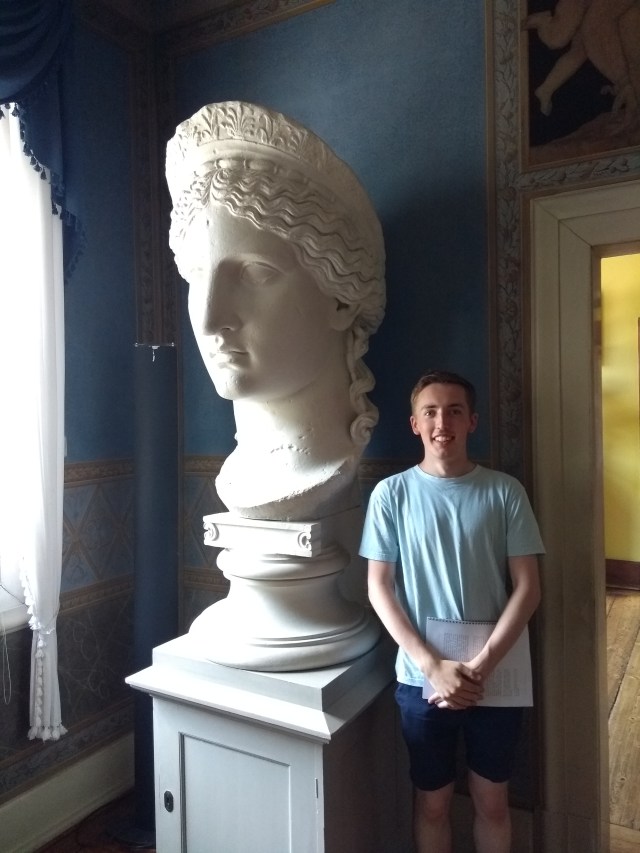
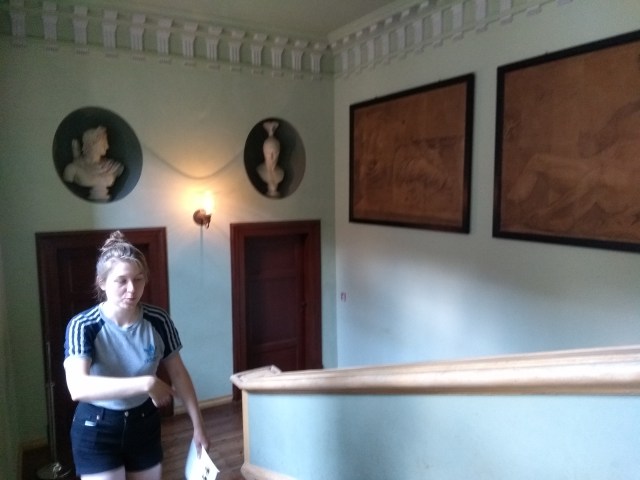
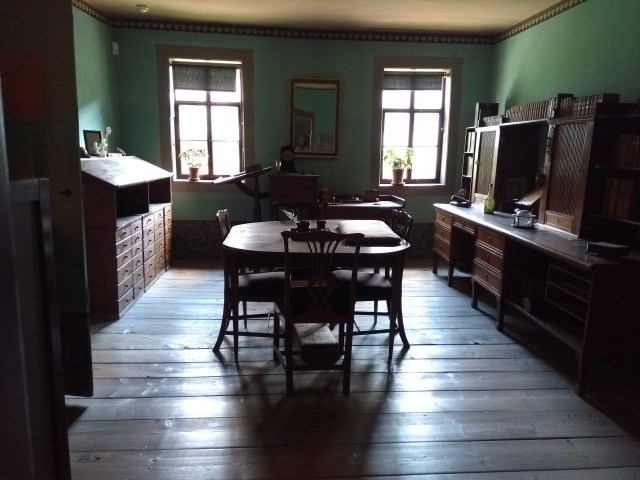
The most obvious manifestation of Goethe’s admiration for the classical world in Weimar is to be found inside his town house, which now exists adjacent to a museum of any and all aspects of the poet’s life. He amassed a considerable number of statues and busts in the renaissance style.IMG_20180609_151736059All the rooms are accessible, and there is barely a barrier in sight; that is, with the exception of the writing room, which cannot be entered, only viewed from the doorway.IMG_20180609_152712066
What I got from the day was not really an impression of the literary man Goethe, but rather the practical one, who exercised minute control over his life – designing his own staircase, for example, in the pre-lift age to require minimum strain to ascend (the steps are really long and shallow). I discovered Goethe the scientist who was not content with a mere “poetic” understanding of the world, who sought to further “natural philosophy” and who published several theories on colour, geology, botany and biology. Finally, I came to understand more about Goethe the politician, who in service to Duke Karl August became the equivalent of the prime minister, was in charge of fortifications and the university of Jena and got the aristocratic “von” added to his name in 1782.

IMG_20180609_145428292A full day walking around Weimar and trying to get my head around at least some of the culture that seems to radiate off every façade, statue and sculpture has left me conflicted about the figure who seemed so comfortably to inhabit the role of Germany’s national poet.
On the one hand, Goethe, the person, embodies many of the qualities I would admire in my idea of an artist. He did not, like some of the Romantics who came after try to set himself apart from the world and assume the position of the apolitical observer. In his work for the duke, he participated in and attempted to change the material world. He also saw no dichotomy between art and science, or at least believed that the two could and should feed into one another. This is an idea that ought to be more valued and promoted today in the face of Humanities and Sciences contemporary mutual disdain for the other group.

Despite this, Goethe seems to have allied himself with the aristocracy very closely in an age where the feudal system was far from uncontentious. This must have stifled him intellectually and prevented him from making a critique even if he privately wanted to. An example I found in the museum of this was when young students started convening in secret committees in order to sort out personal feuds non-violently i.e. without duelling. As a politician, Goethe condemned this more democratic method of settling disputes, but from his letters we can see he supported it. The Weimar group were also highly critical of the French Revolution, with Goethe opposing it even before the Terror, whereas Schiller expressed optimism up until this point.

It is in this capacity that I cannot help but compare him with our national poet, Burns. Whatever one might think about his longstanding kitschification, Burns as a figure is far easier for me to accept than the German. For me, you’re already fighting an uphill battle in terms of credibility if you are born into wealth, as Goethe was. He could have addressed this. Perhaps shunned honours and carved his own path, but instead he was happy to accept patronage and position and to furnish his house with ostentatious sculpture and paintings.

By contrast, Burns was born into a relatively poor farming family and when invited into aristocratic circles, declined opportunities for self-glorification. He tackled the inequalities of feudalism directly and championed democracy. Burns also supported the Revolution, which upset the noble connections he had made following the publication of his first volume.

I’ve also considered the Shakespeare comparison, with whom he’s more often measured against. Goethe has the significant disadvantage that we know so much more for definite about his life. Shakespeare can be all things to all because he is predominantly speaking through characters, there are no diaries and little information about his personal life that might shed light on his political allegiances. Perhaps though, it is unfair to judge the artist more than the art. In Goethe’s case, however, and particularly in the journals and poetry, the two are so closely linked that it becomes difficult to do so.

Posted in Life, Personal experience | Tagged , , , , , , , , , | Leave a comment

Erfurt excursion – Berlin briefly – Leipzig living

I began writing this in transit on the way to the capital having missed the Flixbus and worked up quite a sweat in the process at the tail end of a week of consistently 20-degree weather. The switch to Deutsche Bahn was pricey (adequate punishment for not knowing the location of bus station with enough exactitude) but at least this puts pressure off my rather tight arrival time. I’m actually getting there earlier and alighting right at the rendezvous rather than having to faff around with the U-Bahn. Squinting to read the signage I see the train is bound for Hamburg, Altona – a throwback I wouldn’t have experienced had I taken the road as originally intended.

The day previous I’d visited another capital, this time of the federal state of Thüringen as part of a trip laid on for international students at Leipzig. Passing swathes of verdant East German countryside, the train came fleetingly to berth in Weimar – exciting in itself without even getting off – I must go there properly someday.

We arrived in yet another Willy Brandt Platz. There seems to be a surprising abundance of these in the former GDR for his being a Chancellor of West Germany from Lübeck. More bizarre still is a building housing a Sparkasse and café opposite the shopping centre displaying a sign in large white letters, which reads “Willy Brandt ans Fenster”. We are told that this used to be a hotel where a conference was held in 1970 between East and West. Citizens gathered in the square below to address Brandt directly. Their concerns were heard, so goes the popular version of the events, and this led to greater communication between families divided by the iron curtain.

The tour goes on. A more ideal day is inconceivable. We’re doused in sun, ice cream parlours are trading to capacity and beyond, brass bells of sousaphone and cornet throw glinting flashes into screwed-up eyes. I ask a French medical student (Geigespielerin) how her rehearsal for the uni orchestra went – a sheepish reply to the effect of “unsuccessfully” is followed by an awkward verbal blankness.

We’re wrapped in shade as the seconds tick slowly by, passing through a snaking close. As we turn around the final bend we erupt into light, revealing a gorgeous sandstone church – its roof endearingly askew. Out of the silence, a thought is forming simultaneously in two minds.

Rays beyellow beige stonework. The place is bustling with cafes whose territory is sprawling naturally outwards across the cobbles, separate establishments indistinct and these mutual encroachments unnoticed in this joy of an April day. Chatter swirls up and rebounds off terracotta tiles. Glasses are clinked under the shade of ample greenery beside opportunistically erected market stalls selling ceramics and other useless trinkets.

It’s a scene from le pays de la mére, the south specifically, although accordionless.

We climb to the summit of the highest hill. Atop it sits a fort built after the Thirty Years War (which I somehow appear to be studying at the moment) – completed in the 1660s, I ascertain from our tour guide, and constructed against the fear of Lutherans as a catholic island in a protestant sea belonging to the archbishop of Mainz (one of the seven electors of the Holy Roman Emperor). Below someone is strangling the bagpipes and, of course, as token Scot I’m asked to comment.

At the foot of the castle is Erfurt’s cathedral which houses some interesting sculpture and tapestries as well as the usual stained-glass windows and altarpieces.

After our quick dose of religion, it was time to head to the beer garden. Sitting there, stein in hand, soaking up the sun at a great long table surrounded by students all doing the same was really the picture I had in mind when I imagined my “Year Abroad in Germany”.

The idyllic situation could not last perpetually and the group split off to explore again after an hour or so. We stopped at a church where one of our number went to fill up his water bottle at a fountain just outside. Although there was no “kein Trinkwasser” sign to be found, the general consensus was that it looked a bit dodgy. Anyway, the detour gave me the chance to notice that there was a picture of a moustachioed figure carved into the plinth with the caption “Gustav Adolf” written underneath. Hmm, I thought, then cast my gaze above eye level. Ah, the cherry on top – a lion’s head. What’s a fountain dedicated to a Swedish king doing around here? Thirty Years War again – Der Löwe aus dem Norden – Gustavus Adolphus protected the Holy Roman Empire’s protestants from persecution in the mid-17th century.IMG_20180421_153120425

I began telling this story on the train to Berlin. It seems I’ve omitted the purpose of that journey and launched into another one.

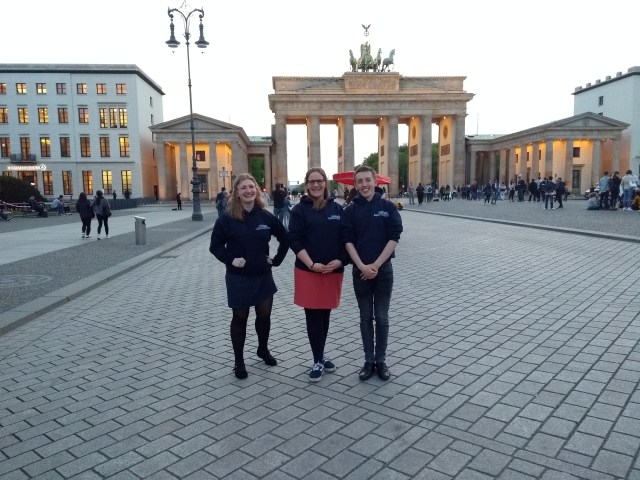
Well, I was travelling to Berlin to attend the first event of a Scottish-German Connection event, coinciding with the opening of a Scottish Hub at the British embassy. We were gathered to collect ideas for a joint project between “young people” in the two countries/learn from each other in how to engage the youth in intercultural understanding. As you may infer from that rather vague sentence, there was quite a high buzzword density to wade through to arrive at some substance. Anyhow, it was good to be back in Berlin properly – the last time I’d been through was for a Mac Demarco concert. It was cool to be inside the British Embassy, meet some new people and get the chance to reunite with my UK-German Connection partner, Sina as well as Jule, who I also met in November.IMG_20180423_202111344

I’m loving being a student again. My courses range from Game of Thrones (name of the Thirty Years War seminar) to Goethe and literature of the GDR to linguistics of proto-Indo-Germanic. I’m pretty well settled in, but I’d like to push myself to get involved in more aspects of student life here outside of academic stuff. Next time I write I’ll have consigned our Plattdeutsch/Orcadian project to the past, with the evaluation seminar coming up soon, and I’ll probably be working quite intensely, having taken on quite a lot of credits out of interest. It seems that I have fewer contact hours in this semester abroad, but that I’m doing more courses, each with their own assessments, so it does add up. It’s hard, but not psychologically challenging like my teaching placement in Hamburg! Reading, research and time dedicated to both is really all I need to do well here. However, I want to do more than that, although part of me would be content with this alone. Tune in for the next update to find out if I succeed in this rather nebulous aim.

Posted in Life, Personal experience | Tagged , , , , , , , , | Leave a comment

German & the Neutral Language?

Since I last committed pen to paper with the intention of publishing a blog nearly a whole month of me living in the city of Leipzig has passed. Tomorrow my first lectures and seminars begin after what I have to say has been quite an extended settling-in period.

As mentioned in the previous post, my first three weeks were spent taking part in a language and orientation course during which some events were organised to facilitate us getting our bearings and experiencing some of the culture, alongside there being suggestions almost every night for possible evening’s entertainment. Of the former the Leipziger Buchmesse, which was a huge event for literature of all kinds including a mini comic-con for manga (fun fact: Leipzig is home to the largest goth gathering in Europe) and at which there were several panel discussions going on being filmed for various TV networks, and the opening and closing buffets were the highlights. The first was held in the Moritzbastei semi-subterranean student union, constructed as a fortification in the 16th century, partially destroyed in the Second World War and then reclaimed by students, among them Angela Merkel, in the 1970s.

For the evening activities my favourite would have to be the “Wir feiern Bach” concert at the Kunstkraftwerk in Plagwitz in honour of the composer’s 333rd birthday. The venue was this converted industrial warehouse lit variously in pink blue and green, with a massive winch descending from the ceiling and an iron staircase running up one wall to a lonely door at first-floor level – this was utilised in a call-and-response oboe piece from alternating between atop the steps and amongst the groundlings. We were placed right at the back and simultaneously had front row seats; the performances happened in all corners of the room and these included barber shop quartets, experimental jazz guitar and a local celebrity busker with a 10-euro flute (sounds horrific – it was, and made more so by his wearing of ear defenders to play a full three movement concerto!) as well as the expected choral and classical instrument ensembles. My only criticism would be the three-hour duration without an interval. Nevertheless, it was excellent value for money.

I’ll admit the introductory course really held your hand through the setting-up process of studying at German university and specifically Leipzig, but I think it has eased my anxieties about what tomorrow will bring to some degree. So far, I can say that I like the city’s vibe and, from what I’ve seen, the university culture seems pretty cool. Getting the vulgar out of the way; it’s much cheaper than Hamburg and Edinburgh, especially rent. People are quite relaxed and the Innenstadt has some beautiful public architecture; the library in particular is utterly gorgeous with its marble interior, abundant natural light and self-regulating blinds (which are admittedly unnerving the first time you notice them scroll up unprovoked). Around midday the Mensa opens for two hours and you can get a lot of food for very little money using your student ID as cashless payment – it’s highly efficient and very convenient as a system and makes me kind of despair that there’s not that culture among UK universities. To be frank, the food is far from gourmet, but it suffices and there are always plenty of options.

Ok, so you’re waxing lyrical about infrastructure; I think that’s really best left to concept albums from Kraftwerk and Public Service Broadcasting don’t you? What about the people you’ve met?

Ah yes, you might be surprised to hear that I have actually bumped into a few of those during the past month. Not always very good about talking about other people in this blog, it’s all a bit introspective as a literature student might say (wait what?)

Flatmates might be a good place to start. To save myself the trauma of going on the Wohnungssuche again, I reserved a place in a Studentenwohnheim – basically halls. This form of accommodation is actually pretty unpopular for German students, so their now being filled up with college students and people doing their Abitur (secondary school leaving qualification) – this applies to my two Mitbewohner who are from Uzbekistan and Syria respectively, the latter being a refugee of Palestinian heritage. They are both very friendly and helped me get my internet set up when I first moved in. I’ve also now got 5000 Uzbekistani som in my possession (traded at the extortionate rate of one pound sterling).

Yes, and then there are the Erasmus, or more accurately international, students as of yet existing in our own microcosm of blind leading blind, but this week released into the real world of Universität Leipzig. Italians make up the largest constituent of the group and there are quite a lot from China, add to this Korea, Denmark, Norway, the Netherlands, USA, France, South Africa, Brazil, Portugal for a flavour of some of the other nationalities, oh and there is a surprisingly large Manchester contingent.

Since moving here I’ve reassessed my relationship with the English language. Although I’m using German as an Alltagssprache of day-to-day business, we speak it in our flat even though none is a native speaker, I employ it when talking to other Erasmus students whose English isn’t as strong as an equaliser and of course in the presence of actual Germans, English does seem to be the default international language. On the one hand that’s incredibly practical and allows you to be the truest version of yourself in social situations, barring complex phraseology (from my time as a teaching assistant I’ve become more used to simplifying and repeating what I say in different words) and using too much of a regional inflection – which I suppose is a kind of betrayal but worth it to be understood, and after all, standard English is also my native language. It’s just sometimes I’m in a group of say six people and I look around and account for all the nationalities/languages and wonder why it should be that although only one or two of us are English native speakers, the conversation is in English. It seems unfair that this should be the case; my advantage is undeserved.

I’m grateful for having grown up where I did because it makes travel and contact with other nationalities incredibly easy, but I’ll also never have the experience of having to employ the dominant international language abroad as a lingua franca.

The effect here is kind of a neutralising one that makes English seem like a base-level language after David Hume (writing as a thoroughly Anglicised Scotsman during the Enlightenment) “the ENGLISH, of any people in the universe, have the least of a national character.” This is obviously not the case, but one can’t help but feel that in these situations. Another effect of English spoken as a language in common is that it feels as if everyone is sort of playing diluted, watered-down versions of themselves on this level playing field and I have this inherent upper hand. It makes English feel rather soulless and not the language of true feeling if that makes any sense at all.

At the beginning of this year I watched a German film called Toni Erdmann which I think sums up this idea quite well. The German class I’d been working with were going to be analysing this in school; something I think was a strange choice considering the film’s exceedingly bleak or very darkly comic tone, extended “love” (more accurately loveless) scene which culminates in the consumption of a semen-smeared cupcake and the film’s climactic final scenes hinging upon extensive nudity as a crucial plot point. This was not the choice of the school, I hasten to add, but the Hamburg education authority; the scenes were going to be cut but I don’t see how they could properly assess the piece without them – needless to say I changed by timetable (but not just because of that).

Anyway, the basic premise of the film is that a 60-something German’s 30-something daughter never has time to se him because she’s working for this multinational company in Romania which completely absorbs her and deals with most of its customers in English. In order to get back into the daughter’s life, her father poses as a client, Toni Erdmann – forcing her to interact with him in a business capacity.

Here the English language is presented in terms of the globalising, depersonalised and disingenuous means of communication. The interests of the Romanians are shoved aside and the daughter flatters and accommodates her business connections’ every whim in flawless English, whilst her British assistant helps arrange her professional life in noticeably fumbling German. It’s a fascinating multilingual film that is far from an easy watch but that really puts language into the spotlight as well as being a critique of global capitalism. Silence also plays a significant role with restrained use of soundtrack and minimal dialogue in the final scenes. German speakers will get more out of it, but I would thoroughly recommend regardless.

I realise this stirs up more questions than answers, but that’s what I’ve been thinking about lately! It’s probably too late for Esperanto and gone are the days of Latin as a neutral language (these are both very Eurocentric suggestions anyway). I’m not sure what the solution is, maybe there’s not even much of a problem. In any case I think it’s an interesting issue.

Posted in Life, Personal experience | Tagged , , , , , , | 1 Comment

Disgorging suspended cargo

Perhaps it begins rightly on a frozen Tuesday morning.

Bikeless, following the previous day’s abandonment to nature of my, on balance, trusty-enough hot pink-saddled steed in central Hamburg after failing to sell it to anybody, I board my usual number 14 HVV bus from Fleestedt, hoping to make it to Sinstorfer Kirchweg where I can pick up the 345 directly to Am Pavillon. Alas, the fates would not allow and I was trapped in an anxious crawl as the truth dawned incrementally that I’d be late on my penultimate day at IKG.

The last thing I wanted to do was phone the school. It would be an admission of defeat. Needlessly narrowing the possibility of a just-in-time appearance. Eventually I caved and broke the news of my tardy arrival. The receptionist of boundless pathos and empathy who took my call was one of two members of staff who gave me the warmest of hugs last Wednesday.

Luckily, I was only meant to be delivering one half of the lesson myself – I’d picked the 1935 Dylan Thomas poem, The hand that signed the paper – so it wasn’t a total disaster.

This paper theme continued in my last art lesson, where I struggled with origami. I then said goodbye to my 9. Klasse, who thanked me and asked me to say “frrrequent” again.

That night my mentor met me at the Ratsherrn brewery, Altes Mädchen on my suggestion.

Compensating for that morning’s mishap I arrived punctually. The place was heaving. No seats in sight. Massive. Noisy. I wanted to escape. But no. Stay with it, she’ll come soon. Breathe.

We sat at the bar. On my own I’d rather not. On my own I wouldn’t go to a bar. Well, at least not just to drink. If a band was on…

We talked of Leipzig, life, art and careers. There was something maybe a bit high stakes about the conversation; both of us knowing it would likely be the last real “chat”. Yet that catalysed as well as impeded and it probably stayed just those vital few steps back from the threshold of “oversharing”.

I’d liked to have talked longer, liked to have drunk more, but once again, and as I said previously, my time was cut off by reason of my relatively remote abode.

The Fleestedt running busses reduced in number through the week approaching midnight; my 14 stopped at Rustweg, two stops prior to the aforementioned. This made for a late-night couple of kilometres dash across snow-covered pavement to reach my flat, where I had to pack for tomorrow because I’d had to wait over an hour in the queue at the Bürgeramt to deregister that afternoon.

The next morning a deeply demoralising trudge to school where I had to lug my stuffed suitcase over a good layer of snow between bus stops ensued. I had my final meeting with the head teacher, who told me that the Leipzig dialect was “eine Katastrophe”, and then after distributing various gifts and having several heart-warming goodbye conversations I received a wee package myself – two books of German poetry (thanks guys).

As much as I enjoyed Hamburg, I was eager to get away. Perhaps if I had nicer accommodation or friendlier flatmates (i.e. ones who were willing to go beyond surface pleasantries) I would have stayed a couple of days longer. However, as it stood I had booked to leave that same afternoon on the Deutsche Bahn to Copenhagen.

Against the odds, I made it to Harburg on time but, perhaps predictably, my first connecting train was delayed, meaning I missed the most important one. Luckily the self-loathing part of my brain that was cursing me for being such an idiot also plays the role of the negative motivator of the practical part of my brain that wants to prove it wrong. So I set out for the ZOB (Zentraler Omnibusbahnhof) determined to make the 1530 Flixbus, which I was relieved to discover had a very similar journey time to the train.

After anxiously waiting in a slowly moving queue, I was finally taken at quarter past and following an embarrassing regurgitation of the contents of my rucksack to find the necessary passport, I held in my possession the all-important ticket.

Ah, I thought, “erwartet 1545”, as I read the display screen, at least I’ve got a bit of time to compose myself now before it arrives. 1600. 1615. 1630. Oh my god. 1645.

Finally all the cases are bundled on. I’m seated next to a guy from Kosovo whose headphones seem to let more sound out than actually reaches his ears (luckily his phone did eventually run out of charge). A very Danish-looking Dane who says he’s already been travelling for over 50 hours now from south America is doubtful we’ll make the ferry because of the delay. An older guy in the seat in front who’s from New Zealand, travelling through the old, tries to put things into perspective citing his 24-hour trip time over to Europe from the Antipodes. Great. And it’s minus seven with blizzards ahead.

Yet the common cause and the confinement bound us and after a scrupulous and lengthy border check, where one of our number, a German-speaking Syrian refugee on his way to pick up papers, and two others were detained by Danish police, we finally made it to Copenhagen at about 10.30pm.

Immediately I notice the difference on the local transport. The bus is pristinely clean after HVV’s gritty filth, its boarding system is very liberal after Hamburg’s strict etiquette and the journeys are all clocked electronically using chip cards tapped against glowing blue terminals throughout instead of the cursorily flashed paper passes of the Hansestadt. This check-in/check-out system is used across the whole country; both busses and trains.

I’ve gone Airbnb after vowing not to put myself through youth hostels again unnecessarily. Despite my more-than-two-hours delay, my host is exceedingly welcoming and gives me a plate of stew absolutely free!

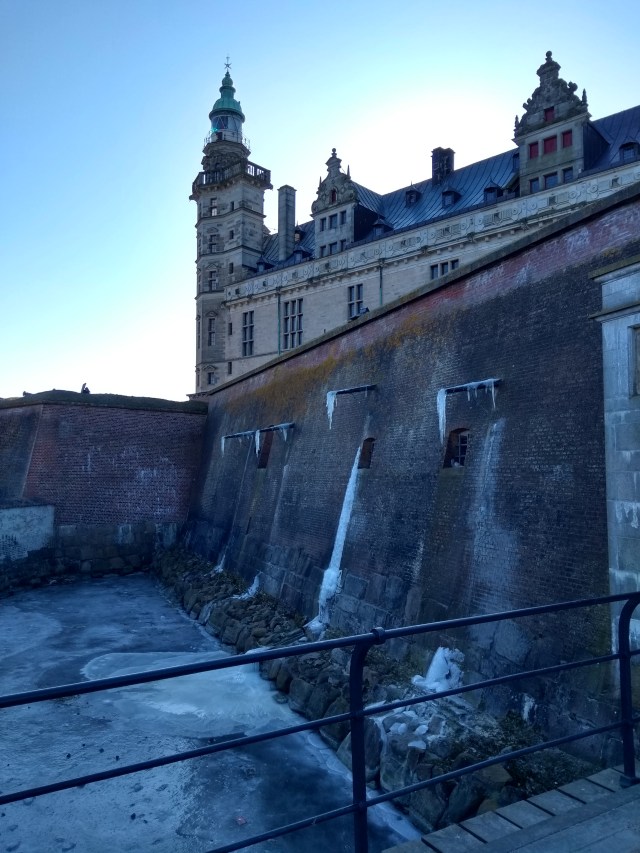
I travel to Helsingør, or as readers of Hamlet might know it, Elsinore the next morning. Punishing temperatures persist. As the train pulls in the moat of Kronborg castle is frozen solid; gushing fountains disgorge a suspended cargo onto hard sheet surfaces. There are chunks of ice in the sea and boats are lodged into place. This all adds to the brutal isolation of the fortress where the action of Shakespeare’s Prince of Denmark takes place. One can just imagine the claustrophobic intensity of living in such an outwardly austere encampment.IMG_20180301_104025662_HDR

To wrap up this blog post, which I feel is necessity because things are now moving quickly in my life, I saw some Viking longships in Roskilde, explored Copenhagen (its royal residencies and anarchist communes) and took a hop across the Øresund bridge to Sweden for a day. I then flew to Orkney for a brief visit where I met the Orcadian participants in the project I set up with my school in Hamburg and spent an afternoon in Egilsay, the site of St Magnus’s martyrdom. I sit typing this in Leipzig, where I arrived yesterday, after a balmy day of exploration. On Monday I start an orientation and language course before I begin my studies fully in April.

Posted in Life, Personal experience | Tagged , , , , , , , , , | Leave a comment

Auf Wiedersehen, Herr Flett

Ah, Sunday. A fine day for reflection and calm, quiet contemplation. In Germany a brief respite from consumerism (also perhaps an inconvenience). Additionally, and purely coincidentally, you understand, optimal for the garnering of likes as the weekend’s accomplishments tie together and the anxious limbo between convalescence and the working week ahead begins to seep into the unoccupied psyche.

This Sunday, however, is unlike most in that it represents a threshold; a liminal phase as much as a stagnant in-between. It’s the last of Sundays I’ll be spending in Hamburg for the foreseeable. This one has been graced with that fluffy whiteness so prevalent this icy February and just as the sheets were beginning to break up and the burns to bubble afresh after their temperature induced stasis.

At present I’m getting another load of laundry in – a luxurious second of the week, owing to the fact I’m not going directly home in the couple of weeks’ gap I’ve got between my contract with the British council coming to an end and the beginning of the “summer” semester at the University of Leipzig. No, I’m off to Denmark, you see – Copenhagen to be precise, although I’ll be visiting other places too; hoping over the Øresund bridge to Sweden and doing a bit of a Hamlet pilgrimage to Elsinore (Helsingør). Ok, it’s a bit of an indulgence but it’s relatively easy on the Deutsche Bahn and I’d like to see something of Scandinavia in person, seeing as I heap on such praises in the abstract.

It’s busy in here (the laundrette I mean), and I’ve had to spend an idle half hour in a Turkish bakery because it seems an entire sports team’s strip was occupying all six drums! That reminds me, I must learn Turkish. No. Really, I’ve got to stop this dabbling and actually commit to mastery of one or two languages! Then again… It does seem like Turkish is a bridge between the European and Middle Eastern languages with its Latinate script and “logical” (or so I’m told) phonetics. It’s also even more agglutinative than German, meaning whole sentences can be condensed into one long word! How exciting. Anyway, I think it might be worth just having a look at seeing as the Turks are the largest minority in Germany (hmm…by that logic I should be learning Polish in Scotland).

Where was I? Yes. End of the British Council contract. Right. Reflection.

Looking back I’d have to say it’s been far from plain sailing. After a terrible start where I got defrauded (what a lovely word for such a horrible thing) on account of a flat that didn’t exist and was sent on a frantic and highly stressful Wohnungssuche, I managed to find a place that was technically over the Niedersachsen border. Transport times and removal from the city centre have, I would say, undoubtedly adversely affected my social life, but at least it came with the advantage of being close to my school – a mere 20-minute bike ride. Moreover, at least I was within an hour of the muckle toon, so on that score I was able to take advantage of the bigger and lesser acts visiting the Hansestadt from time to time.

Of course, having my bike stolen after two months was not much fun at all and I had to forgo seeing King Krule and Gurr on because of that, but at least I’ve had the experience of reporting a crime in German now!

On the subject of bands, on Wednesday night I attended probably the best gig I’ve been to since Mac Demarco in November; this being Jen Cloher at Nochtwache. In order to reach the venue I had to walk through on of the most obviously dodgy areas of the city I’d ever been in –  poorly lit and with so many open drug exchanges going on and police clearly actively investigating things on my exit. However, it was totally worth it. The support act Hachiku spent her childhood in Germany and subsequently moved to Australia, so she was able to warm up the crowd in their native language. She played completely solo, but used looping to create an impressively full, yet delicate and subtle sound. When the band took to the stage I couldn’t help but stare at the guitarist, who looked suspiciously like Courtney Barnett. Maybe Melbourne just breeds loads of women who look like that? Surely not. But right enough it was her, whose new single I’d just written about on the Monday! Amazing and completely unexpected.

Stay on topic. Stay on topic. Ok.

As for school life itself, I never really quite felt fully integrated into the staff team, but I suspect that is partly due to my own nature and a willing ignorance of certain group events i.e. the Christmas meal. That said, I did develop some good individual relationships with certain English teachers and indeed the Music teacher in whose lessons I had great fun during the second half of my placement. I particularly enjoyed teaching the younger kids about Burns Night on the 25 of January, which almost made up for the lack of haggis and irn bru. We sang ‘A Man’s a Man for a’ That’, which also happens to have a German version (‘Trotz Alledem’) that was used as an egalitarian anthem of the Völkerfrühling in 1848.

I think it did take me a long time to get into my stride though. Once things did fall into place, however, it led to some moments of real joy. Among the highlights have been: one of the pupils trying to read a verse of To A Mouse with a Scottish accent and rrreally rrrolling those Rs and then the subsequent realisation that my own accent had become something of an inside joke (they found my pronunciation of the word “frequent” hilarious when I was trying to explain the difference between it and regularly); the sarcastic banter I have with the older pupils; the paranoia I managed to induce with my 1984 Thought Police vs Party Members game and of course my beloved 6. Klasse who never fail to greet me in the corridor or Schulhof with an enthusiastic, “Hallo Mistah Flett!”

Outwith my compulsory work, I also set up an after school group through the UK-German Connection and ran a project facilitating contact with Orcadian pupils. This has honestly at times been the one thing that’s kept me going throughout my time here. Briefly, it was about cultural heritage at the regional level and how that can expand out beyond homogenous nation states, reaching across Europe – this idea being filtered through the lens of local language. If that at all piques your interest than please read more here.

Taking all in all, I think the experience has been beneficial; there has been a net gain. This has not come without frustration and struggle, however. The highs have been immense, but there’s certainly been a lot of drudgery to wade through in order to reach them. Overall, it’s confirmed that if I ever was to become a teacher, I’d put it off for a bit yet.

One of the main things I’ve had to grapple with during my time as a language assistant has been the need for respect. It is impossible to teach pupils anything if they do not first have respect for you. This can be quite a soul-destroying thing to learn from experience, but it is actually a very useful lesson. Those of you who know me can probably vouch for me when I say I’m not a particularly foreboding person to encounter. For me, I think this means I need put on a display of assuredness and expertise fairly early on when I start working with a class, otherwise they will just view me as another pupil who’s just as clueless as them.

Upwards and onwards, as they say though. I’m very much looking forward to becoming a student again next month and of course to experience a new part of the country. A visit to Wittenberg is far from “retrograde to [my] desire” after seeing the court of the Danish prince.

Posted in Life, Personal experience | Tagged , , , , , , , , , , , , , , | 1 Comment

On Orwell

I don’t know if you know or don’t know but I’m currently living and, ostensibly, working in Germany as part of my Year Abroad from the University of Edinburgh. Hence weird gushing praise of Burns, hence the invocation of glorious Viking ancestry, hence emotional responses to public infrastructure. I’m missing home, or well, I’m missing the feeling of deep-seated, innate connection to the banal minutiae of daily life. Its strange how one feels the irretractablity of one’s culture and upbringing when living with people whose frame of reference is just so slightly shifted.

I’m also missing low-stakes interaction. Just going for a coffee with someone spontaneously of an afternoon or having a pint or two to share minds over. Most conversations I have contain a purpose, an end goal with the object of reaching said endpoint in as short a time as possible. The scenario explained above cannot be obtained through Skype, where the objective is too direct and there is no room to gaze absentmindedly in contemplative silence, absorbing an atmosphere that continues to chatter regardless of your presence; the venue a third partner in the verbal exchange.

Anyway, one subject I turn inescapably towards to regain a reassuring foothold in life is literature. Ok, I know what you might say – literature should be shocking, outrageous and discomforting. Yes, I agree, but it can be both, and the type that helps me now is the former even if only affirming for “systemis[ing] the knowledge […] possessed already”, as Winston Smith remarks of Emmanuel Goldstein’s The Theory and Practice of Oligarchical Collectivism in Orwell’s 1984. Or, if I may employ a relevant cliché, Pope’s “what oft was thought, but ne’er so well expressed”.

I refer to the dystopia that politicians and commentators feel very clever about when they invoke in using the word Orwellian because it’s a text that has, not that I have had much choice in the matter, been occupying me these past couple of months due to its being studied by final year pupils at the Gymnasium (German secondary school) where I work.

Unlike so many of these pundits and participants in public life, I’m not at all eager to hail in the reign of the thought police. Yet the value of Orwell goes beyond drawing tenuous parallels between our world and Oceania. We can learn much from his unwavering commitment to the truth, his warning against the lies of propaganda, his historical allegory, his advocacy and practice of a clear, concise writing style and most importantly, his faith in the proles.

The pursuit of the truth is the single most important thing in Orwell’s philosophy. Of course, this is an admirable end in itself, but what’s more to the point is what we do with that knowledge. Orwell made an excellent diagnosis of the ills of his age, but he leaves us in the dark when it comes to the treatment. At least, this is the case when we read 1984 in isolation…

Teaching the novel in the context of German school adds another layer of complexity, and this is especially apparent in the author’s attitude to language. For all Orwell’s contempt for the florid, inaccessible prose of the contemporary intellectual elite, he himself was a huge language snob. In 1984, he undermines the idea of avoiding fancy foreign terminology and expressing things in as few words as possible by equating a smaller vocabulary with a smaller “range of consciousness” a la Newspeak (and that was deliberate!) This does not translate to multilingual German pupils, especially when this fictional language seems to implicitly attack compound words as somehow inferior relative to Anglo-Saxon monosyllabism (again I’m being silly!)

1984 to me is a bit like some people’s Dickens or Austen, although far from a cosy book, it remains pleasure to come back to because it reminds me of the power of the literary prophecy. As much as it irks me to constantly here casual accusations of Orwellian behaviour levelled at parties, governments and institutions, it’s probably a good thing that such shorthand exists.

Posted in Life, Personal experience, Politics | Tagged , , , , , , , , , | 1 Comment

The man o’ independent mind: who was Robert Burns?

Robert Burns is the National Poet of Scotland – a phrase I use to introduce the most important figure of Scottish literature. This led, after about the third repetition to the question of: Why does not England then have a national bard? Did you mean bird? No, Google, I assure you I did not.

Is the idea of a National Poet merely a Celtic conception? Why is he celebrated so much then, if the accolade lacks universal currency? It’s probably because he is the only one; the awkward truth that there’s no one to compare. Incidentally, for the English poet, Shakespeare was suggested. It seems that we speak his language, so that would make sense. Alongside him, though, sit Blake, Wordsworth (of whom I’m no fan) and Coleridge. The Wikipedia entry for National Poet talks of justifying the ethno-linguistic state. I’m not sure Burns quite fits the bill. His Scots was regional really – what of the Northern Isles in his lied? He was also under the influence of the multi-lingual curse; a riven soul between standards and the core. His heart a swarming mass of contradiction channelled in all its various courses, Scots for humour and ecstatic love, English for grave politics and highfalutin reference.

No, the idea of the national poet is not merely a Celtic creation, so it seems – it’s Teutonic too, take Goethe. Schiller here’s a competitor, but he wasn’t quite the universal genius Johann was. Germany did not exist in Goethe’s time, and, if truth be told, he liked it that way. A loose confederation of autonomous city-states and princedoms – that was the ideal. United, perhaps in tax or tariff, but no more. Feels eerily like an EU without the states. On the flag the stars are fixed at twelve, no more, no less; it cannot change. Perhaps Goethe’s Europe would have been more constellational; ever-warping, irregular and full of burning life. Perhaps that’s just a pithy liberal dream.

Did Shakespeare write of England though? Yes, but he also wrote of everything. England was part of this, so it was in. Pride in England get’s a bad rep these days, but, if restored in the right way, it might be part of the path to healing this broken world. Clarification: the British Empire has skewed English nationalism into a restorative ideology seeking to rewind time and suck other nations into the vortex along with it, firmly against their will – if the English saw themselves as just that, England, then perhaps this could be remedied.

I’ve been reading a lot of D. H. Lawrence these days and I’m aware that he’s shunned, and deservedly, for his undue obsession with phallic worship and his disdain for labour movements. Yet, there’s something in him. A core, a kernel of truth that’s worth salvaging from the reaching, often unfocused prose. That is, his radical ideas about relationships and sexuality and, underneath it all, his England. There’s no coincidence, in Women in Love, that these two ideas fuse dramatically in the locus of national myth that is Sherwood forest, where Ursula and Birkin enter for the first time into the true ecstasy of love on equal terms:

She saw that they were running among trees – great old trees with dying bracken undergrowth. The palish, gnarled trunks showed ghostly, and like old priests in the hovering distance, the fern rose magical and mysterious. It was a night all darkness, with low cloud. The motor-car advanced slowly.

‘Where are we?’ she whispered.

‘In Sherwood Forest.’

It was evident he knew the place […]

It is at once possible to be the most strident of radicals and yet be rooted in tradition. Burns here, is an exemplary figure. Absurdly though, it is ritual honouring of this tradition which distances us from these fundamental commonalities by setting these firmly in the remote past, not merely unattainable but inaccessible. In relation to Scottish identity, I mean the characteristics we reinforce in ourselves year in year out that only serve to hold us back. Scots make good soldiers. The highland clansman warrior bashed into shape by British imperial discipline. The clamour to blame the reign of religion for our dour, miserly insularity, as if the spectre of Knox remains president.

Did Burns, like Goethe, go to the people? Or was he like the Russians of Tolstoy’s Francophone drawing rooms, estranged from his serfs? He did not and was not – when he expressed contempt it was only a form of extrinsic self-loathing. He saw potential in the breed and not as merely raw material, but as a dormant nation brooding between cynicism and fancy, this is the ultimate tragedy.

Like, it seems, all great Scots, he was a man of parts and many. Besides poetry he worked on rented land and always had an eye open for the next money-making opportunity. Yet Shakespeare acted, Goethe tried at law and furthered science, and Franklin, whom I take to represent America though he was no poet, had his digits in many pastry-based dishes, not to mention his dampened fingertips on the spinning glass harmonica.

The medium is much derided – Scots, the language, only seems to be sniggered at. An odd relic, absurdly contrived. However, his brand is really comparably light, reflects no spoken tongue and goes so far as to admit ‘small’ when ‘wee’ suffices. Yet it’s strong enough to provoke incomprehension nonetheless.

Burns had the fortune of being recognised for his talents during his short life and was assimilated into the aristocracy. We would do well to remember that the “rank” of National Poet “is but the guinea stamp” – he embraced the French Revolution bore the snubs of the cronies who wanted to make him one of their own. Burns belongs not just to Scotland, but the world. He was exalted as the people’s poet of Russia from the Tsars to the Soviets and beyond and his influence is firmly felt on such classics of American literature as Of Mice and Men and Catcher in the Rye. In this current climate of the adored and the disgraced if Burns were alive today he’d likely fall into the latter – though polite enough, society’s approval meant little to him, what mattered was a humanity worth fighting for.

Posted in Life, Personal experience, Politics | Tagged , , , , , | 1 Comment

My Top 12 Albums of 2017

Top 10 is an arbitrary number and I felt like there were at least two projects that were worth tagging on regardless of the format. Before we start, however, I’d like to give honourable mention to a couple of artists whom my appreciation of did not coalesce around the medium of a single album. Namely, Toro y Moi, Kendrick Lamar and the band No Vacation; they all released new material in 2017, but here I loved the singles more than I did the finished products. So, without further delay, here goes, a list of my favourite sounds this year has had to offer:

  1. In Mind by Real Estate

Melt into 45 minutes of gorgeous jangly glory. This album will rock you gently; while perhaps lacking in drama this doesn’t mean it’s uninteresting. Supremely crafted guitar textures and fertile counter-melodies abound. If you escape being lulled into a blissful slumber, then there is much detail to drink.

‘Saturday’ is for me the highlight here. It has a measured and sombre reverb-heavy piano intro, which gradually gives way to a guitar’s arpeggiated embellishments before the drums kick in and we find ourselves in the familiar, uppity, shimmering world to which we’re accustomed. The tone remains melancholic though, and we are reminded of the plodding chords with which the song began when the train winds down for a jilted phaser-filtered lead solo in the bridge.

So dry!

  1. In Memory Of by Catholic Action

This is the only debut album on this list, but it’s earned its place just like the others. Catholic Action sound like they’ve been around for longer; their first full-length release is a witty, angst-ridden opening statement that promises good things to come. Their sound is shaped in Scottish indie tradition – I’d point to Franz Ferdinand and Belle and Sebastian in particular with a nod to Weezer for good measure. That being said, the band has a unique voice in the stories they tell and the post-punk sheen they wear on some of the more charged tracks.

The song that really drew me in was ‘Propaganda’ – a mere 1.49 burst of concentrated energy. It gets right down to business with a fraught melodic bass line accompanied by bright soaring synths. Never letting up, the song’s rallying cry is frustrated mantra of “music to tick boxes”.

  1. Masseduction by St Vincent

Annie Clark’s fifth studio album under the name of St Vincent was released four years after her self-titled project. Since this it seems she has undergone a stylistic transformation, embracing the slick and provocative world she so deftly satirises in a radical re-imagining. This is reflected in the musical direction also. Where St Vincent was a rip-roaring ride of quirky angular riffs and abrasive synths, Masseduction looks to the brash and bombastic pop music of the eighties as an overarching framework. This doesn’t mean that the fuzzy acrobatics are forgotten; they just appear less often as part of a wider, decidedly more sugary landscape. The album is huge in scope, and for that reason struggles to be entirely coherent; nonetheless it’s worth a listen for the valiant attempt to work from such a varied palette.

‘Pills’ is probably the song that sums up the new trajectory most succinctly. Don’t be put off by the childish refrain, its hook is punctuated by cutting verses and Prince-esque guitar moves. There is also a majestic bridge with saxophone thrown in for good measure.

  1. Lotta Sea Lice by Courtney Barnett and Kurt Vile

This is a dream collaboration between two witty self-styled slackers from opposite ends of the globe. Melbourne-born Barnett and Philadelphian Vile bounce off each other in a way that feels meant to be – that being said, if there was criticism to make it might be that neither really challenges the other; the music they create sounds just as you’d expect it. Nevertheless, it is humorous and spread thick with interesting guitar textures making for ideal lazy day listening.

Top pick from this record is the charming ‘Continental Breakfast’. It speaks about the vagabond and interconnected life of the touring musician that allowed such a meeting of minds to take place.

  1. Memories Are Now by Jesca Hoop

Jesca Hoop seems to have kept a remarkably low profile for being such a manifest and accomplished song-writing talent. Memories Are Now is her fifth album and demonstrates just what a practised craftswoman can achieve after years of refinement and experimentation. As a genre it’s difficult to pin down with elements of folk, country and electronic sounds; one thing is certain, however – it is utterly beautiful.

‘The Lost Sky’ is an exemplar of this wrought, sensitive approach. The tension it weaves is spectacular, full of crescendos that build to abrupt retreat – Hoop is an artist operating at the height of her power.

  1. Uyai by Ibibio Sound Machine

This album is distinct fusion of disco, post-punk and afrobeat your ears will likely never have heard before. It’s a bold and confident statement of a band who know what they are about. With lyrics a mix between English and the Ibibio language and influences including West African funk, Talking Heads and Joy Division there seems to be an inexhaustible well of sounds to draw from.

A personal highlight is ‘The Pot is On Fire’, which is a frantic and paranoid electro banger accentuated by tense retro synths.

  1. A Deeper Understanding by The War On Drugs

I was mesmerised by Lost In The Dream in all its sweeping shoegaze-y grandeur. At last, a real rock band beyond the millennium was prepared to take us over the eight-minute threshold on a single. With supreme confidence in its motifs, finally a group was prepared to devote the time to expanding them to their fullest potential. If I had one criticism, however, it was that these songs seemed to tend to linger rather than drive forward. Cue the release of the first single from A Deeper Understanding, ‘Holding On’ – I was thrust firmly aboard the hype-train.

Where Lost in the Dream was expansive to an almost incomprehensible extent, A Deep Understanding is punchier and more clearly focussed. Nonetheless it retains a sense of sprawling vastness that made its predecessor so impressive. The vocals are pushed further into the foreground too, but this is perhaps to the album’s detriment, as the poetics seem rambling and illogical where the music is minutely arranged. Lost In The Dream’s abstract blending to create a euphoric unified soundscape gives way to a crisper style of production where each element has its chance to shine – particularly effective on the album’s epic fuzzy guitar solos.

As mentioned above, ‘Holding On’ was a favourite and perhaps demonstrates the band’s shift in sound the best.

  1. Antisocialites by Alvvays

By contrast, I seem to have been a little later cottoning on to this band’s well-deserved acclaim. This Canadian outfit takes shoegaze and imbues it with a human touch, managing to tell heartfelt stories through the layer upon layer of distorted guitars. The ethereal and pixie-like vocals cut through the mix and bring more than just an elegant contrast to the gritty overdriven tones below; Molly Rankin’s tales are tragic, defiant and witty.

‘Plimsol Punk’ gives me hope for the future of music. The tones are fantastic and reminiscent of Sonic Youth at their best, yet Alvvays are firmly their own, making equally inventive use of synthesisers.

  1. Every Valley by Public Service Broadcasting

As with about a third of the bands on this list, I first heard PSB on BBC 6music. It was then their Race for Space album in the spotlight, and particularly the furiously paced single ‘Go!’ Invited through the University of Edinburgh’s student radio station, FreshAir to cover their concert in Usher Hall, I became completely enthralled by their unique approach to crafting music.

Every Valley is an album about the decline of the coal industry in South Wales. I love that I can type that sentence. The subject matter is so daringly unglamorous and out-of-fashion – but so is almost all great art. PSB are bold, but they are so lacking in pretension that this pays off massively. They weave archive recordings in and out of epic and sensitive instrumentals, letting the people who lived and worked in these villages do the talking. My album favourite is probably a song that’s half in Welsh and half English bare clean guitar and a swelling string section towards the close.

For an introduction to the piece I would recommend ‘They Gave Me A Lamp’.

  1. This Old Dog by Mac Demarco

I got introduced to Mac Demarco in what was probably exactly the way he would have intended: mindlessly browsing YouTube videos in the search for something new. His videos are in some ways anti-YouTube, harkening to a bygone era of home video. With the parting shot of ‘Ode to Viceroy’, where he smokes several dozen of said cigarette in one overwhelming puff, the character of Demarco is unforgettably branded onto my mind.

This Old Dog is in some ways a departure from this persona. The scumbag antics recede to make way for a more mature, thoughtful Demarco, who uses the album to confront a difficult past. In terms of song-writing, the tracks are as smooth and silky as ever but punctuated now with icy, piercing synths – particularly on the track ‘On a Level’.

  1. Something to Tell You by HAIM

This choice on the list is not intellectually motivated; HAIM just really know how to make a good pop album. Here they prove that they are more than the Fleetwood Mac inspired niche they carved for themselves in 2013. One regret I have is that their studio version of ‘Right Now’ is inferior because of its production gimmicks in comparison with the live promotion video they put out in the run-up to the release of the record.

What better introduction to the hook-crammed riot than the endless chorus and bombastic slap bass of the lead single ‘I Want You Back’?

  1. Drunk by Thundercat

There is an album, and there is what an album represents. This one takes the top spot more because of the latter than the former. One can say the track listing is chaotic, that Thundercat’s vocals are rather samey or that many of the songs feel like underdeveloped skits – all of these criticisms are valid, but they must be taken in light of the project as a whole. No one sounds like Thundercat and no one has attempted what Drunk attempts.

Drunk is an introduction to the world of Thundercat. It’s at times incoherent, messy and crazy. However, because of all of these things and not in spite of them, it is absolutely authentic. It helps that he is an accomplished song-writer too of course, this knack shining through on the incredibly flavoursome yacht rock ballad ‘Show You the Way’ featuring Kenny Loggins and Michael McDonald.

To understand why the album has been constantly revisited over the course of year, listen to this song ‘Friend Zone’, typical of the track listing.

So much for a year. You made it to the end. Did you discover something new, do you agree and what were your favourites?

Posted in Music | Tagged , , , , , , , , , , , , , , , , , , , , , , , , , | Leave a comment

Where fishmen lounge at noon

Last weekend I went to London to attend the UK-German Connection seminar, which facilitates the starting up of joint projects between foreign language assistants in each of the respective countries. Before this I’d only ever driven through or skirted the vicinity of the city on the way to somewhere else. As a result of my brisk pedal-powered departure from Fleestedt (which is south enough of the Elbe to be technically Niedersachsen) at 4.30 am, I had more or less a full day in the UK capital to myself.

“When one is tired of London, he is tired of life” is a quote from Samuel Johnson, famous for writing one of the first dictionaries of the English language. The fact that it’s stood the test if tune makes me strongly want to believe that it’s true. Delve not too far below the surface of this enigmatic epigram, however, and you might find an implied criticism of anyone who expresses even curiosity to venture beyond the city’s bounds. Yet I like to see it as: everything you could possibly hope to experience in the wider world can be found here, in due proportion, if you’re willing to seek it out. All that the globe contains in concentrated in this spot – a true Weltstadt.

And yet, London is also, well…London.  In spite of the hostile symbolism of the Houses of Parliament and the perpetual spin of post-millennial global capitalism finding constant renewal in the fickle-flitting sponsorship of the epitomising London Eye, we are all, in some essential way, at home here. So much of what we culturally consume originates from this locus. The novels we read, the TV we watch and even the board games we play (my initial thought on entering the city was that I was, in a very tangible way, inside Monopoly). Although ostensibly the environment’s a complete novelty, navigation is somehow a matter of confirming the internal map so vividly etched onto my consciousness by unavoidable saturation in television and books. When I turn a corner in the ‘unreal city’ (I add anecdotally with pride when a fellow literature student points out the church of St Magnus the Martyr, that he’s the patron saint of Orkney) I am hit not with foreign awe at the constructions of folk unknown, but with a welcoming wave of proxy familiarity.

IMG_20171124_161146816

It’s very hard not to be impressed though; and believe you me, I wanted to be cynical.

Cynicism comes easily, for example, on Edinburgh’s Royal Mile where screeds and screeds of tartan tat is touted daily and the superfluity thereof only serves to emphasise the total vacuity of it all. Unlike in the Scottish capital, London’s tourism is not so mercilessly concentrated in geography or season (August/the Festival) and thus here a sight more bearable. Edinburgh’s branding is painfully contrived and inauthentic, whereas London succeeds in the subtler cues of its sense of identity in the constant, but gentle insistence to “mind the gap” on its celebrated public transport infrastructure, the charming sixties-style typeface of said underground and the cohesive elegance of its street signage. I’d like to meet someone who thinks Lothian buses possess a similar spirituality, although I would have to admit Glasgow’s subway does have something special about it. Of course, barring logistics and layout, there is that factor of history that goes hand in hand with a city’s soul. Edinburgh has more of that than a lot of places, but here it runs alongside daily life, integrated in continual innovation, not lamented as a warped Romantic ideal.

Rewinding on the subject of tourists, my experience was not entirely unmarred by them. In a previous post I praised the universalistic, egalitarian, municipal spirit of Manchester for allowing me to visit all of its art galleries and museums for free. This point still stands, and I must say for the record that I remain fully supportive of the absence of admission fees, but to provide a counter I must say something about my visit to the National Gallery. Aiming to do a vaguely circular route that would use up the hour I’d allotted on my schedule, and having rushed through the Renaissance and Early Modern stuff, I pushed open the door to the 19th century and was arrested by Turner’s turbulent, stormy landscapes. However, before I was able to draw breath and examine these subtly crafted masterpieces in detail an atonal braying started up at the other end of the room. It was a class trip, and now having been on one or two myself from the other side, I know how draining these can be. This was almost physically painful. It had nothing to do with irritating kids and everything to do with the utterly dominant, patronising, nasal racket in which this educator delivered her excruciating lecture. I had to leave, but I could not escape.

In the next hall was Van Gogh. I had hoped that my experience with his Sunflowers would be if not spiritual, then at least warm and allow me to warmly reminisce about now cherished art lessons in primary school with one of my favourite teachers. All potential for this kind of nostalgia was obliterated by tourists smothering the works to take selfies. I still have these memories, and that especially poignant Doctor Who episode to keep Vincent alive in my consciousness, but to me it seems almost futile to have his paintings on display if that’s the only response they’re going to elicit.

My visit to the British Museum conjured further memories of that beloved TV series with its exhibition on the history of money. There was a small section on production companies having to print fake currency when they use it on screen. A clip from the first Christmas special of New Who was playing on loop in which the Doctor uses his sonic screwdriver on a cash machine to make it spit out a flurry of banknotes in order to create a diversion between him and the approaching killer Santa Clauses. The notes used have David Tennant’s face on them. Oddly enough, a love of Doctor Who is something I have in common with my equivalent German language assistants, Sina and Jule. I suppose the show is something you could name among things that are archetypally British, and I don’t mean this in a pejorative sense at all. Thinking about it, I would say it’s probably one of the best examples of British culture precisely because it rarely tries to be and it’s also a bit rubbish. Partly, this is why I also enjoy Public Service Broadcasting’s music. Anyway, I could go on for hours about the subject, so I’ll quickly move to the seminar.

To my complete surprise and delight, I met the German assistant placed in Orkney. Only the day before I’d been introducing my group to the stanzas of George Mackay Brown, so you can imagine my excitement. We’re going to do a project focussing on regional identity, particularly through language, and this will involve the usual strategies of letter exchange, but also hopefully artistic collaboration and a joint, multi-lingual blog to which the pupils will contribute.

Right now, it’s called “Opposite Sides of the North Sea”. It’s very much evolving. If it’s possible I hope we can learn about Plattdeutsch – a variety of German spoken in the North with some affinities to Dutch, and ultimately see each other’s countries not simply as undifferentiated monoliths closed unto themselves, but as moving conglomerates of distinct regions defined by interrelationships. Of course, somewhere along the line this needs to be translated – quite literally – so that hamburgisch/Orcadian secondary school pupils can understand it, but we’ve got a few months for that.

Posted in Life, Personal experience | Tagged , , , , , , , , , , | Leave a comment