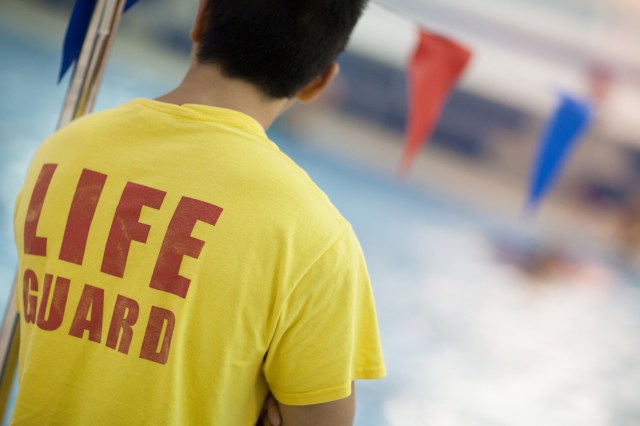
Toot-toot-toot! Lifeguard going in!

The year 2020 is in and I am reaching the end of my twenty third on this planet. Will Taylor Swift ever speak to me in the same way?

I think at this stage I should firmly be considered an adult. It certainly feels that way in a classroom dominated by sixteen-year-olds in the St Magnus Suite of the Pickaquoy Centre of a Wednesday evening. Oh, youth with your transient worries, your world-making, world-ending passions, dreams undashed, loves hopeful, knowledge of world-literature embarrassingly scant. Despite TikTok and Thunberg and Teen Vogue, because TikTok and Thunberg and Teen Vogue you are the hope and despair of this earth.

This is the RLSS UK-wide industry standard, internationally recognised, universally regarded, three-week, fast track, qualification that allows us to entrust them with our lives. In case you didn’t get that – I’m training to be a lifeguard, and it’s making me reflect on a few things.

downloadI, like them, could have done this at 16. At school, I was involved in competitive swimming, so it’s likely the club would have contributed to my course fee. But I didn’t. It wasn’t something I wanted to do. I already had a part-time job by then. What was the point?
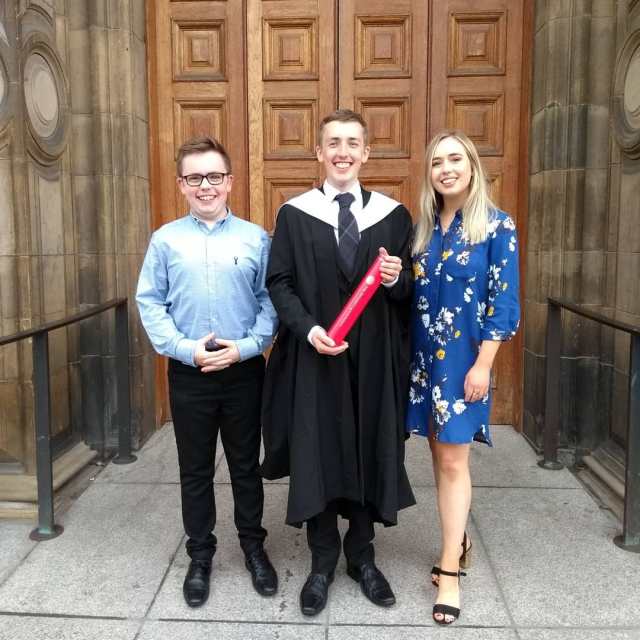
Ultimately, I was naïve. I used that job as an excuse not to do things, not to see people and eventually I wound down the only thing that gave me a communal identity outwith school and all but quit the swim club.

Swimming gave me so much and our first foray on “poolside” reminded me of those late primary school P.E. sessions. Fraught with anxiety for many, just on the cusp of learning to be ashamed of our bodies, it was a rare moment of ease and confidence for me among those struggling to complete a width that I could speed from end to end in a couple of breaths. Obviously, no-one on the course is that unsure and most are clearly sporty in some other discipline, but they marvel nonetheless at my “natural” ability (I am by no means – just many thousands of hours further in than they are).

It helped me immensely in the transition to secondary school. By my final year at Dounby, I had few close friends, and yes, while there was probably an element of self-isolation in there, I held almost no common interest with my peers. I didn’t like football, fighting or farming – but I did have swimming. That other world to which none of them was privy. It was my one-up on them, my gateway, my escape.

Not that there wasn’t bullying in changing rooms. There was, and I was briefly – for my teeth chiefly, which are still pretty massive despite the best efforts of orthodontists. It’s just that, after they’d got bored of that (and I got braces) it was just an extension of the Stromness playground politics, which I could, largely observe as a neutral. That all-male world was a great environment for stories, which I could only imagine, with my being unfamiliar with many of the major characters and settings in person.

I had friends then, true friends before I’d even got to Stromness Academy – and they were all meeting them for the first time, more or less. Orkney is small – yes, but not that small and you can still see on genetic maps of the place that people really haven’t moved around that much, even on the mainland itself. People from one parish compared to another are distinct and there is real variation in the accent. I had early access if you like – I got to play the beta version and became good at the game prior to release.

Swimming gave me access to secret worlds. I heard radio programmes no-one hears, saw sunsets before anyone else, was the first to crunch my shoe into the brittle frost of winter mornings. Those epic red skies as the town gradually emerged from inactivity are etched permanently on my mind. We would stride out onto concrete inhaling the sweet chlorine-flavoured ether and feel the nip of bitter air on rosy cheeks. And we would always walk together, a cross-year-group coalition, a flock with a collective wingspan beyond the arbitrary division of age and house and set.

I gave that up. Why?

Really, I don’t think I came to terms with that until, in a rut of proportions I had never and have never since experienced, I read Infinite Jest.

Infinite Jest is not what you’d expect from one of the defining works of postmodern literature. It’s about a tennis academy. Well, strictly speaking, it’s about a tennis academy and addiction, obsession and competition. It is about a spiritual void that people try to fill with what comes to hand – sporting talent, academic success, substances, lost causes, TV shows. Many people really get a kick out of “getting the joke” that the novel represents, but for me what stands out above the depravity and clever person’s clever person-type humour is its incredibly accurate description of the world of youth competitive sport.

In many ways, it is utterly brutal. As a teenager, everyone is constantly changing. By a fluke of puberty’s jumping the gun, you’re at the top of the pile for a year or so, then suddenly you’re being beaten where it took you no effort to win before. For the whole of your life hitherto, progress has been natural, effortless and it’s easy to believe the graph’s exponential rise. One moment later, half a second takes a hundred hours to shave off. It is a crushing existence, even to maintain the level of fitness required to equal your personal best. At some point, you need to ask yourself if the rewards are worth it. In most cases, in and of themselves, they are not – but because you’ve already invested so much and built a lifestyle around it, how can you let go and not have your identity destroyed?

That got real, real fast.

As I said, I’m doing a lifeguarding course. I’m also managing the St Magnus Way’s social media channels and doing app maintenance, so give that a like if you’d like.

Posted in Life, Personal experience | Tagged , , , , | Leave a comment

Remembering Alasdair Gray

Artistic blooms tend to be triggered by seismic technological or political change. Where the first Scottish literary “renaissance” arrived as the result of the brutal shock to romantic sentiments the First World War had dealt, a new flurry of writing activity arose on the back of the fateful year of 1979. In March a referendum was held on the question of whether Scotland should have a devolved parliament. The result came out in favour of devolution but was declared invalid because of low turnout. In May Margaret Thatcher was elected as prime minister.

external-content.duckduckgo

It would be a mistake, however, to align the novels, plays and poems produced in these eras too closely with contemporary events. Rarely, no matter how much I admire H. G. Wells, is literature simply a case of trumped-up journalism. Lewis Grassic Gibbon, for example, was, in Sunset Song, still processing the tumultuous effects of the 14-18 war on Scottish rural life in 1932, rather than reporting on Europe’s rampant fascism. In the same way, Alasdair Gray does not speculate narrowly on the decade of Thatcher that would follow the publication of his debut novel Lanark in 1981. Instead, he focusses on processing the postwar era just as the consensus was beginning to fragment and fall apart. In this, he often risked unfettered nostalgia and his character Jock McLeish in 1982, Janine, as he looks back fondly (with not-so-subtle sexual subtext) on the moon landing, proclaims:

“There was no one point after which things got worse, but my last spasm of scientific, social delight was in 1969” (299).

Gray was much more interested in long term cultural shifts and changes than the novelty of the Thatcher era. This broader, more encompassing streak, alongside his age (his belonging to a different generation), I think set him apart from his contemporaries who came to prominence in this period such as Liz Lochhead, James Kelman, Iain Banks or Irvine Welsh; he was an odd one out even in his cultural “scene”.

To address the 80s, in a novel that sprawled out from what was originally a short story, Gray turned to a character much less obviously autobiographical than the Thaw of Lanark’s first two books. Jock McLeish of Janine is a self-loathing, Tory voting, sexual fantasist who travels the length and breadth of Scotland repairing “instruments” for “the National”. This allows Gray to peer over the city walls and examine the country at large from the perspective of someone who begrudges its existence but is bound to it psychologically in the form of a resurfacing ex whom he cruelly mistreated despite an unshakable love. It is, in my opinion, his greatest work.

What Gray achieved, however, goes far beyond political analysis. His life’s ambition was to do for Glasgow what James Joyce did for London and he was unique in his pursuit of this single-minded goal. Unlike Joyce, however, Gray rarely left his universal city and died not 10 miles from where he was born. He recognised that Glasgow was not “Scotland” and wrestled with his cosmopolitan instincts and his desire for what he called “Home Rule”. On the one hand, he wanted to imagine Glasgow as a Weltstadt but his constitutional goals were too concrete not to allow him an exploration of Scotland’s contradictions; its Highlands and Lowlands, Clydesides and Lothians, Radicals and Presbyterians.

Although we remember Gray chiefly for his prolific writing period in the 80s and early 90s, before that he had an art career in painting public murals and was commissioned to write radio plays for the BBC. When the contracts and projects dried up, he began to sketch portraits of notable Glaswegians and perhaps then began to contemplate his home city as the microcosm that fizzles from the pages of his Life in Four Books. Conjuring an imagined, diabolical and divine Glasgow in his debut novel, he later left his mark physically in the colossal Oran Mor ceiling painting and the refracted architecture of Hillhead subway station.

It remains to be asked, who will take up the gauntlet and write for a new era? A Scotland in transition, having rejected its independence in 2014 and facing down the dismal defeat of Labour south of the border. I am sure that Gray would not embrace despair. He was relentlessly optimistic and believed things could always be improved upon. In writing Lanark, he did not aim to pen the greatest novel of all time for all time; merely, the greatest novel of all time for our time – thereafter to be surpassed and overturned.

I do not think that Gray achieved his goal. Lanark feels too self-congratulatory, too much like a victory lap in the indulgent fourth book. What he did accomplish, however, is worthy of the highest praise and allowed those who came after him to recognise the wretched aspects of modern Scottish living and to dream of a new republic. His politics and plots owe much to his predecessors but in that, he had a distinct lack of concern for originality. He imagined an intensely local form of literature that at the same time refused to be contained within national boundaries, a genre-defying epic unheeding of science fiction, magical realism or the autobiography’s constraints, and parallel universes foreshadowing dark descent and the lure of utopia.

If great literature holds up a mirror to the world, then Gray’s vision was Alice’s looking glass. Fundamentally interested in alternative realities, it is no wonder that near the time of his death Gray was in the process of, in his words, “Englishing” the concluding third volume of Dante’s Divine Comedy – Heaven. It seems that the greats often turn to translation late in life and it seems a testament to the craft that the most brilliant literary lights have such respect for it that they wait until self-mastery before attempting to realise a foreign-tongued genius. Much like the late Tom Leonard’s turn to Bertolt Brecht’s Mutter Courage (a play that follows a vagrant peasant family speaking in the author’s native Augsburg dialect through Europe during the 30 Years’ War) in his final years, Gray took on Italy’s finest writer’s attempt to understand the complexities of his age through various planes of existence in the afterlife. He published Hell in 2018 and Purgatory late last year.

It was not the first time Gray approached world literature, having translated Goethe’s Faust as Fleck in 2008. The influence of German literature can be felt in all of his works especially the stories of Kafka and the psychology of Jung and Freud. Goethe’s epithet, “Wer immer strebend sich bemüht/ den können wir erlösen“ (loosely translating as whoever continues to strive and apply themselves/ we are able to redeem) is the haunting phrase that echoes across Lanark’s concluding chapters. It excellently demonstrates Gray’s belief in the process over the finished product and the obsessive need for constant revision that dragged out a church mural supposed to be completed within a week to a three-year project and caused his debut novel to spend several decades in gestation.

Of course, Gray knew that his work was temporary. In this, I do find partial agreement with H. G. Wells, who said that “all literature is journalism and will pass away in this changing world”. He learnt this the hard way the aforementioned kirk was scheduled for demolition shortly after he completed the mural to which the congregation grew increasingly hostile as time went on. It wasn’t as if all was folly; only most.


Posted in Tribute | Tagged , , , , , , , , , , , , , | 1 Comment

2019 in retrospect

In January work began in earnest on my German dissertation. I was comparing the 1950s poetry of two of East Germany’s leading literary figures: Bertolt Brecht and Heiner Müller. The latter had been charged with unoriginality in contemporary criticism of this early work; he was accused of being derivative in form and content and drawing heavily on the former in both cases. Müller, in his mature plays, is regarded as a disciple and worthy successor of Brecht. I was working on examining and challenging these assumptions.

The first of the year was also a month in which I was music editor for the now-defunct National Student and I reviewed several albums throughout 2019 until September – some received in advance via pre-release streams. Of these, one would follow me throughout the rest of the year: Toro y Moi’s Outer Peace. As an album, it’s frustrating because while the standout tracks are excellent, they are surrounded by mediocrity, hence the less-than-enthusiastic score. A personal favourite is ‘Laws of the Universe’, which became a bit of a flat anthem at Summerhall Square.

51092589_10218643680748896_6991127806268669952_o

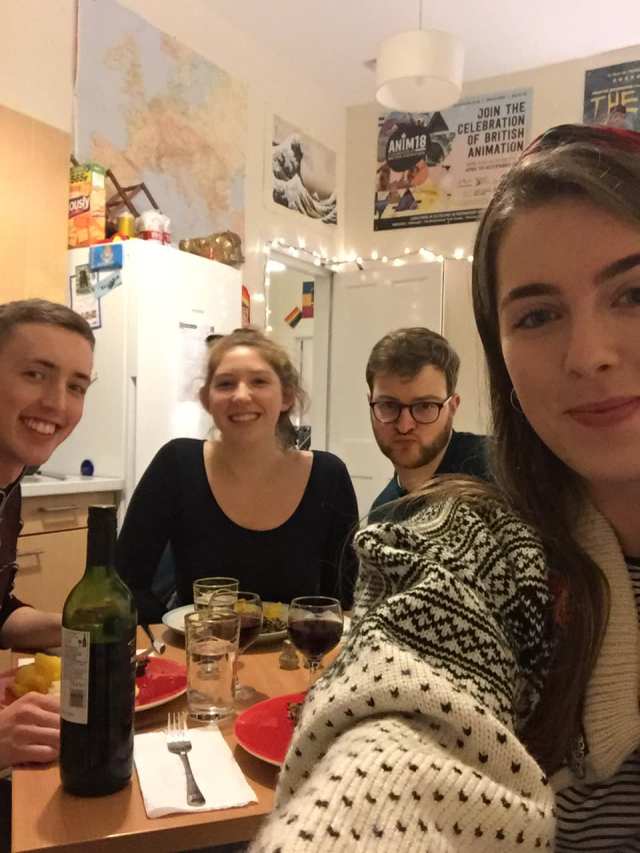
End of Jan highlight – flat Burns Supper

In February the German department organised a dissertation conference at which I was expected to present my ideas up to that point. This was a very useful exercise in articulating my thoughts and forcing myself to condense, hone and distil the results of my reading into an accessible format. It was also interesting to hear what everyone else was working on – an array of wildly different topics – particularly one master’s student’s German Studies/History of Art joint thesis on fin de siècle satire and Dadaism’s links to the carnival tradition.

March was a mad month in which migraines returned, co-presenters dropped out of radio shows and flights to Belgium were missed, as well as Brexit deadlines. It was then when I started to really develop my argument with regards to the two poets’ mutual interest and divergent interpretations of the Roman satirist, Horace. At the same time, I was looking at political violence in Shakespeare’s Richard II, Henry V and my favourite comedy, Twelfth Night.

April was not quite as stressful a month but was still tense with worry that my handed in coursework would disappoint. There were yet more deadlines to cross and an “oral exam” to survive (this always sounds like I just went to the dentist).

Beyond this, my exam “diet” was surprisingly light, with only two German exams in mid-May.

June was a bit of a limbo month for me. I was waiting out the expiration of my lease of Summerhall Square – a university-owned flat solely for students, waiting for exam results and my degree classification and waiting to hear back from various job applications made in haste against the backdrop of the increasing likelihood of my moving back to Orkney at my fulltime education status’s termination. Although I had one in-person interview for a student recruitment role, I was ultimately unsuccessful in my frantic search for dependable graduate employment and returned to my island home once more with the triumph of a first from the University of Edinburgh and the failure to find concrete next steps warring in my breast.

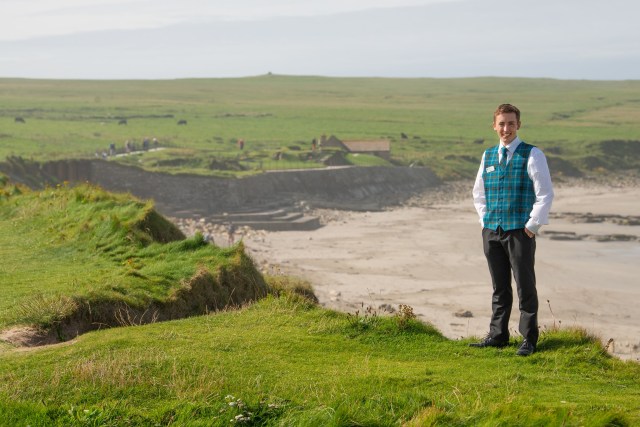
Likewise, July was defined by the in-between. It seemed that this year I had missed the boat. Somehow it is expected of students also to be on the job hunt while in the most intense phase of coursework deadlines, to devote intellectual energy to the tedium of CVs, personality profiling and assessment centres when to do well at university you’re required to meditate extensively and almost exclusively on your specialist subject. Yet there was a beacon of hope. Not quite resigned to a 2019/20 academic year (and yes I have not given up on thinking of years in terms of semesters yet) in Orkney, I thought it could do no harm to apply for a “summer job” at Skara Brae. To my delight, I was invited to interview – my first face-to-face one in over a month. By this time, I was truly psychologically ready to get working again after uni. It may not have been graduate employment per se and not directly relevant to my studies, but it was a salaried job in which I would get paid to extoll the virtues of my beloved island home to the thousands who visit the UK’s “cruise capital” every summer. Moreover, it was only until the end of September, so I had masses of time to secure my dream job in the city before then…or so I thought.

66370190_2293744164014216_8683446166156738560_o

Graduating in July was nice

By the time I got my PVG checks done and my uniform sent away for and delivered, I only worked one and a half weeks in August. There was a lot to learn but it wasn’t long until I was no longer the newbie and the season began to draw slowly to a close through the next month. A job that was initially about retail sales and crowd management morphed gradually into a relaxed sort of micro-tour-guiding and holiday consultancy.

70573238_2417183588336939_4862850289943707648_o

Also, at that time my first car came into my life – a 2004 Vauxhall Corsa, resplendent in burgundy. It was a necessity, given that the transport links to Sandwick are infrequent and unreliable. We’ve had some good times together, and although there’s no Bluetooth or aux cord, the CD player has only destroyed about half the tracks on Toro y Moi’s 2017 Boo Boo, which has been my constant companion for about five months now plus a newfound appreciation of Radio 1. It enabled me to pick up a waiting job in Kirkwall to supplement my Skara Brae hours. This resulted in an amusing crossover where I would meet those who I’d led around the Neolithic village during the day that evening in the restaurant.

In October I went to my pre-arranged post-season treat concert in Glasgow. King Gizzard & the Lizard Wizard was the best gig I went to last year – they were my top Spotify artist and Infest The Rats’ Nest one of my favourite albums. The rest of that month I was distinctly underemployed, but I started a night class in British Sign Language, which at least occupied one evening a week.

During the penultimate month of the year, I switched second jobs to one that guaranteed me more hours and after a brief trip to see my brother in Edinburgh things began to pick up in both jobs as Christmas party season took hold and a brief festive tourist mini-bloom occurred at the end of December.

I look forward to 2020 with uncertainty but potential. My only real desire is to progress, to advance and not plateau.

Die Physiologen sollten sich besinnen, den Selbsterhaltungstrieb als kardinalen Trieb eines organischen Wesens anzusetzen. Vor Allem will etwas Lebendiges seine Kraft auslassen — Leben selbst ist Wille zur Macht; die Selbsterhaltung ist nur eine der indirekten und häufigsten Folgen davon.

Nietzsche, Jenseits von Gut und Böse


Posted in Life, Personal experience | Tagged , , , , , , , | Leave a comment

Mindforming Misattributions

I realise there’s no shame in being poor…but it’s no great honour either.

The above quotation is from the musical Fiddler on the Roof and is spoken by the bumbling patriarch, Tevye before he launches into his song ‘If I Were a Rich Man’. It’s one of the disembodied quotes that revolves around my head without being attached to its original source material because it possesses some quite universally applicable wisdom. On the one hand, it stresses the resilient pride of working people who have to put up with a hard life but on the other, the indignity that poverty forces on people. It’s a maxim that Edwardian writers such as E. M. Forster knew well and that is brought into particularly sharp focus by G. B. Shaw’s play, Major Barbara, where the foundling industrialist and Übermensch, Undershaft has to decide who will inherit his international arms conglomerate. Major Barbara is a play that shatters the Victorian paternalistic view of the industrialist found in novels such as Dickens’s Hard Times and shares much in common with Tim Burton’s adaptation of Rohl Dahl’s Charlie and the Chocolate Factory (2005) – the work to which I falsely attributed the quotation. It is also a story of inheritance and of competing ideologies.

Charlie and the Chocolate Factory had a profound effect on me upon its release. I had read the story and the even zanier Great Glass Elevator (which makes an appearance at the end of the adaptation) and was captivated by Rohl Dahl’s darkly comic imagination. When the film came out, I remember it being met with mixed reviews and compared unfavourably to the 1970s Willy Wonka incarnation starring Gene Wilder. I can see why one could criticise Burton’s decision to foreground the troubled industrialist at the expense of fun and childlike wonderment because although he uses the original title, this film is really about Wonka’s journey – Charlie of course providing an effective foil to the privileged yet unloved son of the ingenious dentist father figure played by Christopher Lee. Burton’s Chocolate Factory is less fantastical enchantment and more technological spectacle.

The film has two main threads, or themes – one psychological and one concerning economic relations and exploring consumer capitalism. It’s opening credits introduce the latter in a several-minute montage of the elaborate automated mass-producing of “Wonka Bars” over a tumbling, emotionally heightened orchestral score by Danny Elfman.

Charlie and the Chocolate Factory’s setting of perpetual winter may have been employed partly to induce festive feeling and ensure durability as a vaguely seasonal escapade, but this largely adds to the dystopian, unforgiving urban landscape Charlie’s family inhabits. The protagonist lives in a comically slanted shack in the shadow of the chocolate factory’s looming chimneys. Charlie venerates Willy Wonka, as is shown by his father handing him the last piece – a misshapen toothpaste lid for the signature top hat of the capitalist – to complete his model of the plant. His grandad is equally in awe despite being made redundant when Wonka imports cheap (possibly even slave) labour from Oompa Loompa Land and dismisses the entire workforce. Charlie’s father also loses his job because of automation. However, the family is resolved to stoic forbearance and quiet dignity – his mother (Helena Bonham Carter) takes it lightly and vows to thin down the cabbage soup. It’s this particular family scene that I associate with Tevye’s aphorism, misattributing it in my mind to the other, more pragmatic of the co-habiting grandfathers.

choco share

Is Charlie a raging communist or does the film just want kids to learn to share?

An odd, quasi-religious, even puritanical, willingness to endure the misery is complemented by a blind faith in the ultimate goodness of the industrialist (Wonka) and, like the proles in Orwell’s 1984, a belief in the divine justice of the lottery (an attitude typified by the sentimental grandfather) which takes the form of the Golden Ticket competition in the film. When the film was released, I was of an age where I did not distinctly distinguish between fiction and reality. I was of the generation for whom some small part of them was disappointed when no letter inviting them to take up residence at Hogwarts School of Witchcraft and Wizardry arrived in the post on the eve of their eleventh birthday. In the case of the Burton film, this blending of worlds was compounded by the promoters’ decision to manufacture actual Wonka bars and run a golden ticket draw of their own. Unlike the magic of Harry Potter, Charlie and the Chocolate Factory’s wonders were broadly scientific feats and its impossible flavours the result of pioneering exploration and experimentation. (This grounding in the rational was echoed in another 2005 phenomenon that deeply impressed my young consciousness – the new Doctor Who – but that’s a story for another time.) Yet this hope of being the “chosen one” and the recipient of an unexpected inheritance was common to both, is a major trope of modern literature and perhaps the most seductive. As a young child, I was utterly drawn into this promise of benevolent fate whisking me away to fortune, fame and glory. However, what sticks with me now is the message of the film – exposing the true nature of capitalism, which is in direct opposition to Charlie’s insistence on sharing his limited wealth, leading him to reject the inheritance that comes with the price of solitude enforced by material superiority.

The film falls down slightly on the resolution of the no-less-engaging psychological plot, which reverses the powerful refusal to take up the mantle of lonely venture-capitalist-cum-philanthropist and rather cornily stresses “family” over class solidarity to appease American audiences. This, however, is not enough to reverse its strong critique.

Watching it back after all these years is different, however. The first thing I noticed was the dialogue, which is resolutely in American English, despite all Charlie’s family’s Britishness. Again, in the corner shop where Charlie buys the winning Wonka bar, he is served by an English shopkeeper, yet pays in dollars. This only leads me to conclude that Burton’s film is set on Airstrip One in the country of Oceania, enhancing the general dystopia by literary reference.


Posted in Entertainment, Politics | Tagged , , , , , , , , , | Leave a comment

Orfeo

Sixty mile an hour gusts subsided; it was time to reopen the village. First, however, I would be consigned to the till, and stock reshuffling – replenishing puffin fledglings from a partially barren wicker basket and depositing fresh ova in the dinosaur hatchery. A steady trickle precipitated through the entrance until the eleventh hour struck and Stagecoach disgorged its cargo accordingly.

Pre-paid entry picked up and tickets to Scotland signed and transacted, it was time for lunch and after a brief interval troubleshooting the exhibition’s Neolithic materials game with a ten-year-old, bracing the inclemency zipped up to the eyes and on to the site for two.

My watch was broken by intermittent stints in the “display” hut and former visitor centre, blasted by welcome warm air from a heater above the doorway spewing hot breath over red raw hands.

Custom consisted of infrequent couples upon whom I inflicted myself. I bemoaned saturated Brodgar with blonde and beardy Australians who wanted to circumnavigate the stones sans vêtements in the style of Billy Connolly and in imitation of a mutual friend but chickened out. Making sure to maintain Skara Brae’s five-star rating, as I always do, I offered to take photos as appropriate.

Gently ushering the last two down the path, my radio crackled into life with that familiar herald – “Base to Sugar Kilo”. Our phonetic alphabet seems to bypass Sierra; my fiery-haired colleague puts it well when he says, in his Brummie accent, “It’s such a pudding phrase”.

A mobility scooter has gone rogue. I check where I had parked it half an hour since. Nowhere to be found. I set out for Skaill House and was greeted by the cold white beam cast out before the rapid, trundling mass advancing towards me under a darkening 4 pm sky – its rider’s wife in the wake at a comical half-walk-half-run as he powers forward at full throttle regardless.

MistaJam ferries me home with his “classic” dance anthems. I return to find my grandad had been here in my absence, thus the necessitated meeting is struck off and I retreat to my bedroom guiltily to squeeze in half an hour’s worth of Civ 6 as Eleanor of Aquitaine.

This weekend my island abode is abuzz with activity. Harvest homes compete with quasi-German/Viking rituals and arm-wrestling championships. The event I’m dragged along to, however, is part of the Orkney Storytelling Festival and takes place in the mysterious venue of the Quoyloo Old School. Featuring a line up of familiar faces, its not a huge gamble; nevertheless, my expectations were modest.

After a leisurely drive through lashing rain and an obstinate Orcadian refusal to occupy the vacant front row of seats only three deep, the evening began with a poem serving as a loose basis for the programme that followed, with its tribute to the Green Isle of Shapinsay, praise of the virtue of tilling the soil, distrust of fleeting fortunes to be won by “trade” and reverence of the vaster, natural world encompassed by the bounds of the sea and the infinite roof of the sky.

Corwen Broch succeeded the poem with a Biblically themed folksong, which he delivered with a drum and Morris bells. Praising the Orcadian incomplete participation in the Great Vowel Shift and the subsequent ability to rhyme “plough” with “view” in the song, he added that he enjoyed the apparent parallel between Biblical chronology and human prehistory in Adam’s transition from the hunter-gatherer (Mesolithic) lifestyle to Cain’s farming, marking the advent of the Neolithic – an era he considers we still live in. Only when lab-grown food overtakes agriculture as our main source of sustenance will we enter a new phase.

This was followed by perhaps the most tangentially connected, but fascinating, Ballad of King Orfeo. Based on the Ancient Greek myth of Orpheus, this British version of the tale has a happier ending and instead of a descent into the underworld to retrieve Eurydice it sees its hero sally forth into the kingdom of the elves to redeem Isabella. The earliest medieval source for the poem dates from the early 14th century and this was translated by Tolkien and cited as an inspiration for Lord of the Rings. Several versions of the text appear across Britain, but the tune was thought lost until a man from Shetland was recorded singing the ballad in 1947. Remarkably, the refrain appears to preserve the Norn spoken from the middle ages to the early modern period throughout the Northern Isles:

Skoven arle grön

Hvor hjorten han gar arlig


Early greens the wood

Where the hart goes yearly

Other highlights included Kate Fletcher’s harmonium playing – it squeaked atrociously, but somehow that added to the effect and deepened the character of its strange tones – and Sarah Jane Gibbon’s rendering of a tale from the Orkneyinga Saga. The latter switched the traditional male perspective for Sigurd’s mother, who wove the infamous raven banner granting victory through pagan magic, which of course demands a terrible sacrifice.

Folk music usually isn’t my scene, but the combination of weird instruments, excellent drones, medieval sources and compelling stories kept me contemplating long after the last (perhaps over-) enthusiastic rotation of the bird-scaring rattle.


Posted in Entertainment, Life, Music | Tagged , , , , , , , , , , , , , , | Leave a comment

1979

I do not mean our political and civil liberties. They will endure. […]

The threat is nearly invisible in ordinary ways.

It is a crisis of confidence.

It is a crisis that strikes at the very heart and soul and spirit of our national will. We can see this crisis in the growing doubt about the meaning of our own lives and in the loss of a unity of purpose for our nation.

[…]

We are at a turning point in our history. There are two paths to choose. One is a path I’ve warned about tonight, the path that leads to fragmentation and self-interest. Down that road lies a mistaken idea of freedom, the right to grasp for ourselves some advantage over others. That path would be one of constant conflict between narrow interests ending in chaos and immobility. It is a certain route to failure.[1]

People rarely respond with a specific year when you ask them about their music taste. And yet, that’s precisely what happened when a colleague and I fell into the discussion as we were closing up the replica house at Skara Brae.

He proceeded to show me a hardback volume of Ian Curtis’s collected notebooks and as the conversation slid into literature at the mention of my degree title, the Joy Division frontman’s status as enigmatic “lost boy” was conflated with my penchant for the not-quite myth of the murky middle ages.

Many of my sentences on the perimeter path of Western Europe’s best-preserved Neolithic Village are prefaced with the words “it is speculated that” or “there are several theories about x”. This far back it seems there is what we can deduce and there is what has been entirely lost to time. The former is ever encroaching on the latter, but there are aspects that shall remain forever irretrievable. Orkney as Britain’s ancient capital? Why not? The problem isn’t really with evidence to the contrary – it’s about what’s difficult to prove positively. And in archaeology, as with science in general, facts have a half-life.

As the quick-witted among you may have gathered, I recently started working for Historic Environment Scotland as a seasonal “steward”. Prehistoric Scotland might be a more accurate term here – as in before writing and recorded history. For me, things begin to get interesting when people put pen to paper/quill to parchment/chisel to headstone etc. etc. Stories are what I’m interested in because they can tell you how a culture conceives itself. So no, there is no particular stone age affinity, although it is hard not to be affected in some way by the objects and monuments where we have no clue as to their purpose but which we must assume had a religious or ritual significance. At Skara Brae, domestic life is represented, yet there is something fatefully poetic about its discovery by the storm and its inevitable swallowing by the sea.

1979. They were able to carbon date by then and fix some uncertainties. Unknown Pleasures was released to the world that summer alongside The Clash’s London Calling and Pink Floyd’s The Wall. Punk was in decline and something new was being born. Billy Corgan of The Smashing Pumpkins wrote about the year in retrospect on Mellon Collie And The Infinite Sadness, making no direct historical references but somehow capturing a fond sense of loss for a world on the cusp of 80s hedonism. Talking Heads too released Fear of Music, which soundtracks the film 20th Century Women shown on BBC 2 last night, the previous listing also sharing a 40-year anniversary link to the assassination of Lord Mountbatten, the protagonist of Viceroy’s House about the partition of India.

Politically, 1979 was something of a turning point. In Britain, Margaret Thatcher was elected and the first referendum on Scottish devolution was held (the outcome was a vote in favour, which was disqualified due to low turnout). Democrat Jimmy Carter was on his way out in America to make way for Ronald Reagan in the following year. In 20th Century Women, the former’s “Crisis of Confidence” speech serves as punctuation in the final act as the main characters gather in the living room to watch the televised address. It’s a special moment in a thoughtful, slow-paced film.

At the then president’s conclusion, the first reaction is a muffled guffaw, which seems more nervous laughter than anything; an expression of unease at the brazen sincerity and lack of irony. The second is something like, “He’s really lost it this time”. This is as if the only explanation for such stark lucidity is madness. The third and final response is from the film’s protagonist, Jamie’s mother, who is repeatedly referred to as having been “raised in the Depression” (born 1929), is, “I thought that was quite beautiful.”

20th Century Women is largely about the female experience at this particular historical moment and the generational differences that make modern life difficult to comprehend at times. It’s also about a teenage boy developing his consciousness and trying to understand the opposite sex and what it means to be a man in the midst of feminism’s third wave.

The film often has an underwater, out-of-body quality kind of like a BBC 4 documentary comprised of archival footage, and the narrative is occasionally interrupted by specific dates and voiceovers from the main character projecting the future and speaking to the Zeitgeist. Its use of colour is impeccable and there are so many eye-popping interior shots. More than that though, the film’s power lies in its story and how it never really takes sides in its quest to navigate the world. It seems to acknowledge with resigned acceptance that the rules of the game are about to change irrevocably and will continue to do so in countless unforeseeable ways from now until the flood, so that any conclusions drawn from 1979 can only hold for the briefest of historical moments.

I was reminded somewhat of HyperNormalisation – a BBC documentary of the same year as 20th Century Women (2016) – which describes how at the end of the 70s trust in the government plummeted and became the new normal. As misinformation became the standard and banks held more sway over policy than the electorate, governments were given a free pass to construct whichever narratives they pleased against a citizenry too apathetic and disengaged to contradict them. It makes for depressing viewing, but in its broad strokes and welcome lucidity, it is somehow cleansing and empowering too.

This leads me to my final thought on the film. The plot of 20th Century Women reminds me of D. H. Lawrence’s Sons and Lovers, and partially the other novels in the family saga trilogy, for its nuanced portrayal of frustrated love and the complex relationship between mother and son. I think the film is noble in its desire to find answers and to understand aspects of a world impossible to stabilise in its entirety, more than it is for the handfuls of truth it dredges up in the process.

[1] Jimmy Carter speaking in 1979 regarding the energy crisis. Although the speech also elaborates on concrete policy decisions, I have quoted only the broader statements, which make their way into the film. He talks about Christianity and a lack of faith here, but the sentiment can be applied to a measurable phenomenon in changing attitudes towards trust in politics. The psychological shift is not a freak anomaly. It is instead a result of a ground shift in the “deep state” where finance controls policy and not the other way around. Carter also rightly sites neoliberal ideological transformation away from collective purpose towards individual gain and personal wealth.

Posted in Life, Personal experience, Politics | Tagged , , , , , , , , , , , , | Leave a comment

Nynorn and beyond

Orkney: an interesting case study for historical linguists

In the following, I’ll discuss my passion for historical linguistics and how this discipline is especially interesting in relation to Orkney and the now-extinct language of Norn. Firstly, I’d like to explain briefly what we know about Norn in terms of how it fits in with other language families and then I’ll consider how we know this. Finally, I will discuss some of the implications of Norn’s existence and how they can be applied to contemporary issues.

What we know

Any discussion of historical languages owes a considerable debt to Jacob Grimm who pioneered linguistics as an academic discipline. He was responsible for discovering that many European and Asian languages share a common ancestor in what is now known as proto-Indo-European, and was able to demonstrate how the Germanic languages (separating into North – Scandinavian; West – German, Dutch and English; and East) branched out from this through the first consonant shift p→f, t→th, k→ch. Alongside the Germanic “dialect” there are Celtic, Slavic, Armenian, Albanian, Baltic, Hellenic, Italic and Iranian. Norn, unlike English, belongs to the North Germanic language family and was born out of Old Norse, specifically the West Old Norse of the Norwegian settlers.

Norn, like the current Scandinavian languages today (Norwegian, Danish and Swedish) would have made up a dialect continuum with the Viking world. This means that the languages are mutually intelligible i.e. a Swede and a Dane can meet each other and carry on speaking their own language while still being able to understand one another. However, it was distinct enough to be more than a “dialect”, with its own grammatical as well as vocabulary differences and was spoken in Shetland, Orkney and Caithness, beginning its slow decline in the 15th century after the islands became Scottish (1468-72) (although Scots became the prestige language in the 14th with the Sinclair earls).

How we know it

Because Norn was never a written language what we know of it must be inferred from a limited number of transcribed sources, namely three, from people who were not native speakers. In the 1690s, James Wallace recorded a version of the Lord’s Prayer in Orcadian Norn. Eighty years later, George Low transcribed a Shetland variation, which differs substantially and is perhaps affected by his native Scots or the language’s evolution and incorporation of Scots vocabulary over time. The most intriguing source we have for Norn is the original poem, The Ballad of Hildina, again written down by Low, the story of which has precedents in the medieval German poem Kudrun and other Norse tales.

I try them with the old Norn words – hraun

Duss, rønis, queedrauns, kollyarun;

they hvarf from me in all directions

Over the hurdifell – klett, millya hellya, hellyina bretta […]”

from On a Raised Beach by Hugh MacDiarmid.

Norn matters in the sense that it provides a historical case study of how Norse mutated in relative isolation into a separate and dominant language of the common folk, and how it died out due to a lack of written record, thus giving us vital information on how to keep languages alive. It still survives in a diluted form in the dialect vocabulary, pronunciations and grammar of Orcadians but there is now no mutual intelligibility with Scandinavia. This has political implications because it naturally orients us towards Scotland and the UK where there is still a lot of cultural continuity between the northern isles and Norway etc. If we were to build up Norn as a useable medium, we would at least then have options, and, unlike Hugh MacDiarmid’s Synthetic Scots, we would not be competing with a living language.

There has been an attempt in recent years to reconstruct Norn as a useable language in the fashion of the Norwegian Landsmål, created out of various dialects to make something distinct from Danish. However, this Nynorn, as it is called, has no political project behind it, as the unifying Nynorsk did and thus, in my opinion, is doomed to fail. The focus must be on uniqueness and mutual intelligibility with other Scandinavian languages with the goal of fostering a closer relationship and enhancing a unique culture if it is to be successful.

Posted in Life, Politics | Tagged , , , , , , | Leave a comment

Runic ramblings

Runes are more than writing, just as writing is more than the transcription of the spoken word. When someone carves a rune, they are doing more than just saving the game up to that point; they are casting their line into the future, gambling on succession; inviting the future into dialogue.

The written word is no longer sacred. We think nothing of jotting down a shopping list, updating songs to check out on our Notepad apps, and yet we are intuitively aware of how special writing is and how it inherently differs from all those meaningful exhalations that pass through our lips almost every day without exception. The current generation is perhaps most conscious of the disjuncture and exploits this to amusing effect on platforms such as Twitter, which rewards short form wordplay generously and where compression gives birth to an imagist resurgence.

English speakers are more aware than most of the spoken and written word’s incongruity. Words like “quay”, “indictment” and “sword” seem to directly contradict phonetic correlation. Unlike French and German which undergo spelling reform fairly regularly to realign the “logocentrism” of their languages, English spelling convention is simply that – convention. This has its drawbacks in the fact that spellings appear objectively illogical, but it does hold an advantage for someone with an interest in historical linguistics i.e. me (and whoever has read this far, so it seems) because they give an insight into word origins and contain traces of how English was pronounced in the past.

Conventions, however, have a habit of being rather fickle and nonsensical. To a large extent, they are just fashions and fads, as is demonstrated by the perplexing examples of “quay”, pronounced “key” (denoting a wharf/place where boats can moor). This word is very old and is believed to have origins in the proto Indo-European “kagh” for wickerwork/fence. An ancestor of the English word is found in Anglo-Norman French, all variants of which begin with “k, but a predecessor first appears in a native language in middle Scots records from Aberdeen, spelt “key”. “Qu” is only introduced into the equation around 1500 to reflect the French origin of this meaning of the word in their now updated spelling rules. The other key, incidentally (as in the thing that unlocks the door), has far more mysterious origins and possesses no equivalent in other Germanic languages. The German, der Schlüssel is literally comprised of the word for lock/bind and a non-standard form of the diminutive suffix. Our word offers no such helpful clues as to how lock and key interrelate (a bit like vagina deriving from Latin for sheath versus the “Anglo-Saxon” denominator).

“Indictment” has a more boring Latin explanation. It was made to look like its root word after it had mutated into “endyte” several hundred years down the line. The “dict” is the same as in “dictionary” and “jurisdiction” – so lawyer-y, wordy people wanted to make it look the same. To indict literally means to “wordify”/ “make word” i.e. put down in writing.

But, to return to the original starting point of this post, runes are not about having something on record. The Vikings did not write their sagas in runes, but in Latinate script like the one we use today, supplemented with Nordic characters to cover additional vowels sounds such as æ and ø and the additional consonants þ and ð. Runes were not written on parchment with a quill, they were carved and with this effort comes a greater pressure to imbue whatever you choose to write with as much meaning as possible; hidden and personal or forthright and clear.

Runes are so special because whenever someone has set out to chip away at a stone or engrave metal with a message they must have been confronted with their own mortality. This was not something written for oneself, not shallow self-expression for its own sake, but an attempt to distil what was most important to them and send it out into the uncertainty of generations to come.

Posted in Life | Tagged , , | Leave a comment

Brilliant yellow tinged with melancholy

University: complete. The opening of a new chapter, as they say. Of course, there are conditionals. A possible return is not ruled out in the long term, but for now postgraduate study is not in the immediate pipeline. What is certain, or at least 90 per cent probable, is that I’ll be donning those monochrome robes at the start of July. All being well – that’s a much-coined expression these days. No less true for repetition though.

Now I suppose I’ll have to go about becoming a fully contributing, council tax paying member of society. I’ve been stripped of my luxurious licence to mope, to ponder unbounded, and to devour literature indiscriminately. The second skin of my dressing gown must, alas, be shed. Student life, with its day drinking, meadows sprawling, and midweek revelry is giving way to sensible structure; anarchy curtailed.

But around what must this era of ushered-in discipline coalesce? A job, perhaps. That seems to be the inevitable terminus if not further institutionalisation. I’ve had two this academic year – as a chef for the student union (through which I was granted immortalisation in a post-festival advertising campaign for fringe catering staff) and my current position as music editor for The National Student. The former I gave up in December due to dissertation pressures and to be able to focus on the journalism, or writing in general, that I would very gladly make a living from. That’s not something I’m intractably bound to, however, and ideal employment, for me, would involve the chance to be creative and to contribute to the betterment of the world, or at least part of it, in some shape or form. From this, you may have already guessed that I don’t have such a “role” lined up.

Another frequently asked question: what will graduation mean for my living situation? Well, accommodation is, of now, a medium-term issue rather than an immediate concern because my flat lease lasts until the end of June. For the time being then, I’m in Edinburgh. I certainly would be sad to leave the city if I have to relocate. Glasgow has been talked about. The BBC, cheaper rent, more gigs. I could return to Orkney – there would be work there, for sure, and fewer distractions too for my projects. London holds appeal and beyond that, Europe post-Brexit; dreams of Paris, Copenhagen, Amsterdam, or, heaven forbid, the country whose culture I’ve dedicated myself to for the past four years – I could start a life in Leipzig. Needless to say, here, too, lies a deal of uncertainty, yet it’s a void from which substance shall emerge; the zero is a placeholder and not a numerical null.

My last exam was on Wednesday – literary translation. I managed to emerge unsullied by baking ingredients before decamping to a beer garden where the afternoon was seen out on scalding hot benches under glorious sunshine. There was talk of returning home, teacher training and the durability of student romances now that circumstance was disbanding us, and so the brilliant yellow held a melancholy tinge, despite the dilution of copious Tennent’s.

After spending many a day holed up in the library, I’d like to devote myself to a better quality of life. That’s already started. Made a nice vegan curry this weekend and went to the gym today, although admittedly it took me a good 20 minutes alone to retrieve finally retrieve my wayward shorts from an obscure corner of the wardrobe after months of neglect.

In the wider world, more important things than my undergraduate career are coming to an end though. Game of Thrones airs its last episode this week. It seems to be rather hurtling towards its conclusion, which is disappointing, but I’ll always be grateful that it exists. My thoughts generally on the matter is that it fell off after the fourth season and never fully recovered, despite some really compelling moments in season six (Battle of the Bastards, The Door). Dialogue and complexity fall to one side in favour of set pieces and stunning visuals, but it does look epic, so there is that. As a book reader, my sights are set on Winds of Winter now, which is sure to be quite a different tale from the fanfiction the show is now embarking on.

It’s a time of transition for all involved. The future is wide open, although I’d like to narrow it down just a little bit if only to be able to answer people’s questions and those I ask of myself.

Posted in Life, Personal experience | Tagged , , , , , , , , , , | Leave a comment

Appeasing AfD: precedent for Chemnitz?

About the Nazis though…

This week around 6000 far right supporters and neo-Nazis gathered in the small city of Chemnitz in Saxony. They turned out in response to the killing of a 35-year-old Cuban-German man by two refugees. About a thousand left-wing demonstrators appeared as a counter with approximately half that number of police officers mediating between the two, who requested back-up from nearby Leipzig and Dresden. 

Chemnitz was formerly known as Karl-Marx-Stadt during the GDR, its most distinguishing feature is a huge bust of the revolutionary philosopher in the main square. Behind Marx’s massive head “Workers of the world, unite!” is written in German, Russian and French. In front stand the far right crowds with banners reading “Ausländer raus!” (Foreigners out!)

ChemnitzIn June I wrote this piece reflecting on the Bavarian Kreuzpflicht and the traction of Alternative für Deutschland ideas, which are seeping into the mainstream parties in Germany, leading on to a discussion of why the far right seems to hold such an attraction for the former East. I did not publish it at the time, but I now feel it has become relevant again following these events.

Bavaria, the largest in landmass of Germany’s 16 federal states and second most populous, has controversially decided to implement a bylaw requiring the display of the crucifix in all public offices, with the exception of colleges, museums and theatres who are only recommended to hang a cross on the wall. A report recently published by the Evangelische Kirche in Deutschland (Protestant Church in Germany) showed that at the end of 2016 over 50 per cent of the Bavarian population were Catholic and 18.8 per cent were Protestant. Despite the change in policy not having been urgently demanded by the majority of Christians, the legal obligation has 38 per cent support in opinion polls. However, Cardinal Reinhard Marx, Archbishop of Munich and Freising, has strongly criticised the move and a petition from a student at the University of Regensburg has already received over 52, 000 signatures.

Why then introduce mandatory crosses now? As justification the Christian Social Union (CSU) – a Bavarian sister party of Merkel’s Christian Democrats (CDU) – have claimed that the display of the crucifix is an “expression of the historical and cultural character of Bavaria” and draws attention to the “basic principles, rights and social order” of the state and of Germany. Markus Söder, Minister President of Bavaria is a practising Protestant, yet he stresses that in this context, the cross is about regional identity and not a religious symbol.

Several commentators have suggested that the motivation behind this shift in policy, if not religious, is to give a concession to would-be AfD (Alternative für Deutschland) voters in the run up to the regional election in October. It is certainly not about the Catholic Church, who can no longer be said to correspond directly with the CSU and who were in conflict with the Bavarian government throughout much of Söder’s predecessor and leader of the CSU, Horst Seehofer’s tenure. These tensions being particularly sharp regarding the state’s refugee policy; Seehofer strongly criticised Angela Merkel’s approach and this critique was then branded as lacking compassion and unchristian by leading Church figures including Cardinal Marx.

Modern Germany is far from a secular state; the Church, Protestant and Catholic, plays a significant role in public life and is integrated into the political system. Religion has power not only institutionally, but also personally, with Germany ranking as comparatively more religious in the context of Europe at large, regardless of confessional allegiance. However, the picture is also highly diverse, with the major cities such as Hamburg and Berlin reporting an atheist absolute majority and the former GDR states having the greatest number of people identifying as non-religious. The other federal states are mostly religious, with Schleswig-Holstein the only Protestant absolute majority and Saarland joining Bavaria as predominantly Catholic. Interestingly, religion in Germany is not on the decline, with young people actually more likely to express some sort of faith. This bucks the trend with the rest of Europe, which is becoming more secular.

Whatever changes are taking place, they are not radical but gradual and there is unquestionably no dramatic surge in religious zeal that could be used to justify the new law. There has, however been a rapid rise in support for the (relatively new) political party, the AfD. Yet the AfD could not be said to be a predominantly Christian movement, rather an Islamophobic one – they define themselves negatively against the Muslim/Arab other. The AfD are seen as a political threat to the CSU, who received their worst result since 1949 in last year’s federal election. In this way, Bavaria’s crucifix obligation can be seen as pandering to a potential electorate, who theoretically delight in the provocation of an increasing Muslim minority.

However, if we look at the picture as a whole it is clear that the AfD’s challenge to the established Christian Democrats manifests itself most strongly in the former GDR (this being one of the most atheistic areas in Europe) where Die Linke (the Left) trail a couple of percentage points behind in third. During last weekend’s demonstration in Berlin, supporters carried placards with, “Dresden, Cottbus, Kandel – Deutschland ist im Wandel” (Germany is in flux) written on them. They are clearly proud of their gains in the East. Die Linke, once the go-to non-mainstream choice for those living in the former GDR, is being supplanted by the far-right.

The question is: why has the East deserted the Left, or, in fact, have they them? Perhaps a little background is needed to attempt to answer this question. Die Linke rose from the ashes of the Sozialistische Einheitspartei Deutschlands (Socialist Unity Party of Germany or SED) after the collapse of real existing socialism in 1989 and were known then as the Party of Democratic Socialism (PDS); the party of ex-comrades who were really conservative under a socialist guise in that they had got used to defending a post-revolutionary status quo. Among the citizens of the former GDR there existed a latent potential for rightist nationalism; they had grown accustomed to a narrative of nation-building, the need to secure strong borders and the external, conspiring enemy, in which responsibility for the National Socialist past was glossed over and dismissed.

The question of who can combat this tendency is therefore not a simple one. AfD are directly trying to exploit it, the CDU have no qualms about appeasing it, the SPD are discredited through their collusion with the establishment and die Linke are hindered by their origins in the party that historically created these conditions. The leader of die Linke, Sahra Wagenknecht’s position is also not antithetical to the AfD’s. In a 2018 interview with FOCUS Magazin she said, “,Offene Grenze für alle’ ist weltfremd” (‘open borders for all’ is a fallacy), elaborating by saying that while she had sympathy for those in need of asylum, Germany needed to build more housing to accommodate new arrivals and that the regulation of capitalism takes place within single states. On the migration issue, it seems the two parties are fighting over the same ground, albeit from different perspectives.

Whilst the CSU may be pandering to the far right, it is perhaps more troubling that die Linke’s internationalist scepticism is a deeply rooted philosophy. Certainly, in the former GDR, die Linke are capturing the public mood more than the SPD, but is this at the expense of transnational solidarity?

Posted in Politics | Tagged , , , , , , , , , , , , , , , , | Leave a comment