Opinion: Using correct punctuation is increasingly seen as impolite

It starts with the full stop. Every time you substitute an emoji for punctuation you are contributing to the erosion of our linguistic convention.

This is not necessarily a bad thing. After all, language evolves; it is a constantly mutating organism. Linguistic rules are only mistakes held in common.

Why then, are we so often moved, consciously or otherwise, to attack the edifice of grammatical orthodoxy? Beyond sheer ignorance of the rules, why do we avoid finality so fervently?

A full stop is just that – a complete halt. A cold, hard boundary between one clause and the next. Full stops are curt. They are blunt instruments in our hands, and they are responsible for breaking the flow of elegant conversation. At best they may appear stiff or standoffish; at worst, rude.

What are the alternatives then? This brings us to another feature of the text-based conversation which is a direct result of full-stop-phobia: overuse of the exclamation mark. If we are so reticent to vulgarly make a statement, it follows logically that it must be shouted. Amplification, however, may result in equal brashness. This mode does allow for the least distortion in meaning, although there is definitely a degree of semantic shift. Liberal exclamation gives an impression of confidence and enthusiasm. However, there is certainly a point where the “Peter and the Wolf” effect comes into play and there is a risk of coming across as insincere.

Another option is our old friend the question mark. This is a popular choice for those who aim at traditional politeness through long accepted means. Framing responses as questions has two main advantages, the first is to soften your sentiment and the second is (particularly in the tennis-like form of online chat) to promote and perpetuate the call and response mode. However, there are serious drawbacks the contemporary conversant must consider. Overuse of question marks can come across as chronic uncertainty. Alternatively, bombardment with questions can be overwhelming, or be perceived as needy (which incidentally I believe most of us are, though we may choose to deny this.)

In my opinion, an increase in the use of questions (and the use of the neutraliser “idk” at the end of sentences) is a symptom of the times we live in. We crave recognition of our own experiences in that of others, and we crave it instantly and effortlessly. Websites such as Buzzfeed and more mainstream memes (which I hope to explore in more detail in a further post) effectively exploit this desire for shared mentality. They reassure us when we ask, “is it just me, or?”

Ah, now the politics of emojis. A smiley face is always a safe bet; but then, what is a safe bet? Lukewarm. Tepid. Beige. We are then forced into riskier territory. Winky face? Shocked? Heart? Open-mouthed smile? Or we may choose to use what is becoming the non-verbal cliché: the ubiquitous crying with laughter face. Only one thing is for sure: never the dreaded thumb.

Is any emoji ever adequate to describe a precise sentiment? Perhaps not, but it is certainly quicker. Pragmatism dictates certain automatic responses; why use symbolic language when we can simply use symbols? Technology is designed to make communication easier, and it does so by allowing us to bypass certain thought processes, thus standardising the way in which we express ourselves. But hey, isn’t that what grammar is in the first place?

I’m not sure how I feel about living in a sort of post-grammar society. It seems part of my genetic makeup to be drawn to rules, structure and strict form. Without the laws of language are we free, or are we simply lost?

Posted in Life, Personal experience | Tagged , , , , , , , , | Leave a comment

Morning, how are you? Fine. Yeah…fine.

To blog is to shout loudly in a room by oneself and expect to spark a conversation. It is this mode however, that I find is so easy to slip into during everyday discourse.

Conversation should be like tennis, one side serves the other returns the ball and the rally is maintained as long as each party remains engaged in the game. Unfortunately this is so often not the case and one player ends up dominating play resulting in short and frustrating rallies with at least one of the players, and more likely both, recognising this imbalance.

The graph of conversational satisfaction starts to decline when one of the participants is essentially delivering a soliloquy. We all love a story, but in conversation anecdotes must be kept brief if a happy equilibrium is to be sustained. Good conversation can never occur if one side is simply using the other as a nodding, “uh-huhing” intellectual sounding board.

But there are difficulties to be overcome if we wish to have more of these satisfying types of chats. It is a great strain to constantly approach conversations as journalistic interviews; it’s an effort to evaluate the open-endedness of one’s enquiries and responses to avoid that dreaded dead space, the numbing radio silence.

Equally, no-one wants filler. They want track after track with no dips in quality. Every single a hit.

This seems like an unrealistic expectation, and it is. Going into a conversation with an idea already in your head about every response, every nuance of the “interviewee” mapped out and charted like a script is never a good idea. We’ve all done it (or at least I have); gone into the shower with a real bone to pick, or that one question you’ve always wanted to know the answer to, and come out having written an entire intricately plotted scene in your head complete with directions and camera angles. You’ve got all the counterpoints ready to go, every rebuttal at your disposal. You go out into the world and perhaps you’ll ask the question, make the point, or bring up the subject. Then the disappointment begins.

The best conversations are never pre-planned. They come of their own accord, naturally, when you learn something about the other person you weren’t expecting to discover. Something tangential grows into an arm of its own.

I’ve written these paragraphs as someone hopelessly unqualified to discuss the subject. It is from my experience of frustration in conversation that this has emerged. I more than anyone am guilty of enacting these flawed methods I have highlighted, but it is only by acknowledging these inadequacies that I can hope to move past them.

So I’m going to have these conversations. I’m going to start these dialogues, because lurking within everyone are these overlaps of interest that can spark uplifting, surprising and enlightening discussion. People have so much to offer and everyone has their particular niche.

A conversation shouldn’t be about showing off how much you know about a certain subject, it should be about learning from each other and developing minds. That’s why from now on I’m resolving to berate myself not for being an asocial freak when I fail to have a satisfying chat, but for missing the opportunity to experience what the other person had to offer. Locked within everyone is the potential for fascinating conversation; we (and moreover, I) just have to get better at accessing it.

Posted in Uncategorized | Leave a comment

Fickle Friends @ Electric Circus Review

Fickle Friends hail from the sunny seaside town of Brighton and this is evident in the summery aesthetic of the scintillating synth pop they supply. This was the band’s first ever performance in Scotland, let alone Edinburgh, and they went home encouraged by the warm responsiveness of the crowd to their infectious sound.

Granted, the set list was inexorably short seeing as the group are relatively new – their first single was released in 2014 – but this did not detract as the quality never let up.

Fickle Friends were supported by two other acts; alt pop four-piece Indigo Velvet and the synth-driven rock duo Monogram. The former, Indigo Velvet, were fantastic. They demonstrated real presence and were locked together impeccably. Particular praise must be attributed to the playful lead guitar; the crisp, clear chorus-glazed licks permeated every song with their witty articulations. Energetic drumming with subtle bongo and woodblock flourishes helped to further define a luscious and interesting sound.

Monogram, consisting of a drummer and multi-instrumentalist (stage left and right respectively), made use of sequencing and a highly technical setup to recreate live their complex full-on soundscape, alongside the more traditional rock guitar. The frontman had good patter with the audience, which broke up their intense offerings into which he launched his entire being. Sequencers and gadgets were integral to every song, and while interesting to watch, this did draw attention to the feeling that this was a “studio band” involved in the reconstruction of something carefully formulated and audio engineered, rather than something more organic.

The headliners, Fickle Friends delivered an uplifting and engaging set. Their music is a pristine, sublime blend of indie pop impossible not to dance to, and dance the audience did. Fickle Friends are imbued with the sheen and inventiveness of Bombay Bicycle Club’s electronic exploration So Long, See You Tomorrow mixed in with the intelligent synth-pop sensibilities of the likes of Hot Chip. Unlikely to shy away from euphoric lead noodling or the gnarliest bass grooves, they retain a sort of eighties sparkle alongside a thoroughly contemporary relevance. Compact and tantalising pop tune after pop tune given voice by an infallibly anthemic female vocalist made me grin from ear to ear.

Posted in Entertainment, Music, Review | Tagged , , , , , , , , , | Leave a comment

February, Flats and Frankenstein

Happy Pancake Day everyone! Pleasantries aside, welcome to February and to another entry of this long-winded, seemingly never-ending chronicle.

What has changed since when I left you last? Well, I sold out to the mainstream media and wrote for the student newspaper, which is imaginatively indeed The Student newspaper. I say sold out, but I don’t get paid – I only get to suffer the embarrassment.

Yes, the “TV & Radio” section is where I made my big break into the popular press. Without people like me just how would Edinburgh University students be able to evaluate which Radio 4 documentaries to iPlayer? A vital public service I’m sure you’d agree.

I’ve even got my own journalist profile (about the third result down when you type “Alasdair Flett” into Google). Well, it’s really just three articles all loosely connected around a common originator. Nevertheless the link serves to prove permanence of my contribution to the history of light entertainment documentation.

Just as the summer was full of “where you going to uni?” and Freshers’ Week was all “where you from? what you study?”, February’s question is “got a flat sorted for next year then?” Though I will miss my love/hate relationship with the Hermit’s Croft cat, Backus; the convenience of ground floor living; and certainly the weekly bathroom/kitchen clean, going to the few viewings that I have has made me look forward to a more truly independent existence.

Opinions are fairly divided about the etiquette of flat hunting, and I’m in no position to judge who has the right of the issue, seeing as my only reference point is Phil and Kirsty’s Location, Location, Location (which is so mind-numbingly formulaic that the best I could hope for would be some sort of subliminal absorption of its contents). Some are eager to bag a flat now – have the best already gone? Others say to wait until at least May – apparently that’s when most come on the market anyway. Who’s right? Who’s wrong? Quite frankly, who cares? Of the two flats we managed to have a quick scan around, peeping through doorways, distracted by the abundance of quirky notes and décor of the current occupants, I was able to identify conclusively that first flat definitely had higher ceilings than the second. I suspect keener observations are required before the signing of any sort of lease.

In the month of January, I made my first trip to the student-run Bedlam Theatre. As a student of English Literature I am a little ashamed to admit that this was my maiden voyage, but hey-ho the experience is soon to be repeated as I’m due to go and see their stage adaptation of Frankenstein later on this week. Billed as an “icy” production, and with source material which I know contains rather a lot of shouting from the mountain tops and protracted pursuits across ice floes, I’m hoping against the odds that the venue will be a little more cosy than my last outing, when the climes made breath visible and did little to stimulate the circulatory system.

January concluded with a gig in Electric Circus. I obviously miscalculated the popularity of the event, and hence spent a rather miserable ten minutes or so outside the venue whilst they “opened the doors” officially. Consoling myself with the obvious realisation that I was not the only one in this situation, I then texted my former boss of the Standing Stones glory days whom I had seen was in attendance to the gig in question on Facebook. After an awkward half an hour or so wandering around inside “circus”, buying myself a pint just for something to do and arousing the suspicion of security just for being such a loner, the support act started.

The openers were nothing to shout about; the crowd were restless and indifferent and the frontman provoked an impassioned division as to the relative merits of the town of Bathgate. After such poetic discourse as “fuck you Tory cunts” the interval was upon us and the intimacy of the venue was soon apparent as members of the main act jumped off and onto the stage, cutting directly through the crowd as they set up their equipment and sound-checked amidst general chatter.

We Were Promised Jetpacks wholeheartedly lived up to expectation and put on an astonishing show. Admittedly, the mainstay of the songs I knew were pulled from their debut These Four Walls, but this placed no limit on my enjoyment both of their indie anthems and their more nuanced, progressive, and deafening alt-rock. The show was then followed by a reunion and a tour of some of my home city’s pubs before culminating in some folk-bar, where I was obliged to plead excuses on account of my comparative lack of alcohol tolerance.

Academically, last week I conducted my German interview with Times Educational Supplement Scotland journalist, Julia Belgutay, which was much less intimidating than initially perceived (probably helped by the fact that other group members were far more fluent than I). I also wrote an essay on Medieval Authorship, and I’m currently trying to decide whether the belle epoch of the nineteenth century was “necessarily doomed.”

Please try to stay happy and coherent and I’ll try to do the same…

B-run xx


Posted in Entertainment, Life, Music, Personal experience | Tagged , , , , , , , , | Leave a comment

10 YouTube Channels worth Subscribing To

We all use YouTube, quite a lot of us on a daily basis, but I’ve found that as a conversation piece it usually falls flat. Often one of the parties is struggling to grasp just exactly what made a certain video or user worth mentioning, and the other is desperately trying to make their case whilst ultimately conceding that “you just have to watch it” to understand.

Here I’ve compiled my own list of the channels which have recently been of interest to me. If you’re intrigued at all by the preamble I’ve provided prior to each clip then just click the link. Maybe you’ll discover something new, maybe you’ll hate it, but hey at least now I’ve told you!

  1. Ikea Heights

Ikea Heights is a soap opera spoof filmed almost exclusively in the beloved Swedish home furniture store without the company’s permission. A failing husband tries to mend his marriage to his unfaithful wife whilst struggling to come to terms with his reunion with a long lost brother, who suffers from acute amnesia. Meanwhile, a frustrated police detective attempts to untangle a vast and pervasive criminal network at the heart of the lawless hell-hole of “Goddamn Ikea Heights!”

  1. The Yafa Show

This channel was of personal interest as a language student. Yafa interviews people on the street, asking their opinions on certain topics and focusing on the perception of nationality – particularly, German. Although the answers can seem repetitious, and the interviewer shows a pretty shallow understanding of capitalism and socialism, the casual technique offers a valuable international perspective on issues of identity and collective mentality.

  1. Crash Course

Don’t be put off by the 11 minute average length of these videos – they are crammed with quality content. If you want a quick, yet surprisingly comprehensive overview of a given topic in history then John Green would probably be a good place to start. Of course, there are drawbacks to this approach, and not everybody will be a fan of his at times shouty and flippant style, but these are extremely well put together programmes, each neatly wrapping up a coherent argument and providing a succinct gloss on the areas of controversy.

  1. Langfocus

Once you manage to see through the gap in his teeth (haha, see what I did there?) you quickly realise the utility and interesting nature of this more amateur-ish channel of an accomplished linguist. Whenever I’m low on motivation to improve my language skills, this channel is there to give me fresh incentive. Good if you’re interested in languages more broadly, for theoretical discussion as well as practical advice.

  1. Tom Richey

Yes, it’s another history one – but I appreciate accurate, well-researched history channels! Plus I think that they have been pretty useful personally for my university course. YouTube is too full of painful inaccuracies and sweeping generalisations fuelled by “reactionary” comment sections, and this is a peaceful isle of considered reflection in a turbulent sea of often vitriolic misunderstanding. Anyway, if you’re into 18th/19th century stuff then this is the place to go.

  1. Alt Shift X

This is a bit of a wildcard, but I think after a 2015 which saw the rise of an internet TV/Film “theory” cult, this channel is worth a mention. The calming sonorous tones of this well-informed Australian coupled with impeccably researched textual evidence and excellent visual presentation is enough to convince me that any of his wild Game of Thrones/A Song of Ice and Fire speculations could conceivably be true. The more obvious R+L=J theory is presented eloquently alongside interesting musings on the prophecy of Azor Ahai and the bizarre suggestion that Varys is a mermaid.

  1. KEXP

KEXP is a radio station focused on the promotion of alternative and independent label music, hosting many live studio sessions a week. Although the quality of artists featured varies dramatically and the audio mixing can be a bit hit and miss, there is a good chance that you’ll stumble across something golden every once in a while, which makes the whole trawl worth it. The radio station is comprised of two main branches, one in Seattle and the other in Reykjavik, Iceland – showcasing some serious Scandinavian talent.

  1. Owen Jones

Guardian journalist Owen Jones’s YouTube channel is a good place to go for a discussion of the day’s most divisive current affairs, in particular international news and UK politics. He does present an obvious left-wing bias, and acknowledges the perspective frequently, however, he tries to counter this by deliberately interviewing those he disagrees with so that their points of view are shown in contrast. His coverage of the recent general election in May has been enlightening, especially considering the apparent lack of coverage in the UK mainstream media.

  1. Victorious Sponge

Now for something of a lighter consistency; my favourite YouTube comedy channel, Victorious Sponge. If you like sketches, especially surreal sketches, then you’ll probably like this. The recent vlogs aren’t the best representation of their work in general, but their earlier material is exemplary of the bizarre genre of hilarity.

  1. School of Life

Finally, my top YouTube channel of the year is The School of Life. This is principally a philosophy channel, first established to provide potted guides to great thinkers and to make the subject more accessible. Philosophy has had a reputation for being full of jargon and as quite impenetrable for the great majority of people. The School of Life tries to change this with its excellently produced videos narrated by the kindly and authoritative Alain de Botton.

If I must make a criticism, it would be a tendency to oversimplify and generalise; occasionally the ideas of certain figures are warped to fit the channel’s obvious (but ultimately benevolent) agenda. However, The School of Life is worth sticking with because it so often finds that niche in our psyche which is silenced by the intellectual conventions and prejudices of today’s society. Not to mention that alongside philosophy, it covers topics of government, political theory, art, literature and history. It is a haven of the humanities which offers a pleasing ratio of refreshment and reassurance resulting in a roaring success.


Posted in Entertainment, Life, Music, Politics | Tagged , , , , , , , , , , , , , , | Leave a comment

Doctor Who: A Series in Retrospect

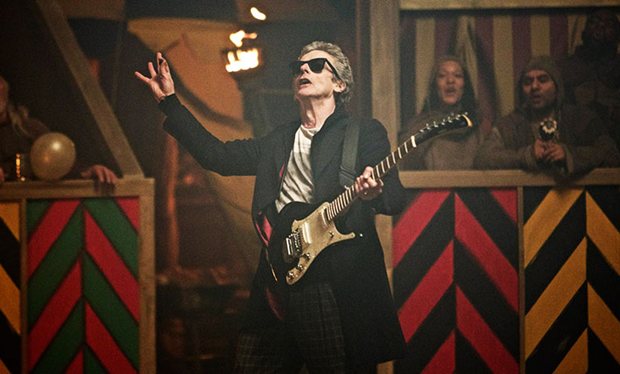
Was_that_really_Peter_Capaldi_playing_the_guitar_in_Doctor_Who_Something I’ve noticed at university is that being a Doctor Who fan is strikingly more niche than I had imagined.

People are willing to admit that they’ve watched it in the past. They whole-heartedly endorse the concept. Yet their admission comes with a pang of regret. They have been disappointed, and they are about to disappoint me. The show currently plays no part in their regular TV schedule.

The next most common thing they are wont to impart is that the time they “dropped out” was after David Tennant left. Now, I’m not going to argue that they were wrong to do that. I won’t defend Matt Smith with any of the zeal I praise Tennant. I even agree to a large extent with their decision given that the show has suffered quite a dive in quality of late. However, is that enough to unplug oneself from such a rich source of indigenous culture? Doctor Who is a source of our collective mythology. Its characters and tropes are embedded in the national psyche and for all its escapism, it remains relevant and necessary for the world of today.

Now enough of that, you came here for a review of the latest series. I think now is a good time to make my own confession, entrust you with my “confession dial” as it were. I’ve wavered, been disloyal, hypocritical – a fraud. Whilst all episodes used to be faithfully observed, I have faltered. As Matt Smith skipped closer towards his regeneration into Peter Capaldi, I fell from the path of the righteous and was negligent in my veneration. This lapse continued into the twelfth (or thirteenth if you count the War Doctor?) but recently I’ve come back to the show. Not precisely because of a renewed sense of duty, rather out of surplus hours afforded to me as a student. Anyhow, for your pleasure (or otherwise) I’ve comprised my thoughts of the twelfth doctors escapades this year into a handy surmise for anyone out there who still cares (though I realise this number may be relatively few.)

The series opened with a caper starring Missy, the latest female incarnation of the Master – the Doctor’s arch-enemy and fellow Time Lord. I feel that something of the intensity of the John Simm/David Tennant portrayal has been lost during the Moffat years. The stakes seem lower. The great ideological clash of chaos and compassion is replaced by bickering and wry banter. This is entertaining on a superficial level, but as a viewer we fail to become emotionally invested in either of the sides. Capaldi and Michelle Gomez feed off each other, but not in any constructive way – their disagreements seem to be incidental and lack the confrontational punch which Tennant/Simm were able to capture so well. The opening two-parter also features the appearance of UNIT, regrettably – more about that later.

We visit Skaro, planet of the Daleks next, where the Doctor is faced with the moral conundrum of the opportunity to save a young and yet uncorrupted Davros long before the Time War breaks out. (Davros Actor) as the old Davros, who is dying and wants to speak with the Doctor one last time. Capaldi and the evil genius have great banter and there is a particularly touching moment when he requests to see the sunrise with his real eyes as opposed to relying on his third, bionic ocular. It is later revealed that this conversation was doubly disingenuous, with both parties using the situation to manipulate each other. Nevertheless, this was a series highlight.

Another interesting moment of this two-part story was when Clara had to infiltrate the dalek ranks and inhabited the exoskeleton/battle tank temporarily. This concept was fairly ridiculous but we did learn something from it; that daleks scream “exterminate” when they are in emotional distress. It was pretty cool to see Clara’s words translated into Dalek and perhaps explains why the daleks never seem to shoot the Doctor even though he is clearly surrounded and easily “exterminable”– he has a calming influence, and thus they cannot get worked up enough to fire their ray gun. The dalek sewers concept was also satisfyingly dark – the mutants survive beyond the decomposition of their flesh and become a sort of semi-conscious sludge, screaming in constant pain.

The Zygons were brought back this series after their reintroduction in the 50th anniversary special as a sort of light-hearted subplot. Now I shall return, as promised, to the issue of UNIT as a concept in Doctor Who. Needless to say, I’m not a fan. UNIT is the legacy of an austere BBC budget during the seventies. The Doctor was conveniently banished to present day Earth by the Time Lord council; this allowed the production to save on location and set design. Whilst the Doctor did get a rather snazzy car to add to his terrestrial arsenal, he was also burdened with the institution known as UNIT.

UNIT are a military organisation created to combat alien threats to earth – and clearly, they aren’t very good at that, otherwise the Doctor would not have to intervene so much. I’ve never liked UNIT, ever since they were reintroduced in a pretty terrible two-parter entitled The Sontaran Experiment during the third series (Martha era.) They seem to embody a lot of the things the Doctor disagrees with, such as eagerness to resort to violence to solve problems and an unquestioningly negative prejudice towards extra-terrestrials. However, the Doctor seems to tolerate them because they feed his ego and provide him with his own private plane – bringing out the worst in his character.

The first episode was marred by some abysmal acting, particular the UNIT second in command. The scene where a UNIT officer is “tricked” by the Zygons (inhabiting human form, somhow also with the ability to access humans’ memories and shape-shift into people from their past – OP bro! Am I right?) was particularly terrible. However, I did enjoy the not-so-subtle allusions to the current political situation with ISIS and prejudice towards refugees, and the mind-wiped Zygon morphing out of human form uncontrollably. Osgood, somewhat convolutedly resurrected, is a great tribute to the committed Doctor Who fan here also.

Ashildr (AKA Arya Stark from Game of Thrones) plays a big role in this series, as the immortal daughter of a Viking village invaded by a Napoleon Complex sufferer and his robot army. Masie Williams is absolutely brilliant in this – even though I may not be the biggest fan of her character in A Song of Ice and Fire, she is a superb actress, really holding her own against the experience of Capaldi. I do have an issue, however, with the concept of her character and how she given eternal life.

As you may be aware, and I expect you are if you’ve read this much of the review, there was another prominent immortal character who was a recurring star of the Russel T. Davies era (though interestingly enough, created by Moffat in his debut two-parter in series 1.) That’s right, a certain rogue Time Agent known as Captain Jack Harkness – whose legacy lives in the “spacehopper” time-travel device – the Vortex Manipulator (used by “Missy” this series.) Captain Jack was given also given immortality by mistake when Rose Tyler (Billie Piper) harnessed the power of the heart of the TARDIS to bring him back to life after being shot by the daleks in The Parting of the Ways (2005). Yet, can we really be expected to accept that the Doctor would be just as careless? He for one knows what it is like to be immortal, so is the least likely to bestow it upon humans arbitrarily. Forget the fact that both time travel and immortality are possible in this show. This was just a step too far for me to believe.

Rose Goddess

Captain Jack was also given immortality by mistake when Rose Tyler harnessed the power of the heart of the TARDIS to bring him back to life after being shot by the daleks in The Parting of the Ways (2005).


Sleep No More was easily the worst episode of the series. Penned by Mark Gatiss, that is not surprising (sorry!) I have much respect for the guy, but in my opinion, he is a far better actor than a writer (Mycroft in Sherlock.) The concept, of eliminating sleep to increase human productivity had great potential. However, this was ultimately wasted. I mean, monsters made of the grit in the corner of your eye *sigh*. I felt cheated. This was a great opportunity to show humans as the real monsters – insane ravenous creatures driven to madness by sleep deprivation a la the “Soviet Sleep Experiment” (urban myth by the way.) Also, the physics were laughable. Someone please explain to him how gravity works.

Now, to the final three-part story beginning with the interesting Face the Raven (AKA Clara dies again but this time it’s for real…or is it?) Poor writing never quite made Clara as loveable, and perhaps because we’ve had her death dangled before us so many times before that when it actually happened my honest feelings were- so what? Clearly the Doctor felt otherwise, as he appeared to swear vengeance on the whole universe for allowing this event to occur. Anyway, he is teleported off to his own personal Hell for my favourite episode of the series Hell Bent.

Here is a one sentence summary: The Doctor chooses to punch through a twenty-feet thick wall of diamond in order to reach an unknown goal over the course of four-and-a-half-billion years, repeating the same course of events over and over again, chipping away miniscule fragments at a time, just so he can avoid giving up his darkest secret. Further explanation is unnecessary.
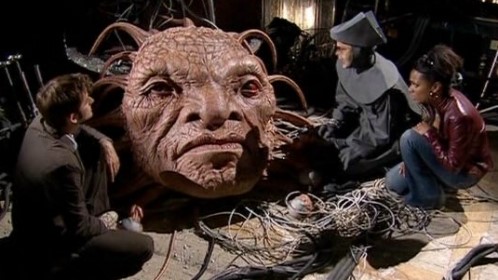
Boe Face

The death of the Face of Boe, some five billion years from now in 2007’s Gridlock.

In the series finale, after successfully completing his task (not having aged a day, because he was teleported to the hell-fortress and thus vaporised and re-materialised himself after each attempt) the Doctor reaches Galifrey, which he teleported out of its time-locked location in space-time using the power of thirteen TARDIS’s at the end of the 50th anniversary special. To be honest, this was something of an anti-climax. Clara was brought back – shocker, not really dead. However, the Doctor had to be mind-wiped for some reason because her death was a “fixed point in time and space”, so her departure from the show was suspiciously similar to Donna Noble’s (Catherine Tate) in that respect. We learnt that Time Lord is in fact not a species, but a rank – there seem to be “Time Peasants” in this hyper-advanced feudal society. We also found out that contrary to the evidence to be found in Captain Jack/The Face of Boe, immortals appear not to age at all, even after a hundred trillion years (approximate death-date of the universe according to 2007’s Utopia) when we meet Ashildr again at the “end of time” (although I am forced to reconsider, did Jack elect to have some sort of extreme body modification – let the debate begin in the comments…) Thankfully, the series ended on a cheerful note when Doctor ditched his ridiculous “sonic glasses” for a new sonic screwdriver


Posted in Entertainment, Review | Tagged , , , , , , , , , , , , | Leave a comment

2015: Year in Review

What happened in the Year of Our Lord Two Thousand and Fifteen? From a broad perspective, Scots had to come to terms with the fact that independence had been put on hold for at least a “generation.” Bumper stickers were ripped off in triumph or peeled back in slow melancholy. Lampposts were depoliticised and profile pictures made plain. Gradually even the “45-ers”, who had been pushed into the bottom corner relinquished their militancy and focused their attention on new battles – which have evidently been all but won, as shown in May’s general election.

For me, this year has been a mixture of triumph and tragedy. I successfully lived another lap round the sun and turned eighteen. I hosted two parties and got was accepted by the University of Edinburgh to study English Literature and German. But it would be lying to say things have been all plain sailing. The road to passing my driving test was a protracted and painful experience. And a dark first half of the year was brought to its conclusion with the sudden death of my grandma.

Death is difficult to talk about. It is inevitable, but that does not mean you expect it. When it arrives people are reduced to imparting clichéd comfort to the inconsolable. It is a time for silence as much as anything; yet laughter too – that is so vital. No one knows what to say. A lifetime cannot be summarised in a line.

In January I announced that I had self-published my first novel on the Kindle Store. In hindsight, this was a mistake. The writing process was worthwhile itself, but after weeks of redrafting and editing I had begun to hate my creation. It was unoriginal, even disgusting in some places and the plot made no logical sense at all. Yet I have not been deterred from writing and I can tell you now that I am currently revising the first draft of a sci-fi novella which I wrote over the summer.

Hosting parties has been a new thing for me this year. Dinner parties were so 2014; proper shindigs were the order of this annum. When you host a party, you have so much control. You set all the parameters, and people are compelled to comply because you are giving them a venue to consume alcohol. Plus they have given me the chance to explore the limitations of my speaker system, which does sound awesome when being fed high volumes. It is very strange to see the place you inhabit for the most mundane domesticity transformed simultaneously into a bar, club and dancefloor.

I’ve noticed whilst flicking back through previous posts in this blog that reviews are a recurring theme. In 2015 I reviewed the Orkney Schools Big Band in Matchmakers; the Youth Drama Festival one act plays; Jackalope’s gig in the Bothy Bar; Nacho Heap at 2Loud2Live, and Muse’s latest album Drones. The biggest disappointment of my year is a close call between the delayed release of George R. R. Martin’s sixth book The Winds of Winter, and the failure of Jackalope’s long awaited EP to appear. I have also really struggled to replace my infatuation with Hybrid Constellation – flirtations with other bands have proved unfruitful, though I did get to hear Ross Clark’s new venture In Stations earlier in November.

For me, August seemed to linger. Life was suspended between my old life in Orkney and the new to come in Edinburgh. I allowed optimism to grow within me. At home on my own I drove to windy beaches and walked over the stones, breathing in the sea. Pacing over old routes made more beautiful by the knowledge that these sights would be denied me for the months ahead. The job I had tolerated, that had shaped my identity, that had financed much musical paraphernalia for years, became to me in those last few weeks almost unbearably mundane. I itched for new things, but was sad to leave.

And then September. University was finally here – I felt like my whole life had been planned towards this. That’s not me being pretentious, I just don’t know what I’m going to end up doing as a job at the end of it all. Student life is different to how it is commonly portrayed, at least for me it isn’t exactly party every day. I’ve experienced the infamous Hive, and the Liquid Room; but gigs and poetry are more my thing.

October was perhaps the most cultural month of my life. In my course I was reading Goethe (perhaps not comprehending, but nevertheless, reading) and Oscar Wilde. I went to see the new film adaptation of Macbeth – very intense, much red smoke. The Literature Society, or “LitSoc” as they are colloquially known, hosted a discussion on modern dystopia and then organised a trip to see a theatre adaptation of Huxley’s Brave New World. This was an extremely impressive and immersive experience, which transferred from the page faithfully whilst subtly updating the text for today.

In November I was in the eighteenth century. After a brief spell in conversation with the German Enlightened philosophers, I took up residency at the court of Versailles to study the rituals and politics of the Bourbon dynasty.

Finally, to the present. Fresh from exams I sit bereft in the post-study void of Hermit’s Croft. I type opposite a half-packed suitcase and await the dawn, whence I begin my journey to the shores of the Treeless Isles.

Posted in Entertainment, Life, Music, Personal experience, Politics, Review, Uncategorized | Tagged , , , , , , , , , , , , , , , , | Leave a comment

Lazy Lights, Lamps, Love and Leather Seats

I think I owe you a blog post. It’s almost the end of my first semester at university and I’d like to keep you in the loop.

Life in Hermit’s Croft is falling into its routines. The installation of street furniture is complete. A gleaned guitar, a lamp and leather seat. Fairy lights lazily draped above the sink exude their quiet glow, and 6 Music is interspersed with Radio 3 from generously gifted PC speakers.

On Thursdays of an evening I’ll attend some wordy gathering, or when the mood takes me, a guest lecture or a workshop. Perhaps a couple of days in the week I’ll visit the gym or swim. I’m settling into equilibrium, but I want to fight it.

You find me just as I have given my presentation for my oral class in German. The subject was the federal state of Brandenburg – core of the Hohenzollern dynasty and seat of Prussian Kings. In German one is prompted to reflect upon the nature of language. Is one dialect representative of the language as a whole? Can you say you’ve learnt German if all you know is Hochdeutsch? You’d probably have a hard time in Bavaria.

Similarly, one is also invited to consider questions of identity and a sense of place or belonging. We think of our Scottish identity, a year on from a no vote and on the day of our patron saint. I consider my Orcadian upbringing. I’ve come to realise just how lucky I’ve been to have grown up in such a nice place, with a real sense of cultural identity; this perhaps coming rather artificially from the need to promote ourselves to further the tourism industry? Maybe I’m being cynical – it could be that the strength of oral tradition and inherent kinship with our forbearers has led to the preservation of such things, but who knows?

Edinburgh has many advantages over Orkney, whilst it may be great to go into the pub and recognise almost every person, one can’t help but crave anonymity at times. I can go to things alone and feel less of a loner, because actually quite a lot of people are loners too. I can go to a writing workshop and feel among friends without exchanging names.

Over the weekend I took part in Scotland’s Climate March, praying most of the time for a turn in the weather to ease the damp miserly of our technicolour advance. I suppose that’s what they call direct democracy.

Speaking of democracy, let’s talk absolutism. Yes, I’m loving my European History course, which stretches from the Renaissance to the French Revolution. I am fascinated and appalled at the audacity of figures such as Machiavelli, Louis XIV and Frederick the Great. I find it thrilling to contemplate the intellectual movements which influenced them; the apparent contradiction of Absolutism and Enlightenment married to great affect by Prussian Kings. You can see why I picked Brandenburg now…

University allows time for deep reflection, self-discovery and extra-curricular development. So naturally, I’ve spent mine watching Rick and Morty, discovering Peep Show, Parks and Recreation and becoming a huge fan of Community. In all seriousness, some books I’ve read in my spare time are More’s Utopia, Wilde’s A Picture of Dorian Gray and I’m just finishing Dracula. But just to be clear, I whole-heartedly endorse Rick and Morty. Everything about it is great. Watch it.

I don’t feel as if I’ve lost touch with Orkney. Feelings of home come out of me in bursts. A dialect word that so perfectly fits a situation, when one afternoon you find yourself writing a crofting scene ripped from 1850s Harray without ever intending. Just last week I was at a gig where Ross Clark of Hybrid Constellation fame was playing with his new band In Stations. I felt a pang of sentimentality at the syncopated djent breakdown slotted quite unsubtly into some intricate alt-rock composition. Disclaimer, they were by far the best act of the three I saw that night and I’ll definitely go and see them again if I get the chance.

That’s just about all I have to say for now. Adios! Adieu! Tschuss! Ciao! And may the force be with you! #StarWarsEpisodeVIIhype

Posted in Uncategorized | Leave a comment

The Hermit Emerges

I write to you after a considerable absence at the keyboard for the past month. Since my last post I have moved to the Scottish capital Edinburgh where I am attending the University thereof in the study of English Literature and German. I currently reside on the ground floor of a block of student accommodation known charmingly as Hermit’s Croft with four other male flatmates, each bestowed with single-syllable names to my triplicate title.

You find me now at the end of my first week of “proper” lectures, following on from the introductory foray that is Freshers’ Week. Henceforth I shall transcribe an account of my misadventures that have accompanied me to this point.

Saturday 12th – moving in day. My family sticks around for as long as possible, we dine in the Elephant House café; an establishment which claims to have been host to the production of much of the first in the Harry Potter series. I eat little of my lasagne; I’m tense and defensive – this heightened state is mixed in with a good helping of FMO (Fear of Missing Out) because obviously everyone is having the time of their lives and is in a state of unprecedented euphoria, already having a whole city’s worth of friends in their possession within the first day of Freshers’ Week.

I tread carefully around in my new nine-month home. Any quirk or misdemeanour could sour a whole year’s worth of relations between myself and my randomly allocated acquaintances. Steeling myself for rejection and abuse I knock on the door of my, one and only at this stage, neighbour.

And we go out. Because it is expected and because I’ve planned it. All of it. Planned meticulously planned because spontaneity really isn’t me and this day has had too much already. I know the names of the bands playing, all researched and catalogued and calandered (yes that’s a verb now.) And yet, still utterly terrifying.

But by chance, sweet happenstance and coincidence, we meet a Bulgarian. Female Bulgarian. Out of all the nationalities that could have approached us, a Bulgarian.

This sounds unhinged I know, but there is an explanation for the remarkability with which I attribute the cultural collision. Yet a fortnight’s past I had hosted a European Union themed party which required of the attendees to dress according to their own specific and unique member state; this could be either the national dress, an indigenous celebrity or something more abstract to represent the given country. As luck would have it, I gave myself the task of representing Bulgaria for which I learnt “good evening” in the native tongue and made a Shopska Salad for the international buffet.

But the façade of friendship was eroded by the revelation that this 20-year-old was in fact a second year Freshers’ Week volunteer. I immediately began to question the veracity of the encounter, whether the entire conversation had been a false construct designed to make me feel welcome. This information once solicited, could never be withdrawn and even as I sat opposite her and my newly confessed vegan friend drinking ginger and lemon tea back at the flat I could not help the gnawing sense of paranoia from nibbling at my psyche.

On Sunday I attended my first Model UN debate in the Teviot Hall. This was where I met my New Yorker friends as we discussed solutions to the Syrian Refugee crisis. I found it very entertaining as a charismatic and impassioned representation of Lebanon was made, allied with Assad and blaming the Western intervention for the escalation of the conflict and the rise of ISIS. Of course I signed up for this society as I was advised by a cousin – say yes to everything; this of all weeks is the week of agreeability.

As darkness fell I returned to the Student Union; a place I had been told beforehand that I would never return to after the first week. Pronto Mama – a Glasgow-based six piece “indie prog” band were playing. They mixed a progressive sound with funky brass/saxophone breaks and rich harmonies to create a fascinating textural soundscape. For one song the entire band descended from the stage and unamplified sang a hauntingly beautiful acapella. To top it off I realised that I had been “dancing” beside someone doing exactly the same course as me all the way through.

On Monday I took the “lads” on a pub quiz in the Pleasance in which we did pretty poorly. Tuesday saw another UN debate, where territorial disputes and the increasing militarisation within the arctic were proposedly solved by making the region a permanent venue for winter sports by the delegate for the International Olympic Committee. Wednesday was my first proper experience of a DJ set, with a member of Metronomy taking to the decks to deliver a good mix of funk and indie tunes for the night.

Thursday was another first experience, this time of a poetry slam. This was truly a verbal extravaganza, an astounding level of quality and thoroughly contemporary content. It was quite strange to begin with, to listen to and experience poetry in a competitive context but the format did not seem to detract from what was being delivered. The crowd clicking in approval at particularly evocative moments, respectful but clearly engaging with what was being said. This was probably the most subtle yet potent moments of Freshers’ Week, although it was followed by discordant, atonal post rock in the Teviot whilst drunk members of the front row set about their task of destroying a plastic Guitar Hero controller during the progress of the set.

On Friday I went to the Introduction to the Student Newspaper, which really wasn’t much of an introduction to the Student Newspaper but was an introduction to some students who wanted to write for the newspaper. There I met a fellow Hermit’s Croftian and we went off to some flat party in Robertson’s Close which descended into some strange possibly too posh nightclub where shattered shards were scattered across the dancefloor.

The finale of my induction to Edinburgh concluded in Glasgow, where I had purchased months previously a ticket to see Wolf Alice off the back of a generous Ticketmaster voucher. I was greeted, on arrival in the Second City of the empire, by The Proclaimers blasting through the PA in George Square at a huge Yes rally, a year on from the rejection of independence by the Scottish people.

My experience of the gig was hindered somewhat by the necessity of carrying my overnight bag on my back, otherwise I would have been right in the moshpit. Anyhow, the band were excellent and I got to see Drenge also. The night ended after flat “pre-drinks” (a somewhat alien concept for me admittedly) in the Glasgow University Union, which is an entirely different animal from EUSA’s offerings. I have two words – Topless Balcony.

This may seem rather rambling and lacking in any perceivable connecting thread so I’m just going to wrap up in this following paragraph.

After two weeks in Edinburgh I’m slowly beginning to think that I may have made the right choice coming here. Though I won’t admit to having anything like the seemingly instantaneous camaraderie expected of a Fresher during their first couple of weeks, I feel the origins and roots of deeper things emerging. Intellectual bonds and meetings of the mind. I’ve met people whose, although I may not agree with them entirely, views and passions will help me to see the world more clearly and develop as person. I think of philosophy, and of seemingly useless anecdotes suddenly becoming relevant. On my visit to the anarchist society, my knowledge of communism suddenly finding forums for informed discussion. Even in these early days the theory of university as a scholastic community and a place of people who care about ideas is proving to be true. P.S. The city is totes beaut also.

Posted in Uncategorized | Leave a comment

Wallow in Solitude

Dropped Mum off at work. I’m in the driving seat now. Alone. Drizzling unceasingly. I fire up the wipers, flick the headlights to dip. The jangly, sparkly bliss of the Stone Roses eminates from the somewhat plastic-y speaker system and I’m ready for the road.

I turn left up the hill. I observe up and down like a good boy; determined not to slide, as the most of drivers tell me of the inevitability, into bad habits. At the roundabout I go straight ahead, taking an unwitting tour of the housing estates of Stromness before about turning and indicating left for Outertown.

Not precisely sure where I’m going on this stretch of single track, I see a sign, a brown one, whispering Warbeth.

Living in Harray, the island’s only landlocked parish, the beach would be something of a novelty as the coast is not within reasonable walking distance.

I descend and am disconcerted by the number of passing places dotted at alarmingly close intervals on my way down. I should be thankful that they’re there, but their presence seems to me only to indicate the potential volume of flow. I’m in the mood to wallow in solitude. I’d rather avoid meeting anything, or anyone.

I park beside the graveyard, taking a swig of water from an old Strathmore bottle – this driving’s a dehydrating business. Ignoramus that I am I try, not that hard mind you, to gain access to the sea of headstones that I might gain access to the sea beyond. Quickly I realise there’s a footpath branching off to the right before the kirkyard, and continue on my way.

The first I meet are two dog walkers. Thankfully their canine companion takes no interest inme whatsoever save the briefest of upward glances before burying its nose into the damp grass ahead as it trots along nonplussed.

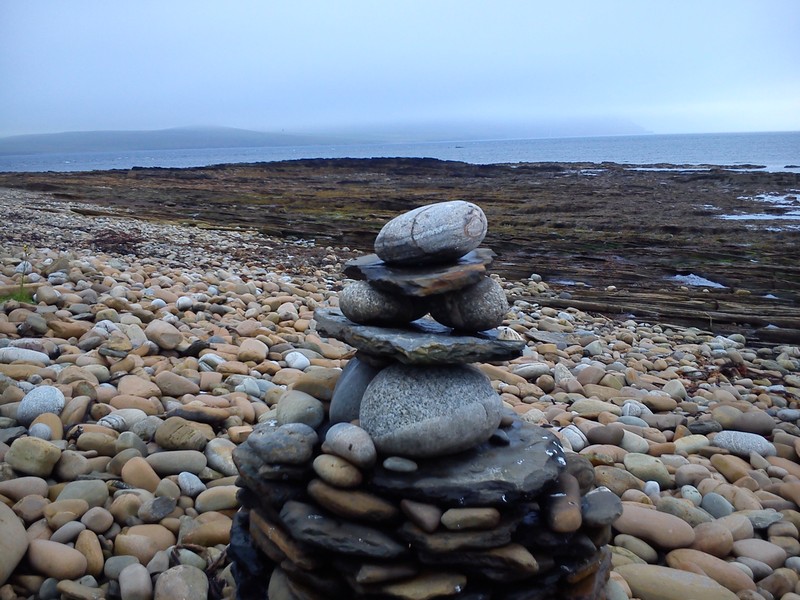
I reach the shore, stopping momentarily to make a visual document of my adventure with my phone camera. Fog and drizzle obscure the scene and a fresh breeze wafts waves of salty sea air into my olfactory system. These are ideal climes, for there’s something detestable about a blinding sunny day when one is in the mood for brooding solitude.

DSC_0047

Someone’s built a cairn. I negotiate over nature’s patchwork of geometry and colour in the indefatigable variety of stones and place my hand on top as if completing all four of the big red balls on Total Wipeout in record time. I then make my way to the edge of the graveyard, all across my path is strewn kelp like discarded power cables in tangled bundles and straggly loose threads. I see evidence of a barbeque of the recent past and the sad remains of a forgotten bucket and spade – their gaudy fluorescence standing out against the natural hues of the coast.

DSC_0049

Scrambling over the rocks I come to the base of the small fringe of cliff. The layers of sediment are clearly visible, marking out years of composition. A hole has been burrowed out just below the topsoil. Who lives here?

A malimak swoops in low over my head gliding back out over the sea in cool effortlessness. These are beautiful birds with grey encrusted beaks; endowed with all the grace that seagulls lack (theirs is a clumsy flapping flight, whereas the fulmar’s rigid wings allow them to surf the air currents expertly.) I’m reminded that these seafowl are known to spit, but surely only when guarding chicks? I’m fine. I leave spittle-free.

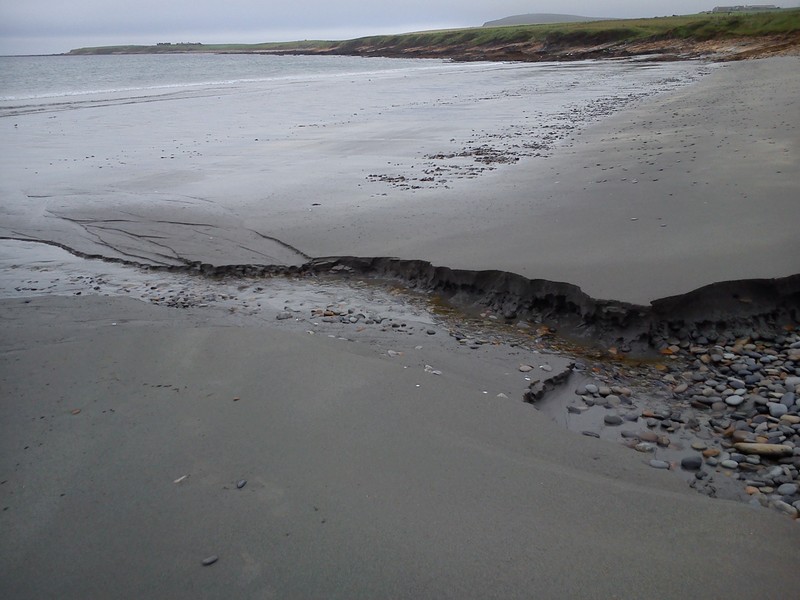
Rocky beaches are okay, but I want sand so I make my way to the grey expanse ahead. I watch the dance of squabbling sandpipers as they follow me along the shore. I the middle of the stretch of grey grit there is a tributary. Its banks appear to be sculpted from compacted sand, like glacial névé. Oh. Not so compacted. I seem to have caused a landslide. What I love about this beach, being less frequented than such other Orkney haunts (the Broch, Skaill etc.) is that it is entirely devoid of human footprints if caught early enough. I am utterly alone.

DSC_0051

Suddenly a woman rushes out from nowhere. She’s dark haired, wearing a pink bikini and quite beautiful in the sheer absurdity of the situation. I turn away instinctively at the sight of her, has she seen me? I don’t want to disturb the intimacy of the moment. I must look back, this is too strange to miss. My heart is pounding under my ribs.

She runs into the waves, dressed like this on a day which I have described above as blatantly inclement. I hastily carry myself away, stealing the occasional glance backward.

A thought strikes me and I’m forced to pause. What if she drowns? Gets hypothermia? What position does that put me in? Could I save her? Wild permutations of the possible outcome of such a rescue attempt scroll over my mind.  I look back again. Her head is above water – she dives and I hold my breath until she comes back up again. I walk back to the car. For now I am absolved.

Posted in Life, Personal experience | Tagged , , , | Leave a comment