I want this end-of-year sum-up to focus on the positive. Let’s start with this: 2021 was better than 2020. A very low bar indeed, but 2021 improved on its predecessor in most ways.
It was a bleak start to the year, and I delayed my return to Glasgow from Orkney by several weeks because there was really nothing to go back to apart from some very restricted library opening hours, and university lectures were all online anyway. Despite university being just about the only thing I could do, I still managed to get some extra-curricular stuff in with the continuation of the Mooting competition virtually throughout the first half of the year. Appropriately enough, the first round of the new year was on culpable and reckless conduct during the pandemic, which was Jason Leitch’s predecessor and an SNP MP’s downfall when travel restrictions were severe. Luckily that early lockdown phase does seem a long time ago now and unlikely to return.
I also kept myself as sane as I could by throwing myself into Law Clinic work, helping host the fortnightly Zoom drop-in sessions and managing cases in between coursework.
The age of Zoom quizzes had a second wind, and I organised a few virtual pub meet-ups with people on my course before we all finally met up in May at the end of a year without seeing each other in person.
Although I was lucky enough to get some furlough pay from my Historic Environment Scotland job during Tier 4, I also took up a one-off paid acting gig through the university where I took part in a role-play scenario for diploma students as a soon-to-be divorcee police officer.
In 2021 I have been thinking more about my career than usual and applying for traineeships and summer placement in the hope of getting a contract with a law firm before I start my diploma in professional practice this year. I have attended several virtual assessment centres and some final stage interviews but am yet to be ultimately successful. Nevertheless, I am pushing on and have another interview lined up for later this month.
I went to the Sheriff Court twice this year. The first time was after the mooting semi-final judge invited all the participants to come and shadow him for a day. I was able to observe the accused’s evidence at a High Court criminal trial where the sheriff was covering and got an idea of what a typical day was like for him. The second time I was appearing in front of a sheriff as a lay representative for a Law Clinic client with a simple procedure claim. I felt prepared for the hearing as a result of my mooting experience, advocacy training and having visited the court before, but unfortunately, the client lost his case due to procedural regulations.
By summer outdoor socialising and internal travel was starting back up and I was able to go to a family barbeque. My sister paid me a visit in Glasgow, and we went to Arran for a day trip where we climbed the Goat Fell and I got quite sunburnt. I also managed to get to Bute with my brother for a couple of hours after being excluded from the limited-capacity ferry at the intended departure time initially.
Through my work, I managed to get a week’s work experience within the new HES in-house legal team, and I also mixed things up by looking after Dumbarton castle for a few days.
In August, I finally got back to gigs after a painfully long absence, the first being Black Country, New Road at the Edinburgh Festival, as I talked about in my previous post. I’m hoping to start off 2022 with The Twilight Sad at Barrowlands if Sturgeon smiles upon us.
In September I was in London for the memorial service of my good friend Charles who died suddenly at the beginning of lockdown. It was a beautiful tribute and showed what an impact he’d had on so many people and in so many aspects. Even though I had been in regular contact with him all the time he had been working in London after graduation, there were things I learnt that I didn’t know about him. The contributions from his siblings were especially moving, capturing his playfulness and intellectual seriousness vividly. It still seems surreal to me, but I am glad we were finally able to come together properly and celebrate him in the right way.
The new semester brought back a single weekly in-person lecture(!) and real-life tutorials. I always looked forward to our Friday morning Ethics and Justice sessions we were privileged enough to receive as Clinic students and will never take a 9am lecture for granted again! These lecture/seminar hybrids kept me going where the majority of learning was still online and the 12 o’clock finishing time often segued nicely into a pint at the newly opened student union just across the road. I was also able to meet third- and fourth-year Clinic students doing honours, which was good socially, as well as getting the perspectives of slightly more experienced people.
In general, I think the second half of the year was when I started to ask people for advice about things a bit more, which is something I’ve struggled with slightly because I like to be self-sufficient. Mostly it has been about my career, but I’ve also realised I want to become happier in my life as well and that can be quite hard to achieve purely on your own. In terms of my professional life, I have more of a plan than I ever have had, and it’s the sort of plan that is robust enough to withstand the thousand natural shocks of Covid regulations. Something similar might have to occur if I want to get beyond “basically fine”, drifting to mildly miserable, on the life-joy scale.
2021 got off to a terrible start with Tier 4 restrictions imposed in Glasgow for the best part of four months. Things began to revive in April and by May I had finally met the people on my course for the first time in real life. From there, things began to open up properly again and I got into bouldering for a time and there was a semblance of a tourist season at Glasgow Cathedral, although much muted.
It was mid-August before I had my first gig back post-Covid. I went to see Black Country, New Road at the Edinburgh festival, a band whose debut single ‘Sunglasses’ I had covered during my tenure as Music Editor at The National Student. Although it was quite surreal, taking place effectively in an open-sided tent where everyone was seated and socially distanced, the gig was a great return to live music – one of the things I had missed most throughout the pandemic times.
The band’s debut album features on this short list of records I have enjoyed this past year. For whatever reason, I have not been as interested in contemporary albums this year. My top Spotify artist was Stereolab, whose 1997 album Dots and Loops I looped throughout 2021. King Gizzard appeared again as my number two, a band who this year re-explored microtonal music on KG and LW neither of which in album form made it into my top records but each containing some standout singles like ‘Straws in the Wind’ and ‘K.G.L.W’. Eyedress, a Filipino artist who makes lo-fi, moody punk was my third and Slowthai, who released a double-album this year was my fourth. Unknown Mortal Orchestra again made my top five with songs like ‘That Life’ and ‘Weekend Run’.
Aside from that though, here is a list of albums that I liked the most in 2021:
5. Daddy’s Home by St Vincent
On this album, St Vincent explores the textures of 1970s soul, jazz and soft rock with her typical warped and glitchy twist. I preferred this record to MASSEDUCTION, despite the latter’s singles such as ‘Los Ageless’ and ‘New York’, because it had more replayability from start to finish. It also seemed to have a more cohesive aesthetic and natural recording style that leaves space where appropriate, such as on the title track, in marked contrast with the appropriately claustrophobic and compressed ‘Pay Your Way in Pain’.
St Vincent brings back the electric sitar on ‘The Melting of the Sun’, which I think showcases why the album is worth listening to through its bizarre blend of gospel and Eastern vibes.
4. Juno by Remi Wolf
Remi Wolf’s type of music is not the genre I’d usually go for, but sometimes pop hooks just can’t be denied. Juno has these in abundance. If I were to describe the closest thing to Remi Wolf I listen to, it would probably be Kero Kero Bonito. Juno has the same sort of hyperactive energy, colour and charm as KKB. Its use of samples is often hilarious such as on the standout track, ‘Front Tooth’ which plays the cackle of a dolphin as an auditory illustration. Sometimes the talky bits in tracks get slightly grating, but Wolf more than makes up for that with her ear for melody.
There’s not an especially strong thematic thread through this album, which is more a kaleidoscope of singles than anything. It’s exceptionally well produced and an extremely strong debut from an artist who seems to have shot to popularity from nowhere. There aren’t many people making records like this at the moment, although it’s not like Juno is particularly new sonically, drawing heavily from 90s R&B and pop. The thing that seems to set it apart is how upfront the songs are – they demand your attention and aren’t content to be background music.
A favourite track is ‘Anthony Kiedis’ (yes, the Red Hot Chili Peppers singer), but an honourable mention has to go to ‘Sexy Villain’ about the morbid contemporary fascination with serial killers.
3. For the First Time by Black Country, New Road
As I mentioned in the intro, I have been following BC, NR for a couple of years now and went to see them live at (literally) the earliest opportunity. I think the main thing that was apparent in their songs is how impressive their dynamic range is. It’s not all about the softly-softly to a dramatic crescendo in their songs, however, like some contemporary post-rock bands. You can actually enjoy their quiet patches in and of themselves and not just an interlude between face-melting. In fact, there is actually not a huge amount of that on the album, and where it appears it is “tasteful” if that makes sense as a description.
I haven’t taken quite as much to their quickly released follow-up Concorde that just came out. For me, For the First Time’s appeal is in the odd simplicity of their music for being a seven-piece band. The textures never feel too busy and the extra instruments augment and complement the sound rather than overcomplicate it. My particular favourites are ‘Athens, France’ and ‘Track X’.
2. Bright Magic by Public Service Broadcasting
I love what Public Service Broadcasting do. They can communicate things no other artist seems able to articulate. On previous albums, they have used archive recordings of 20th century moments and built characterful, emotive and thoughtful instrumental tracks around them whether describing space exploration, the heroism and tragedy of the coal industry or the wonder of the postal system. Bright Magic takes a step away from this approach and into the more abstract. Dedicated to the city of Berlin emerging from the despondency and total destruction of losing two world wars, it features many original vocal performances and poetry mostly in German.
It may not have the quirkiness of previous albums, but Bright Magic has some seriously beautiful peaks of emotion. Because of its abstraction, it can take some time to fully get into, but once you do find an interpretation that seems to work for you it can really transport you. One of my favourites is ‘Der Rythmus der Maschinen’ as an ode to re-industrialisation after the disaster and a desire to create an automated workers’ republic, the product of material self-forged material conditions.
Equally powerful, however, is the track ‘Blue Heaven’, featuring Andreya Casablanca of Gurr, whose massive coda features the line, “Ich bin mein Produkt, ganz von mir gemacht”. It is a huge tune apparently inspired by Marlene Dietrich going her own way in Weimar Berlin.
Bright Green Field by Squid
My top album of the year is also by the band whose gig at SWG3 was my highlight of the year, Bright Green Field by Squid. Again, I covered their first singles, such as the angsty ‘Houseplants’, at The National Student. Like BC, NR they have truly smashed it out of the park with their debut record. There are so many crunchy tunes on here from ‘Narrator’ to ‘Paddling’ and ‘Pamphlets’ each having unhinged energy that is somehow under complete perfectionist control.
Their songs aren’t really about anything in particular and the lyrics are quite abstract (or possibly, read another way, matter-of-fact). One doesn’t listen to Squid for the words though. It’s about the jam, the groove, the mosh-ability of their music. These are the musicians at the top of their game, and they have something to say! You probably won’t hear it in their lyrics though.
I’ve spent the summer in a cathedral, talking about cathedrals.
But why is it a cathedral when there’s no bishop and it’s a place for him to sit?
Yes, you’re right, it’s Presbyterian now. Church of Scotland since 1560, though they had them through the 17th century up until the Glorious Revolution and the Claim of Right. The Elders and the congregation pick the minister. As the window in the sacristy says, let them be counted as double.
But I don’t just talk about Mungo, I talk about Magnus too. Though my experience of cathedrals extends beyond that. One such building imprinted on my mind is the imposing edifice of Cologne’s archbishopric. It’s the third to me, and the first city of my year abroad in Germany, in the city where the three-day course before my teaching placement started was held.
France’s cathedrals I have no direct experience of but was happy to hear about them at the beginning of this week from an International Relations graduate with his piece of paper in hand testifying to his diplomatic credentials.
I reflected on my own limited time in Paris when I was almost wholly ignorant of the revolution. My desire to travel was rekindled as I heard about a summer spent working at a French holiday resort only returned from two weeks ago. All you need is the Pass Sanitaire, I was told, and the continent is yours. Well, I’m double vaxxed. Europe, await my return.
Talk of travel also took place on Thursday when I was discussing reading up on Russia. Latterly I’ve looked into the life of Lenin by Robert Service. Lenin is someone who would have loathed Carlyle’s lens through which he viewed history. Yet you can’t deny he was arguably the 20th century’s Great Man.
Apparently, there is a scheme where you can travel visa-free from Finland to St Petersburg. I’ll need to check that out because Moscow and Leningrad are definitely on the list, alongside Norway, Italy, Austria and Bavaria.
I want to see the cities, the mountains, the lakes and the fjords, but I also crave something quieter, subtler and slower.
Though I’ve been away from Orkney for more than a year now, I’ve retained my links with the isles through volunteering. At the start of the month, I was compering again for the Orkney International Science Festival and throughout the annum I’ve kept up my role as website/app updater for the St Magnus Way.
That first year of the Science Festival was for the organisers overshadowed by loss, following the death of Kristen Linklater, internationally recognised acting coach and founder of the Voice Centre in whose workshops we were lucky enough to participate, earlier in the year.
It was really the first proper community event I had taken part in since lockdown and such a time when I was also still experiencing personal grief for my friend Charles who had suddenly passed away that April.
Despite it being online and despite the difficulties, alienation and barriers to communication Zoom erects between us all, the OISF of 2020 truly was a community phenomenon in the most meaningful sense of the word. But it was also a community in a particular sense, in that it was a scientific community with a shared commitment to the expansion of human knowledge and species-capability that transcends both nation and generation.
Science, of course, is impersonal, but that does not preclude a truly tangible solidarity between those who gaze heavenward or into the darkest ocean trench and cry, “Mehr Licht!”
It was this that I most needed at this particular ebb in my life. A reaffirmation of what I’d believed in since boyhood after a summer of stagnation and solitude.
It is, in my opinion, chiefly an exploratory impulse that drives scientific development and being stuck to the confines of four walls when I’d dreamt of the seven seas was, to say the least, infuriating.
Now, though, this generalised Wanderlust was given a focus in a double sense. In a desire for discovery, and in dedication to someone whose attitude to travel on land and on the waves I hope to emulate.
So, when I make it to Russia, when I start off on the St Cuthbert’s Way and when I do eventually learn to sail, I’ll be doing it in tribute to you, Charles Jonathan Peter Wright.
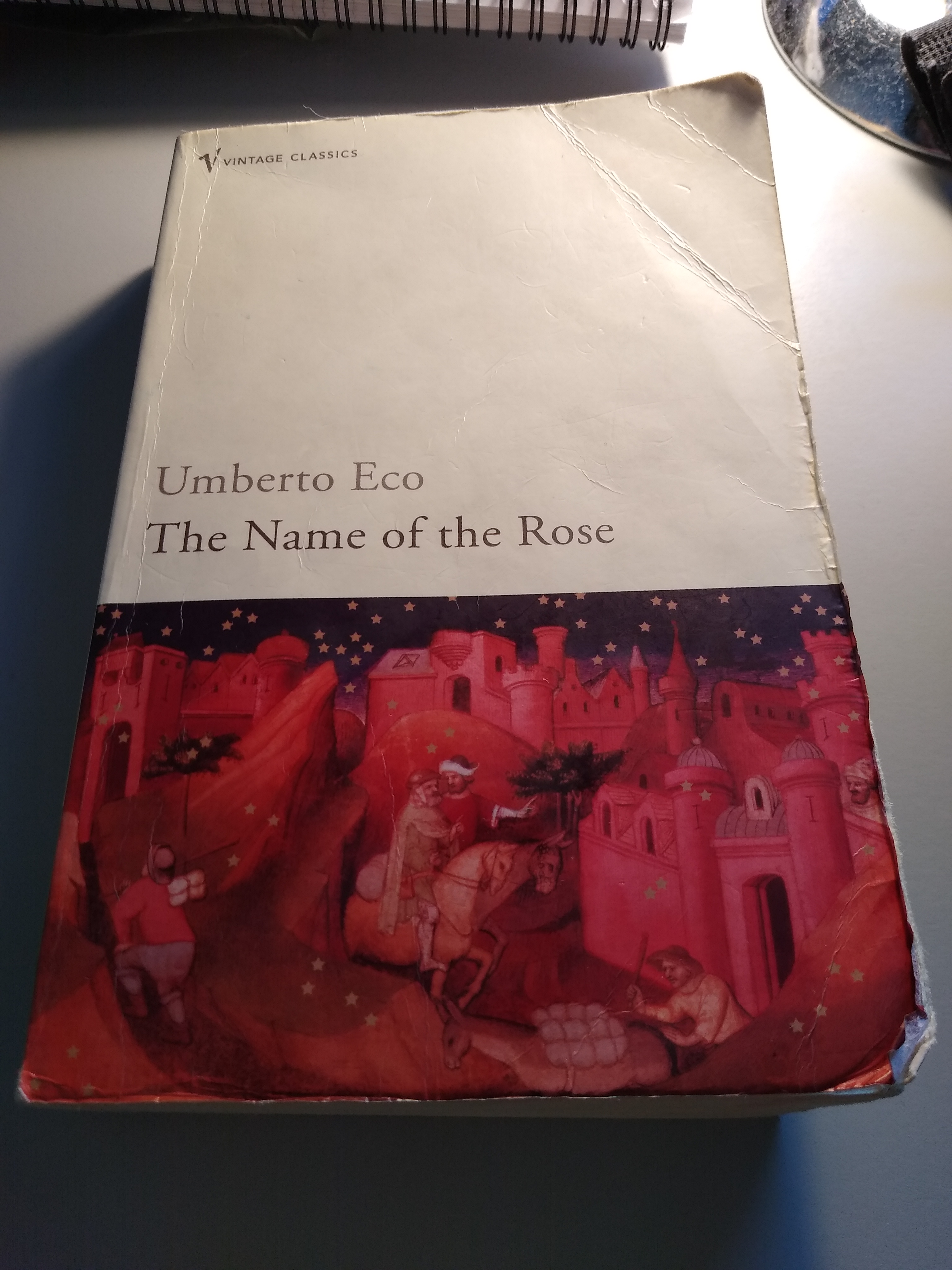
The Name of the Rose by Umberto Eco is presented to the reader as the text of an authentic medieval manuscript form the fourteenth century. Its author’s love for the time period radiates from every page; beyond passion, beyond fascination, which as the novel explores, can blind and distort. Instead, what one gets the impression of is Eco’s fidelity to something he knows is irreproducible.
He does not capture a Zeitgeist and prod it to mouth expected cliches and mannerisms; he lets it speak freely, for itself in all its messiness and contradiction.
Our perception of the Middle Ages is that of a time where things were more or less the same for about a thousand years. The features are stable and certain: knights, monks, kings, castles, the Church. We are used to medieval-inspired fiction where we can feel familiar with our surroundings, accept a given level of technology, weaponry and intellectual development. No one is going to pull a gun, fly a plane or start advocating for representative democracy. Yet Eco’s fourteenth-century Europe is dynamic. Natural philosophy is rising in tandem with, or to challenge, revelation as the principal means of knowledge acquisition; a great theological conflict over the poverty of Christ is threatening to split the Roman Church, and beyond that medieval culture war there are those excluded from that conversation point blank but whose influence is pressingly felt at the porous fringes: the heretics.
But, of course, The Name of the Rose is not just about the fourteenth century. No historical novel is solely about the time in which it is set, otherwise, it might as well be a theme park ride, not an art form. While many characters feel thoroughly, authentically medieval with obscure concerns and mindsets alien and hard to comprehend, Brother William, the novel’s object (though not the narrator) is a man who belongs to another age.
In a world where one’s rigidity of doctrine is rewarded above all else, the English monk constantly questions the basis of his fellow brothers’ theological assertions. New knowledge should only be pursued, for his contemporaries, insofar as it confirms what has been foretold already in divine revelation. William on the other hand wants practical science to improve and edify man. He holds that God ought to retreat from the administration of states and that men should govern in council (as they do in the corrupt city-states of the non-monastical secular clergy) as opposed to monarchical one-man rule. Worst of all, he has no wish to blanket-denounce as heresy everything that has the appearance of divergence from orthodoxy, instead, he maintains the need to define and separate the various interpretations the Church has deemed heretical to better understand and combat, or possibly even integrate, them.
This attitude does not set him up for success in a highly factionalised intrigue-wrought time of the papal schism. Born two centuries later, he may have been able to reconcile and temper the excesses of Luther’s break and the counter-response. As it is, he is hopeless to heal the chasm opened up between John XII and the Holy Roman Emperor, Louis the Bavarian. Like Hardy’s Jude, Brother William was born in the wrong era.
Eco’s presentation of the strangeness of the medieval era is truly inspired. From detailed discussions on manuscript marginalia doodles to Adso, our protagonist’s fretful anxiety over the existence of unicorns, to which William replies, “We cannot say that they do not exist.” Adso’s dreams and visions, drawn from his obsession with the Revelation of St John, are far removed from the psychological stew of most modern consciousnesses. As a former Germanist who loves old languages, I loved to see some heartfelt snippets of Mittelhochdeutsch (Adso’s vernacular) left in their expressive original.
Yet some themes we seem to turn to again and again, no matter the generation. What is the proper place of luxury or opulence, if is to be indulged in at all? Is there virtue in hardship or bare minimalism? Can beauty and desire be reconciled? Will laughter lead us close to the truth, or is tragedy more instructive to the soul?
The Name of the Rose may lean a certain way on all these seemingly eternal issues, but even as William’s righteous contempt builds one cannot but acknowledge a kernel of truth in all the bluff and bluster of the opponents of mirth, proponents of splendour and condemners of lust.
It’s a postmodernist, maximalist novel – of course, it doesn’t answer any questions. Even so, we are the better for them being raised and made strange in the most erudite and overwhelming way.
I have passed year one of two of my condensed law degree at Strathclyde. That was Wednesday’s news, delivered to the mobile app and received during lunch break at Glasgow Cathedral, with breakdowns of each exam. One annum’s study hasn’t gone to waste. Onwards to year two.
One year’s worth of law notes.
Covid restrictions remain in place, and it looks like they will do for at least another month, following indications of the position in England and their delay of so-called Freedom Day that was supposed to happen on Monday. There seems to be a lot of resignation to the idea of permanent restrictions or clinging to the belief that zero Covid is possible, neither of which are credible positions. I don’t believe we will continue to have restrictions into the autumn, and if there are it will be the result of policy decisions of individual public bodies and companies, not government mandated.
Vaccines are the way out of this, and highly effective vaccines we have – I’ll be receiving my first dose next week. Freedom is at hand, despite the naysayers, and so it should be. Still though, in the meantime, it’s not that much fun without any real events on the calendar (with the exception of work). We are grateful that Glasgow’s punishing purgatory of Tier 3 is at an end and pubs are open (if with no singing, no dancing and low-volume music), but I fear proper gigs are off the cards unless everything goes.
Everyone is so atomised at the moment. People need to be together, in the same room. It is essential to human flourishing! And I suppose we have been. But on the perimeter at first, on benches outside rooms.
I have met some of my fellow students post-exams after organising some Zoom get-togethers during the Glasgow no-go days, and this month I ventured into the interior with my mooting partner following our eventual defeat in the final of the competition. It was a great experience, although I didn’t appreciate being tantalised by the organiser’s repeated reference to the “fancy dinner” they normally have after the conclusion of the moot. Mooting definitely formed part of my identity during those first months of the year when lockdown was at its strictest. I’m hoping to join the ranks of the committee next year and get the opportunity to compete against other unis.
As the rounds of the competition went on, the judges increased in prestige from committee members to university staff, trainees, procurator fiscals, advocates and sheriffs and finally Lady Rae of the High Court and Court of Session. It was after the semi-final that the judge, a Glasgow sheriff, invited all the participants to come in to shadow him for a day in court. I took up that opportunity last week and watched the proceedings of a High Court trail where he was covering. It was a bit weird to be the only spectator, as the jury were being streamed from a cinema, but it was good to be able to watch the QCs with their wigs examine and cross examine the accused. I also found it strange to see the opposing counsels chat to each other informally as colleagues when the accused and judge were out of the court.
This hopefully won’t represent the beginning and end of my legal experience this summer, and indeed it has already been followed by my first visit to the Miscarriages of Justice Organisation office yesterday, a body dedicated to reassessing the cases of people serving sentences for offences they claim they did not commit. Additionally, I am in the process of organising a placement with the Historic Environment Scotland legal team next month, and of course, Law Clinic cases are ongoing.
It can be difficult to stay positive at the moment, what with Covid doom all around, but on a personal level there are a lot of things to count as objectively good and signs of progression, and I suppose one has to cling to that. Plus, I booked what will be my first proper concert in almost two years, and three King Gizzard & the Lizard Wizard albums later, which is Black Country, New Road at the Edinburgh Festival. It’ll be seated, but it’s a start. Normal life is coming back!
We have a date now. 25th September. It’s still very far away and it won’t be a funeral per se.
I won’t be at the graveside service tomorrow. I’ve been though. In October, on the eve of England’s second lockdown. There is that at least. I couldn’t not have gone.
September will be much different to now. It will be torture if “social distancing” is still going on, but I feel like there’s a strong chance it won’t be. We’ve nigh on vaccinated ourselves and we’re giving doses to other countries now. The virus is no longer a deadly one for old people and it’s going to get harder for the government to justify this half-life they’ve mandated for everyone for the past year.
I’m reminded of Charles in so many small things. Inconsequential, mundane things.
Drinking tea – I don’t really drink tea, only if the alternative is unavailable. But even that. I was reminded of that cup of tea we had in the Meadows in exam leave. He wanted another but negotiated with the guy to get a top up of hot water rather than him charging a pound extra, which in all fairness was the practical solution.
Or that tearoom amid the trees near Blackford Hill. No fancy coffees, just tea in a Styrofoam cup with blue top milk or nothing.
Or Gullane, the town with the name that sounds nothing like it’s spelt. Us the sole customers after I’d pretended to be interested in bric-a-brac you were earnestly surveying at a charity shop for two minutes until I cracked. Gaudy oilcloth tables, the rugby on TV in the background.
Far from the hipster vibes of Cult Espresso, here there was no pressure to be anyone cooler than you were. But such was always the case in his company. I was happy to be wrapped up in the bodywarmer he’d offered me on that bitter cold, frosty day; walking boots caked in sand from the infinite beach.
Microwaving my mixed bean, sweet potato, curried lentil fibrous amalgam takes me back to 50 George Square that April/May of studying for finals, making use of that communal kitchen. We’d sit in the Meadows for lunch. Or that night after the Russian art lecture I felt was too Tsar-deferent under the red sky corrugated with cloud. We were approached by the ruby glint of drunk guy swigging echo falls – you and he exchanged a few lines, and he stumbled on.
Listening to Unknown Mortal Orchestra. I know I’m remembering you from an earlier phase, but you loved that song – I-so-la-tion. I can hear you sing it now, like so many of your greatest hits.
It’s been a year. And sadly, I think it’s likely I wouldn’t have seen you anyway. But I’d at least have heard your voice, been able to share my plans and you’d have told me about all your projects and schemes – I knew you would have had so many. There was no one like you and there won’t ever be again. I miss you every day.
I’m scrolling through the timeline on sunny afternoon. After an excursion to the library in the morning and a luxurious luncheon in the Botanics my mind was mulling matters of religion. We can circle around other topics, but it always seems to come back to this – why do people believe and what do people actually believe in?
Before we roll away the stone, it may be worth mentioning what has rekindled my interest in Christian theology recently. Firstly, I set myself the task of becoming more generally knowledgeable about stuff during lockdown, starting from the start – the world of Ancient Rome and historical Jesus, and then jumping ahead to the various reformations of the early modern period. Secondly, at the end of last year, I read the utterly astounding Dominion by Tom Holland, which is a history of Christian ideas through time, which I wrote about in December.
I want to start this post with a bold claim but one which is not novel: Christianity is the atheist religion.
Christianity is about how to live in a world without God, at least as an active interlocutor. The Son has ascended to heaven, the Father no longer intervenes with the drama of the old testament and we are left only with the Spirit. The interventionist God is gone, and we must decide how to live in the interregnum between the departure and the return, which may as well be perpetual.
What then, is the point in believing anything at all? Well, to understand that you have to understand that Christianity is not about the present, it is, rather, eschatological. In other words, it’s concerned with what happened and what will happen. Where things get confusing is that what happened is continually happening, as is what will happen, according to most denominations.
Doubt about precisely what happened is baked into Christianity. Even Christ himself, in the agony of dying, cried out, “Father, why hast thou forsaken me?”
The resurrection is not part of a worldview that believes such things are generally possible. Christ’s return to life is the one exception proving the rule, that death is not conquerable, but in the life to come.
Christianity is a fundamentally materialist religion. Christians are not encouraged to heap scorn on Thomas, the doubter, but to doubt with him – to become an unbeliever, a rational sceptic, until we have seen, and we have touched the wounds of Christ. You can imagine then to the incredibly cloth-eared tweet of Prof Alice Roberts, which she posted on Good Friday this year:
Just a little reminder today. Dead people – don’t come back to life.
Prof Alice Roberts, 2nd April 2021
Just a little reminder today. Dead people – don’t come back to life.
— Prof Alice Roberts💙 (@theAliceRoberts) April 2, 2021
Inadvertently, Prof Roberts hit upon a theological point rather close to the Christian message and strikingly in tune with the church’s cyclical calendar.
On Good Friday, Christians do just that – remember that dead people don’t come back to life, that for three days the son of God was beaten by human mortality in the cruellest way imaginable. Light had gone from the world and there was no hope or expectation that it would ever return. On this day, Christians are encouraged to put from their minds any redemption to be gleaned from suffering and to focus solely on the torture and unmeaningness of violence as a brute fact of being incarnate creatures. It is on Good Friday that Christians are their most atheist, and this is absolutely necessary if what follows is to have any earth-shattering, life-changing significance.
I am not a Christian. I identify with all the steadfast non-believers throughout history who ridiculed the church, whether openly or privately, and just got on with life without the need for religion or approval from the man upstairs. However, if you are going to attack Christianity, I’m sure we can all agree you can do better than to affirm the very thing that makes it so: Dead people die…AND YET!
I postponed the boat Glasgowward to two-thirds through the month and made it up a tier from three to four without arrest, though I intelligently left a Kindle on the Megabus as evidence of my transit (recovered a week later after reporting through official channels).
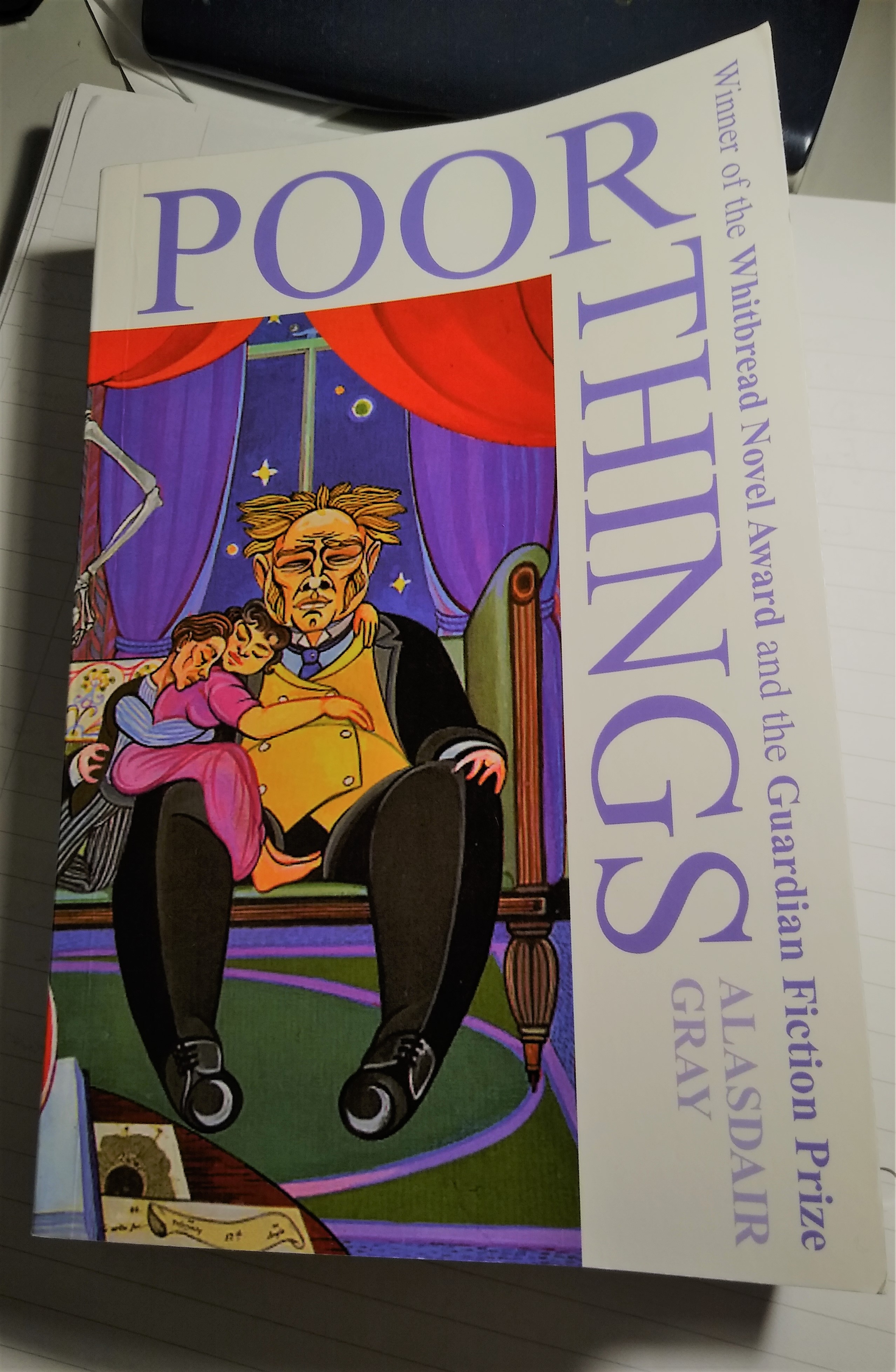
Like all Gray’s novels, the text is set out with an idiosyncratic typographical exactitude.
Arriving in a frozen metropolis glazed with a fine white crust, I dived into that most famous of Glasgow novelists, Alasdair Gray’s book, Poor Things.
It is the fourth of his works that I have read following Lanark, Janine and Unlikely Stories, Mostly. Although future dystopias featured in Lanark (as well as the immediate past) and Unlikely Stories contained an extensive and entertaining 17th century pastiche (a period I am very interested in), I had not yet seen him tackle a past quite alien from our own time and yet so much a cause of the disaster/triumph of the 20th century.
Yes, Poor Things tackles the Victorian era – a time universally shunned by modernists as encapsulating everything wrong with society as they say it. Specifically, Gray’s book concerns the late Victorian Age – the full bloom of the British Empire whose dizzying success seemed to threaten to decay into decadence at any moment. It’s a novel about the professional class of that time, primarily, in the second city of Empire – Glasgow. Medical doctors on the one hand and a crazy middle section by a slowly maddening lovestruck solicitor on the other.
Presented as an edited amalgam of a memoir, collection of letters and historical biography, the book’s contradictory accounts follow in the tradition of James Hogg’s Confessions of a Justified Sinner. Its central trio of characters, augmented by Duncan Wedderburn, the aforementioned lawyer, all bring conflicting perspectives to the tale, none of which can be dismissed outright or considered definitive and they frequently rebut and invalidate each other in particulars. All of their biographies are undermined by each other or the Editor and yet the cast is comprised of distinctive, sympathetic and complementary figures that make the story emotionally rich as well as just plain weird.
Archie McCandless is in many ways a typical Gray hero (if such a thing exists). He is proud of his humble beginnings, modest but romantic in a contained, mostly socially acceptable way. It is the bizarre experiences of his life that lead him to become an eccentric recluse, scribbling unpublishable fiction in his later years.
Wedderburn is also Gray, only screwed up to 11. Again, he is changed irrevocably by his encounter with the novel’s antagonist (if not villain), Bella Baxter, for whom the online magazine Bella Caledonia is named. His comparisons with Faust in order to understand what is happening to him might have been useful to me when I was writing my essay on Janine in my third year. For me though, it is his theological ravings that provide the funniest parts of the book.
Although Gray’s typographical experiments are not as extreme as in Janine, the strangest part of the novel is Bella and the account she gives of her Grand Tour elopement with Wedderburn. She and Godwin Baxter (more of a father than a husband) are the paranormal, Gothic heart of the tale. Like Frankenstein’s Creature Bella is created not begotten (according to McCandless) and like said Creature, is also surprisingly eloquent following near-total amnesia. Unlike the Creature, however, she has no trouble finding a mate and is an irresistibly beautiful alpha-female. Instead of parroting Miltonic phraseology, Bella begins in blank verse. Whereas the Creature is banished to the ends of the earth after his plan to resettle in the South American jungles falls through, Bella does a world tour before eventually deciding that Glasgow suits her best. Much like the eponymous Lanark of Gray’s first novel, she occasionally wonders what she was like before she was brought to life in media res and given a new name but doesn’t dwell on this.
This all changes when the Coriolanus-like figure of General Blessington comes to reclaim her as his bride. He is one of Gray’s most horrible villains but, amusingly, McCandless is bound to respect him even so because he is a Liberal MP.
Gray’s epilogue really interests me. It’s a blend of research authenticating the historical sources of the novel, and part of the novel itself, weaving real events with the later biography of the re-christened Victoria (formerly Bella).
As much as it used to be a filmic cliché to end a turn-of-the-millennium story with 9/11, there is something overdone about finishing with the outbreak of the First World War. It doesn’t quite end there though; there is a coda. A coda about the interwar Scottish left that features an invented correspondence and personal acquaintance with Hugh MacDiarmid, whom Bella/Victoria calls ‘Chris’.
Dying at the close of 1945, she is content that Britain is heading for socialism, decolonisation and the end of misery. The book seems to ask, should we share in her optimism knowing what we know now?
Bella’s late-Victorian Fabianism is utterly unprepared for the mainstream labour movement’s betrayal of international solidarity at the outbreak of the war, but it is difficult to conclude that Gray wants us to throw out her world-changing enthusiasm as naïve entirely. Likewise, across Gray’s oeuvre there is praise for the post-war settlement i.e., welfarism and republics versus monarchical empires.
Yet, there is definitely an ambivalence about Bella’s state of peace at the end of the novel; only her minimal goals of public health provision have been promised. Free love and good pay for honest work seem distant dreams, crushed into the ground by realists and ostensible radicals alike. Like her literary heroes, H.G. Wells and D.H. Lawrence, she is considered a crazy eccentric in the 20th century. Technological optimism and desire for sexual freedom in its fullest sense (beyond mere genital liberty) seem absurd dispositions in an irredeemably callous world.
2020 has been a truly terrible year, but there has been some decent music. On the off chance that anyone was vaguely interested, I thought I’d list off some of my highlights from Anno Corona:
10. The Slow Rush by Tame Impala
This one’s a grower. Not as big a jump sonically from Lonerism to Currents, the latest from Kevin Parker sticks to its synth-psych precedent with dips into disco and more of an emphasis on groove than its predecessor. Instrumentally it is finely crafted, although markedly less progressive than Currents. With a lack of iconic, stand-out singles, the album is better appreciated as a unified aesthetic with common themes of insecurity, ageing and feeling out of touch.
‘It Might Be Time’ is the standout track here. Rhodes keys are jangling centre-stage backed by an aggressive synth bass and booming drums. Thematically it’s about coming to terms with one’s inadequacy, however much that might hurt.
9. Mordechai by Khruangbin
Not quite reaching the heights of 2018’s Con Todo El Mundo, the Thai-funk influenced Texan trio’s follow-up still delivers some fantastic grooves, branching out into more vocals-focussed tunes. Khruangbin is one of those bands that is hard to describe to a friend. They have a distinctive blend of spicy Latin funk-rock plus a raft of world music influences ranging from Ethiopia to Thailand to Africa’s West Coast. Mordechai lacks the forward momentum of Con Todo even though the infectious spirit of that record comes through on a select few tracks.
A highlight for me is the song ‘Time (You & I)’, which is definitely one of my top songs of the year. What a bassline, what a tone, what a joyous sentiment.
8. Protean Threat by Oh Sees
John Dwyer is as productive as ever, releasing yet another album with the Oh Sees in 2020. A much tighter effort than last year’s Face Stabber, this album is also subtly political, critiquing surveillance capitalism and technocracy in a summer that saw global protests, taking on a violent character in the US. It perhaps doesn’t go as hard as Face Stabber’s most abrasive moments, but it is more cohesive and takes fewer diversions, making for an ideal album to stick on at the gym for an unrelenting 40 minutes or so. With the gimmicks pared-back, Protean Threat is much more focussed, if less eccentric. It’s classic Oh Sees – furiously paced garage rock with fantasy flavours.
‘Terminal Jape’ at a blistering two minutes and 20 seconds probably best sums up the album. Its riff isn’t the most original but thematically it has some great lines about facial recognition technology – “all adults/must line up/your visage must be chronicled”.
7. K. G. by King Gizzard and the Lizard Wizard
The spiritual successor to 2017’s Flying Microtonal Banana, King Gizzard’s latest revisits the notes between the notes. It doesn’t really have the anthems of its predecessor – no Rattlesnakes, Nuclear Fusions or Sleep Drifters here, but it explores new areas, particularly acoustic cuts and some Turkish house experimentation on ‘Intrasport’. Thematically it’s also looser than the band’s highly conceptual previous work.
My top pick from this record is ‘Straws in the Wind’. I always enjoy an Ambrose track on a King Gizzard album and this one is no exception. The timbre of his voice and the bluesier inflections give his songs a refreshingly different feel. Trebly acoustic guitar lines at acute intervals coupled with a countermelodic bassline really immerse you in the eastern microtonal soundscape.
6. Suddenly by Caribou
I was aware of but hadn’t really got into Caribou before this year. Five years on from his last release, Caribou’s latest album Suddenly seems like as good as any introduction to his work. Each of its tracks, be they five minutes or a 30-second interval, is finely crafted and invites you into a world that could only be his. Skirting the boundary between singer-songwriter and producer, Caribou brings the best out of organic samples, infusing them with an electronic edge.
‘Sunny’s Time’ is a great example of how he manipulates a piano sample to make it express much more than a plain recording could achieve. The tension he works into the descending melody by distorting pitch bends invites you to rise and fall with the line.
5. Lianne La Havas by Lianne La Havas
The lush textures, gorgeous instrumentals and soulful vocals developed and experimented with on her two previous records come to glorious fruition on Lianne La Havas self-titled album. More focussed, honed and compelling, it aptly distils the essence of this supremely talented songwriter. Not a word or melody is wasted here, everything is sincerely meant and delivered with an astonishing clarity of vision.
Essential listening from this album is the track ‘Bittersweet’, which opens the record. In no rush for the finish line, it luxuriates in a lush instrumental palate so you may savour every syllable.
4. Roisin Machine by Roisin Murphy
2018-19 was the year I re-discovered neo-disco with my fourth-year flatmate. In that mini-Renaissance of a Renaissance alongside classics from Sophie Ellis-Bextor was a remix of a tune by a band called Moloko. Little did I know that 2020 would be the year the frontwoman of the group would undergo a re-imagining of the style she had played no small part in the mainstream success of by releasing the deconstructed dub-disco of Roisin Machine. Perhaps it leans a little too hard into the “deconstructed-ness” of it all at times, indulging in the incremental progression of motifs just a fraction longer than necessary.
Thematically though, it is tightly focussed, while leaving room to attribute your own thoughts onto ambiguous lyrics. Over huge-sounding instrumentals, Murphy’s expressive vocals articulate the pain of isolation and the thrill of female desire under government-mandated solitude. Her voice is really another instrument and a crucial part of the aesthetic. She relishes each line and mixes typical disco tropes with a unique theatricality, which she feeds through a host of effects, particularly room-filling delay.
If I were to pick one track that sums up the album, it would be ‘Murphy’s Law’.
3. How I’m Feeling Now by Charli XCX
Although I’d liked a couple of her tracks in a semi-ironic way before, such as the infectious ‘Girls Night Out’ and the unavoidable ‘Fancy’, 2020 was the year I truly discovered Charli XCX as a serious artist. Quite simply, there is no one in pop music making the kind of sounds she is and to such a high standard. This is of course in large part down to her long-term collaborator, the producer AG Cook of PC music, but this in no way to belittle her contribution to the joint vision.
Listening to this album actually give me hope for the future of pop music and I am beginning to discern its influence on the charts already. Of course, this record has its bangers, but it really shines in its moments of melancholy. My current favourite is ‘Enemy’.
2. Swimmer by Tennis
I can’t exactly remember when I first heard Tennis, but I know it was an instant affection. The voice was the first thing that caught my ear I think; a curious combination of Kate Bush and Madonna, definitely of an earlier era anyway. Since then, it seems to have mellowed in the direction of Carol Carpenter with more of an emphasis on the nasal sweetness of delicate highs than the alto basement of her 70s predecessor.
Swimmer is in many ways an escapist sort of album, and in 2020 we have all needed a bit of escape. Away from the misery, the grief and the grey of this year Tennis transports you to balmy holiday resorts, shimmering coasts and cloudless skies. I love how unfashionable it sounds, how it unabashedly sticks to its minimalist, yacht rock aesthetic. The song writing is class and so are the lyrics, what more do you want?
For me, the title track is a good counterpoint to the disappointment of this year – “Some Summer you have planned for me/ Emptied into the sea”.
1. Women in Music Pt. III by HAIM
Sometimes I just sit back and think about how strange HAIM are and how they have achieved such massive mainstream success. Perhaps objectively they are not that weird, but in the context of pop music, as it stands, they are definite oddballs. HAIM’s 2020 release is unquestionably their best to date. I feel as if their approach to song writing has changed with this record. Instead of trying to craft the perfect pop song, they’ve begun to actually write about interesting topics, with the musicianship displayed on previous albums just naturally seeping in.
Women in Music, although the title seems semi-ironic, is in a lot of ways about just that. Well, not just that, but a handful of tracks do deal with the female experience of the music industry directly or indirectly. While ‘Don’t Wanna’ is clearly pop perfection and both ‘3AM’ and ‘All That Ever Mattered’ are quirky highlights, my favourite has to be ‘Man From The Magazine’ as an acoustic feminist anthem.
It’s about interpretation, but at more than just a textual level. Theology is greater than mere wrangling over obscure or difficult passages in the Bible – it concerns the nature of their source and determining God’s plan. So too does the study of law extend to the ontology of the concept and its ultimate end, whether fixed and finite or teleological.
As the legal profession fills its ranks with only the correctly ordained, so the Church constructed its known globe-spanning apparatus of the clergy. The law’s ritual, ceremony and special language all evoke an elevated realm, separate from daily life, just as the Church’s practices serve to demarcate it from the secular.
I began to have these thoughts as I was studying jurisprudence and as I reflected on the claims of legal positivism. The positivists in one sense hold no illusions about the law and aim to demystify and clarify the social phenomenon. Try as they might, though, they cannot escape dealing with the question of a first cause.
A bit of light reading to keep me going this semester.
Unlike his sceptical teacher, Jeremy Bentham, John Austin was a devout Christian who tried to square his predecessor’s utilitarian worldview with the Bible’s teachings. In many respects, he was trying to unite two largely incompatible philosophies, but he did hit upon a more profound truth than is perhaps appreciated these days – that Divine Law is, for the most part, posited. Just as black letter lawyers stick to scripture, so do Christians and Jews live by the Book. This is an aspect of the Abrahamic faiths that Tom Holland expounds on in the early part of his newest volume entitled Dominion: the making of the Western mind. Integral to the Christian worldview is the value of the Word as a source of knowledge above epiphenomena; it is a distinguishing feature that separates it from Greek and Roman culture.
The positivists in one sense hold no illusions about the law and aim to demystify and clarify the social phenomenon. Try as they might, though, they cannot escape dealing with the question of a first cause.
Holland admits that it is more fashionable to go searching for Western civilisation among the ruins of Athens and Rome. Was it not the Greeks who invented democracy, drama and philosophy? Surely Roman administration, architecture and empire-building are the cornerstones of European culture? Well, in the course of the first section of his book he sets out to challenge these narratives and show how almost all of them have taken on distinctly Christian casts. Take democracy – it is well known that Athens’s people power was limited to those who qualified as citizens – male, propertied, taxpayers. Christianity’s democracy in this regard is much more radical, certainly in the spiritual realm – man or woman, all are equal before God; the first shall be last – no minimum entry requirements here regarding wealth or status. Everyone is a citizen in the kingdom of heaven.
While the contractarian thinking of the Old Testament was difficult to shake off and Christians did see themselves, by and large, as a chosen people, they did not conceive of this in the sense of literal genetic bonds. With the coming of Christ, the terms of the covenant had changed forever. Unshackled from particularism, the message could be spread across the known world and St Paul could become all things to all men.
The middle ages were the height of the Church’s universalism; the European continent was simply known by the tag of Christendom. Of course, now the Church’s all-encompassing embrace had ossified into a monoculture – the age of missions to the pagan reaches of Celtic Britain, Norse Scandinavia and Woden-worshipping Saxony was over and the demand for conformity took its place. Where the Jews of Europe had largely been left unbothered up until this point, when the woes of plague war and famine visited the realms of medieval monarchs, the religious outsiders were blamed and expelled or marked out for special treatment. Thus, the persecuting society was born alongside the clamping down on “sodomites” of stripes and the driving out of heresy. Disappointed in its world-conquering expansionist ambitions by defeat at the hands of the “Saracens” in Palestine, the papacy turned inward and launched the abysmal atrocity of the Albigensian Crusade. Genocidal violence was sanctified by the Church in excising the cancerous Cathar heresy from Iberia and southern France in the early 13th century.
While the contractarian thinking of the Old Testament was difficult to shake off and Christians did see themselves, by and large, as a chosen people, they did not conceive of this in the sense of literal genetic bonds.
What had once been a civilising force promoting tolerance and brotherly love began to cannibalise itself. A consequence of the Church’s remarkable success in cultural dominance and majoritarianism was that it had to distort the understandings of the fringe figures whose sheer force of will had brought Christ to the masses to fit lay believers’ daily lives. Central to the problem was the former’s enthusiastic embrace of celibacy and the latter’s instinct to propagate the human race. Ancient ideas about sex were yet to face a direct challenge. The Greeks and Romans mostly viewed it as a non-issue – relieving desires like a glass of water relieves thirst. From a Christian perspective, to give a generous reading, sex is sacred and should therefore be valued only in the context of a monogamous union. The body is a temple whose integrity should be protected, but equally, as is the implication worshipped in. Against this was the practice of monks, nuns and hermits whose contempt of the world and mortification of the flesh defied all this. Popular Christianity was then left, in a sense, with the worst of both worlds: the demonisation of extramarital relationships, minimisation or discouragement of pleasure, hyper-valuation of virginity and chastity and suspicion of the sexual.
Then came the Reformation.
The Reformation was a return to the Word away from tradition, process and titanic clashes between spiritual and temporal realms. Modern jurisprudence (since the mid-19th century) has had its own reformation of sorts in the form of Ronald Dworkin’s interpretivism. He was tired of a form of conceptualising judicial decision making that was stifled by legal custom, forms and clashes between the duty of office and extra-legal factors such as policy and morality. Like Luther’s return to the Bible as a coherent chain novel whose multiple authors, taken together, amount to the single moral vision of a purposeful God, Dworkin saw the sum of all statutes and cases, once legal principles are extracted, as able to determine the outcome of legal decisions 100 per cent of the time. There was no need for the Church as an intermediary, just as there was no need to consider external factors in a compartmentalised self-fulfilling legal universe.
Holland’s attempt to link Christian thinking with modern secularism starts with a look at the Enlightenment. Its Deists, often contemptuous of Christianity’s restrictions on popular freedom and intellectual inquiry, perhaps wittingly, perhaps inadvertently, inherited a framework of monotheism and belief in Providence that was following in familiarly Christian conception of man’s place and value in the universe.
Like Luther’s return to the Bible as a coherent chain novel whose multiple authors, taken together, amount to the single moral vision of a purposeful God, Dworkin saw the sum of all statutes and cases, once legal principles are extracted, as able to determine the outcome of legal decisions 100 per cent of the time.
Dismissing the anti-clericalism of the French Revolution as really a continuation of the iconoclasm of the preceding two centuries, Holland starts to falter in his interpretation of modernity. He fails to fully acknowledge that something from outwith Christianity is creeping back into society. The idea, and cherished bourgeois ideal, of meritocracy. It is and was far from a fringe view that the strong deserve to be on top and owe no particular duty to the poor, and thoroughly unchristian.
Following a quick dash through Nietzsche via the medium of Otto Dix, Holland arrives at the 20th century. I was lucky enough to see some of Dix’s colossal and, frankly horrifying (but in a good way) canvasses in his native Dresden on a day trip through from Leipzig in 2018. They depict suffering, as experienced in the trenches during the First World War, as mechanical, undignified and without any redemptive quality whatsoever. Ironically, however, they employ distinctly devotional imagery. Dix represents a discovery of the abject industrial slaughter machine humanity is capable of mobilising. God is dead […] and we have killed him.
I saw this painting at the Galerie Neue Meister in Dresden.
Nietzsche, for Holland, is one of the few figures who doesn’t somehow absorb the hegemony of Christian thinking to understand the world. Ultimately, I believe his is a liberating philosophy with provoking subtleties that don’t lend themselves well to trite synthesis. Holland disagrees, falling into the trap of labelling him as amoral and a gateway drug to Nazism.
A similarly predictable intellectual trope is parroted in his analysis of communism, which he likens to a religious anti-religion, very much the shadow of its antithesis.
Of Holland’s commentary on the 20th century, the most satisfying section is his spirited defence of Lord of the Rings as an exemplar Christian text without Christianity.
Concluding the text with a foray into the 21st century, Holland analyses contemporary feminism, the MeToo movement and the culture wars for the vestiges of Christian-oriented intellectual hegemony. Here he ends on a strong point, drawing attention to the ironies of using puritan logic to oppose a supposedly Biblically sanctioned patriarchy. In America, also the “first shall be last” thinking is still going strong in the obsessively hierarchised catalogue of oppression wherein the “privileged” are expected to show deference and “amplify” those on the so-called lower rungs.
Like lawyers, theologians don’t start from nothing – they have the facts of the case in the form of the Old and New Testaments, centuries of tradition and interpretation to consider and they may consult pre- and proto-conceptual sources to shed light on their subject’s end. I believe it’s more than a facetious comparison, and really more of an observation than a critique. More than the methodology, of course, Christianity is deeply infused in our legal system and it may be useful to acknowledge the cultural specificity of our laws when various interest groups make demands for its reform.
Ultimately, I think that Holland’s insider-perspective on the intellectual impact of Christianity on the Western mind is much more useful than a cynical eulogy for the ancient world, which we must not forget was built on the backs of slaves and naked power. For all its contradiction, it is easy to lose sight of Christianity’s radicalism, its revolutionary upending of hierarchy and redistributive, egalitarian dreams.