North and South: 19th-century doorstopper still bears the heft it once did

As far as Victorian novels go, I think North and South by Elizabeth Gaskell retains a degree of accessibility that many have shed in the intervening 150 years or so. The North/South divide lives on in the popular consciousness where workhouses and rigid sexual morality have long since melted into air.

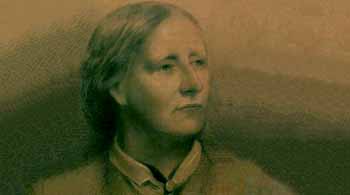
Elizabeth Cleghorn Gaskell 1810-1865

The Northerner retains a fiercely guarded cultural identity. It is rarer these days for a Southerner to be quite so vocal. Economics plays less of a role in the split now. The Northerner is generally less well-off, and more dependent on government support. Wealth is generated in the financial centre: London.

It wasn’t always so. Britain’s growth used to be far more concentrated around its middle. Manufacturing was the preserve of the North and factory towns were the economic engine of the nation. Money was made here and the workers were beginning to understand their significant bargaining power balanced against the turbulence of world trade.

Gaskell brings an outsider’s perspective on all this in the dauntless character of the vicar’s daughter, Margaret Hale from Hampshire. Margaret adores the rural idyll in which she has grown up – Helstone – and finds interest and pleasure in the London society of petty gentry, her adolescent social milieu. By the novel’s conclusion, however, she has come to see what her contemporaries Marx and Engels described as the “idiocy of rural life”. Higgins, a fervent unionist out of work contemplates moving to the south to become an agricultural labourer. Margaret counsels him against this in the strongest terms:

You could not stand it. You would have to be out all weathers. It would kill you with rheumatism. The mere bodily work at your time of life would break you down. The fare is far different to what you have been accustomed to.

[…]

You would not bear the dullness of the life; you don’t know what it is […] They labour on from day to day, in the great solitude of steaming fields—never speaking or lifting up their poor, bent, downcast heads. The hard spadework robs their brain of life […] they go home brutishly tired, poor creatures! caring for nothing but food and rest.

North and South, Chapter 37

North and South belongs to the Condition of England genre. I began re-reading this novel just as I finished the BBC 4-part miniseries, Collateral. It, too, exemplifies the Condition of England in presenting a portrait of a nation conflicted, contradictory and divided in novel and emerging ways. Collateral and Gaskell feature a vicar with a crisis of faith, an awol militarist, would-be perjurers and embittered migrant politics. In Collateral, gig work and the casual economy are the focus, employment that recruits from and is attractive to immigrants in its unofficial, as-and-when nature. North and South puts the spotlight on the mills where work is similarly susceptible to the feast and famine of demand and the value of labour undercut by desperation and imported “hands”. On its own terms, Collateral is worth watching for the unresolved nature of its central conflict and I think it is particularly courageous in its portrayal of an alternative reality Labour party trying to out-nasty the Conservatives on immigration and security. The principled MP, played by John Simm is an incisive creation that ought to jolt the leader of the opposition into action, but inevitably will not.

As in Collateral, most characters in North and South are either in dysfunctional relationships, single, widowed, divorced or bachelors. The romance element in the novel is less, “will-they, won’t they” than “she won’t but he still would”. Margaret is bewildered by two declarations of love respectively in the novel’s second chapter and first half, both of which she immediately shuts down. There is certainly an element of realism in this but it rather throttles that source of tension. Instead of manly feats of strength, the novel’s antagonist, the industrialist Mr Thornton attempts to woo Margaret essentially by being nice to her family and pulling some bureaucratic strings to avoid her having to perjure herself. Hardly bracing eroticism.

Beyond the bearing of fruit baskets to the protagonist’s dying mother,  Mr Thornton is a fascinating character who boldly embodies the Zeitgeist. His story is principally that of squaring his hard-headed capitalist realism with the challenging and softening influence of Margaret and the union leader, Higgins. Both Higgins and Thornton despise charity. For Thorton it encourages dependency by the weak-willed and artificially perpetuates the unsuccessful and lazy. For Higgins it erodes the dignity of working people and disempowers them, discouraging political action.

Thornton refuses to give in to the striking workers’ demands and the strike breaks down as the union fails to maintain discipline and he undermines the action by hiring Irish immigrants.[1] He will only raise wages if the market allows; his hand will not be forced. Higgins respects him as an antagonist and is similarly a stickler for rules and principle. He recognises that the relation between worker and master is material in character. It is on this basis that he objects to the ban by Thornton’s rival industrialist, Hamper on workers paying into the union and organising. Higgins defends trade unionism with an appeal to individual liberty – one should have the choice to spend one’s money and free time as one likes.

Although Thornton recognises that the interests of the workers and masters are fundamentally opposed and initially describes the struggle between them as a “battle”, his attitude changes over the course of the novel. Presumably, owing to the influence of Margaret, he sets up a kitchen for his workers and allows them to buy ingredients from him and make their own meals. He recognises his purchasing power; his ability to buy in bulk for cheaper is far greater than that of his employees. Thornton, much like Higgins, despises charity, however, and allows the workers to help themselves rather than literally dishing out meals. His self-mythology is that of someone who brought themselves up to their position and his kitchen is part of an altered worldview of facilitating those who are capable to become masters in their own right.

Of course, none of this is explained to his employees just as fluctuations in world trade are not appealed to as a defence against not raising wages. Thornton is a technocrat – this is an experiment conducted by someone whose know-how is beyond the ken of workers. It is an attempt to solve a problem that by the end of the novel he is beginning to recognise. If it fails, it will be abandoned and new “solutions” devised. Such is the innovating power and drive of the bourgeoisie which will—

 hardly submit to the decision of an umpire, much less to the interference of a meddler with only a smattering of the knowledge of the real facts of the case, even though that meddler be called the High Court of Parliament.

North and South, Chapter 10

North and South as a novel is too long. It has obvious issues with plotting and pacing. Physical descriptions of Margaret Hale start off as disparaging and end up as weirdly idealising. Its religious concerns hardly resonate today.

However, it contains an unflinching depiction of the realities of industrialised capitalist society in full flow and both trade unionist and manufacturer philosophies in all their contradictions. It’s a novel that resonates in spite of itself because, melodrama aside, it is fundamentally realist and material relations govern our lives as much as they ever have.

Unions still clash with employers and divide public opinion. While we have abolished the most egregiously unsafe industrial practices in Britain, global manufacturing is outsourced to countries with far laxer environmental and safety norms. We have not yet evolved out of capitalism, and so a 19th-century doorstopper still bears the heft it once did. Indeed, it is perhaps even more clear-sighted in retrospect than at the time it was published.


[1] There was speculation at the book group meeting that this was the origin of much of continuing anti-Irish prejudice in Glasgow – a hangover from when they were brought over as strikebreakers.

Posted in Politics, Review | Tagged , , , , , , , , , , , , , , , , , , | Leave a comment

My year in music: 2023

2023 has very much been a year of two halves professionally. In June I left my job working as a steward at Glasgow Cathedral and took up the role of paralegal at Digby Brown, becoming a trainee solicitor with them in September. On the whole the year has been characterised by the fulfilment of expectations rather than dashed hopes. It has been a time of making and carrying out plans and embarking on new journeys.

As for the gig-going calendar, I’ve seen Dry Cleaning, Lemon Twigs, Alvvays, Geese, Free Love, LA Priest, Warmduscher, Weyes Blood and Flyte. I saw them at Barrowlands, SWG3, King Tut’s, Rum Shack, Hug & Pint, Maryhill Community Centre, Old Fruitmarket and Oran Mor respectively. Lemon Twigs and Geese were the best gigs, both of whom put out great albums this year – more on that later on. The gigs were in medium-sized (SWG3 small stage) and small venues (King Tut’s) respectively and, particularly in the case of Geese who are just breaking out and whose lead guitarist just left the band, you got the sense of witnessing something special.

My top tunes of the year were mostly new songs from old favourites with the exception of “3D Country” by Geese, which has the same title as the album and is definitely my discovery of 2023. The others were “Billie Toppy” by Men I Trust, “One Night with the Valet” by Tennis and an epic collaboration between Thundercat and Tame Impala on “No More Lies”.

As for my two SWG3 gigs this year – Lemon Twigs and Alvvays – they were two contrasting experiences. Lemon Twigs are not exactly a “cool” band – they make very good music but don’t make any attempt to pander to current trends. They have an aesthetic, clearly but I think the reason people are drawn to them is the quality of the songwriting. The audience is there to relish the artistry of every chord change and modulation, to wait for a resolution to a phrase that twists and spins out in unexpected directions before announcing satisfyingly, finally, we are home. Alvvays, sadly, are victims of their own popularity and half the crowd aren’t there to hear the new album and instead converse amongst themselves when there’s a song they don’t know.

My Spotify Wrapped threw up much the same as previous years with Mac Demarco coming in at number one alongside King Gizzard and the Lizard Wizard and Tennis. A new artist who made it into the top 5 was Say She She who are a vocal trio comprising former session musicians that makes catchy, groovy, soulful, funky bangers.

In terms of this year’s top albums, I would say I have five that I can award the “would recommend” tag in 2023.

5. Jonny by The Drums

I wouldn’t say that The Drums re-write the book on this one but in my opinion they up the emotional intensity on their latest album, Jonny. As the title would suggest, it is a very personal record about the songwriter’s childhood trauma and healing from this. Of course, it’s also humourful, cheeky and most importantly contains several songs that are hard not to replay over and over. It combines a kind of surf-punk, minimal aesthetic with a powerful sense of melody and of course the lead vocalist’s unmistakable crooning and vocal affectations. These may not be to everyone’s taste, but I am certainly a fan. The best tunes, in my opinion, are “Better” and “Teach my Body” for the combination of emotional depth/vulnerability and tongue-in-cheek lyrics.

4. Petrodragonic Apocalypse etc. by King Gizzard and the Lizard Wizard

My love for this band will never die. Even if I skip a record, I know that there is a banger coming round the corner, usually within the next six months. And this is a banger of a record. This is the sequel to 2019’s Infest the Rats’ Nest which is regarded as the band’s first foray into thrash metal. It isn’t just bringing back the same sounds as on that album though. Here we have more ambition, harder riffs, crazier time signatures and most notably, seriously impressive drumming inspired by Tool. The album imagines a world where oil is worshipped as a deity but is truly a malevolent god, manifesting in the Dragon of the title. “Dragon”, the penultimate track is the album’s most ambitious and one of three epic near-10 minute pieces. If you want a taster though, “Gilla Monster” most neatly encapsulates the tone, even if not quite as lightning-fast as many of the other tracks.

3. Pollen by Tennis

I was a big fan of Tennis’s previous record, Swimmer which came out in 2020. Pollen is yet to quite reach the heights of repeated listens to that one, but it is still a very good album. It is full of sugary earworms that will repeat themselves endlessly and add a romantic wistfulness to mundane activities such as, for example, going to Lidl. Tennis are a married couple and this album tells the story of how they met over a few of their tracks, of the risk, trepidation and weirdly specific common interests, such as a passion for Latin. It also has songs about working in hospitality and hayfever, so all-in-all a highly relatable listening experience. “Gibraltar” stands out as an accessible single, which I presume refers to their sailing lifestyle, which they embark on between touring and recording. For me, though, a lyric that stands out from the closing track, “Pillow for a Cloud” accompanied of course by a gorgeous melody, is “Time passing used to thrill me/Now it only terrorises me”.

2. 3D Country by Geese

This is the second album from Geese who I had heard tracks by before but not got seriously into. I think I saw their session on KEXP, but this was in 2020/21 when they were doing the “From Home” sets. The first album seemed pretty cool but more in the way they reminded me of The Strokes. With 3D Country Geese have produced something much more original and weird. In one sense, it’s classic rock and roll but in another, it’s totally unconventional. The lead singer does share some similarities with Julian Casablancas in his vocal affectation but is much more unpredictable. Instrumentally it is very rich and features gospel backing vocals on many tracks which add so much. They do noise, they do sweetness, they do comedy and absurdity. My advice to you is to check Geese out. You may feel their songs are on the out-there side at first, but you will be rewarded with repeat listens and continually notice touches that show how much attention to detail has been paid in putting together this seemingly chaotic record. “Cowboy Nudes” is a great single to get started with, as is “3D Country”, but an album favourite of mine is “Crusades”.

1. Everything Harmony by The Lemon Twigs

I came away from The Lemon Twigs’ gig at SWG3 knowing I had to buy this album. From top to bottom, it is tune after tune. No heed is paid to any current music trend. It would sit comfortably with any classic record from the late 60s/early 70s. The musical ideas are given time to develop and the phrasing is so much more elongated than anything you would expect to hear on mainstream radio. And yet, there is a market for it. They have a niche and they do it so well and I am so glad they do.

It is extremely jangly and joyous where it means to be but there is also a deep melancholy, verging into melodrama mixed into this album. “I Don’t Belong To Me” is devastatingly downbeat as is the repeated titular lament of “Every Day is the Worst Day of my Life”. For Everything Harmony at its most Everything Harmony though, I would recommend “Any Time of Day” – what chord (and key) changes! There is not a bad song among them.

Posted in Music, Personal experience, Review | Tagged , , , , , , , , , , , , , , | Leave a comment

Scrooge the Affective Altruist: ‘A Christmas Carol’ reviewed

I have a complicated relationship with Charles Dickens. He is the epitome of the Author. He was hugely prolific, massively popular, and has had a profound cultural impact on how Britain sees itself.

How is it possible, then, to dismiss and downplay such a figure when novels and national identity are very much one’s thing? When industry, history, material conditions and class relations are the prism through which all books you read are refracted?

Quite easily, as it turns out. Dickens is a particularly springy springboard; I will say that for him.

My relationship with Dickens began at school when we had to read A Tale of Two Cities for Higher English. I have fond memories of this. Overall, the novel is sympathetic to the suffering of the French peasantry and condemnatory of the aristocracy but it crudely demonises anyone actively political and is desperately shallow in its caricatures. The main thing though was that after I finished it I scoured the Wikipedia page and came to the cultural impact/film adaptations section. There I discovered that Christopher Nolan’s The Dark Knight Rises is loosely based on the novel. Following this discovery, I was generously indulged and got to show the film in class on the condition that I give a presentation on the references and parallels.

This tumultuous encounter had its second act when Hard Times was set as a typical example of Victorian literature and the so-called Condition of England novel in the second year of my English Literature degree. On the surface this book is about industrialisation, class and material conditions when Britain was at its peak as the workshop of the world. So far, so good.

Marx was a contemporary of Dickens and an admirer of his work. I therefore expected Hard Times to be a record of exploitation and shed light on social relations in the factory towns of the mid-19th century, if not in a revolutionary way then at least accurately and honestly. My disappointment was great indeed. Hard Times essentially rejects materialism and condemns trade unionism. Its bases for doing this are that 1) quantification can only exist at the expense of qualitative values and 2) unions’ powers of coercion are mean in that they create an unlevel playing field. This is totally false as material conditions that can be counted are in dialectical relationship with qualitative outcomes. Furthermore, Dickens misunderstands trade unionism entirely – it’s not about giving workers the same level of input into decisions as the employer or necessarily even collaboration. Trade unionism is about coercion, forcing employers to take notice even if they do not wish to; in other words, if mobilised they ought to have greater power than employers and workers as individuals – that’s the whole point.

This brings me to the third act in my personal psychodrama with Charles Dickens – A Christmas Carol. Now, in between I have engaged with Dickens through the musical, Oliver and I watched the recent adaptation of David Copperfield (which I thought was brilliant, by the way), but my next prose encounter was with this notorious yuletide novella. The occasion was, of course, my Mitchell Library Classic Book Group now meeting on the first Thursday of every month at 6pm. I’d never read it before then and I’ve not seen the Muppets version. Although, one cannot get away from its permeation of Christmas culture in the UK and around the world.

Again, this should have been a text that I could get on with. It is centrally concerned with social justice and how to be a good person in a cruel world. By and large, I do get along with it. Reading it you get a sense that this is the archetypal expression of the secular myth of Christmas. Its “true meaning of Christmas” really has little to do with Christianity explicitly and that aligns with most people’s contemporary understanding. That being said, it is also historically situated and its social relations are of their time with their stark class divisions and references to workhouses and debtors’ prisons. Dickens vividly evokes a version of Victorian urban life with lavish descriptions and a superabundance of material culture in his ever-accumulating lists.

Ultimately, Scrooge’s motivation for his change of heart and altered treatment of his peers is how he will be remembered when he dies (after being shown reactions to his death by the Ghost of Christmas Yet to Come). This humanist message is perhaps more grounded than the promise/threat of heavenly reward/infernal punishment. I do think, however, that it fails to address consequentialist reasons for being nice or generous to people at Christmas, and indeed at any other time of the year. Scrooge’s transformation is on the whole a subjective one in the sense that it is self-pity and reputational concern that primarily precipitate the character switch. His nostalgia for his old employer’s generosity and the FOMO-inducing revelations of the Ghost of Christmas Present equally spur him on. The pathetic scene of Tiny Tim’s preventable demise creates a well of emotion in him. Scrooge is a Man of Feeling who ends the tale practising what I would describe as affective altruism.

I think the emotional approach to ethical action comes across in Scrooge’s language. He is someone who instinctively and almost involuntarily reacts to the world around him. His dialogue abounds with interjections (and I’m sure if the author were not born in such a generally PG era, expletives). His most famous catchphrase is “Bah humbug!” (though the words never appear consecutively). This visceral id response informs his moral acts, not any thought-out philosophy.

Scrooge is an affective altruist, not an effective altruist. There is no greatest good-to-action ratio calculation going on here. His is purely a vibes-based approach. In other words, he’s a sentimentalist not a dispassionate sum total of virtue increaser.

I think that the message of A Christmas Carol is really, to be a better employer and be a better patriarch (I don’t mean this necessarily pejoratively). Give your staff time off, put on a staff party occasionally and be generous to family and friends i.e. people with whom you already have a social relationship that (certainly in Dickens’s view) ought to be more than transactional. Nevertheless, the categories of employer, benefactor and patriarch go unchallenged. And what of one’s moral obligation to people with whom we will never interact? There exists a limit to our capacity for tele-empathy, which Adam Smith articulated 90 years before Dickens in his Theory of Moral Sentiments.

Feeling is a gateway drug to moral action and to that end, it cannot be underestimated, but pity-triggered moral action may also evolve[1] into hard[2] calculus of consequentialism[3] (i.e. affective altruism → effective altruism) which Dickens so eschewed.


[1] I mean this in the sense of synthesis, not progress per se.

[2] But not necessarily hard-hearted.

[3] What we may wish to “consequent” is beyond the scope of this blog post.

Posted in Politics, Review | Tagged , , , , , , , , , , , , , , , , , , , , , , | Leave a comment

The Sack of Thames-on-Singapore

Last weekend I finished one of the best books I’ve read this year. This is The Singapore Grip by JG Farrell.

I really like the cover design!

It is an epic novel and also a family saga of sorts. It’s about a business dynasty and a reluctant inheritance – not just of a business dynasty but a general Kulturerbe. Its characters are confronted with the challenge of preserving a way of life under rapidly changing and increasingly hostile circumstances. Will they persevere despite the hand they’ve been dealt by history and is it even worth fighting against the tide?

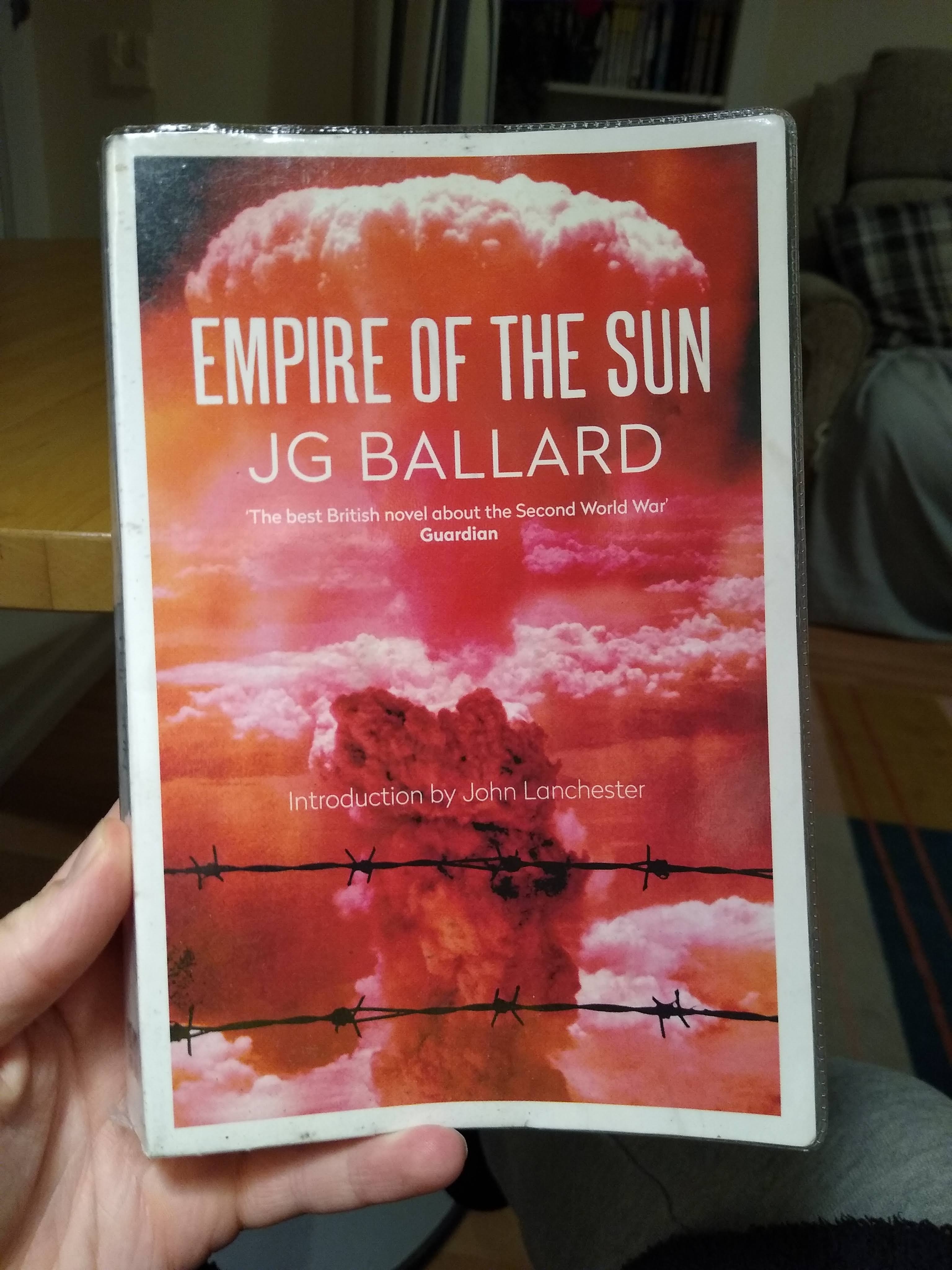
I had never heard of JG Farrell before. I had just finished reading another JG – JG Ballard – on similar subject matter – the war in the Far East. This time instead of Shanghai I was immersing myself in 1940s Singapore at the southern tip of Malaysia – then Malaya.

Now we have the idea of “Singapore on Thames”; then it was very much Thames on Singapore -transposing Anglo-capitalism into the remotest key possible.

JG Ballard’s novel, Empire of the Sun has little comedic about it whereas this, at least for most of the first half and a good bit of the second, is highly satirical and pretty funny. At The Singapore Grip’s conclusion, however, there is real pathos, and the characters are rarely anything other than 100 per cent in earnest. We laugh a lot more at them than with!

Whereas Empire of the Sun deals unflinchingly with the harshness of occupation and life in a Japanese prisoner-of-war camp, SG takes place in the run-up to the invasion and the setting of Singapore is vividly evoked as simultaneously unique and a synecdoche for the entire British imperial project.

To be British in 1941 was to be a citizen of the Empire. Its peak territorial extent was realised in the 1920s and over the preceding two centuries or so Britons had become accustomed to the idea of their invulnerability. Potential crises would be weathered or absorbed – it would all work out for the best. A last-minute deal could be struck. It’ll be fine. After all, we’re British. The echo of this attitude is a Johnsonian perspective on the Brexit negotiations.

Spoiler – then and now they would not work it out. And in Singapore’s case, the signs were there since the mid-1930s.

For the British in Singapore of the mid-20th century life was pleasant, full of perks, luxuries, servants, abundance and most importantly breathing space at the periphery, comfortably distant from the metropole, London. It is a lifestyle hard won – Walter reminds us – and against hostile conditions, geographically and demographically speaking. Singapore is sweltering, humid and at first, entirely lacking in the infrastructure necessary to do business.

The novel cycles through many third-person limited perspectives but its main protagonist is Matthew Webb, son of the recently deceased Mr Webb of the Blackett and Webb rubber company. He arrives in Singapore to pay his respects and claim his father’s legacy.

Except Matthew is not a typical “rubber baron”. He has spent formative years in Cambridge and began a diplomatic career lobbying for peace at the League of Nations HQ in Geneva. Matthew is unwaveringly idealistic and farcically impractical. He is a thinker, not a doer and in times of stress is given to intellectualise rather than confront immediate problems. In this sense, he takes on a Hamlet-like role and in fact, the plot can be mapped to the play in numerous ways.

Walter Blackett is the Claudius figure, set in antagonistic opposition to Matthew. He relishes in the role of capitalist overlord. His whole life has been dedicated to the business of business. The war and wars generally are an inconvenience for him but also an opportunity – not something to be overcome but negotiated with and managed. Difficult circumstances call for immediate practical solutions. A crisis may call for unconventional thinking and re-accommodating one’s principles to reach a beneficial outcome.

Like Claudius, Walter is a string-puller. His first thought on the death of Mr Webb is how to turn the situation to his advantage. With an attractive 20-something daughter, Joan and an eligible bachelor in Matthew he sees a chance to exert considerable influence on the Webb share of the company.

Joan has more mettle and cunning than her fundamentally uninterested brother, Monty, so in an inadvertently feminist way, this is her route to assuming worldly power. For Walter, this is making the best of a bad hand and he rails against the unfairness of his rival producing five competent sons to his two daughters and Monty.

Joan’s campaign of seduction is not without effect. The problem is that Matthew is being simultaneously courted by Vera Chiang – a “Eurasian” of uncertain heritage – whose wiles prove equally if not more enticing. Herein lies much of the humour of the novel’s first half.

The flirtation and wheeling and dealing are all heightened by the impending Japanese invasion. Where things may have taken a natural course, all operations are accelerated under this rapidly materialising threat. Thus, with the world as they know it coming to an end, Matthew resolves to take decisive action and propose to Joan’s father officially (the fact of his future marriage to her is already taken for granted by him in any case).

The whole situation is rather like Peep Show where Mark marries Sophie out of social embarrassment more than anything else. Thankfully, Matthew is saved by Walter getting distracted and he manages to miss his chance. He will get him when he is invited to dinner at the Blacketts later that week.

It is really this dinner and not when the first shell is fired when the novel turns and becomes much darker in tone. There is frenzied talk of the effects of the invasion to come; mostly on the business and the huge stores of rubber they have stockpiled that will likely be captured by the Japanese. Walter’s principal regret is that he has not been able to profit from this while at the same time he has deliberately stifled production to keep prices artificially high. Tension around the table, let alone around the globe, has reached an excruciating pitch. Matthew must say something, time is running out, the world is ending, and he must make his intentions clear. He says, “Although I like Joan very much, I don’t want to marry her”.

From here, the novel becomes more Ballardian in subject matter. The Dad’s Army that the men have been training for is mobilised. It is seriously impressive how a hundred pages of detailed description of fire-fighting can be so utterly compelling. Matthew finds spiritual purpose in this role and questions his abstract dedication to world peace, which, thankfully, ultimately does remain intact.

There is an underlying battle, separate from that against the Japanese bombardment, with the Singaporean authorities to procure travel documents to leave. This is particularly the case regarding Vera, whom Matthew ultimately chooses over Joan, and her abovementioned uncertain heritage. This battle is almost as heroic and one of my favourite scenes of the novel is where the middle-aged bachelor, and veteran of the Great War, known to everyone as The Major intervenes on her behalf. He uses his connections to secure a face-to-face meeting with the responsible official and when he refuses to grant her application challenges him to a fistfight.

Tragically, the novel ends in their failure to escape and alludes to their years-long internment up until the war’s conclusion. Having read Empire of the Sun and having spent over 600 pages with these characters this is a heart-rending ending. The only consolation is that in leaving us with this novel, the story of the last inhabitants of a destroyed culture, whether justly (likely) or otherwise, is subtly and faithfully monumentalised.

Posted in Review | Tagged , , , , , , , , , , , | Leave a comment

Imperial sunsets

I first read J G Ballard when I was getting into the idea of the postmodern. His novel Crash is seen as a seminal (pun intended) text.

Crash is a difficult book, conceptually and also because it is rather disgusting. The J G Ballard interested in bodily fluids and excrement is still present in his war novel Empire of the Sun, as is the sexiness of modern machines, in a disquietingly literal manner. Whereas it is automobiles fuelling the autoerotic in Crash, aeroplanes awaken latent desire in the adolescent protagonist of Empire.

The novel is challenging but less for its postmodernity than its uncompromising depiction of a Japanese prisoner of war camp on the outskirts of occupied Shanghai. For me, the setting of Shanghai was fascinating as an international hub where all the actors involved in the Second World War were present in some way. The International Settlement was a British- and American-dominated portion of the city that held effective political control there; sovereignty was de jure retained by the Chinese and they, in theory, exercised delegated power. There was also the French concession, which by the 40s was held by Vichy France. In the 1930s Shanghai was the only place to accept unconditionally Jews fleeing persecution in Germany.

An interesting aspect of Empire is the protagonist’s relationship with Britishness. Jim has never set foot in Britain, having been born and brought up in Shanghai. He has led a rather separate existence and socialises pretty much exclusively with fellow expats. This is in line with the author’s own childhood experience. It is a protected and protective bubble sheltering him from the seriousness of international developments. This makes the contrast of the world unleashed by the post-Pearl Harbour attack all the more shocking.

Jim contemplates the horror and brutality of the mid-20th century with an unflinching gaze filtered only through his naivety and trusting nature. He has “confused” ideas, the most striking of which is his fascination for the Japanese which easily coexists with his admiration for the Americans and, as previously mentioned, his obsession with aerial warfare.

There is a three-year time jump in the action, which is a great relief to the reader after 100 or so pages spent in late 1941 and early 42. Despite Jim’s optimism, these are very grim years both on a local level, as he looks forward to the opportunities to be had on transfer from a detention centre to an internment camp, and from a global perspective where the Axis look very much to have the upper hand. The time jump propels us to 1945 by which time the Japanese are losing. It is a very compelling stage in the conflict as they do not let up the brutality but instead increase it in response to the collapse of their imperium. Counterintuitively, the war coming to an end makes things much worse for the prisoners as rations are cut and the security of the camp becomes far less reliable, with frequent American bombing raids.

When the war finally does end Jim’s woes are far from over. The power vacuum instantly turns allies into enemies and new conflicts break out between nationalists and communists, the bombing of Nagasaki and Hiroshima having finally forced the Japanese surrender. For Jim, there is no gap between the end of World War II and what he perceives as the start of World War III.

A lesser consequence of the war in global terms but of significance to Jim is the shift in British identity that has taken place while he has been effectively cut off from the world news cycle. In 1945 he is re-united with an American he meets in the post-Pearl Harbour attack who gives him copies of Life magazine in a pathetically one-sided exchange for Jim’s labour. In these pages he reads of the “nation” that “stood alone” – the Battle of Britain has already been mythologised as a re-imagined community. The sun has set on the Empire as it rose (and fell) in the East.

Jim’s main feeling towards his fellow “Britishers” is contempt. He finds them unnecessarily complicated and inclined towards complaining. He is equally contemptuous of the Chinese and their perceived passivity in the face of imperial domination. Jim admires the Japanese for their discipline and activism. He looks up to the Americans for their optimism and abundance.

I am going through a bit of a Japan phase at the moment. It is not the usual one of anime, sushi or martial arts. I am interested in the wartime Japan of the 30s and 40s as it seems so remote from the country we would recognise today. Perhaps it is just my Western perspective but I don’t feel that the Empire of that time is nearly as interrogated as Nazi Germany even where in many cases its war crimes were no less.

Alongside reading Murakami’s depiction of Japanese Manchuria in Wind Up Bird Chronicle I went to watch a screening of the 1980s film Merry Christmas, Mr Lawrence starring David Bowie this summer at the Glasgow Film Theatre. I highly recommend the film, set in Japanese-occupied Indonesia and featuring an incredible synthesiser soundtrack by Ryuichi Sakamoto.

A line that sticks out to me from that is, “We are not Germans! There is no Geneva Convention here.”  I’m not sure the Nazis were renowned adherents to international law, but it is an interesting insight into the moral mindset of those running Japanese prison camps in their occupied territories.

Posted in Review | Tagged , , , , , , , , , , , , , , , , | 1 Comment

English Road

I wouldn’t exactly recommend the Camino Ingles in England, even though overall it was enjoyable.

The route follows what is thought to be the path taken by pilgrims from the south before they departed from Great Britain and onto mainland Europe on the Santiago de Compostela.

It is not the most well-established of pilgrimages – the English leg I mean – and is far from embedded. The main thing wrong with it is that there is simply too much walking on roads or beside roads. That is not what I want out of a pilgrimage experience.

Because it is not that established or embedded you cannot really call it a phenomenon. The issue is that no one is really doing it with you. I didn’t meet a single person on the Camino who said that’s what they were doing anyway.  The only person who said they had was someone right at the start among the ruins of Reading Abbey. She blessed me and told me to collect a pilgrim passport from the Father in St James’s Church. He wished me, “Buen Camino”.

Reading Abbey – a section of it.

The lady in the Abbey gave me a bit of an idea of what to expect. When I asked if it was fairly well marked out she was slightly hesitant. She said that it was quite overgrown by the River Itchen. She wasn’t wrong – I was fighting through vegetation for considerable stretches on my final day on very narrow paths.

Narrowness is one of the main differences between hiking in England versus Scotland. Whereas in Scotland we have the Right to Roam empowering us to traverse any land apart from a golf course or a dwellinghouse[1], in England one is forced into these resentfully thin corridors, scurrying along like rats in a drain. Speaking of sewer systems – one of the lowlights of Day 3 was in parallel to a sewage processing plant.

These byways and bridleways are a lot better than the alternative though – roads. Walking on the road in the south of England is a far worse experience than in Scotland for one main reason: hedges. You won’t find drystone dykes here or fences for that matter (apart from the barbed wire that often flanked the abovementioned public rights of way between two fields). I’ve recently been reading Klara and the Sun by Kazuo Ishiguro and in it a character fondly describes the England of their youth that they’ve left behind, waxing lyrical about its hedges fixing the fields for evermore versus the impermanence of fences. My perspective is in total opposition to this view. Why praise the immemorial apportionment of land for all time? It is the exclusion of generations for generations.

The hedge represents the inviolable separation between mine and thine in the collective Anglo-psyche. It should be abolished now and for all time.

On a practical level, hedges make walking on B-roads unnecessarily perilous. They eradicate the need for a verge and thus eliminate any refuge for the walker in the face of oncoming vehicles. The fact is, cars are king here even if the situation can primarily be blamed on centuries of agricultural practice since enclosure.

Roads here also frustrated me even when I was not on them. They ruthlessly bisect the countryside, making it almost impossible to get anywhere efficiently on foot without endangering yourself. I am taken back to my geography classes at school, learning about how the logging companies in the rainforest isolate animals so they can no longer roam freely in their habitat, fragmenting ecosystems and turning them into ever-shrinking islands doomed to sink under their lack of interconnectedness. The phrase “wildlife tunnels” comes to mind. There are also apparently “green bridges”. They put them into new motorways so creatures aren’t cut off. All I can think is – I need a wildlife tunnel!

The long and short of it is this: You simply cannot have a pilgrimage experience with the M27 speeding right over your shoulder. If pilgrimage ought to be marked by hospitality, mine was mostly characterised by inhospitable infrastructure both in terms of transport and law towards travellers on foot in the south of England.

That being said…

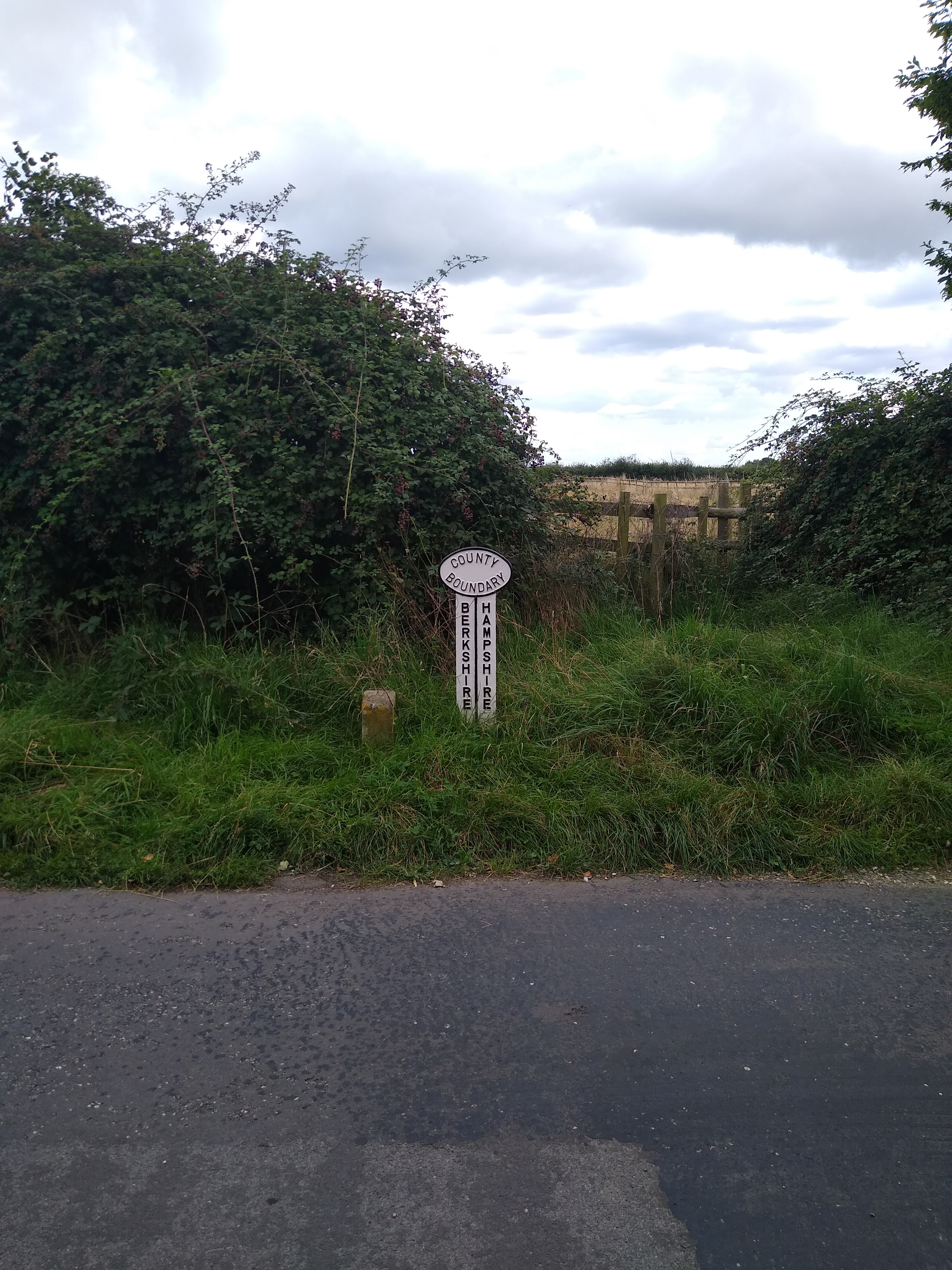
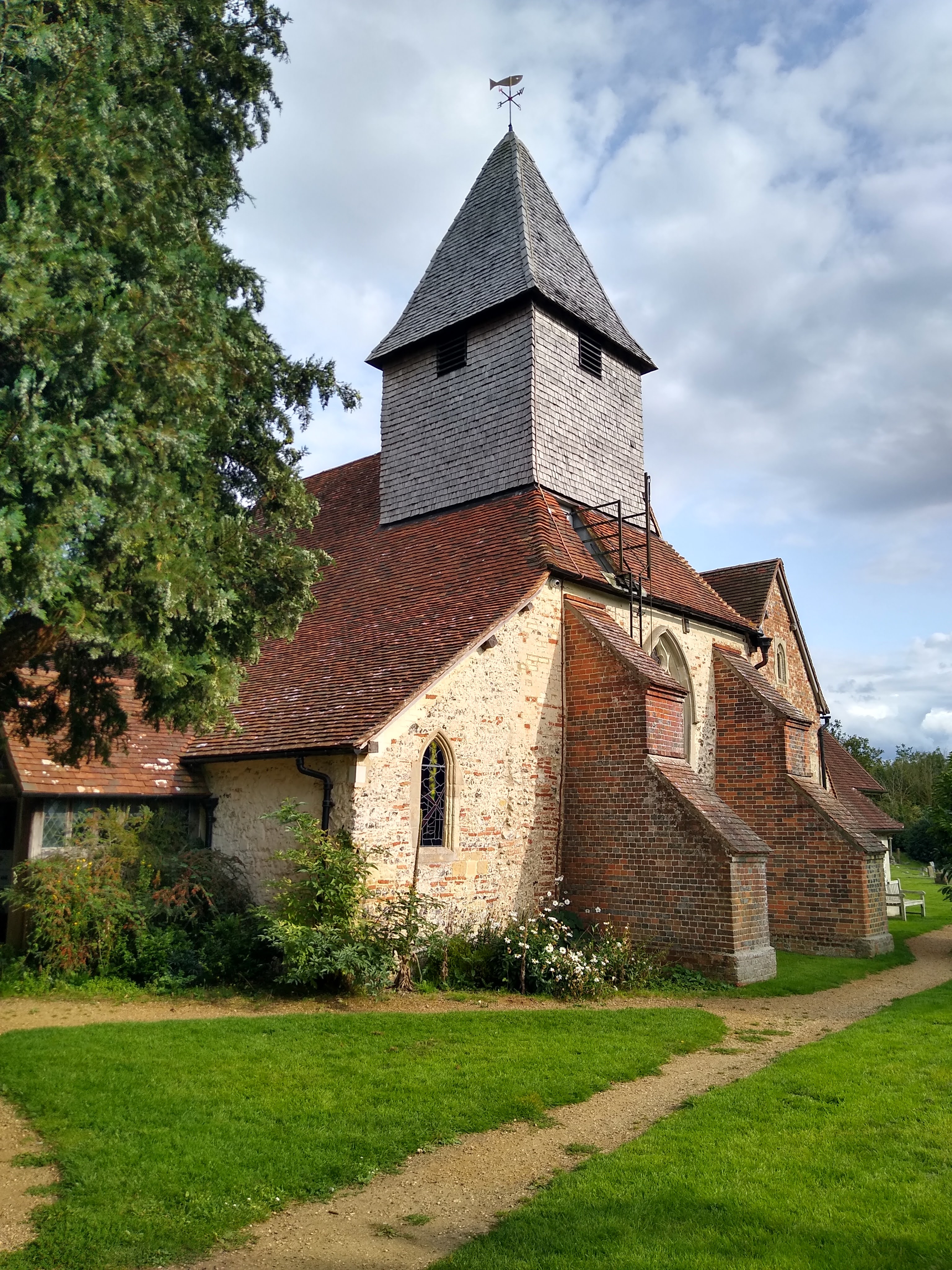
There were highlights. The Church of St Mary the Virgin at the halfway point on Day 1 – a beautiful 12th-century building with painted decoration of the walls that seems to have been spared the reformation. Rejoining the way on the same day after a detour and finding the Berkshire/Hampshire county border like the parish boundaries on the Hammars o Syradale. The Quaker cemetery in Basingstoke whose centrepieces are the shells of ruined chapels and whose winding path is paved with prostrate graves.

Day 2 was unquestionably the worst. Long endless roads. I was led through bridleways to the edge of a dual carriageway across which supposedly a parallel public path lay. It was non-existent. I trudged through nature’s barbed wire – brambles – before giving up and going back on myself for a more accessible route.

Halfway through this deviation from a deviation, I decided I’d get a bus when I could. Easier thought than done. The detour ended only in another stretch of verge-less B-road whose laughably-named termination was Cheesefoot Hill. About a third of the way along this I contemplated the idea of hitchhiking. Before I stooped to this my salvation came in the form of a farmgate layby and a fortuitous vape break.

My deliverance was named Joel and he’d just been at Boomtown Festival, up from Portsmouth. I asked him if he was going to Winchester. He said, I can if you want, mate. He drove me the last few miles to the soundtrack of bling-era 90s rap. I sheepishly paid him a little something for his trouble and disembarked for the Airbnb. All in all, an encapsulating anecdote.

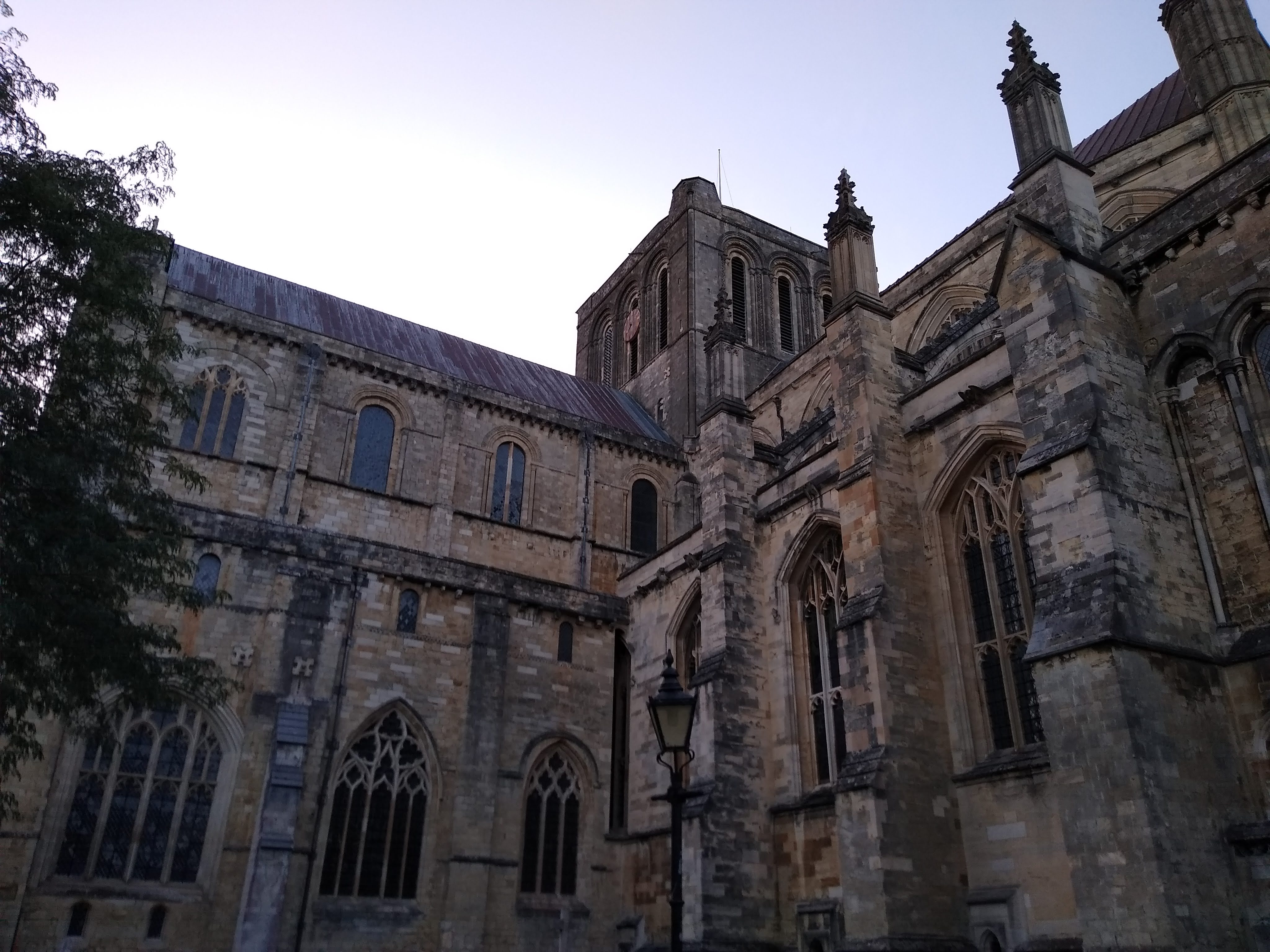
Having calmed down from my ordeal somewhat with a shower and a change of clothes, I ventured out to witness the 2/3-way point of my journey. I’d missed the Winchester Cathedral opening hours by a considerable margin, and tomorrow was Sunday – not for tourists in the morning. No pilgrims toll for me, no bread roll and a cup of beer. No stamp even, for my newly acquired passport.

No matter, I was at ease and content to enjoy the edifice in the last glow of the twilight. My very recent experience of custodial kirk-keeping reconciled me to the circumstances.

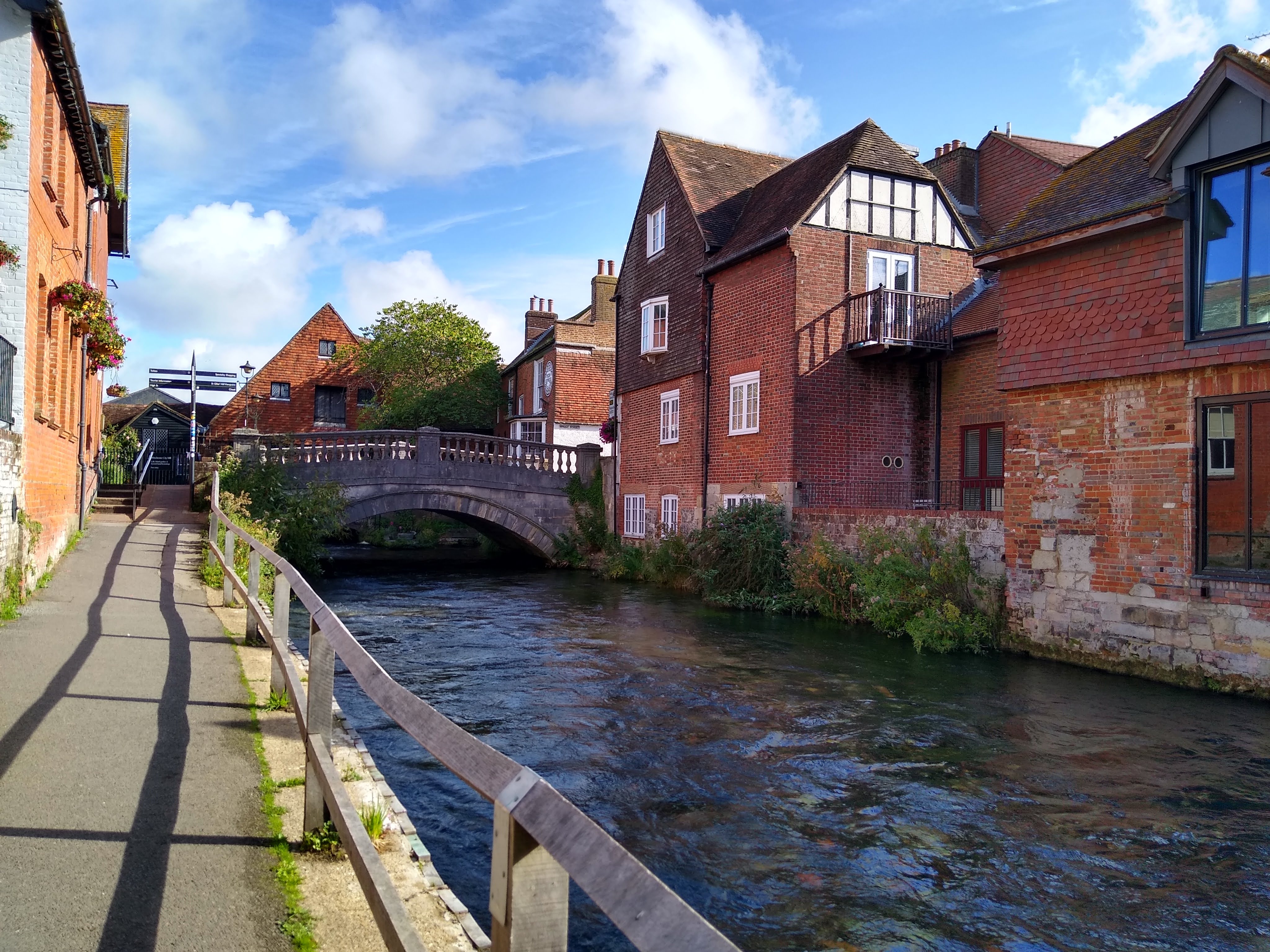
The next morning began my favourite stretch of the pilgrimage and had a wonderful start along the River Itchen where it flowed fast and straight through the city. In retrospect, this is perhaps less attributable to the Camino itself than it is to the fact that it is coterminous with the deal more established Itchen Way.

Here I experienced, as I got further along, something of the true solitude I was seeking, as opposed to the loneliness I found on the open road. In patches where I didn’t have to relentlessly concentrate to grapple with greenery and avoid snapping my ankles, I was able to access some of the higher thoughts that these experiences are supposed to lend themselves to. That was until I came across the sewage plant and the M27.

Arriving in Southampton, there really is no definitive end; like a cathedral, for example. I suppose this is because it is really the beginning of a further, much more epic, continental trek. However, before I went I did look up some significant sites and came upon one as I ventured out to find somewhere to eat.

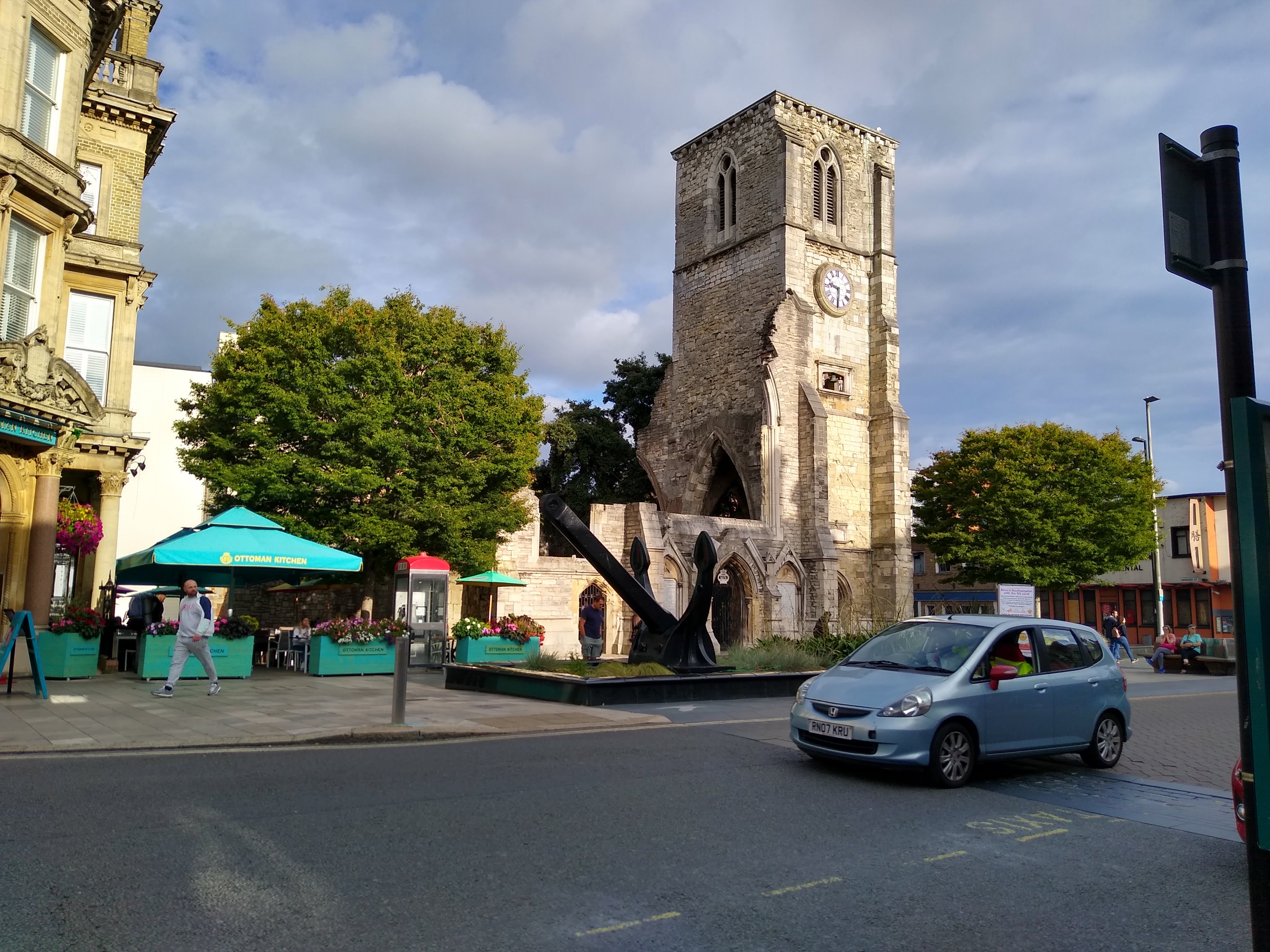
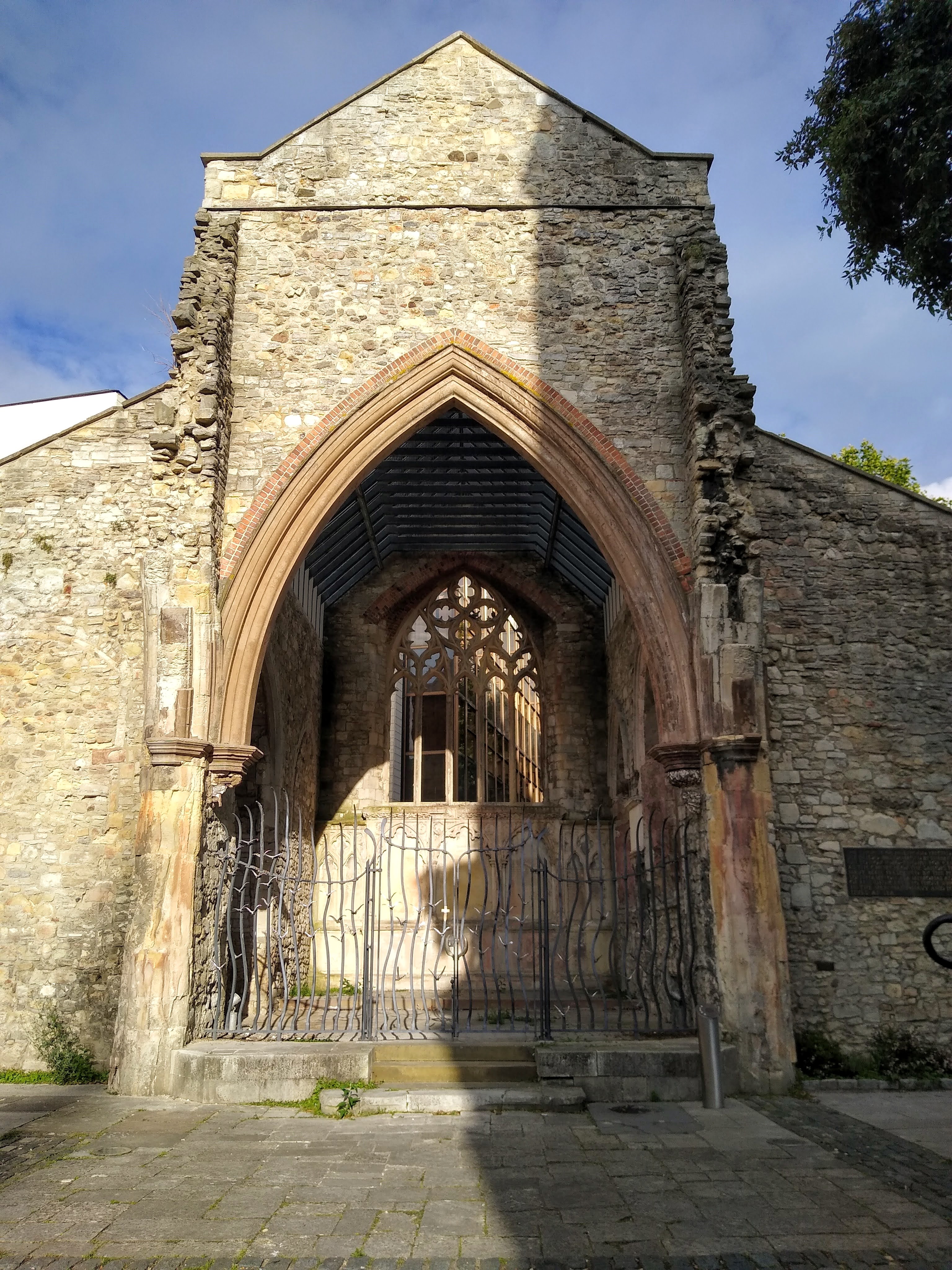
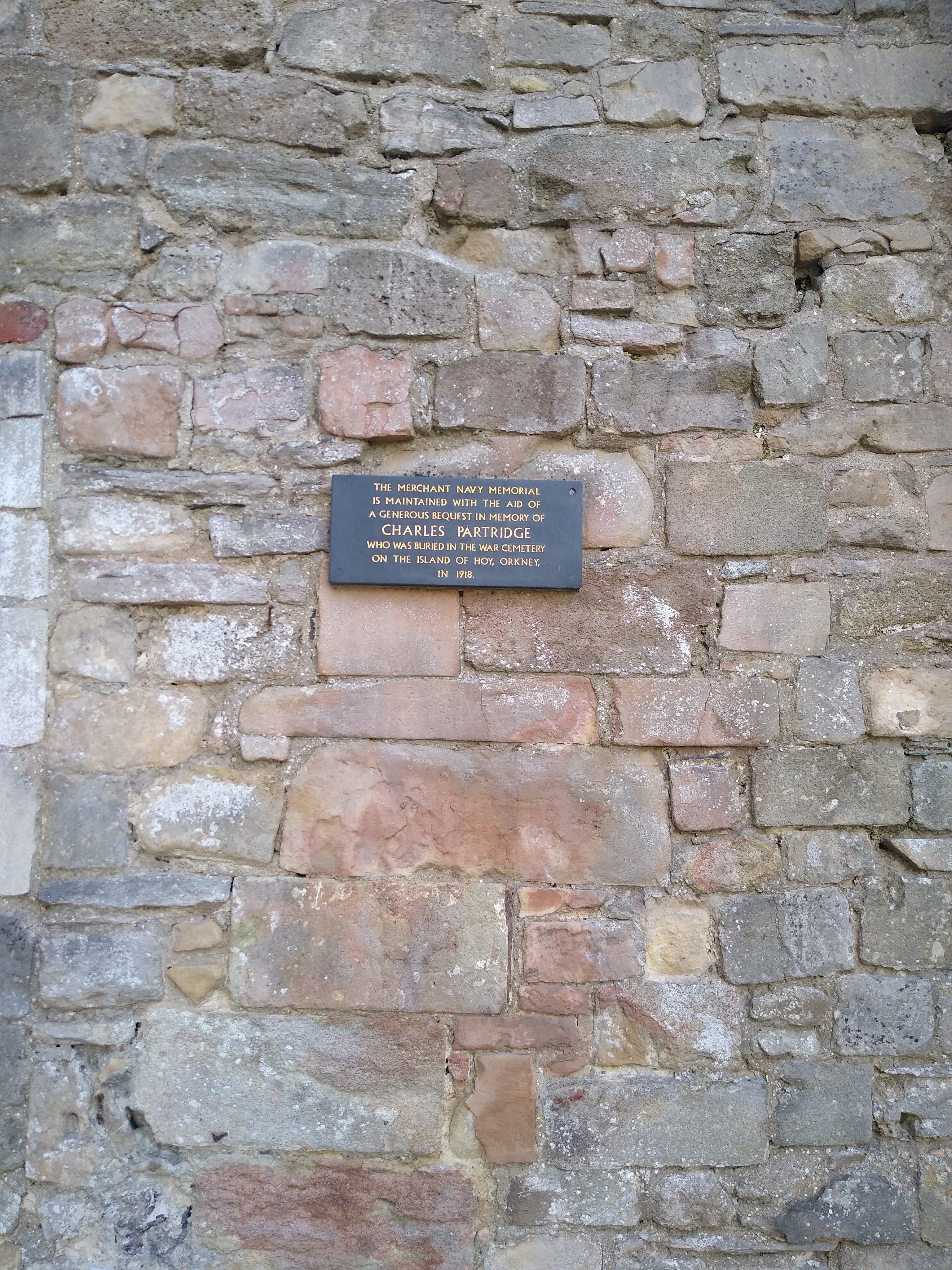
The Church of the Holy Rood is a medieval building, now a shell because of bombing in the Second World War. It has been maintained like this, instead of being swept away, and remains as a monument to those in the merchant navy who lost their lives at sea. In the corner is mounted a plaque – “This memorial is maintained with the aid of a generous bequest in the memory of Charles Partridge who was buried in the war cemetery on the island of Hoy, Orkney in 1918”.

After the self-inflicted ordeal of the preceding three days, I had arrived back where it all started; uncannily aligned with the grief for a foreshortened life that had the power to raise temples.


[1] Obviously a little more complex than this but not much more!

Posted in Life, Personal experience | Tagged , , , , , , , , , , , | 1 Comment

A Tale of Two Wheels

“Nice bike, pal,” a fellow Genesis owner heckles to me on the north bank of the Clyde as I make my way back to the office from Glasgow Sheriff Court. I quickly realise the reason for the compliment and mumble a thank you.

It is a nice one – a gravel bike with chunkier tyres than the standard road bike, as remarked upon by my shadow shadower who is tagging along behind the advocate instructed to represent our client. Bike2Work scheme! I hastily add – the company paid upfront.

My steed, whom I admit to christening Cécile after the character in Dangerous Liaisons – the last book group novel, has enabled me to take trips to places I’d otherwise find too effortful to arrive at and has expanded my psychogeographic sphere. Yesterday we went to Falkirk together. Well, not Falkirk proper – I decided to halt my journey when the famous Wheel came into view and lock up there.

The ride out was sprinkled with intermittent drizzle but otherwise smooth. There was one patch, however, where tree roots were bursting through the tarmac unexpectedly and gave the frame such a jolt that my phone mount flew off its anchor and into the bushes. Luckily, it was quickly recovered unharmed and I continued on my way.

When I got to the Wheel it was unlike what I’d imagined. There is a whole entertainment complex there. You can go zorbing, do archery and explore a visitor centre. Of course, the main attraction is the Wheel itself, which raises canal boats 24m from the Forth & Clyde Canal to the Union Canal to Edinburgh.

I arrived just in time to watch the Wheel rotate 180 degrees from stationary. To observe the Wheel in motion was for me an unexpectedly moving experience. Coming across the landmark at a standstill is impressive enough as a towering modern art installation, but to see it move approaches the technological sublime.

Standing about and tucking into a well-deserved apple I can hear the chirpy tour guide rattling off facts over the loudspeaker, but their contents are indistinct. Lined up along the Forth & Clyde dock are clinking China and cutlery as the café overspill are beset by a fresh westerly. Yet more onlookers grip onto railings, some clutching tickets to be the next to ascend.

The five-minute spiel comes to a close and the process begins. Steadily, inexorably the boat is drawn up towards the spectators. The rational part of our brains knows it’s going to miss us and get pulled up over our heads, but the animal in you cannot help but be somewhat unsettled by the inevitable arc of this colossus. I intuitively step back, though I know the café tables at the water’s edge will be safe. My rational self says this is just to get a better viewing angle but I know on some emotional level there is fear. An autistic child vocalises what I’m sure many are feeling at this moment in a repetitive and emphatic cry, “It’s coming straight for us! It’s coming straight for us!”

As I retreat for a better angle I am struck by the beauty of this creation. Not merely for what it is, objectively – an impressive and elegant piece of engineering – but as I imagine it too. It is a symbol and material manifestation of humanity’s dominion over Nature: terrible and beautiful; Godlike precision and simplicity.

A medieval peasant might marvel at this while shrugging off an iPhone. Witnessing the wheel at once shows the smallness and greatness of Man.

After refreshing myself with a slice of Victoria sponge I saddle up again for the journey back. Before I leave, I catch two young boys in conversation. From the context, I gather, one of them local and the other from further afield. “Do you know this is one of the wonders of the world?” says the local, and from the tone of his voice I can tell he believes it.

On the return cycle, I experience a different sort of humbling. Already pretty fatigued from my morning run and cycle out I faced a relentless headwind and become progressively more puggled with each pedal. My phone, on which I’d helpfully programmed a route map from what is essentially a straight line along the canal, showed me objectively that I was at close to half the speed of my outward journey on my energy-depleted final third.

The sense of smallness was compounded as drizzle gave way to downpour. I battled on and was able to make it home. Conclusion: I think I will wait for more conducive weather conditions before I attempt Loch Lomond, which is likely to be my next bike-based weekend adventure.

Posted in Life, Personal experience | Tagged , , , , , | Leave a comment

The deserts of Scotland

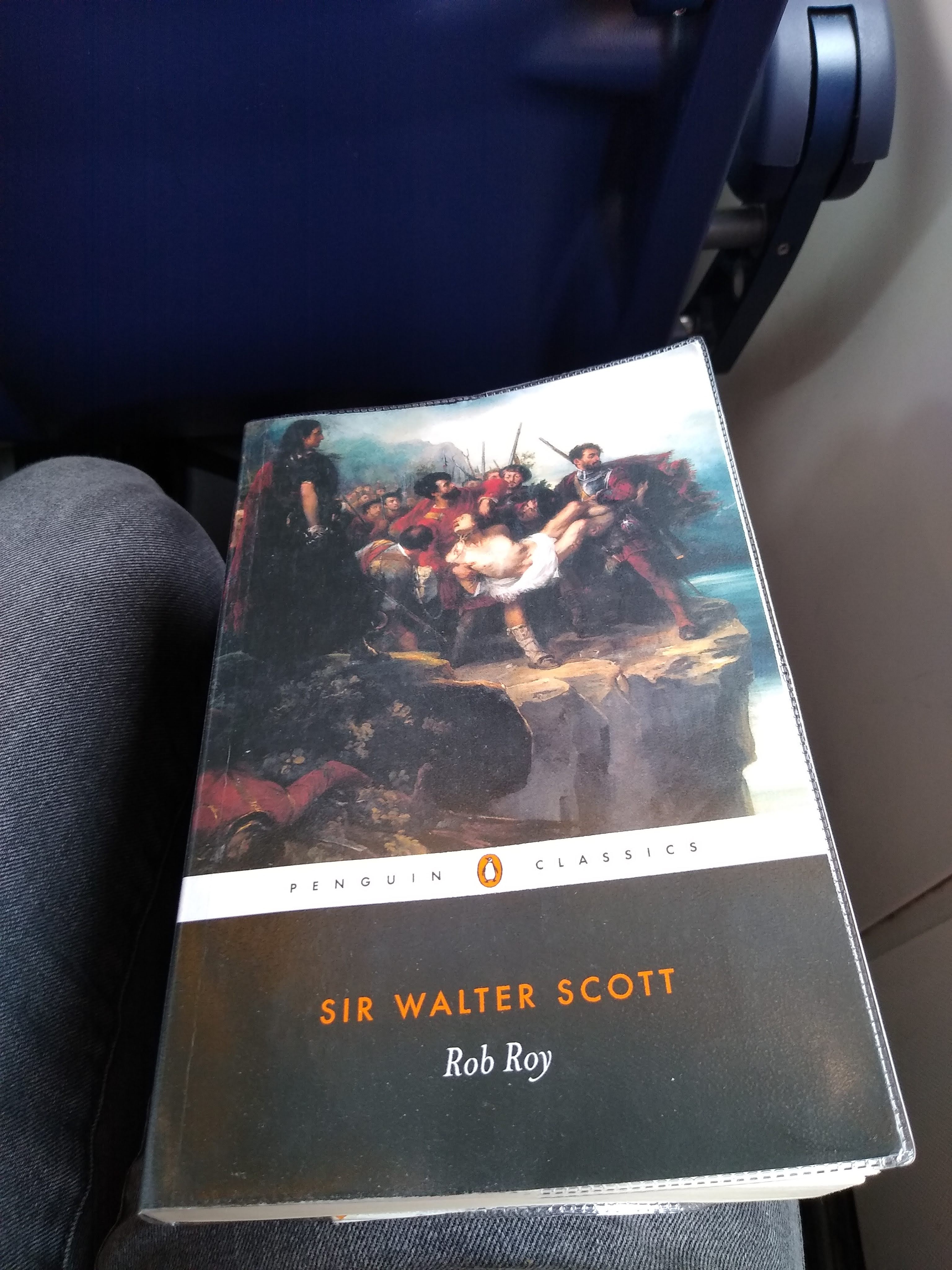
I’d always wanted to read Walter Scott. In fact, I’d attempted to before – embarking on a free Kindle version of Waverley which was abandoned for whatever reason; probably the dense prose style that strains the attention of a restless mind. Rob Roy is similarly encumbered but for my edification I had got through a couple of Henry James novels before, so for my own sake and the sake of my classic book group this time I persisted and reached the end.

Something that is impossible to get away from when reading Rob Roy is its pervasive preoccupation with Scottishness. By name and by nature, Scott is creating and adding to a national myth. I’m not sure why he decided to write this tale at this particular time. In 1817 the Union was old news and Scotland a full and disproportionate participant in the British imperial project, as alluded to even in the conceit of a memoir written sometime after 1745 and about the failed Jacobite rising of 1715. Scotland and England’s shared political destiny would have seemed assured from this historical vantage point – no nascent nationalist movement existed. So why did Scott turn to mythmaking at this time?

Writing set in the past is almost never about the past as such. A novel is something new – novel. Bertolt Brecht theorised that the only way to speak truthfully about the present was to approach it from the perspective of the past. For him, historicisation was an important subcategory of his seminal Verfremdungseffekt. He was vigorously opposed to the idea of cyclical, recurring history and by placing his plays in the past he sought to show social conditions that the audience could see had been consigned to history, which had been overcome and thereby allow onlookers to conclude for themselves that their political situation could likewise be transcended. I don’t believe this is what Scott is attempting in his “historical fiction”; from what I know of him he is unlikely to have endorsed a Marxian theory of literature, notwithstanding that this is chronologically impossible. However, a consignation might be an apt way of looking at what is being attempted here; in other words, he is trying to consign a wilder, more politically volatile Scotland to the past and contain it there.

At the same time, my impression is that Scott has a benevolent preservation or conservation instinct. His use of Scots language, in particular, in the characters’ dialogue shows a genuine concern for accuracy and fidelity to its actual use in the early 18th century. This is one of the novel’s greatest strengths, even if it hinders accessibility to the modern reader. It depicts Scotland as a land of three languages – Gaelic, Scots and English – and the titular Rob Roy is a master of all three.

Scott is quite even-handed about the relative strengths and characteristics of Scotland and Scots vs England and the English. His protagonist is English and at times seems unnecessarily harsh on his Scottish servant Andrew Fairservice who is portrayed as proud to the point of overt bigotry and money-loving to the point of repeatedly practising false economy. On the other hand, Scotland itself is depicted as a vigorous country with fast-flowing, virile burns compared with England’s slow, lazy streams.

The Scotland of Rob Roy is not one homogenous polity, however. There is the “lawless” hinterland of the Highlands whose inhabitants are on multiple occasions compared with “desert” people:

It is always with unwillingness that the Highlander quits his deserts

And:

 A people patriarchal and military as the Arabs of the desert were suddenly dragged into modern commercial and industrial society.

This was an image I also found in Mary Shelley’s Frankenstein, published in the same decade, where the Creature speaks this line:

I have dwelt many months in the heaths of England and among the deserts of Scotland.

An aspect of the novel I found interesting was Scott’s legal background coming through fairly strongly. He particularly highlights differences between English and Scots law, which survived the, at the time when the novel is set, recent Treaty of Union. Take this passage from Nicol Jarvie:

there’s nae bailie-courts amang them—nae magistrates that dinna bear the sword in vain, […] But it’s just the laird’s command, and the loon maun loup; and the never another law hae they but the length o’ their dirks—the broadsword’s pursuer, or plaintiff, as you Englishers ca’ it, and the target is defender; the stoutest head bears langest out;—and there’s a Hieland plea for ye.

The “lawless” Highlands are contrasted with the legal culture of the lowlands, whose terminology is helpfully translated for the benefit of our English protagonist and Scott’s English readership.

Osbaldinstone seems to have undue or naïve respect for the law and always cooperates with authority even where he is falsely charged or where doing so puts his friends in danger. His solution to his cousin Rashleigh’s treachery is not physical confrontation (apart from their drunken scuffle in the early part of the book) but a lawsuit against him.

In this way, Osbaldinstone is apolitical – cavorting with Jacobites and Hanoverians (the government) alike without seeming to be invested in any particular side. He is largely indifferent to the main political question of his time. The novel’s eponymous hero is another apolitical figure – Rob Roy recognises no authority but his own and uses extra-legal means to get his way. Perhaps he could be seen as an anarchist, albeit a violent one who uses violence to obtain what he wants.

If Osbaldinstone does possess a “political” opinion it might be anti-Catholicism, but this only really expresses itself for practical reasons as it complicates his desire to marry Diana who is being sent to a convent. Religion in Scotland is in focus for a couple of chapters which take place in Glasgow Cathedral and are a highlight for me for obvious reasons. Scottish religion is depicted as serious, intellectual and, once again, proud.

Overall, I enjoyed Rob Roy. Although its style can be off-putting at times, the Scots dialogue is good and the time period is interesting. I’m sure I’ll return to Scott’s other works in due course.

Oh, and Orkney gets a mention (well, two – St Magnus is mentioned as a pre-reformation survival alongside Glasgow Cathedral):

And in this country, and in the isles, whilk are little better, or, to speak the truth, rather waur than the mainland, there are about twa hunder and thirty parochines, including the Orkneys (sic), where, whether they speak Gaelic or no I wotna, but they are an uncivilised people.

Orcadians also receive similar treatment in Frankenstein:

The soil was barren, scarcely affording pasture for a few miserable cows, and oatmeal for its inhabitants […] whose gaunt and scraggy limbs gave tokens of their miserable fare.

[…]all the senses of the cottagers [had] been benumbed by want and squalid poverty.

Not a great tourist ad from the early 19th century!

Posted in Review | Tagged , , , , , , , , , , , , | Leave a comment

Well World

In three months I will start my legal traineeship which lasts two years and at the end of which I will become a qualified solicitor. Meanwhile, I will be known as a “trainee solicitor”. Before then, though, I’ve been asked by my new employer to start early with them as a paralegal – an offer which I’ve accepted. I’m due to begin on 12th June.

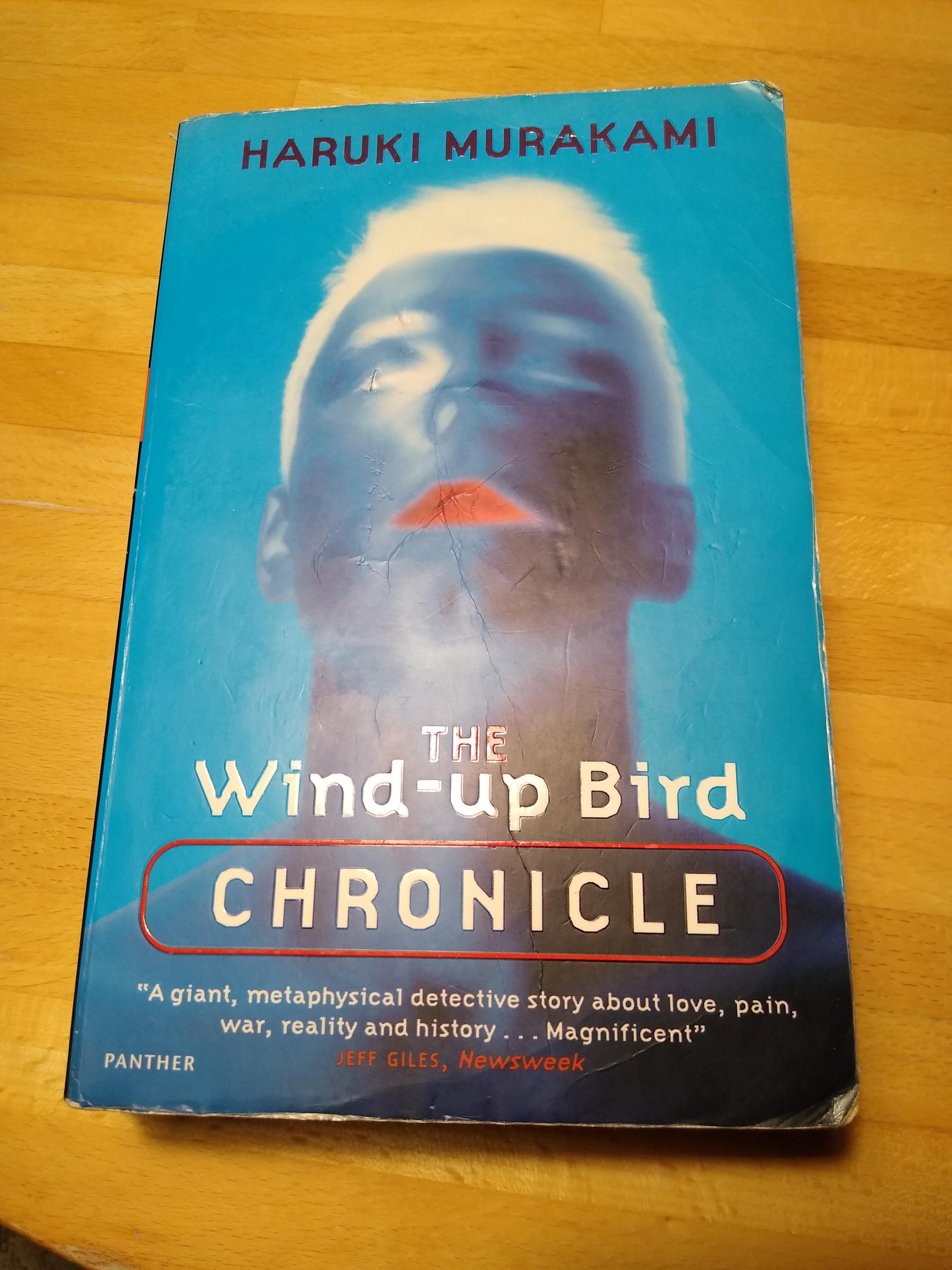
There is another (former) paralegal whose life I’ve been following these past couple of weeks in the pages of Haruki Murakami’s Wind Up Bird Chronicle, which was lent to me by a friend recently. Even in paperback, it’s something of a doorstop of a tome at 600-odd pages.

Not being a Manga man myself, this was the first novel I’d read translated from Japanese. It starts at a slow burn and describes in great detail the quotidian rituals of domestic life in urban 1980s Japan. A lot of beer bottles are got from fridges, a lot of meals are carefully prepared and a lot of records find themselves on turntables.

Things do fairly rachet up though and the novel takes a very literal plunge into darkness about a quarter of the way through when we hear about the wartime escapades of Lieutenant Mamiya, which includes witnessing someone being flayed and spending days on end down an abandoned well.

What seems like pretty near to domestic bliss in the novel’s first 50 or so pages turns out to be nothing of the sort. The protagonist’s (Mr Okada’s) cat has gone missing and then, one night, without any warning, so does his wife.

My year began with the tale of a wife who runs away without explanation leaving a bereft husband behind. Ian McEwan’s Lessons was the best book I’d read in a good while. The main character of that novel, though, also had a newborn baby to contend with and complex childhood trauma to boot. Our hero in WUBC is childless and it seems as though he has no Past to speak of.

Not that he is without preoccupations. He hates his brother-in-law’s guts for no single discernible reason. An irrational antipathy, impossible to ignore. The reasons for this animus are diffuse. It appears that he and his wife, for reasons not completely clear, decided to name the missing cat after this man. It seems odd to the reader that the protagonist would jokingly bestow this epithet on his beloved feline, given that he is deadly serious about his disgust for his brother-in-law.

Two of my female friends, when I mentioned that I’m reading Murakami, have said that his novels are misogynistic. I think that WUBC is trying to say something about women, generally, and how they relate to men. This generality and generalisation doesn’t happen figuratively, but literally. In the world of the novel, there exists a parallel world, which I will term the Well World, as this is our protagonist’s principal means of accessing it.

The Well World allows one to travel great distances and communicate with others in their dreams; it is also a parallel reality. In this reality, the women in Mr Okada’s life merge and combine and present us with archetypes specific to his mental universe.

One of the central ideas that comes up, again and again, is that of “defilement”. This is a concept we feel uncomfortable with in our contemporary society of sex positivity and its shedding of the value of female virginity. To clarify, I believe these are both unequivocally good things. As a reader when I happened upon the word “defilement” I had to take a second to think about what that really means in today’s world. I understand defilement to connotate an act so vile in nature that it corrupts or taints the one to whom it is being done on some moral level. That idea is alien to the current discourse on sex and sexual violence, making its reintroduction disturbing.

What’s also interesting is that it’s the women themselves (through Murakami of course) who talk of being cheapened or diminished by the acts they have had done to them. These “defilements” also take place in the context of sex work, which many would see as of its nature degrading, if not “defiling” per se. There is clearly some boundary being crossed, some unbearably malevolent facet of male sexuality unknown even to experienced sex workers.

Another thing I found interesting regarding the sex work explorations of the novel was the idea that one of the characters, Creta Kano, after having been a physical sex worker, describes herself as a “prostitute of the mind”. To me this evokes our current world of OnlyFans where there is no physical contact between client and “service provider” but some other quantity is being lavished on them – an intangible psychosexual connection that delivers orgasms at a distance. The harsher, blunter language of “prostitute” conveys something that is lost in the sanitised amorality of “sex worker” – that it is the mind itself being prostituted, which is, in many ways, much more disturbing.

If there is one character people might deem problematic in WUBC it would probably be May Kasahara, a 17-year-old girl with whom Mr Okada has a strange friendship. While there are some weird elements like Mr Okada thinking and then saying to her that she looks good in a bikini, and May Kasahara’s thoughts on sex and sexuality given in the form of letters to him which never arrive, I think on the whole she is one of the most vividly realised of all of the books many characters. Her late-book correspondence with Mr Okada is full of energy, naïveté, and curiosity and abounds in the fathomless if clumsily expressed philosophical seriousness that is only bestowed upon teenagers.

Most importantly, it’s funny! Besides, are we, in spite of her deadly seriousness, supposed to take her views on sex seriously? And, furthermore, are we to equate them with the views of the author? I don’t think so.

The reader is, I think, invited to condemn her past frivolity (she is responsible for her boyfriend’s death in a motorbike accident by her foolish actions), which she also regrets in her final few letters. She is clearly not aligned with the patriarchal expectations imposed on and accepted by her peers. I would wholly defend her creation. Mr Okada is a weak and lonely man who fails to understand his wife (not that he is an unsympathetic character). Even so, May Kasahara never merges with the other women in his life in the Well World. She is isolated from that part of his subconscious, even if May Kasahara herself insinuates herself into her own fantasy relationships with him.

One final aspect of WUBC to comment on is the late part of the novel’s tale of Lieutenant Mamiya’s time as a Japanese soldier and POW in Soviet Siberia. I’d never read anything set in WWII from this perspective. The scenes in occupied Manchuria towards the end of the war were especially poignant. They reminded me of the futility with which one is confronted at the end of three gruelling hours of the film Das Boot – brutal orders carried out to the last when everyone involved knows the cause is lost.

A pattern consistent across many of the characters is the theme of trauma, sterility caused thereby and the ultimate inexplicability of why certain events cause one to react in a specific way. If there is a political point to be made here I am not familiar enough with Japanese history or politics to connect the dots. All I know is that WUBC will stay with me as an eerie exposition through paranormal means of spiritual pathologies pervasive in everyone from paralegals to politicians and gurus to geishas.

Posted in Review | Tagged , , , , , , , | 1 Comment

Ambiguous forks and subtle alienation

My trip to the Republic began in the Confederation. Specifically the Confederation of Helvetica or CH for short, otherwise known as Switzerland.

Acceptable names for geographical entities would be one of the first things to learn as I disembarked from my flight at Geneva airport. I was told not to refer to the lake of the same name by that epithet. Rather, it should be addressed as le Lac Léman. This designation stretched back to Roman times when it was part of Cisalpine Gaul – the Gauls on their side of the Alps as opposed to Transalpine Gaul to the west.

Geneva, the city of refuge and shelter for political exiles, only happens to be the largest settlement of many on the shores of this massive body of fresh water. Therefore, especially to a patriotic Française, it has no right to lay claim to the entire aqueous territory, which is equally French and Swiss.

I think that’s Lenin in the sculpted bit. Would make sense as he spent time in Swiss exile from the Tsarist regime.

The departement I was visiting la Haute-Savoie or Upper Savoy – it is one of two Savoys, as one of the postcards I was kindly gifted by my host’s mother informed me. The Savoy has at various points in its history been part of Lotharingia, the Kingdom of Burgundy and the Holy Roman Empire prior to its contemporary Frenchness.

I’d been on a class trip to Switzerland in secondary school where we’d visited the UN in Geneva and gone on the cable car up Mont Blanc from Chamonix. This stay, however, would be more shoreline and historical than Alpine and diplomatic.

My base was the quiet village of Anthy-sur-Léman. It was, indeed, very quiet. There was no shop, just a couple of restaurants, only one of which was open, and a place to buy fish open on weekdays 9-12 (also closed).

I was informed that most people living there are what is known as frontaliers. They work in Switzerland where the wages are high and reside in France on the other side of the lake where living costs are comparatively low. My friend aspired to join this class and work for a Swiss law firm in Geneva. It makes economic sense, from an individual perspective.

People don’t just merely exist here though. Apart from hobbyist lake fishing, the area is a spa region. Its biggest town (barring the capital Annecy, further inland – more on that later) is Thonon-les-Bains, in other words “the baths”. In German it would be a prefix – “Baden-something” (even if that’s also Baden, see “Baden-Baden”).

Something I noticed in the semi-rural villages skirting the shore of the Lac Léman is the abundance of fountains. Most came with a warning affixed – “l’eau n’est pas potable”. The water’s not potable. In Germany where public taps appear it says simply, “Kein Trinkwasser”. Is there an ideological difference here? I feel as if the French is more informational – at your own risk, whereas the German, in referring to a verb, is more behaviourally proscriptive. It was from the fountains that I learnt some more French signage lore – SVP – s’il vous plait.

I’m new to this country’s abbreviations and shorthand. The last times I visited I was a complete cultural ignoramus. To be fair, I was a child when I was taken to Paris without a clue about its history. I knew nothing of the revolution! Then there was the aforementioned cable car where I think my knowledge of the French language extended to being very pleased with myself to be able to recognise that the hot chocolate I enjoyed at the summit of Mont Blanc was indeed “chaud”.

I get the impression that Chablais is not a particularly touristy region and I liked that because it made for a more culturally immersive experience. Regular readers will know that I do a fair bit of solo travelling and I enjoy it. When travelling alone, though, one is quite often in survival mode, constantly planning and working out how to acquire essentials in a non-embarrassing and semi-competent way. With a guide and companion, this base-level stress evaporates and you are enabled to experience things otherwise debarred.

Previously I mentioned the capital of la Haute-Savoie – Annecy. I had looked it up beforehand in a bit of pre-trip googling. It looked gorgeous. Beautiful turquoise waters surge in between narrow medieval streets situated in an Alpine amphitheatre. Could we go there? I suggested tentatively on WhatsApp. It’s about an hour’s drive. The reply: a tourist trap, so cliché. Haunt of the Anglos. We’ll not go there. Instead – to Yvoire.

Another example of something I’d never have been or unlikely to have been, brave enough to do on my own was the meal out in a relatively fancy restaurant where the waiting staff only laughed at me at the very end when I came to pay on my way out. It basically comprised a glass cube stretching out over the lake, which was great for the first 40 minutes or so before it got dark.

I was fascinated by the tremendous-smelling baskets filled with unidentified battered objects being delivered to the surrounding tables. Can we have that? I suggested. They weren’t on the starters list; aperitifs – 9 euros. Okay then. We were presented with whitebait coated in the thinnest veneer of batter; the tiny fish’s eyes starting up at us was slightly off-putting. It seemed the smell had a more potent effect than the taste which was pretty much batter with a hint of fishy oil offset by a little ramakin of tartare sauce. Not something one can gorge on. Ironically, it seems what we ended up having was basically a fancy version of fish and chips, albeit freshly caught from le Lac Léman.

The highlight of the trip for me was the first full day. We began by taking in not one but two medieval castles – one each for adjacent summits, known collectively as the Châteaux des Allinges. These belonged to the Count of Savoy, a vassal of the Holy Roman Emperor in days gone by. They are named respectively, Château Vieux and Château Neuf. In the latter, there was a chapel containing a fresco from the 10th century, remarkably well-preserved. Its colour palette reminded me of our single painted stone fragment in Glasgow Cathedral’s lower church. It was special to have these heavily stylised, almost cartoonish depictions of the evangelists to ourselves for a good 10 minutes, even though there was what appeared to be a pilgrim group having lunch in the courtyard outside. The site is associated with St Francois de Sales who was a late 16th/early 17th-century churchman tasked with winning back the inhabitants of Chablais to Catholicism after they had been persuaded by the Calvinist teachings radiating from Geneva.

From this doubly fortified hilltop, we descended down the valley past cowbelled cattle and notices about forest hunting rules. That gave me the feeling of the type of holiday I seem to have developed a liking for of late. The kind where you just walk without knowing precisely what’s in front of you but with a definite ultimate destination. You notice the subtly alien nature in your vicinity – the rustle of the brush denoting neither lurking wrens nor nervous robins but flighty lizards. You seek strategically placed waypoints where an ambiguous fork appears.

Bliss.

This trip did not quite have the purpose of my Aachen visit, but being relieved of purpose, and surrendering to the curated itinerary of another has its appeal too. My typically serious travels will resume in the summer as I visit another kaiserliche Hauptstadt and embark on the English leg of the Camino de Santiago.

Posted in Life, Personal experience | Tagged , , , , , , , , , , , , | 2 Comments