1979

I do not mean our political and civil liberties. They will endure. […]

The threat is nearly invisible in ordinary ways.

It is a crisis of confidence.

It is a crisis that strikes at the very heart and soul and spirit of our national will. We can see this crisis in the growing doubt about the meaning of our own lives and in the loss of a unity of purpose for our nation.

[…]

We are at a turning point in our history. There are two paths to choose. One is a path I’ve warned about tonight, the path that leads to fragmentation and self-interest. Down that road lies a mistaken idea of freedom, the right to grasp for ourselves some advantage over others. That path would be one of constant conflict between narrow interests ending in chaos and immobility. It is a certain route to failure.[1]

People rarely respond with a specific year when you ask them about their music taste. And yet, that’s precisely what happened when a colleague and I fell into the discussion as we were closing up the replica house at Skara Brae.

He proceeded to show me a hardback volume of Ian Curtis’s collected notebooks and as the conversation slid into literature at the mention of my degree title, the Joy Division frontman’s status as enigmatic “lost boy” was conflated with my penchant for the not-quite myth of the murky middle ages.

Many of my sentences on the perimeter path of Western Europe’s best-preserved Neolithic Village are prefaced with the words “it is speculated that” or “there are several theories about x”. This far back it seems there is what we can deduce and there is what has been entirely lost to time. The former is ever encroaching on the latter, but there are aspects that shall remain forever irretrievable. Orkney as Britain’s ancient capital? Why not? The problem isn’t really with evidence to the contrary – it’s about what’s difficult to prove positively. And in archaeology, as with science in general, facts have a half-life.

As the quick-witted among you may have gathered, I recently started working for Historic Environment Scotland as a seasonal “steward”. Prehistoric Scotland might be a more accurate term here – as in before writing and recorded history. For me, things begin to get interesting when people put pen to paper/quill to parchment/chisel to headstone etc. etc. Stories are what I’m interested in because they can tell you how a culture conceives itself. So no, there is no particular stone age affinity, although it is hard not to be affected in some way by the objects and monuments where we have no clue as to their purpose but which we must assume had a religious or ritual significance. At Skara Brae, domestic life is represented, yet there is something fatefully poetic about its discovery by the storm and its inevitable swallowing by the sea.

1979. They were able to carbon date by then and fix some uncertainties. Unknown Pleasures was released to the world that summer alongside The Clash’s London Calling and Pink Floyd’s The Wall. Punk was in decline and something new was being born. Billy Corgan of The Smashing Pumpkins wrote about the year in retrospect on Mellon Collie And The Infinite Sadness, making no direct historical references but somehow capturing a fond sense of loss for a world on the cusp of 80s hedonism. Talking Heads too released Fear of Music, which soundtracks the film 20th Century Women shown on BBC 2 last night, the previous listing also sharing a 40-year anniversary link to the assassination of Lord Mountbatten, the protagonist of Viceroy’s House about the partition of India.

Politically, 1979 was something of a turning point. In Britain, Margaret Thatcher was elected and the first referendum on Scottish devolution was held (the outcome was a vote in favour, which was disqualified due to low turnout). Democrat Jimmy Carter was on his way out in America to make way for Ronald Reagan in the following year. In 20th Century Women, the former’s “Crisis of Confidence” speech serves as punctuation in the final act as the main characters gather in the living room to watch the televised address. It’s a special moment in a thoughtful, slow-paced film.

At the then president’s conclusion, the first reaction is a muffled guffaw, which seems more nervous laughter than anything; an expression of unease at the brazen sincerity and lack of irony. The second is something like, “He’s really lost it this time”. This is as if the only explanation for such stark lucidity is madness. The third and final response is from the film’s protagonist, Jamie’s mother, who is repeatedly referred to as having been “raised in the Depression” (born 1929), is, “I thought that was quite beautiful.”

20th Century Women is largely about the female experience at this particular historical moment and the generational differences that make modern life difficult to comprehend at times. It’s also about a teenage boy developing his consciousness and trying to understand the opposite sex and what it means to be a man in the midst of feminism’s third wave.

The film often has an underwater, out-of-body quality kind of like a BBC 4 documentary comprised of archival footage, and the narrative is occasionally interrupted by specific dates and voiceovers from the main character projecting the future and speaking to the Zeitgeist. Its use of colour is impeccable and there are so many eye-popping interior shots. More than that though, the film’s power lies in its story and how it never really takes sides in its quest to navigate the world. It seems to acknowledge with resigned acceptance that the rules of the game are about to change irrevocably and will continue to do so in countless unforeseeable ways from now until the flood, so that any conclusions drawn from 1979 can only hold for the briefest of historical moments.

I was reminded somewhat of HyperNormalisation – a BBC documentary of the same year as 20th Century Women (2016) – which describes how at the end of the 70s trust in the government plummeted and became the new normal. As misinformation became the standard and banks held more sway over policy than the electorate, governments were given a free pass to construct whichever narratives they pleased against a citizenry too apathetic and disengaged to contradict them. It makes for depressing viewing, but in its broad strokes and welcome lucidity, it is somehow cleansing and empowering too.

This leads me to my final thought on the film. The plot of 20th Century Women reminds me of D. H. Lawrence’s Sons and Lovers, and partially the other novels in the family saga trilogy, for its nuanced portrayal of frustrated love and the complex relationship between mother and son. I think the film is noble in its desire to find answers and to understand aspects of a world impossible to stabilise in its entirety, more than it is for the handfuls of truth it dredges up in the process.

[1] Jimmy Carter speaking in 1979 regarding the energy crisis. Although the speech also elaborates on concrete policy decisions, I have quoted only the broader statements, which make their way into the film. He talks about Christianity and a lack of faith here, but the sentiment can be applied to a measurable phenomenon in changing attitudes towards trust in politics. The psychological shift is not a freak anomaly. It is instead a result of a ground shift in the “deep state” where finance controls policy and not the other way around. Carter also rightly sites neoliberal ideological transformation away from collective purpose towards individual gain and personal wealth.

Posted in Life, Personal experience, Politics | Tagged , , , , , , , , , , , , | Leave a comment

Nynorn and beyond

Orkney: an interesting case study for historical linguists

In the following, I’ll discuss my passion for historical linguistics and how this discipline is especially interesting in relation to Orkney and the now-extinct language of Norn. Firstly, I’d like to explain briefly what we know about Norn in terms of how it fits in with other language families and then I’ll consider how we know this. Finally, I will discuss some of the implications of Norn’s existence and how they can be applied to contemporary issues.

What we know

Any discussion of historical languages owes a considerable debt to Jacob Grimm who pioneered linguistics as an academic discipline. He was responsible for discovering that many European and Asian languages share a common ancestor in what is now known as proto-Indo-European, and was able to demonstrate how the Germanic languages (separating into North – Scandinavian; West – German, Dutch and English; and East) branched out from this through the first consonant shift p→f, t→th, k→ch. Alongside the Germanic “dialect” there are Celtic, Slavic, Armenian, Albanian, Baltic, Hellenic, Italic and Iranian. Norn, unlike English, belongs to the North Germanic language family and was born out of Old Norse, specifically the West Old Norse of the Norwegian settlers.

Norn, like the current Scandinavian languages today (Norwegian, Danish and Swedish) would have made up a dialect continuum with the Viking world. This means that the languages are mutually intelligible i.e. a Swede and a Dane can meet each other and carry on speaking their own language while still being able to understand one another. However, it was distinct enough to be more than a “dialect”, with its own grammatical as well as vocabulary differences and was spoken in Shetland, Orkney and Caithness, beginning its slow decline in the 15th century after the islands became Scottish (1468-72) (although Scots became the prestige language in the 14th with the Sinclair earls).

How we know it

Because Norn was never a written language what we know of it must be inferred from a limited number of transcribed sources, namely three, from people who were not native speakers. In the 1690s, James Wallace recorded a version of the Lord’s Prayer in Orcadian Norn. Eighty years later, George Low transcribed a Shetland variation, which differs substantially and is perhaps affected by his native Scots or the language’s evolution and incorporation of Scots vocabulary over time. The most intriguing source we have for Norn is the original poem, The Ballad of Hildina, again written down by Low, the story of which has precedents in the medieval German poem Kudrun and other Norse tales.

I try them with the old Norn words – hraun

Duss, rønis, queedrauns, kollyarun;

they hvarf from me in all directions

Over the hurdifell – klett, millya hellya, hellyina bretta […]”

from On a Raised Beach by Hugh MacDiarmid.

Norn matters in the sense that it provides a historical case study of how Norse mutated in relative isolation into a separate and dominant language of the common folk, and how it died out due to a lack of written record, thus giving us vital information on how to keep languages alive. It still survives in a diluted form in the dialect vocabulary, pronunciations and grammar of Orcadians but there is now no mutual intelligibility with Scandinavia. This has political implications because it naturally orients us towards Scotland and the UK where there is still a lot of cultural continuity between the northern isles and Norway etc. If we were to build up Norn as a useable medium, we would at least then have options, and, unlike Hugh MacDiarmid’s Synthetic Scots, we would not be competing with a living language.

There has been an attempt in recent years to reconstruct Norn as a useable language in the fashion of the Norwegian Landsmål, created out of various dialects to make something distinct from Danish. However, this Nynorn, as it is called, has no political project behind it, as the unifying Nynorsk did and thus, in my opinion, is doomed to fail. The focus must be on uniqueness and mutual intelligibility with other Scandinavian languages with the goal of fostering a closer relationship and enhancing a unique culture if it is to be successful.

Posted in Life, Politics | Tagged , , , , , , | Leave a comment

Runic ramblings

Runes are more than writing, just as writing is more than the transcription of the spoken word. When someone carves a rune, they are doing more than just saving the game up to that point; they are casting their line into the future, gambling on succession; inviting the future into dialogue.

The written word is no longer sacred. We think nothing of jotting down a shopping list, updating songs to check out on our Notepad apps, and yet we are intuitively aware of how special writing is and how it inherently differs from all those meaningful exhalations that pass through our lips almost every day without exception. The current generation is perhaps most conscious of the disjuncture and exploits this to amusing effect on platforms such as Twitter, which rewards short form wordplay generously and where compression gives birth to an imagist resurgence.

English speakers are more aware than most of the spoken and written word’s incongruity. Words like “quay”, “indictment” and “sword” seem to directly contradict phonetic correlation. Unlike French and German which undergo spelling reform fairly regularly to realign the “logocentrism” of their languages, English spelling convention is simply that – convention. This has its drawbacks in the fact that spellings appear objectively illogical, but it does hold an advantage for someone with an interest in historical linguistics i.e. me (and whoever has read this far, so it seems) because they give an insight into word origins and contain traces of how English was pronounced in the past.

Conventions, however, have a habit of being rather fickle and nonsensical. To a large extent, they are just fashions and fads, as is demonstrated by the perplexing examples of “quay”, pronounced “key” (denoting a wharf/place where boats can moor). This word is very old and is believed to have origins in the proto Indo-European “kagh” for wickerwork/fence. An ancestor of the English word is found in Anglo-Norman French, all variants of which begin with “k, but a predecessor first appears in a native language in middle Scots records from Aberdeen, spelt “key”. “Qu” is only introduced into the equation around 1500 to reflect the French origin of this meaning of the word in their now updated spelling rules. The other key, incidentally (as in the thing that unlocks the door), has far more mysterious origins and possesses no equivalent in other Germanic languages. The German, der Schlüssel is literally comprised of the word for lock/bind and a non-standard form of the diminutive suffix. Our word offers no such helpful clues as to how lock and key interrelate (a bit like vagina deriving from Latin for sheath versus the “Anglo-Saxon” denominator).

“Indictment” has a more boring Latin explanation. It was made to look like its root word after it had mutated into “endyte” several hundred years down the line. The “dict” is the same as in “dictionary” and “jurisdiction” – so lawyer-y, wordy people wanted to make it look the same. To indict literally means to “wordify”/ “make word” i.e. put down in writing.

But, to return to the original starting point of this post, runes are not about having something on record. The Vikings did not write their sagas in runes, but in Latinate script like the one we use today, supplemented with Nordic characters to cover additional vowels sounds such as æ and ø and the additional consonants þ and ð. Runes were not written on parchment with a quill, they were carved and with this effort comes a greater pressure to imbue whatever you choose to write with as much meaning as possible; hidden and personal or forthright and clear.

Runes are so special because whenever someone has set out to chip away at a stone or engrave metal with a message they must have been confronted with their own mortality. This was not something written for oneself, not shallow self-expression for its own sake, but an attempt to distil what was most important to them and send it out into the uncertainty of generations to come.

Posted in Life | Tagged , , | Leave a comment

Brilliant yellow tinged with melancholy

University: complete. The opening of a new chapter, as they say. Of course, there are conditionals. A possible return is not ruled out in the long term, but for now postgraduate study is not in the immediate pipeline. What is certain, or at least 90 per cent probable, is that I’ll be donning those monochrome robes at the start of July. All being well – that’s a much-coined expression these days. No less true for repetition though.

Now I suppose I’ll have to go about becoming a fully contributing, council tax paying member of society. I’ve been stripped of my luxurious licence to mope, to ponder unbounded, and to devour literature indiscriminately. The second skin of my dressing gown must, alas, be shed. Student life, with its day drinking, meadows sprawling, and midweek revelry is giving way to sensible structure; anarchy curtailed.

But around what must this era of ushered-in discipline coalesce? A job, perhaps. That seems to be the inevitable terminus if not further institutionalisation. I’ve had two this academic year – as a chef for the student union (through which I was granted immortalisation in a post-festival advertising campaign for fringe catering staff) and my current position as music editor for The National Student. The former I gave up in December due to dissertation pressures and to be able to focus on the journalism, or writing in general, that I would very gladly make a living from. That’s not something I’m intractably bound to, however, and ideal employment, for me, would involve the chance to be creative and to contribute to the betterment of the world, or at least part of it, in some shape or form. From this, you may have already guessed that I don’t have such a “role” lined up.

Another frequently asked question: what will graduation mean for my living situation? Well, accommodation is, of now, a medium-term issue rather than an immediate concern because my flat lease lasts until the end of June. For the time being then, I’m in Edinburgh. I certainly would be sad to leave the city if I have to relocate. Glasgow has been talked about. The BBC, cheaper rent, more gigs. I could return to Orkney – there would be work there, for sure, and fewer distractions too for my projects. London holds appeal and beyond that, Europe post-Brexit; dreams of Paris, Copenhagen, Amsterdam, or, heaven forbid, the country whose culture I’ve dedicated myself to for the past four years – I could start a life in Leipzig. Needless to say, here, too, lies a deal of uncertainty, yet it’s a void from which substance shall emerge; the zero is a placeholder and not a numerical null.

My last exam was on Wednesday – literary translation. I managed to emerge unsullied by baking ingredients before decamping to a beer garden where the afternoon was seen out on scalding hot benches under glorious sunshine. There was talk of returning home, teacher training and the durability of student romances now that circumstance was disbanding us, and so the brilliant yellow held a melancholy tinge, despite the dilution of copious Tennent’s.

After spending many a day holed up in the library, I’d like to devote myself to a better quality of life. That’s already started. Made a nice vegan curry this weekend and went to the gym today, although admittedly it took me a good 20 minutes alone to retrieve finally retrieve my wayward shorts from an obscure corner of the wardrobe after months of neglect.

In the wider world, more important things than my undergraduate career are coming to an end though. Game of Thrones airs its last episode this week. It seems to be rather hurtling towards its conclusion, which is disappointing, but I’ll always be grateful that it exists. My thoughts generally on the matter is that it fell off after the fourth season and never fully recovered, despite some really compelling moments in season six (Battle of the Bastards, The Door). Dialogue and complexity fall to one side in favour of set pieces and stunning visuals, but it does look epic, so there is that. As a book reader, my sights are set on Winds of Winter now, which is sure to be quite a different tale from the fanfiction the show is now embarking on.

It’s a time of transition for all involved. The future is wide open, although I’d like to narrow it down just a little bit if only to be able to answer people’s questions and those I ask of myself.

Posted in Life, Personal experience | Tagged , , , , , , , , , , | Leave a comment

Appeasing AfD: precedent for Chemnitz?

About the Nazis though…

This week around 6000 far right supporters and neo-Nazis gathered in the small city of Chemnitz in Saxony. They turned out in response to the killing of a 35-year-old Cuban-German man by two refugees. About a thousand left-wing demonstrators appeared as a counter with approximately half that number of police officers mediating between the two, who requested back-up from nearby Leipzig and Dresden. 

Chemnitz was formerly known as Karl-Marx-Stadt during the GDR, its most distinguishing feature is a huge bust of the revolutionary philosopher in the main square. Behind Marx’s massive head “Workers of the world, unite!” is written in German, Russian and French. In front stand the far right crowds with banners reading “Ausländer raus!” (Foreigners out!)

ChemnitzIn June I wrote this piece reflecting on the Bavarian Kreuzpflicht and the traction of Alternative für Deutschland ideas, which are seeping into the mainstream parties in Germany, leading on to a discussion of why the far right seems to hold such an attraction for the former East. I did not publish it at the time, but I now feel it has become relevant again following these events.

Bavaria, the largest in landmass of Germany’s 16 federal states and second most populous, has controversially decided to implement a bylaw requiring the display of the crucifix in all public offices, with the exception of colleges, museums and theatres who are only recommended to hang a cross on the wall. A report recently published by the Evangelische Kirche in Deutschland (Protestant Church in Germany) showed that at the end of 2016 over 50 per cent of the Bavarian population were Catholic and 18.8 per cent were Protestant. Despite the change in policy not having been urgently demanded by the majority of Christians, the legal obligation has 38 per cent support in opinion polls. However, Cardinal Reinhard Marx, Archbishop of Munich and Freising, has strongly criticised the move and a petition from a student at the University of Regensburg has already received over 52, 000 signatures.

Why then introduce mandatory crosses now? As justification the Christian Social Union (CSU) – a Bavarian sister party of Merkel’s Christian Democrats (CDU) – have claimed that the display of the crucifix is an “expression of the historical and cultural character of Bavaria” and draws attention to the “basic principles, rights and social order” of the state and of Germany. Markus Söder, Minister President of Bavaria is a practising Protestant, yet he stresses that in this context, the cross is about regional identity and not a religious symbol.

Several commentators have suggested that the motivation behind this shift in policy, if not religious, is to give a concession to would-be AfD (Alternative für Deutschland) voters in the run up to the regional election in October. It is certainly not about the Catholic Church, who can no longer be said to correspond directly with the CSU and who were in conflict with the Bavarian government throughout much of Söder’s predecessor and leader of the CSU, Horst Seehofer’s tenure. These tensions being particularly sharp regarding the state’s refugee policy; Seehofer strongly criticised Angela Merkel’s approach and this critique was then branded as lacking compassion and unchristian by leading Church figures including Cardinal Marx.

Modern Germany is far from a secular state; the Church, Protestant and Catholic, plays a significant role in public life and is integrated into the political system. Religion has power not only institutionally, but also personally, with Germany ranking as comparatively more religious in the context of Europe at large, regardless of confessional allegiance. However, the picture is also highly diverse, with the major cities such as Hamburg and Berlin reporting an atheist absolute majority and the former GDR states having the greatest number of people identifying as non-religious. The other federal states are mostly religious, with Schleswig-Holstein the only Protestant absolute majority and Saarland joining Bavaria as predominantly Catholic. Interestingly, religion in Germany is not on the decline, with young people actually more likely to express some sort of faith. This bucks the trend with the rest of Europe, which is becoming more secular.

Whatever changes are taking place, they are not radical but gradual and there is unquestionably no dramatic surge in religious zeal that could be used to justify the new law. There has, however been a rapid rise in support for the (relatively new) political party, the AfD. Yet the AfD could not be said to be a predominantly Christian movement, rather an Islamophobic one – they define themselves negatively against the Muslim/Arab other. The AfD are seen as a political threat to the CSU, who received their worst result since 1949 in last year’s federal election. In this way, Bavaria’s crucifix obligation can be seen as pandering to a potential electorate, who theoretically delight in the provocation of an increasing Muslim minority.

However, if we look at the picture as a whole it is clear that the AfD’s challenge to the established Christian Democrats manifests itself most strongly in the former GDR (this being one of the most atheistic areas in Europe) where Die Linke (the Left) trail a couple of percentage points behind in third. During last weekend’s demonstration in Berlin, supporters carried placards with, “Dresden, Cottbus, Kandel – Deutschland ist im Wandel” (Germany is in flux) written on them. They are clearly proud of their gains in the East. Die Linke, once the go-to non-mainstream choice for those living in the former GDR, is being supplanted by the far-right.

The question is: why has the East deserted the Left, or, in fact, have they them? Perhaps a little background is needed to attempt to answer this question. Die Linke rose from the ashes of the Sozialistische Einheitspartei Deutschlands (Socialist Unity Party of Germany or SED) after the collapse of real existing socialism in 1989 and were known then as the Party of Democratic Socialism (PDS); the party of ex-comrades who were really conservative under a socialist guise in that they had got used to defending a post-revolutionary status quo. Among the citizens of the former GDR there existed a latent potential for rightist nationalism; they had grown accustomed to a narrative of nation-building, the need to secure strong borders and the external, conspiring enemy, in which responsibility for the National Socialist past was glossed over and dismissed.

The question of who can combat this tendency is therefore not a simple one. AfD are directly trying to exploit it, the CDU have no qualms about appeasing it, the SPD are discredited through their collusion with the establishment and die Linke are hindered by their origins in the party that historically created these conditions. The leader of die Linke, Sahra Wagenknecht’s position is also not antithetical to the AfD’s. In a 2018 interview with FOCUS Magazin she said, “,Offene Grenze für alle’ ist weltfremd” (‘open borders for all’ is a fallacy), elaborating by saying that while she had sympathy for those in need of asylum, Germany needed to build more housing to accommodate new arrivals and that the regulation of capitalism takes place within single states. On the migration issue, it seems the two parties are fighting over the same ground, albeit from different perspectives.

Whilst the CSU may be pandering to the far right, it is perhaps more troubling that die Linke’s internationalist scepticism is a deeply rooted philosophy. Certainly, in the former GDR, die Linke are capturing the public mood more than the SPD, but is this at the expense of transnational solidarity?

Posted in Politics | Tagged , , , , , , , , , , , , , , , , | Leave a comment

Burger flippin’

You find me at the end of a month in the role of grillmaster at Eusa’s Gilded Garden burger outlet.

After an unshaven dressinggowned week or so with a short intermission in Stirling for my brother’s brass band course concert I set sail on the overnight ferry from the confines of my native island to Aberdeen.

I was venturing out without guarantee of employment, hedging my bets that Auld Reekie’s Fringe would extend the welcoming hand of a temporary contract a day after the festival had officially begun. A scattergun approach to the job search had so far yielded only one response and my answer in the affirmative was rejected promptly once she knew I couldn’t make the immediate start. So, frustrated and eager to return to the city I’d made my home over the course of two years I concluded that night to take the Hjatland south.

Handily my health decided to give way just at that moment of resolution and as I settled down into my reclining cinema seat in the semidarkness I was sporadically set upon by chronic sneezing fits. Having watched an Outlander episode the previous evening I felt like an ill-fated voyager struck down by deadly typhoid on his speculative passage to the colonies.

And yet the risk paid off and I arrived in the capital in the late morning of the next day with two offers to my name. I called up the Students’ Association (they were offering more hours and had called me directly), they interviewed me at two and I got the job that afternoon with first shift the next day.

So began my career, initially as chief late-night nacho-microwaver, but soon, after that re-assigned to the burger van. Although…I hesitate to call it a burger van exactly. It was more of a stall, a portacabin, a hut, a shack. It certainly did not have wheels.

There were four burger items on the menu. Cheese, Scottish, chicken and halloumi. In addition we sold hot dogs, chips and “garden fries”, which had bacon on them.

I had four duties to perform before opening in the morning, depending on stocks. Slice sticks of haggis. Butterfly chicken. Dice peppers. Chop halloumi. Nothing simpler. Nothing more complex.

My hours were ideal; I was outside but never cold, it was usually busy enough to keep boredom at bay but rarely so bad as to be overstrained. And the company, mostly made up of impractical but intelligent humanities students and/or recent graduates wasn’t bad either.

It was also an ideal vantage point for minor celeb spotting and the odd direct encounter. Over the course of the festival I gave Jon Culshaw directions, served Dolorous Edd from Game of Thrones a “smashing” cheeseburger (ditto Phil Jupitus), had lunch across from Alex Brooker off the Last Leg and walked past Sarah Pascoe.

Now all that’s history. Two weeks of September lie head before the start of the fourth and final semester. I have missed Edinburgh. The Wee Red with its indie nights and weird school disco vibe, Paradise Palms lit low in soft pink with pineapple pints and future funk jukebox, the view from the top deck of a Lothian bus going over south bridge at dusk; russet-tinged Calton Hill a whisper of the Northern Athens of the Enlightenment.

I’ll be studying Political Shakespeare, Edwardian literature and Brecht this year and along the way completing a dissertation on Heiner Müller and GDR theatre. Part of me would like to take on more responsibility at The Student or Fresh Air and maybe get involved in the German play again. I have definite ideas for the radio and quite a specific one for the play. Yet again, I don’t want to dedicate too much time to that in fourth year seeing as real life is looming large.

Leipzig lingers in my thoughts. The beer; the climate; the folk. Leipzig wouldn’t pimp itself out so monstrously for the sake of “the arts”. Even if the standards of authenticity are so low, I feel it wins in that realness category. Capital hasn’t yet entirely conquered the East. There is space to breathe, to idle and to think. Shame about the Nazis though…


Posted in Life, Personal experience | Tagged , , , , , , , , | Leave a comment

Blog zum Semesterende

Do you know when an interior seems to suggest a certain lifestyle? Well here it’s in full effect and by here I mean this interim address post-student halls in Leipzig. I’ve found myself drinking herbal tea, reading niche German books and sketching in my notepad. This reminds me of Rousseau, indirectly accessed through Goethe’s Werther, who said that drawing (alongside dancing) was one of the first stages on the road from savage to civilised man. There seems an air of getting back to nature about this place, surrounded as I am by copious greenery and crucially, deprived of wi-fi. Perhaps it’s the oxygenation fuelling this creative outburst.

Yes, I’ve finished my exams and seem to have passed them all; some better than others. Germany seems to follow in the humanist tradition by continuing to value rhetoric as key component of education. What I mean is that four of six exams have been orally assessed, be it one-to-one or in the form of a class presentation. Most, the one’s that were focussed around a presentation with follow-up questions went reasonably well; the one that didn’t was in the form of a “conversation” with no specified subtopic within the seminar. I enjoyed the three because there was agency regarding what one could research; they were carried out more on the basis of “present your findings” rather than “I am the expert and I will interrogate”. Anyway, I’m glad to have done not too badly because I respect the academics here and didn’t want to let them down.

The day after I finished my final exam my “friend who shares the same name as me and whose surname rhymes with Lord Voldemort* but without the peerage and the ‘of death’” arrived off the Flixbus from Dresden for a couple of days. From the ZOB we headed up the street to an ice cream café, where we ordered a couple of iced coffees. He’d been visiting a friend in the Saxon capital.

It was quite the trek to pick up an air mattress from a friend of the friend. In fact, we walked a lot over those three days. Perhaps it would have been better to scoot around on bikes; we might have seen more then.

On the way to the student halls we met someone from my history seminar. Quite coincidentally he was reading Amy Liptrott’s The Outrun (a powerful memoir from the perspective of a once RSPB Ranger on Papa Westray, one of Orkney’s smaller islands, that swaps between Orcadian and London life). I’m happy that I was able to demonstrate that I knew at least one person in the whole city during the visit.

We headed back into town and I was generously treated to meal by my guest before we ventured out to Connewitz to see the punk band Metz. It must be said that their set consisted more of noise than music; Thee Oh Sees, who I’d seen the previous week got the balance right, whereas what we witnessed was like the most aggressive Nirvana B-Sides fed through serrated, blown-out speakers to the point where the “songs” constituent parts become indistinguishable. During one track, the evidence of my eyes was telling me drumming was taking place, however my ears did not agree. We retreated to a safe distance and the residual tinnitus had gone by the next morning.

Packing up lasted into the afternoon. We then returned the borrowed crockery and donated surplus uni books to Oxfam.

With that behind us we strode down to the Thomaskirche and Bach Museum, which had a special exhibition on that featured an authentic, working clavichord from the era which members of the public could actually play themselves. The instrument was very delicate and the sound rather timid, but the fun of it was more the beautiful design, the exposed mechanism of the plucked strings and the chance to play the composer’s music through the original medium it would have been performed on. Much better, it must be said, than the sampler keyboard at Hamburg’s Museum für Kunst und Gewerbe, which wasn’t even working when I took my family there in December – 18 century technology seems much more reliable.

Leipzig was showing her most attractive side that day. We were being constantly followed by woodwind trios, a string and tuba quartet and people playing lutes and lyres.

Sunshine streamed onto the courtyard cobbles outside the Thomaskirche. Ice cream was briefly contemplated, decided upon and polished off respectfully in the square.

We entered the body of the kirk where Bach worked as choirmaster for over 20 years up until his death. There was a Catholic communion going on, so we had to sit patiently on the pew before an epic organ recital concluded the ceremony.

Then it was up to the front to contemplate Bach’s grave.

The bronze slab on the floor was surrounded by fresh flowers, and by tourists, several of whom were taking selfies.

We no longer live in the age of the graveside eulogy, the contemplative lament on mortality, the man and his works; yet everyone has a phone with a front camera, so I guess that’s progress.

After Bach we visit the piano shop am Markt and sample everything before sheepishly admitting we aren’t there to buy. We try some vegan currywurst and sit down to drink a beer at the foot of a fountain opposite Goedlerring. The successful day ends in a sushi restaurant on Karl-Liebknecht Strasse (the Karli).

I had to move out of my flat early on Friday morning due to the janitor’s working hours. This being sorted out we enjoyed a light breakfast outside a bakery on a street corner in Lindenau. I checked into an Airbnb and we ascended the many, many steps of the Völkerschlachtdenkmal (Memorial to the Battle of Nations); as my friend observed, completing a symmetrical narrative arc from my visit during the first week upon arrival in Leipzig to this repeat performance in the last.

Posted in Life, Personal experience | Tagged , , , , , , , , | Leave a comment

MTV Cribs: Goethe

The extent to which I’ve read into Goethe’s oeuvre is really quite limited. I’ve covered about as much as an average German school pupil can be expected to in the course of their education; the early poems – Prometheus, Willkommen und Abschied, Ganymede etc. Through the uni seminar I’m attending I’ve also looked through Götz von Berlichingen, Clavigo and Stella, and of course the quintessential Romantic epistolary novel –Die Leiden des jungen Werther.

Faust, of the big titles, remains unopened. Apparently some of the settings are inspired by Goethe’s time in Leipzig as a law student; especially Auerbach’s Keller – a Bierhall and restaurant in the historic centre.

Goethe only spent a few of his formative years in Leipzig though. Most of his life he resided in Weimar -a town of huge cultural and historical significance for Germany in which, during the late 18th century, he, Schiller, Wieland and Herder congregated and shared ideas under the patronage of the proto-enlightened absolutist, Karl August, grand duke of Saxon-Weimar-Eisenach. Of course, Weimar also gives its name to the Weimar Republic – the liberal democracy in place in Germany from 1918 to 1933. During the Nazi dictatorship, Buchenwald concentration camp was situated in the outskirts.

The works that I’ve listed above don’t really belong to the artistic movement most strongly associated with the town – Weimar Classicism. After a period criticising French playwrights for sticking too closely to the dramatic rules laid down by the ancient Greeks and French architecture for being more imitation than innovation (instead holding up Shakespeare and the Gothic style as exemplary), Goethe went on a trip to Italy and began a lifelong obsession with antiquity. Each of these artistic ideologies can be evidenced in Weimar. There is a statue of Shakespeare in the Park an der Ilm, which is designed in an “English” style i.e. asymmetrically, as opposed to the French, and built around nature rather than in opposition; the town hall is a beautiful neogothic building which was constructed some years after Goethe’s death. Behind the Shakespeare statue is, however, evidence of a taste for the ancient – the ruins which serve as a backdrop are actually artificial, the stone taken from a burnt-down castle and reconfigured to give the appearance of a grand, mystical heritage. Most of the buildings in Weimar are very rectangular, elegant and mathematical, but there are some striking examples of architectural clashes, such as in the market square and surrounding area…


That said, there is a significant overlap and interplay between these styles and ideas – rather than exact opposites, they represent antithetical ideologies which can practically combine and feed into each other.

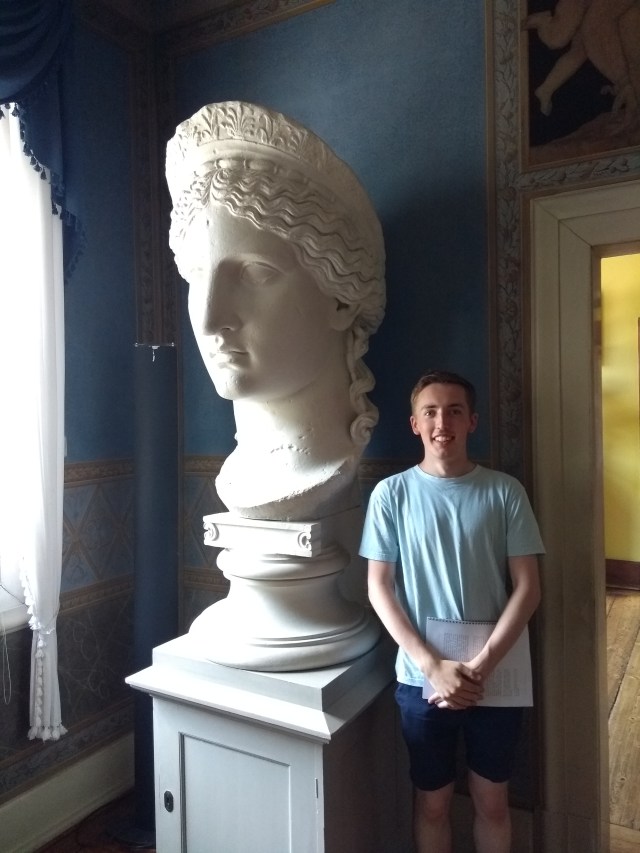
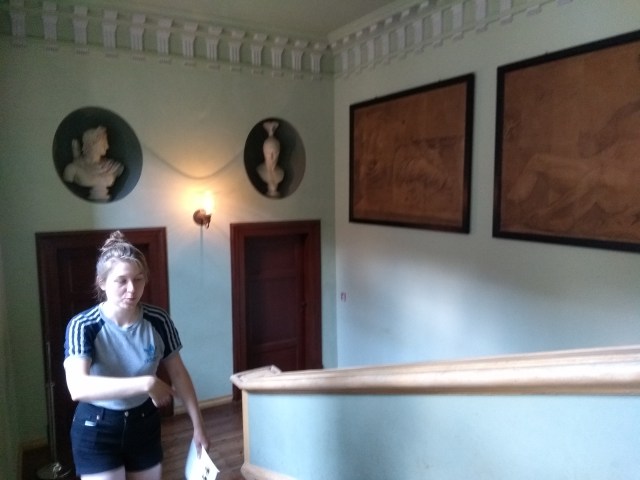
The most obvious manifestation of Goethe’s admiration for the classical world in Weimar is to be found inside his town house, which now exists adjacent to a museum of any and all aspects of the poet’s life. He amassed a considerable number of statues and busts in the renaissance style.IMG_20180609_151736059All the rooms are accessible, and there is barely a barrier in sight; that is, with the exception of the writing room, which cannot be entered, only viewed from the doorway.IMG_20180609_152712066
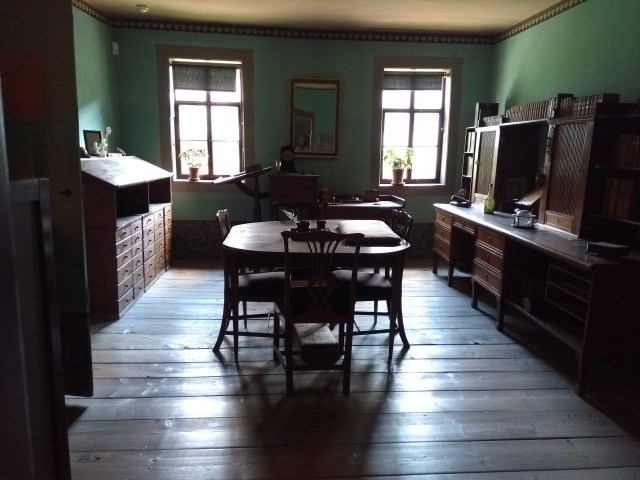
What I got from the day was not really an impression of the literary man Goethe, but rather the practical one, who exercised minute control over his life – designing his own staircase, for example, in the pre-lift age to require minimum strain to ascend (the steps are really long and shallow). I discovered Goethe the scientist who was not content with a mere “poetic” understanding of the world, who sought to further “natural philosophy” and who published several theories on colour, geology, botany and biology. Finally, I came to understand more about Goethe the politician, who in service to Duke Karl August became the equivalent of the prime minister, was in charge of fortifications and the university of Jena and got the aristocratic “von” added to his name in 1782.

IMG_20180609_145428292A full day walking around Weimar and trying to get my head around at least some of the culture that seems to radiate off every façade, statue and sculpture has left me conflicted about the figure who seemed so comfortably to inhabit the role of Germany’s national poet.

On the one hand, Goethe, the person, embodies many of the qualities I would admire in my idea of an artist. He did not, like some of the Romantics who came after try to set himself apart from the world and assume the position of the apolitical observer. In his work for the duke, he participated in and attempted to change the material world. He also saw no dichotomy between art and science, or at least believed that the two could and should feed into one another. This is an idea that ought to be more valued and promoted today in the face of Humanities and Sciences contemporary mutual disdain for the other group.

Despite this, Goethe seems to have allied himself with the aristocracy very closely in an age where the feudal system was far from uncontentious. This must have stifled him intellectually and prevented him from making a critique even if he privately wanted to. An example I found in the museum of this was when young students started convening in secret committees in order to sort out personal feuds non-violently i.e. without duelling. As a politician, Goethe condemned this more democratic method of settling disputes, but from his letters we can see he supported it. The Weimar group were also highly critical of the French Revolution, with Goethe opposing it even before the Terror, whereas Schiller expressed optimism up until this point.

It is in this capacity that I cannot help but compare him with our national poet, Burns. Whatever one might think about his longstanding kitschification, Burns as a figure is far easier for me to accept than the German. For me, you’re already fighting an uphill battle in terms of credibility if you are born into wealth, as Goethe was. He could have addressed this. Perhaps shunned honours and carved his own path, but instead he was happy to accept patronage and position and to furnish his house with ostentatious sculpture and paintings.

By contrast, Burns was born into a relatively poor farming family and when invited into aristocratic circles, declined opportunities for self-glorification. He tackled the inequalities of feudalism directly and championed democracy. Burns also supported the Revolution, which upset the noble connections he had made following the publication of his first volume.

I’ve also considered the Shakespeare comparison, with whom he’s more often measured against. Goethe has the significant disadvantage that we know so much more for definite about his life. Shakespeare can be all things to all because he is predominantly speaking through characters, there are no diaries and little information about his personal life that might shed light on his political allegiances. Perhaps though, it is unfair to judge the artist more than the art. In Goethe’s case, however, and particularly in the journals and poetry, the two are so closely linked that it becomes difficult to do so.

Posted in Life, Personal experience | Tagged , , , , , , , , , | Leave a comment

Erfurt excursion – Berlin briefly – Leipzig living

I began writing this in transit on the way to the capital having missed the Flixbus and worked up quite a sweat in the process at the tail end of a week of consistently 20-degree weather. The switch to Deutsche Bahn was pricey (adequate punishment for not knowing the location of bus station with enough exactitude) but at least this puts pressure off my rather tight arrival time. I’m actually getting there earlier and alighting right at the rendezvous rather than having to faff around with the U-Bahn. Squinting to read the signage I see the train is bound for Hamburg, Altona – a throwback I wouldn’t have experienced had I taken the road as originally intended.

The day previous I’d visited another capital, this time of the federal state of Thüringen as part of a trip laid on for international students at Leipzig. Passing swathes of verdant East German countryside, the train came fleetingly to berth in Weimar – exciting in itself without even getting off – I must go there properly someday.

We arrived in yet another Willy Brandt Platz. There seems to be a surprising abundance of these in the former GDR for his being a Chancellor of West Germany from Lübeck. More bizarre still is a building housing a Sparkasse and café opposite the shopping centre displaying a sign in large white letters, which reads “Willy Brandt ans Fenster”. We are told that this used to be a hotel where a conference was held in 1970 between East and West. Citizens gathered in the square below to address Brandt directly. Their concerns were heard, so goes the popular version of the events, and this led to greater communication between families divided by the iron curtain.

The tour goes on. A more ideal day is inconceivable. We’re doused in sun, ice cream parlours are trading to capacity and beyond, brass bells of sousaphone and cornet throw glinting flashes into screwed-up eyes. I ask a French medical student (Geigespielerin) how her rehearsal for the uni orchestra went – a sheepish reply to the effect of “unsuccessfully” is followed by an awkward verbal blankness.

We’re wrapped in shade as the seconds tick slowly by, passing through a snaking close. As we turn around the final bend we erupt into light, revealing a gorgeous sandstone church – its roof endearingly askew. Out of the silence, a thought is forming simultaneously in two minds.

Rays beyellow beige stonework. The place is bustling with cafes whose territory is sprawling naturally outwards across the cobbles, separate establishments indistinct and these mutual encroachments unnoticed in this joy of an April day. Chatter swirls up and rebounds off terracotta tiles. Glasses are clinked under the shade of ample greenery beside opportunistically erected market stalls selling ceramics and other useless trinkets.

It’s a scene from le pays de la mére, the south specifically, although accordionless.

We climb to the summit of the highest hill. Atop it sits a fort built after the Thirty Years War (which I somehow appear to be studying at the moment) – completed in the 1660s, I ascertain from our tour guide, and constructed against the fear of Lutherans as a catholic island in a protestant sea belonging to the archbishop of Mainz (one of the seven electors of the Holy Roman Emperor). Below someone is strangling the bagpipes and, of course, as token Scot I’m asked to comment.

At the foot of the castle is Erfurt’s cathedral which houses some interesting sculpture and tapestries as well as the usual stained-glass windows and altarpieces.

After our quick dose of religion, it was time to head to the beer garden. Sitting there, stein in hand, soaking up the sun at a great long table surrounded by students all doing the same was really the picture I had in mind when I imagined my “Year Abroad in Germany”.

The idyllic situation could not last perpetually and the group split off to explore again after an hour or so. We stopped at a church where one of our number went to fill up his water bottle at a fountain just outside. Although there was no “kein Trinkwasser” sign to be found, the general consensus was that it looked a bit dodgy. Anyway, the detour gave me the chance to notice that there was a picture of a moustachioed figure carved into the plinth with the caption “Gustav Adolf” written underneath. Hmm, I thought, then cast my gaze above eye level. Ah, the cherry on top – a lion’s head. What’s a fountain dedicated to a Swedish king doing around here? Thirty Years War again – Der Löwe aus dem Norden – Gustavus Adolphus protected the Holy Roman Empire’s protestants from persecution in the mid-17th century.IMG_20180421_153120425

I began telling this story on the train to Berlin. It seems I’ve omitted the purpose of that journey and launched into another one.

Well, I was travelling to Berlin to attend the first event of a Scottish-German Connection event, coinciding with the opening of a Scottish Hub at the British embassy. We were gathered to collect ideas for a joint project between “young people” in the two countries/learn from each other in how to engage the youth in intercultural understanding. As you may infer from that rather vague sentence, there was quite a high buzzword density to wade through to arrive at some substance. Anyhow, it was good to be back in Berlin properly – the last time I’d been through was for a Mac Demarco concert. It was cool to be inside the British Embassy, meet some new people and get the chance to reunite with my UK-German Connection partner, Sina as well as Jule, who I also met in November.IMG_20180423_202111344

I’m loving being a student again. My courses range from Game of Thrones (name of the Thirty Years War seminar) to Goethe and literature of the GDR to linguistics of proto-Indo-Germanic. I’m pretty well settled in, but I’d like to push myself to get involved in more aspects of student life here outside of academic stuff. Next time I write I’ll have consigned our Plattdeutsch/Orcadian project to the past, with the evaluation seminar coming up soon, and I’ll probably be working quite intensely, having taken on quite a lot of credits out of interest. It seems that I have fewer contact hours in this semester abroad, but that I’m doing more courses, each with their own assessments, so it does add up. It’s hard, but not psychologically challenging like my teaching placement in Hamburg! Reading, research and time dedicated to both is really all I need to do well here. However, I want to do more than that, although part of me would be content with this alone. Tune in for the next update to find out if I succeed in this rather nebulous aim.

Posted in Life, Personal experience | Tagged , , , , , , , , | Leave a comment

German & the Neutral Language?

Since I last committed pen to paper with the intention of publishing a blog nearly a whole month of me living in the city of Leipzig has passed. Tomorrow my first lectures and seminars begin after what I have to say has been quite an extended settling-in period.

As mentioned in the previous post, my first three weeks were spent taking part in a language and orientation course during which some events were organised to facilitate us getting our bearings and experiencing some of the culture, alongside there being suggestions almost every night for possible evening’s entertainment. Of the former the Leipziger Buchmesse, which was a huge event for literature of all kinds including a mini comic-con for manga (fun fact: Leipzig is home to the largest goth gathering in Europe) and at which there were several panel discussions going on being filmed for various TV networks, and the opening and closing buffets were the highlights. The first was held in the Moritzbastei semi-subterranean student union, constructed as a fortification in the 16th century, partially destroyed in the Second World War and then reclaimed by students, among them Angela Merkel, in the 1970s.

For the evening activities my favourite would have to be the “Wir feiern Bach” concert at the Kunstkraftwerk in Plagwitz in honour of the composer’s 333rd birthday. The venue was this converted industrial warehouse lit variously in pink blue and green, with a massive winch descending from the ceiling and an iron staircase running up one wall to a lonely door at first-floor level – this was utilised in a call-and-response oboe piece from alternating between atop the steps and amongst the groundlings. We were placed right at the back and simultaneously had front row seats; the performances happened in all corners of the room and these included barber shop quartets, experimental jazz guitar and a local celebrity busker with a 10-euro flute (sounds horrific – it was, and made more so by his wearing of ear defenders to play a full three movement concerto!) as well as the expected choral and classical instrument ensembles. My only criticism would be the three-hour duration without an interval. Nevertheless, it was excellent value for money.

I’ll admit the introductory course really held your hand through the setting-up process of studying at German university and specifically Leipzig, but I think it has eased my anxieties about what tomorrow will bring to some degree. So far, I can say that I like the city’s vibe and, from what I’ve seen, the university culture seems pretty cool. Getting the vulgar out of the way; it’s much cheaper than Hamburg and Edinburgh, especially rent. People are quite relaxed and the Innenstadt has some beautiful public architecture; the library in particular is utterly gorgeous with its marble interior, abundant natural light and self-regulating blinds (which are admittedly unnerving the first time you notice them scroll up unprovoked). Around midday the Mensa opens for two hours and you can get a lot of food for very little money using your student ID as cashless payment – it’s highly efficient and very convenient as a system and makes me kind of despair that there’s not that culture among UK universities. To be frank, the food is far from gourmet, but it suffices and there are always plenty of options.

Ok, so you’re waxing lyrical about infrastructure; I think that’s really best left to concept albums from Kraftwerk and Public Service Broadcasting don’t you? What about the people you’ve met?

Ah yes, you might be surprised to hear that I have actually bumped into a few of those during the past month. Not always very good about talking about other people in this blog, it’s all a bit introspective as a literature student might say (wait what?)

Flatmates might be a good place to start. To save myself the trauma of going on the Wohnungssuche again, I reserved a place in a Studentenwohnheim – basically halls. This form of accommodation is actually pretty unpopular for German students, so their now being filled up with college students and people doing their Abitur (secondary school leaving qualification) – this applies to my two Mitbewohner who are from Uzbekistan and Syria respectively, the latter being a refugee of Palestinian heritage. They are both very friendly and helped me get my internet set up when I first moved in. I’ve also now got 5000 Uzbekistani som in my possession (traded at the extortionate rate of one pound sterling).

Yes, and then there are the Erasmus, or more accurately international, students as of yet existing in our own microcosm of blind leading blind, but this week released into the real world of Universität Leipzig. Italians make up the largest constituent of the group and there are quite a lot from China, add to this Korea, Denmark, Norway, the Netherlands, USA, France, South Africa, Brazil, Portugal for a flavour of some of the other nationalities, oh and there is a surprisingly large Manchester contingent.

Since moving here I’ve reassessed my relationship with the English language. Although I’m using German as an Alltagssprache of day-to-day business, we speak it in our flat even though none is a native speaker, I employ it when talking to other Erasmus students whose English isn’t as strong as an equaliser and of course in the presence of actual Germans, English does seem to be the default international language. On the one hand that’s incredibly practical and allows you to be the truest version of yourself in social situations, barring complex phraseology (from my time as a teaching assistant I’ve become more used to simplifying and repeating what I say in different words) and using too much of a regional inflection – which I suppose is a kind of betrayal but worth it to be understood, and after all, standard English is also my native language. It’s just sometimes I’m in a group of say six people and I look around and account for all the nationalities/languages and wonder why it should be that although only one or two of us are English native speakers, the conversation is in English. It seems unfair that this should be the case; my advantage is undeserved.

I’m grateful for having grown up where I did because it makes travel and contact with other nationalities incredibly easy, but I’ll also never have the experience of having to employ the dominant international language abroad as a lingua franca.

The effect here is kind of a neutralising one that makes English seem like a base-level language after David Hume (writing as a thoroughly Anglicised Scotsman during the Enlightenment) “the ENGLISH, of any people in the universe, have the least of a national character.” This is obviously not the case, but one can’t help but feel that in these situations. Another effect of English spoken as a language in common is that it feels as if everyone is sort of playing diluted, watered-down versions of themselves on this level playing field and I have this inherent upper hand. It makes English feel rather soulless and not the language of true feeling if that makes any sense at all.

At the beginning of this year I watched a German film called Toni Erdmann which I think sums up this idea quite well. The German class I’d been working with were going to be analysing this in school; something I think was a strange choice considering the film’s exceedingly bleak or very darkly comic tone, extended “love” (more accurately loveless) scene which culminates in the consumption of a semen-smeared cupcake and the film’s climactic final scenes hinging upon extensive nudity as a crucial plot point. This was not the choice of the school, I hasten to add, but the Hamburg education authority; the scenes were going to be cut but I don’t see how they could properly assess the piece without them – needless to say I changed by timetable (but not just because of that).

Anyway, the basic premise of the film is that a 60-something German’s 30-something daughter never has time to se him because she’s working for this multinational company in Romania which completely absorbs her and deals with most of its customers in English. In order to get back into the daughter’s life, her father poses as a client, Toni Erdmann – forcing her to interact with him in a business capacity.

Here the English language is presented in terms of the globalising, depersonalised and disingenuous means of communication. The interests of the Romanians are shoved aside and the daughter flatters and accommodates her business connections’ every whim in flawless English, whilst her British assistant helps arrange her professional life in noticeably fumbling German. It’s a fascinating multilingual film that is far from an easy watch but that really puts language into the spotlight as well as being a critique of global capitalism. Silence also plays a significant role with restrained use of soundtrack and minimal dialogue in the final scenes. German speakers will get more out of it, but I would thoroughly recommend regardless.

I realise this stirs up more questions than answers, but that’s what I’ve been thinking about lately! It’s probably too late for Esperanto and gone are the days of Latin as a neutral language (these are both very Eurocentric suggestions anyway). I’m not sure what the solution is, maybe there’s not even much of a problem. In any case I think it’s an interesting issue.

Posted in Life, Personal experience | Tagged , , , , , , | 1 Comment