English Road

I wouldn’t exactly recommend the Camino Ingles in England, even though overall it was enjoyable.

The route follows what is thought to be the path taken by pilgrims from the south before they departed from Great Britain and onto mainland Europe on the Santiago de Compostela.

It is not the most well-established of pilgrimages – the English leg I mean – and is far from embedded. The main thing wrong with it is that there is simply too much walking on roads or beside roads. That is not what I want out of a pilgrimage experience.

Because it is not that established or embedded you cannot really call it a phenomenon. The issue is that no one is really doing it with you. I didn’t meet a single person on the Camino who said that’s what they were doing anyway.  The only person who said they had was someone right at the start among the ruins of Reading Abbey. She blessed me and told me to collect a pilgrim passport from the Father in St James’s Church. He wished me, “Buen Camino”.

Reading Abbey – a section of it.

The lady in the Abbey gave me a bit of an idea of what to expect. When I asked if it was fairly well marked out she was slightly hesitant. She said that it was quite overgrown by the River Itchen. She wasn’t wrong – I was fighting through vegetation for considerable stretches on my final day on very narrow paths.

Narrowness is one of the main differences between hiking in England versus Scotland. Whereas in Scotland we have the Right to Roam empowering us to traverse any land apart from a golf course or a dwellinghouse[1], in England one is forced into these resentfully thin corridors, scurrying along like rats in a drain. Speaking of sewer systems – one of the lowlights of Day 3 was in parallel to a sewage processing plant.

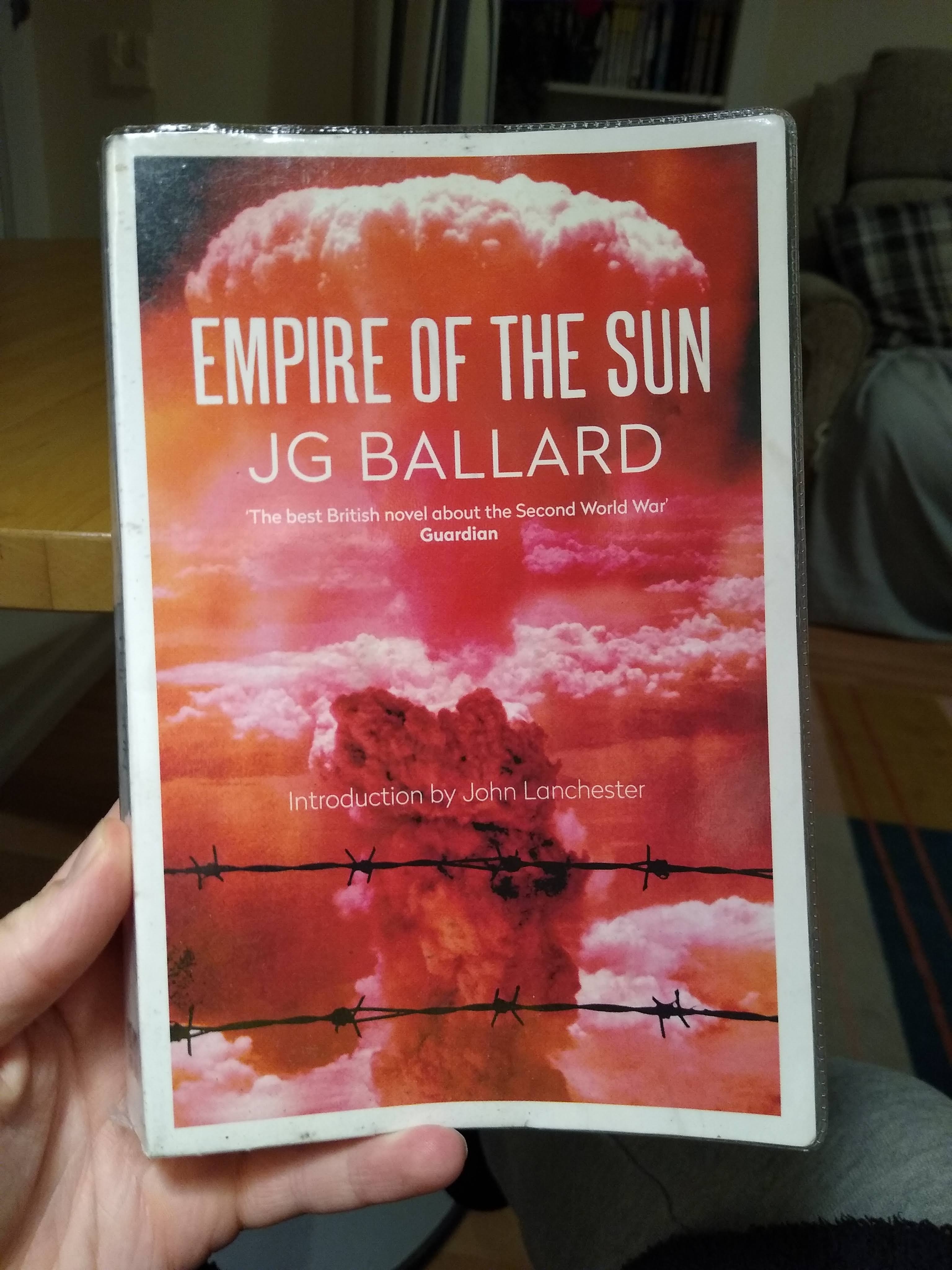
These byways and bridleways are a lot better than the alternative though – roads. Walking on the road in the south of England is a far worse experience than in Scotland for one main reason: hedges. You won’t find drystone dykes here or fences for that matter (apart from the barbed wire that often flanked the abovementioned public rights of way between two fields). I’ve recently been reading Klara and the Sun by Kazuo Ishiguro and in it a character fondly describes the England of their youth that they’ve left behind, waxing lyrical about its hedges fixing the fields for evermore versus the impermanence of fences. My perspective is in total opposition to this view. Why praise the immemorial apportionment of land for all time? It is the exclusion of generations for generations.

The hedge represents the inviolable separation between mine and thine in the collective Anglo-psyche. It should be abolished now and for all time.

On a practical level, hedges make walking on B-roads unnecessarily perilous. They eradicate the need for a verge and thus eliminate any refuge for the walker in the face of oncoming vehicles. The fact is, cars are king here even if the situation can primarily be blamed on centuries of agricultural practice since enclosure.

Roads here also frustrated me even when I was not on them. They ruthlessly bisect the countryside, making it almost impossible to get anywhere efficiently on foot without endangering yourself. I am taken back to my geography classes at school, learning about how the logging companies in the rainforest isolate animals so they can no longer roam freely in their habitat, fragmenting ecosystems and turning them into ever-shrinking islands doomed to sink under their lack of interconnectedness. The phrase “wildlife tunnels” comes to mind. There are also apparently “green bridges”. They put them into new motorways so creatures aren’t cut off. All I can think is – I need a wildlife tunnel!

The long and short of it is this: You simply cannot have a pilgrimage experience with the M27 speeding right over your shoulder. If pilgrimage ought to be marked by hospitality, mine was mostly characterised by inhospitable infrastructure both in terms of transport and law towards travellers on foot in the south of England.

That being said…

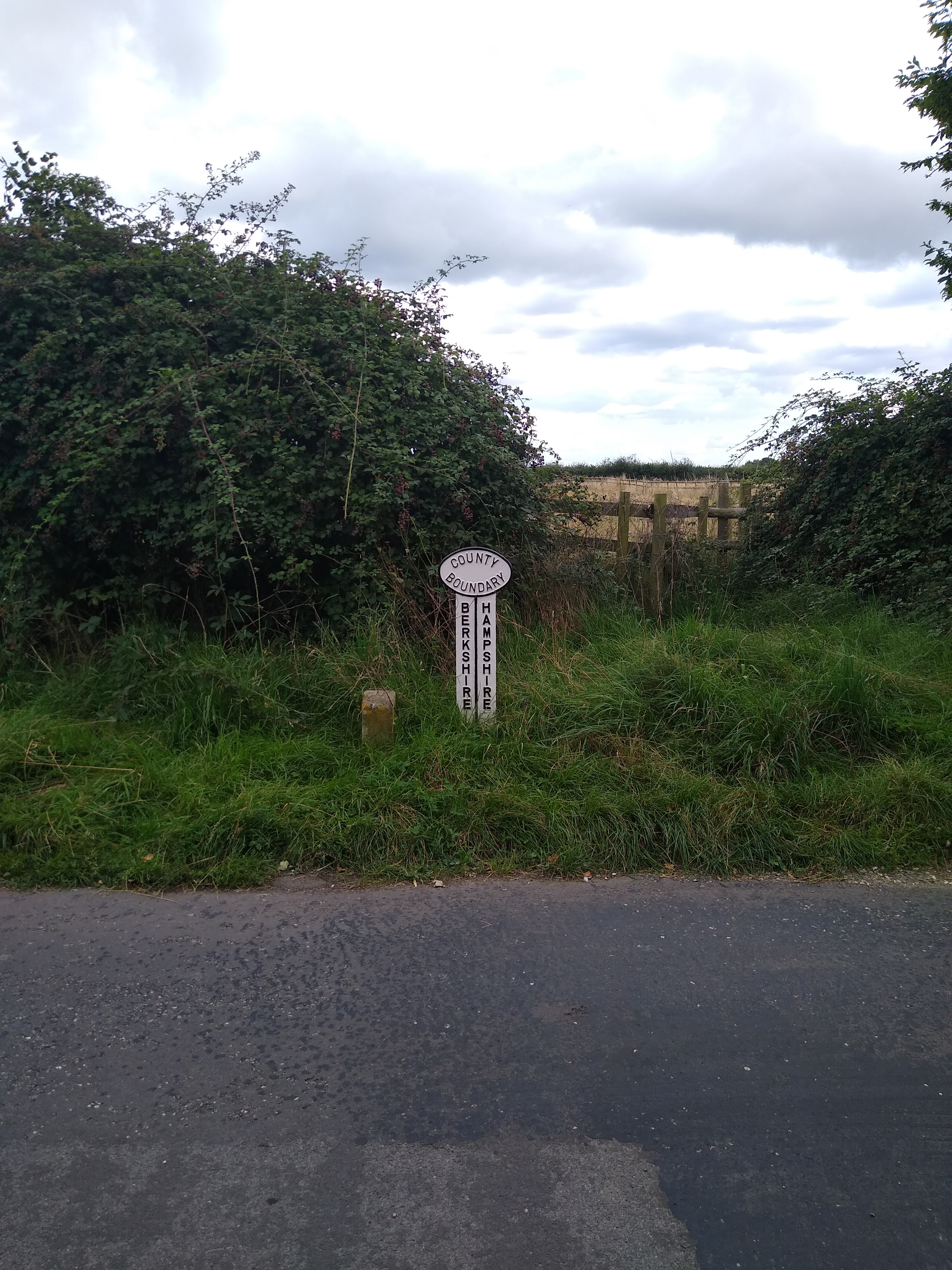
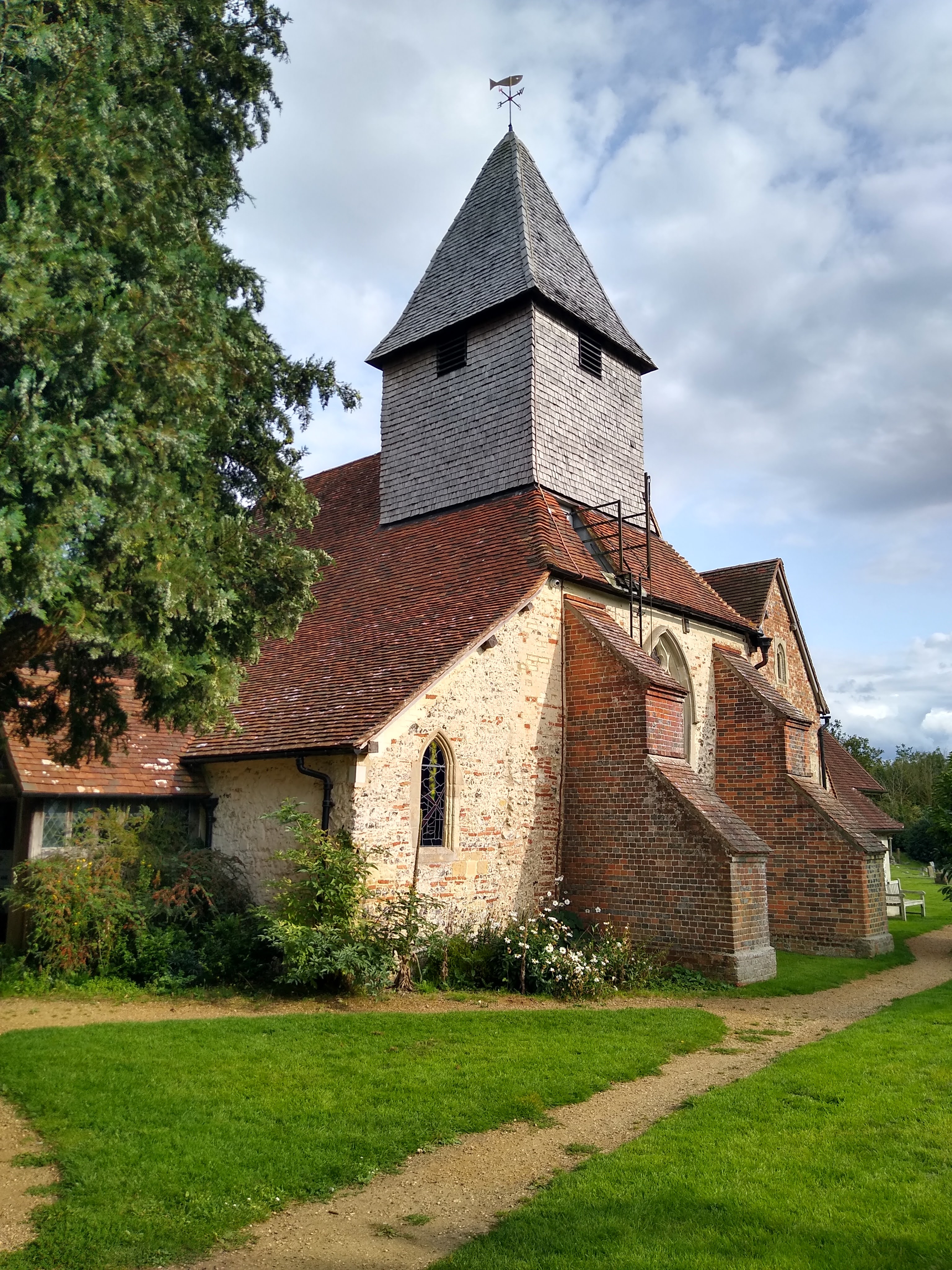
There were highlights. The Church of St Mary the Virgin at the halfway point on Day 1 – a beautiful 12th-century building with painted decoration of the walls that seems to have been spared the reformation. Rejoining the way on the same day after a detour and finding the Berkshire/Hampshire county border like the parish boundaries on the Hammars o Syradale. The Quaker cemetery in Basingstoke whose centrepieces are the shells of ruined chapels and whose winding path is paved with prostrate graves.

Day 2 was unquestionably the worst. Long endless roads. I was led through bridleways to the edge of a dual carriageway across which supposedly a parallel public path lay. It was non-existent. I trudged through nature’s barbed wire – brambles – before giving up and going back on myself for a more accessible route.

Halfway through this deviation from a deviation, I decided I’d get a bus when I could. Easier thought than done. The detour ended only in another stretch of verge-less B-road whose laughably-named termination was Cheesefoot Hill. About a third of the way along this I contemplated the idea of hitchhiking. Before I stooped to this my salvation came in the form of a farmgate layby and a fortuitous vape break.

My deliverance was named Joel and he’d just been at Boomtown Festival, up from Portsmouth. I asked him if he was going to Winchester. He said, I can if you want, mate. He drove me the last few miles to the soundtrack of bling-era 90s rap. I sheepishly paid him a little something for his trouble and disembarked for the Airbnb. All in all, an encapsulating anecdote.

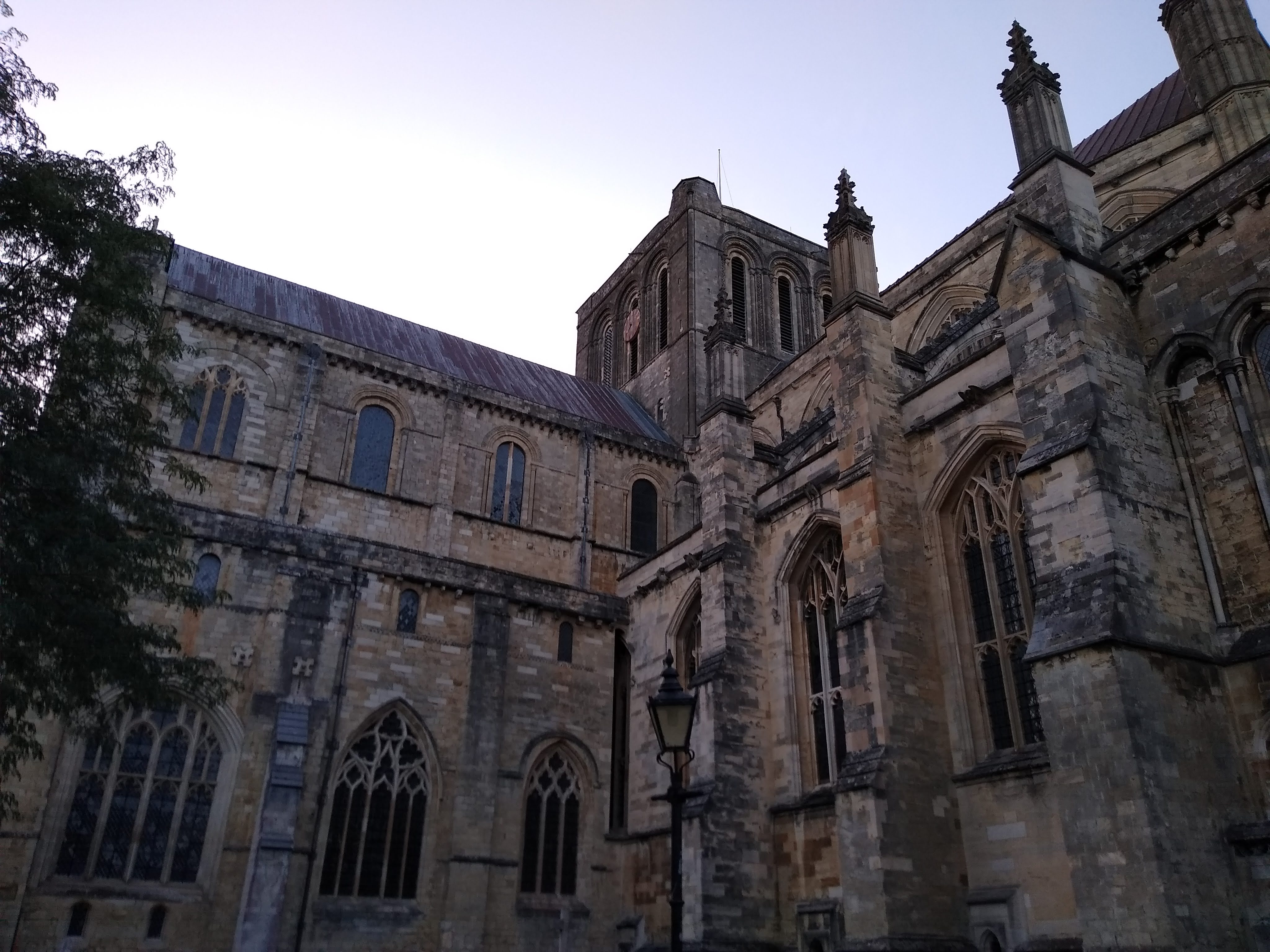
Having calmed down from my ordeal somewhat with a shower and a change of clothes, I ventured out to witness the 2/3-way point of my journey. I’d missed the Winchester Cathedral opening hours by a considerable margin, and tomorrow was Sunday – not for tourists in the morning. No pilgrims toll for me, no bread roll and a cup of beer. No stamp even, for my newly acquired passport.

No matter, I was at ease and content to enjoy the edifice in the last glow of the twilight. My very recent experience of custodial kirk-keeping reconciled me to the circumstances.

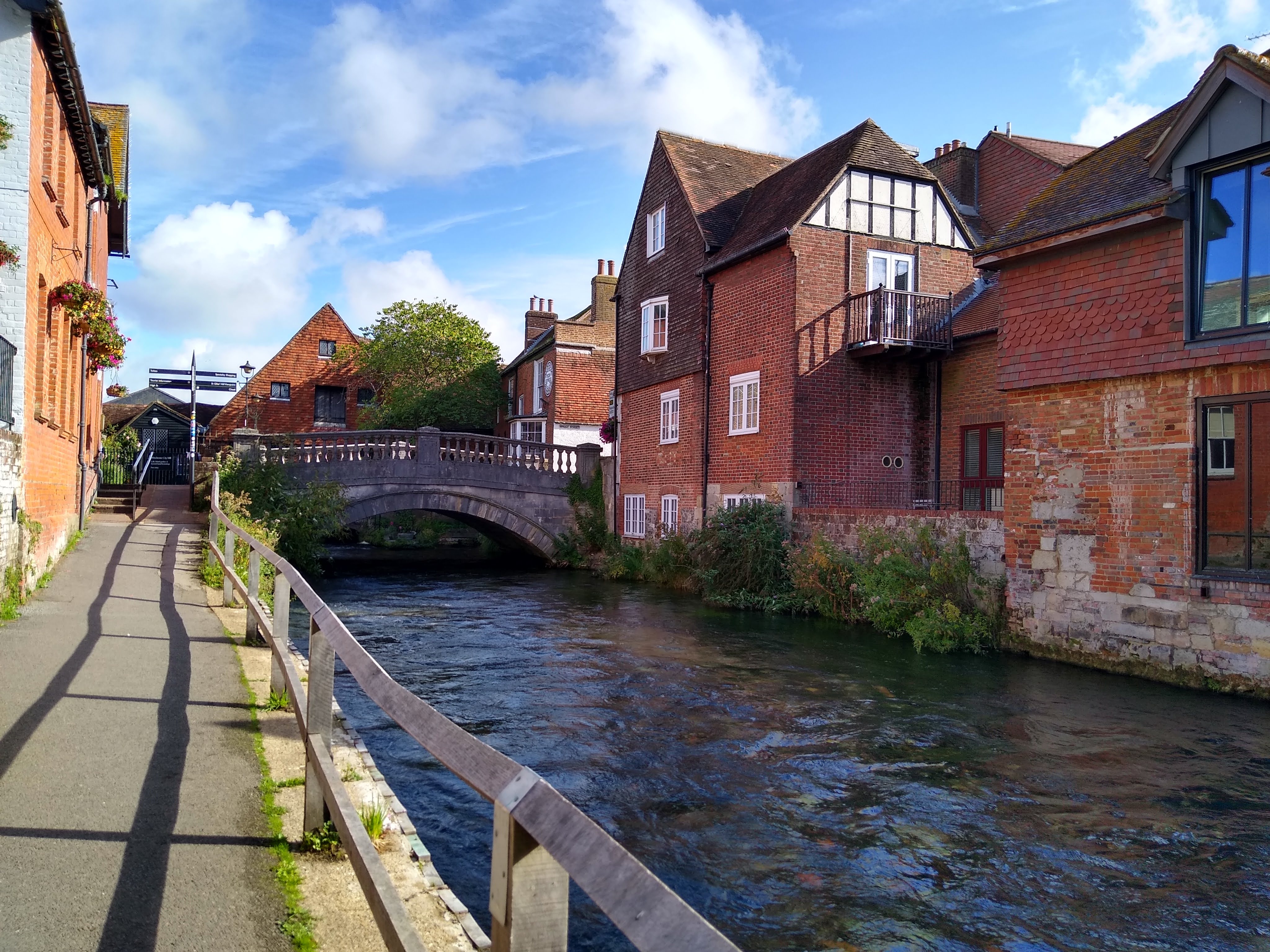
The next morning began my favourite stretch of the pilgrimage and had a wonderful start along the River Itchen where it flowed fast and straight through the city. In retrospect, this is perhaps less attributable to the Camino itself than it is to the fact that it is coterminous with the deal more established Itchen Way.

Here I experienced, as I got further along, something of the true solitude I was seeking, as opposed to the loneliness I found on the open road. In patches where I didn’t have to relentlessly concentrate to grapple with greenery and avoid snapping my ankles, I was able to access some of the higher thoughts that these experiences are supposed to lend themselves to. That was until I came across the sewage plant and the M27.

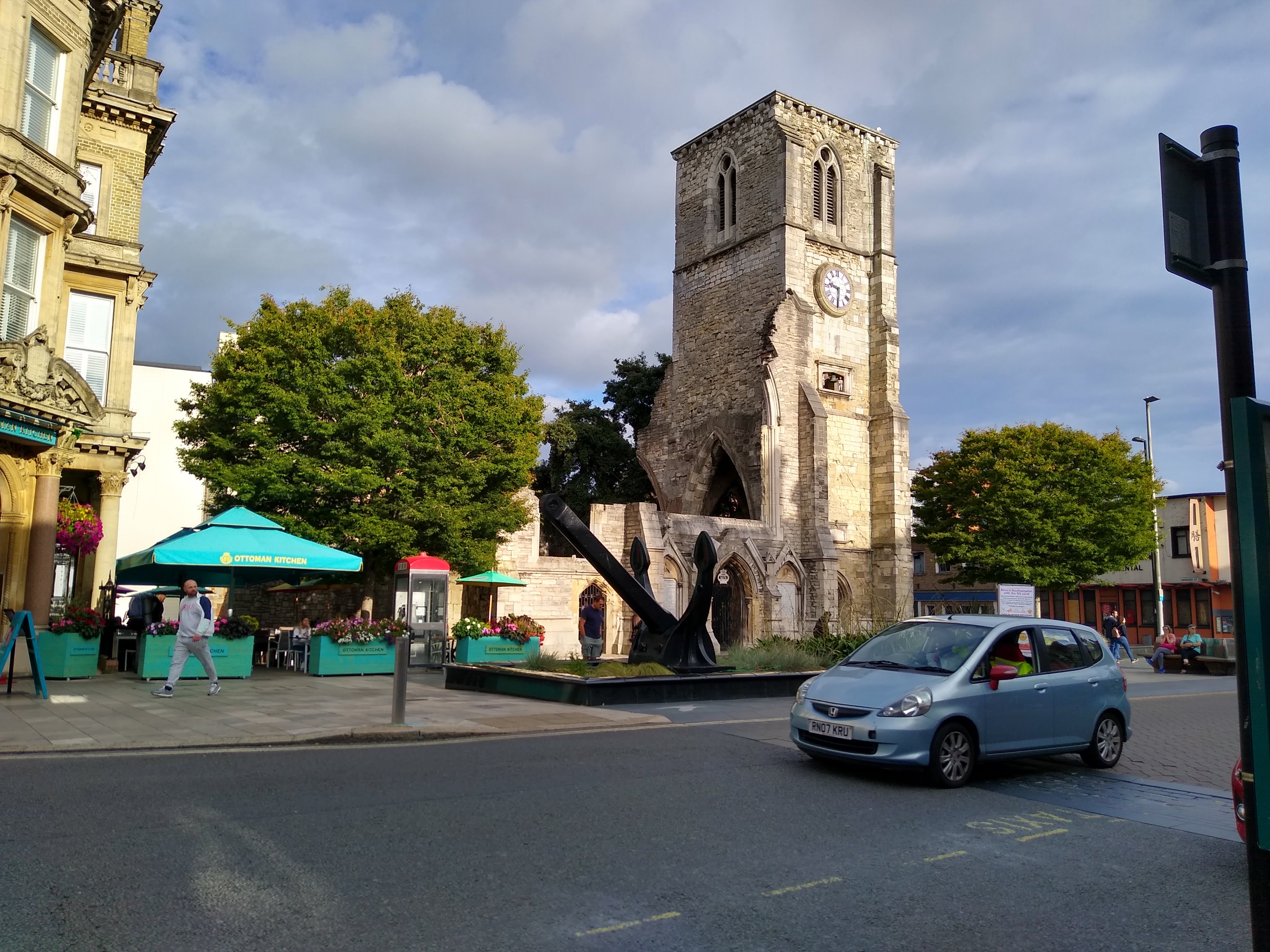
Arriving in Southampton, there really is no definitive end; like a cathedral, for example. I suppose this is because it is really the beginning of a further, much more epic, continental trek. However, before I went I did look up some significant sites and came upon one as I ventured out to find somewhere to eat.

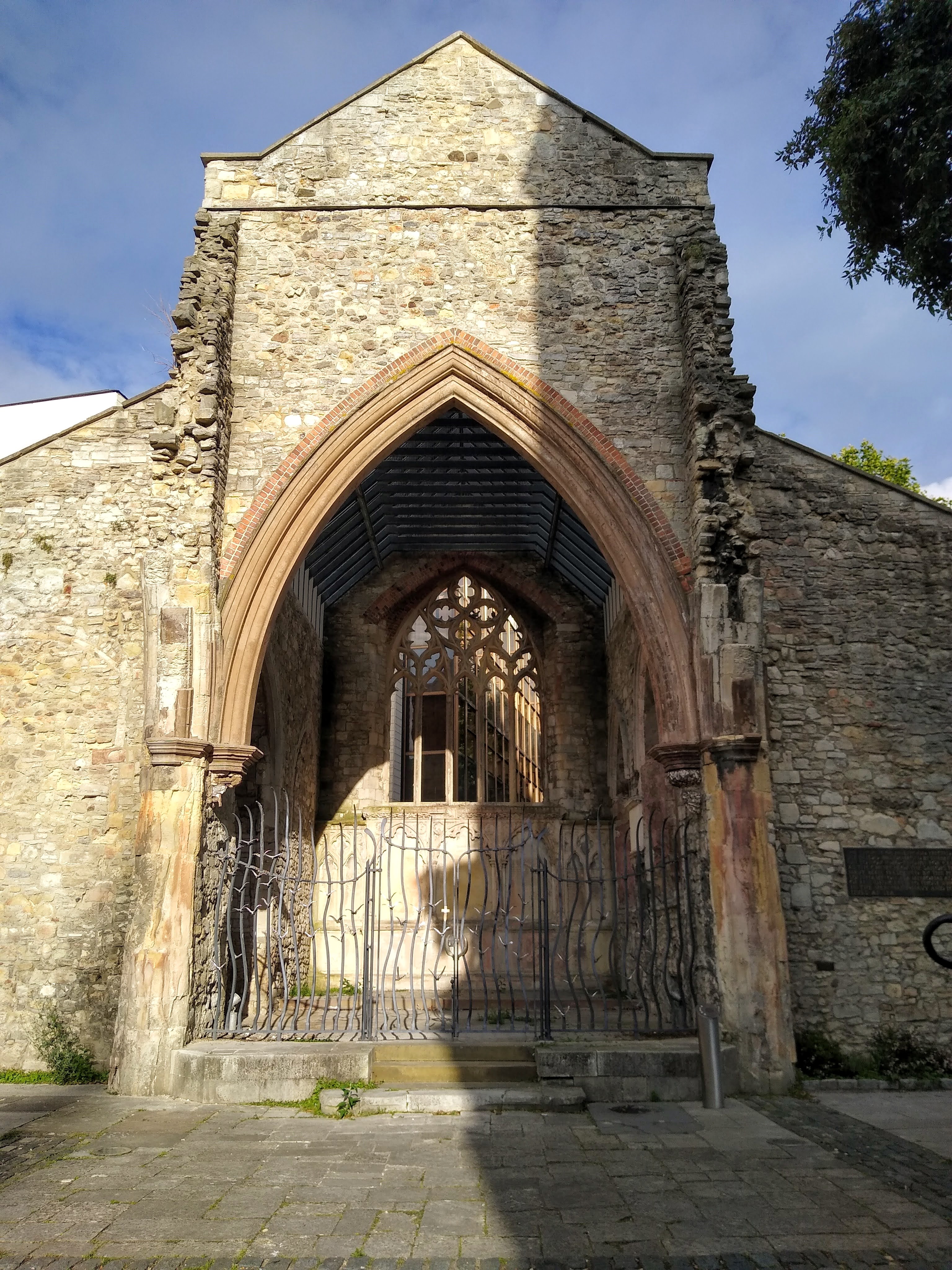
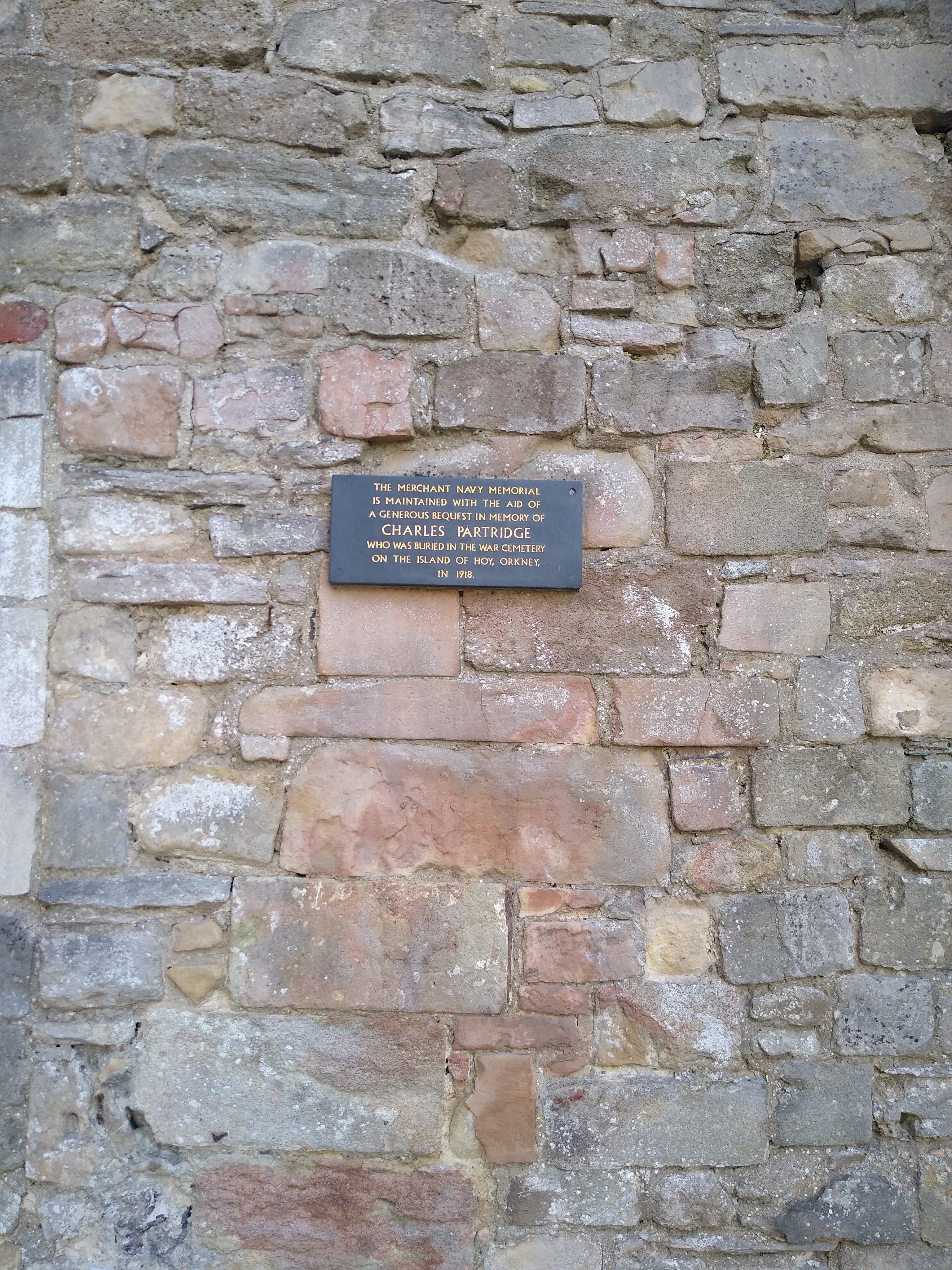
The Church of the Holy Rood is a medieval building, now a shell because of bombing in the Second World War. It has been maintained like this, instead of being swept away, and remains as a monument to those in the merchant navy who lost their lives at sea. In the corner is mounted a plaque – “This memorial is maintained with the aid of a generous bequest in the memory of Charles Partridge who was buried in the war cemetery on the island of Hoy, Orkney in 1918”.

After the self-inflicted ordeal of the preceding three days, I had arrived back where it all started; uncannily aligned with the grief for a foreshortened life that had the power to raise temples.


[1] Obviously a little more complex than this but not much more!

Posted in Life, Personal experience | Tagged , , , , , , , , , , , | 1 Comment

A Tale of Two Wheels

“Nice bike, pal,” a fellow Genesis owner heckles to me on the north bank of the Clyde as I make my way back to the office from Glasgow Sheriff Court. I quickly realise the reason for the compliment and mumble a thank you.

It is a nice one – a gravel bike with chunkier tyres than the standard road bike, as remarked upon by my shadow shadower who is tagging along behind the advocate instructed to represent our client. Bike2Work scheme! I hastily add – the company paid upfront.

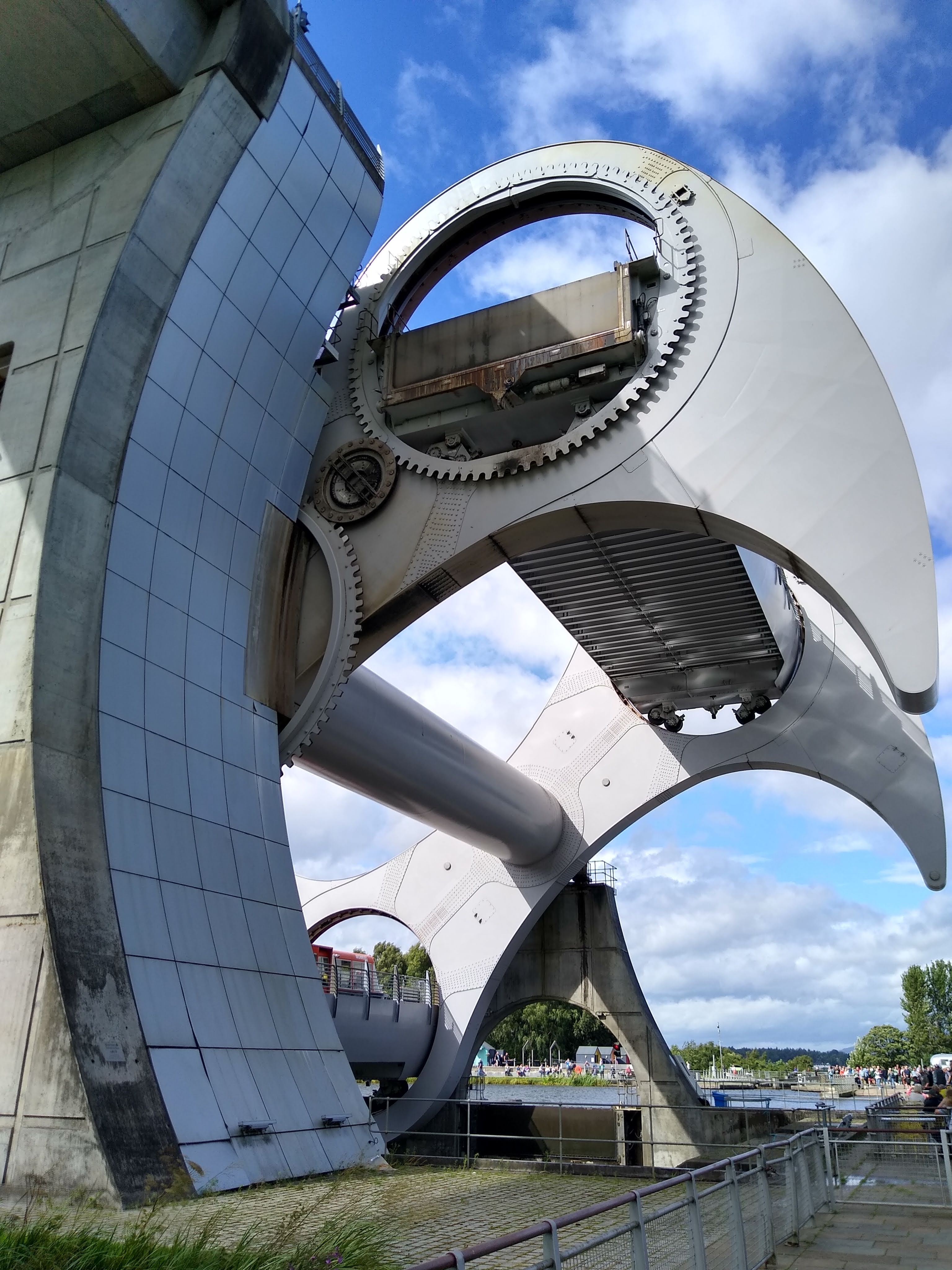
My steed, whom I admit to christening Cécile after the character in Dangerous Liaisons – the last book group novel, has enabled me to take trips to places I’d otherwise find too effortful to arrive at and has expanded my psychogeographic sphere. Yesterday we went to Falkirk together. Well, not Falkirk proper – I decided to halt my journey when the famous Wheel came into view and lock up there.

The ride out was sprinkled with intermittent drizzle but otherwise smooth. There was one patch, however, where tree roots were bursting through the tarmac unexpectedly and gave the frame such a jolt that my phone mount flew off its anchor and into the bushes. Luckily, it was quickly recovered unharmed and I continued on my way.

When I got to the Wheel it was unlike what I’d imagined. There is a whole entertainment complex there. You can go zorbing, do archery and explore a visitor centre. Of course, the main attraction is the Wheel itself, which raises canal boats 24m from the Forth & Clyde Canal to the Union Canal to Edinburgh.

I arrived just in time to watch the Wheel rotate 180 degrees from stationary. To observe the Wheel in motion was for me an unexpectedly moving experience. Coming across the landmark at a standstill is impressive enough as a towering modern art installation, but to see it move approaches the technological sublime.

Standing about and tucking into a well-deserved apple I can hear the chirpy tour guide rattling off facts over the loudspeaker, but their contents are indistinct. Lined up along the Forth & Clyde dock are clinking China and cutlery as the café overspill are beset by a fresh westerly. Yet more onlookers grip onto railings, some clutching tickets to be the next to ascend.

The five-minute spiel comes to a close and the process begins. Steadily, inexorably the boat is drawn up towards the spectators. The rational part of our brains knows it’s going to miss us and get pulled up over our heads, but the animal in you cannot help but be somewhat unsettled by the inevitable arc of this colossus. I intuitively step back, though I know the café tables at the water’s edge will be safe. My rational self says this is just to get a better viewing angle but I know on some emotional level there is fear. An autistic child vocalises what I’m sure many are feeling at this moment in a repetitive and emphatic cry, “It’s coming straight for us! It’s coming straight for us!”

As I retreat for a better angle I am struck by the beauty of this creation. Not merely for what it is, objectively – an impressive and elegant piece of engineering – but as I imagine it too. It is a symbol and material manifestation of humanity’s dominion over Nature: terrible and beautiful; Godlike precision and simplicity.

A medieval peasant might marvel at this while shrugging off an iPhone. Witnessing the wheel at once shows the smallness and greatness of Man.

After refreshing myself with a slice of Victoria sponge I saddle up again for the journey back. Before I leave, I catch two young boys in conversation. From the context, I gather, one of them local and the other from further afield. “Do you know this is one of the wonders of the world?” says the local, and from the tone of his voice I can tell he believes it.

On the return cycle, I experience a different sort of humbling. Already pretty fatigued from my morning run and cycle out I faced a relentless headwind and become progressively more puggled with each pedal. My phone, on which I’d helpfully programmed a route map from what is essentially a straight line along the canal, showed me objectively that I was at close to half the speed of my outward journey on my energy-depleted final third.

The sense of smallness was compounded as drizzle gave way to downpour. I battled on and was able to make it home. Conclusion: I think I will wait for more conducive weather conditions before I attempt Loch Lomond, which is likely to be my next bike-based weekend adventure.

Posted in Life, Personal experience | Tagged , , , , , | Leave a comment

The deserts of Scotland

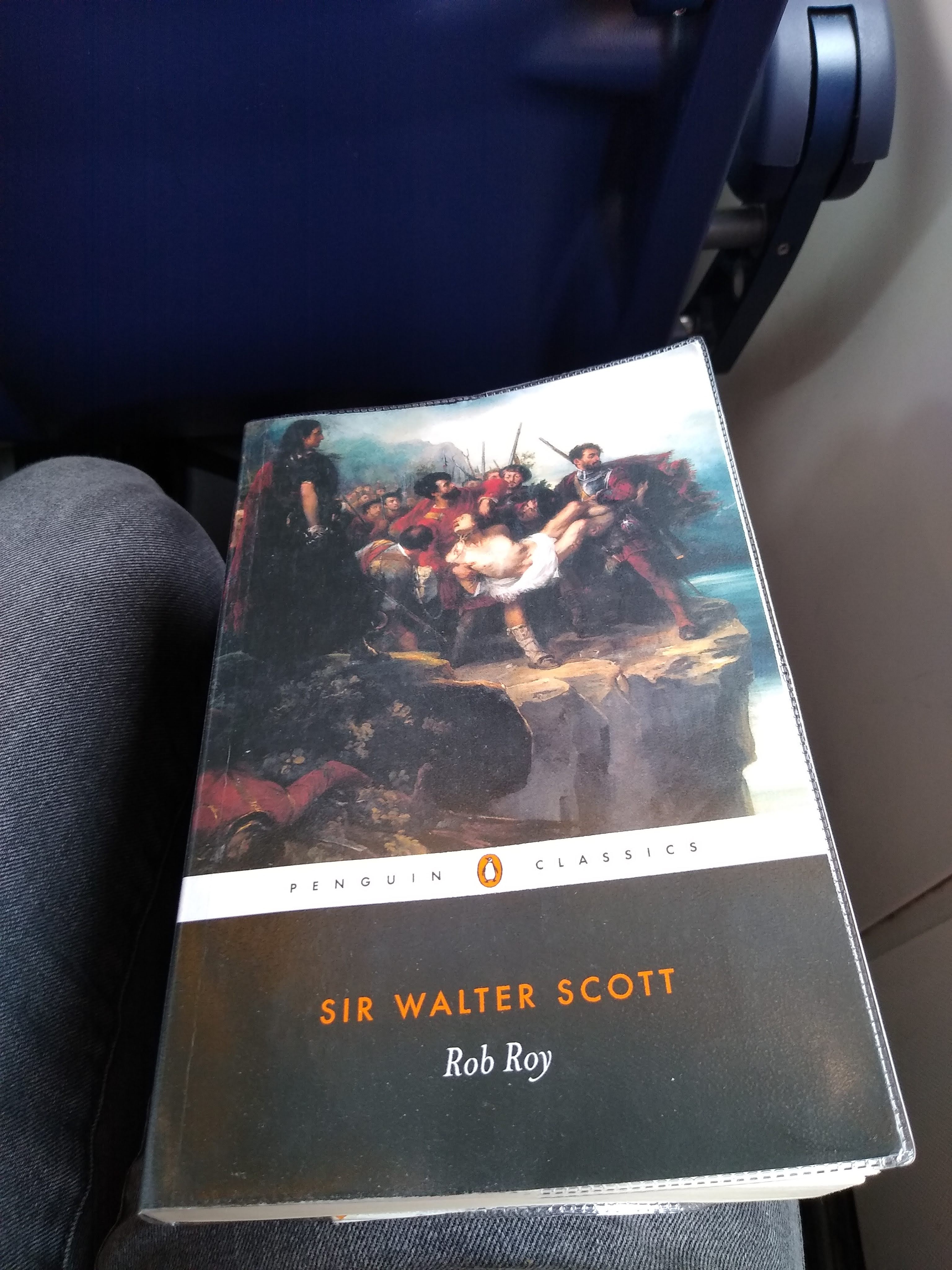
I’d always wanted to read Walter Scott. In fact, I’d attempted to before – embarking on a free Kindle version of Waverley which was abandoned for whatever reason; probably the dense prose style that strains the attention of a restless mind. Rob Roy is similarly encumbered but for my edification I had got through a couple of Henry James novels before, so for my own sake and the sake of my classic book group this time I persisted and reached the end.

Something that is impossible to get away from when reading Rob Roy is its pervasive preoccupation with Scottishness. By name and by nature, Scott is creating and adding to a national myth. I’m not sure why he decided to write this tale at this particular time. In 1817 the Union was old news and Scotland a full and disproportionate participant in the British imperial project, as alluded to even in the conceit of a memoir written sometime after 1745 and about the failed Jacobite rising of 1715. Scotland and England’s shared political destiny would have seemed assured from this historical vantage point – no nascent nationalist movement existed. So why did Scott turn to mythmaking at this time?

Writing set in the past is almost never about the past as such. A novel is something new – novel. Bertolt Brecht theorised that the only way to speak truthfully about the present was to approach it from the perspective of the past. For him, historicisation was an important subcategory of his seminal Verfremdungseffekt. He was vigorously opposed to the idea of cyclical, recurring history and by placing his plays in the past he sought to show social conditions that the audience could see had been consigned to history, which had been overcome and thereby allow onlookers to conclude for themselves that their political situation could likewise be transcended. I don’t believe this is what Scott is attempting in his “historical fiction”; from what I know of him he is unlikely to have endorsed a Marxian theory of literature, notwithstanding that this is chronologically impossible. However, a consignation might be an apt way of looking at what is being attempted here; in other words, he is trying to consign a wilder, more politically volatile Scotland to the past and contain it there.

At the same time, my impression is that Scott has a benevolent preservation or conservation instinct. His use of Scots language, in particular, in the characters’ dialogue shows a genuine concern for accuracy and fidelity to its actual use in the early 18th century. This is one of the novel’s greatest strengths, even if it hinders accessibility to the modern reader. It depicts Scotland as a land of three languages – Gaelic, Scots and English – and the titular Rob Roy is a master of all three.

Scott is quite even-handed about the relative strengths and characteristics of Scotland and Scots vs England and the English. His protagonist is English and at times seems unnecessarily harsh on his Scottish servant Andrew Fairservice who is portrayed as proud to the point of overt bigotry and money-loving to the point of repeatedly practising false economy. On the other hand, Scotland itself is depicted as a vigorous country with fast-flowing, virile burns compared with England’s slow, lazy streams.

The Scotland of Rob Roy is not one homogenous polity, however. There is the “lawless” hinterland of the Highlands whose inhabitants are on multiple occasions compared with “desert” people:

It is always with unwillingness that the Highlander quits his deserts

And:

 A people patriarchal and military as the Arabs of the desert were suddenly dragged into modern commercial and industrial society.

This was an image I also found in Mary Shelley’s Frankenstein, published in the same decade, where the Creature speaks this line:

I have dwelt many months in the heaths of England and among the deserts of Scotland.

An aspect of the novel I found interesting was Scott’s legal background coming through fairly strongly. He particularly highlights differences between English and Scots law, which survived the, at the time when the novel is set, recent Treaty of Union. Take this passage from Nicol Jarvie:

there’s nae bailie-courts amang them—nae magistrates that dinna bear the sword in vain, […] But it’s just the laird’s command, and the loon maun loup; and the never another law hae they but the length o’ their dirks—the broadsword’s pursuer, or plaintiff, as you Englishers ca’ it, and the target is defender; the stoutest head bears langest out;—and there’s a Hieland plea for ye.

The “lawless” Highlands are contrasted with the legal culture of the lowlands, whose terminology is helpfully translated for the benefit of our English protagonist and Scott’s English readership.

Osbaldinstone seems to have undue or naïve respect for the law and always cooperates with authority even where he is falsely charged or where doing so puts his friends in danger. His solution to his cousin Rashleigh’s treachery is not physical confrontation (apart from their drunken scuffle in the early part of the book) but a lawsuit against him.

In this way, Osbaldinstone is apolitical – cavorting with Jacobites and Hanoverians (the government) alike without seeming to be invested in any particular side. He is largely indifferent to the main political question of his time. The novel’s eponymous hero is another apolitical figure – Rob Roy recognises no authority but his own and uses extra-legal means to get his way. Perhaps he could be seen as an anarchist, albeit a violent one who uses violence to obtain what he wants.

If Osbaldinstone does possess a “political” opinion it might be anti-Catholicism, but this only really expresses itself for practical reasons as it complicates his desire to marry Diana who is being sent to a convent. Religion in Scotland is in focus for a couple of chapters which take place in Glasgow Cathedral and are a highlight for me for obvious reasons. Scottish religion is depicted as serious, intellectual and, once again, proud.

Overall, I enjoyed Rob Roy. Although its style can be off-putting at times, the Scots dialogue is good and the time period is interesting. I’m sure I’ll return to Scott’s other works in due course.

Oh, and Orkney gets a mention (well, two – St Magnus is mentioned as a pre-reformation survival alongside Glasgow Cathedral):

And in this country, and in the isles, whilk are little better, or, to speak the truth, rather waur than the mainland, there are about twa hunder and thirty parochines, including the Orkneys (sic), where, whether they speak Gaelic or no I wotna, but they are an uncivilised people.

Orcadians also receive similar treatment in Frankenstein:

The soil was barren, scarcely affording pasture for a few miserable cows, and oatmeal for its inhabitants […] whose gaunt and scraggy limbs gave tokens of their miserable fare.

[…]all the senses of the cottagers [had] been benumbed by want and squalid poverty.

Not a great tourist ad from the early 19th century!

Posted in Review | Tagged , , , , , , , , , , , , | Leave a comment

Well World

In three months I will start my legal traineeship which lasts two years and at the end of which I will become a qualified solicitor. Meanwhile, I will be known as a “trainee solicitor”. Before then, though, I’ve been asked by my new employer to start early with them as a paralegal – an offer which I’ve accepted. I’m due to begin on 12th June.

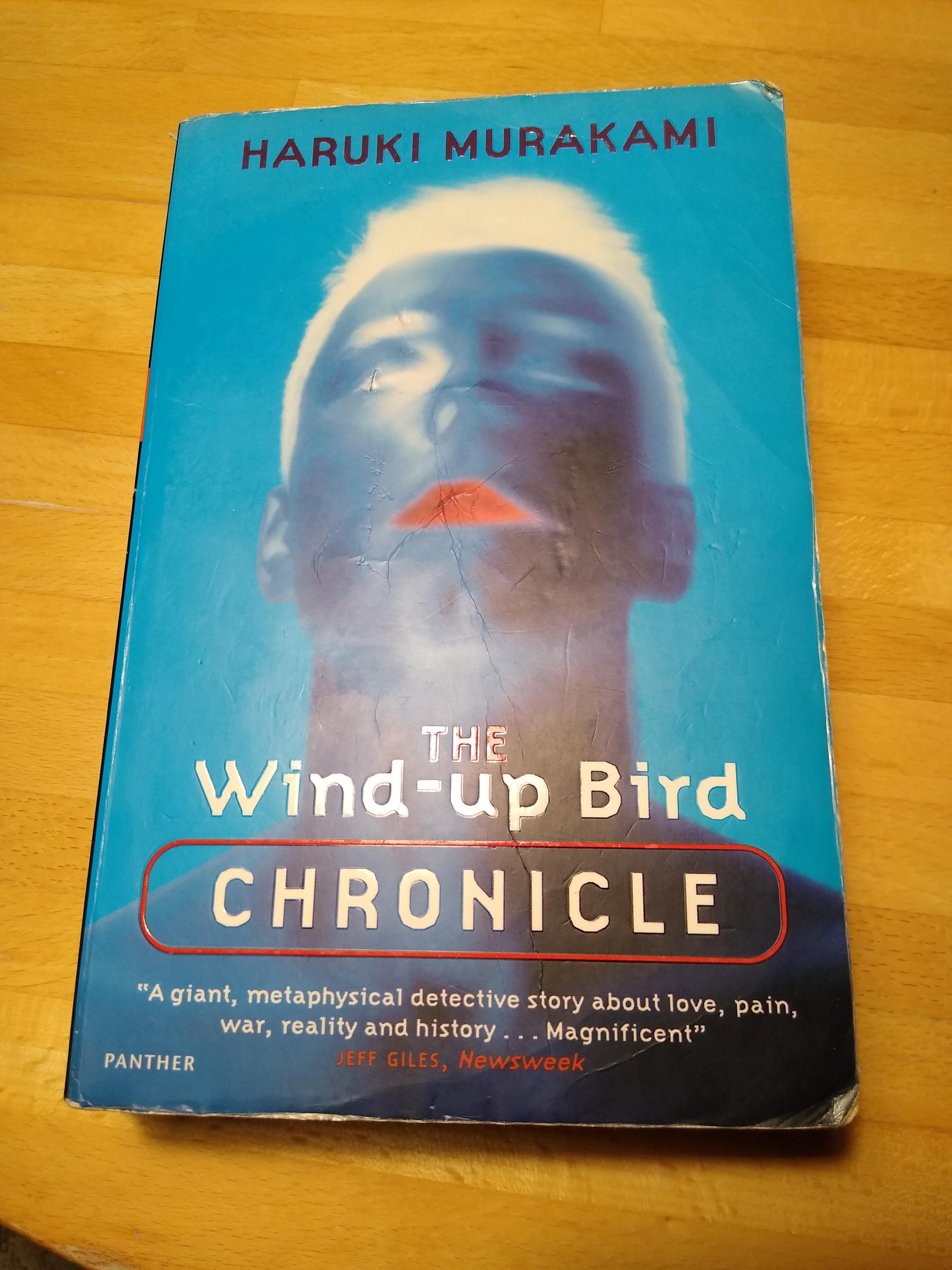
There is another (former) paralegal whose life I’ve been following these past couple of weeks in the pages of Haruki Murakami’s Wind Up Bird Chronicle, which was lent to me by a friend recently. Even in paperback, it’s something of a doorstop of a tome at 600-odd pages.

Not being a Manga man myself, this was the first novel I’d read translated from Japanese. It starts at a slow burn and describes in great detail the quotidian rituals of domestic life in urban 1980s Japan. A lot of beer bottles are got from fridges, a lot of meals are carefully prepared and a lot of records find themselves on turntables.

Things do fairly rachet up though and the novel takes a very literal plunge into darkness about a quarter of the way through when we hear about the wartime escapades of Lieutenant Mamiya, which includes witnessing someone being flayed and spending days on end down an abandoned well.

What seems like pretty near to domestic bliss in the novel’s first 50 or so pages turns out to be nothing of the sort. The protagonist’s (Mr Okada’s) cat has gone missing and then, one night, without any warning, so does his wife.

My year began with the tale of a wife who runs away without explanation leaving a bereft husband behind. Ian McEwan’s Lessons was the best book I’d read in a good while. The main character of that novel, though, also had a newborn baby to contend with and complex childhood trauma to boot. Our hero in WUBC is childless and it seems as though he has no Past to speak of.

Not that he is without preoccupations. He hates his brother-in-law’s guts for no single discernible reason. An irrational antipathy, impossible to ignore. The reasons for this animus are diffuse. It appears that he and his wife, for reasons not completely clear, decided to name the missing cat after this man. It seems odd to the reader that the protagonist would jokingly bestow this epithet on his beloved feline, given that he is deadly serious about his disgust for his brother-in-law.

Two of my female friends, when I mentioned that I’m reading Murakami, have said that his novels are misogynistic. I think that WUBC is trying to say something about women, generally, and how they relate to men. This generality and generalisation doesn’t happen figuratively, but literally. In the world of the novel, there exists a parallel world, which I will term the Well World, as this is our protagonist’s principal means of accessing it.

The Well World allows one to travel great distances and communicate with others in their dreams; it is also a parallel reality. In this reality, the women in Mr Okada’s life merge and combine and present us with archetypes specific to his mental universe.

One of the central ideas that comes up, again and again, is that of “defilement”. This is a concept we feel uncomfortable with in our contemporary society of sex positivity and its shedding of the value of female virginity. To clarify, I believe these are both unequivocally good things. As a reader when I happened upon the word “defilement” I had to take a second to think about what that really means in today’s world. I understand defilement to connotate an act so vile in nature that it corrupts or taints the one to whom it is being done on some moral level. That idea is alien to the current discourse on sex and sexual violence, making its reintroduction disturbing.

What’s also interesting is that it’s the women themselves (through Murakami of course) who talk of being cheapened or diminished by the acts they have had done to them. These “defilements” also take place in the context of sex work, which many would see as of its nature degrading, if not “defiling” per se. There is clearly some boundary being crossed, some unbearably malevolent facet of male sexuality unknown even to experienced sex workers.

Another thing I found interesting regarding the sex work explorations of the novel was the idea that one of the characters, Creta Kano, after having been a physical sex worker, describes herself as a “prostitute of the mind”. To me this evokes our current world of OnlyFans where there is no physical contact between client and “service provider” but some other quantity is being lavished on them – an intangible psychosexual connection that delivers orgasms at a distance. The harsher, blunter language of “prostitute” conveys something that is lost in the sanitised amorality of “sex worker” – that it is the mind itself being prostituted, which is, in many ways, much more disturbing.

If there is one character people might deem problematic in WUBC it would probably be May Kasahara, a 17-year-old girl with whom Mr Okada has a strange friendship. While there are some weird elements like Mr Okada thinking and then saying to her that she looks good in a bikini, and May Kasahara’s thoughts on sex and sexuality given in the form of letters to him which never arrive, I think on the whole she is one of the most vividly realised of all of the books many characters. Her late-book correspondence with Mr Okada is full of energy, naïveté, and curiosity and abounds in the fathomless if clumsily expressed philosophical seriousness that is only bestowed upon teenagers.

Most importantly, it’s funny! Besides, are we, in spite of her deadly seriousness, supposed to take her views on sex seriously? And, furthermore, are we to equate them with the views of the author? I don’t think so.

The reader is, I think, invited to condemn her past frivolity (she is responsible for her boyfriend’s death in a motorbike accident by her foolish actions), which she also regrets in her final few letters. She is clearly not aligned with the patriarchal expectations imposed on and accepted by her peers. I would wholly defend her creation. Mr Okada is a weak and lonely man who fails to understand his wife (not that he is an unsympathetic character). Even so, May Kasahara never merges with the other women in his life in the Well World. She is isolated from that part of his subconscious, even if May Kasahara herself insinuates herself into her own fantasy relationships with him.

One final aspect of WUBC to comment on is the late part of the novel’s tale of Lieutenant Mamiya’s time as a Japanese soldier and POW in Soviet Siberia. I’d never read anything set in WWII from this perspective. The scenes in occupied Manchuria towards the end of the war were especially poignant. They reminded me of the futility with which one is confronted at the end of three gruelling hours of the film Das Boot – brutal orders carried out to the last when everyone involved knows the cause is lost.

A pattern consistent across many of the characters is the theme of trauma, sterility caused thereby and the ultimate inexplicability of why certain events cause one to react in a specific way. If there is a political point to be made here I am not familiar enough with Japanese history or politics to connect the dots. All I know is that WUBC will stay with me as an eerie exposition through paranormal means of spiritual pathologies pervasive in everyone from paralegals to politicians and gurus to geishas.

Posted in Review | Tagged , , , , , , , | 1 Comment

Ambiguous forks and subtle alienation

My trip to the Republic began in the Confederation. Specifically the Confederation of Helvetica or CH for short, otherwise known as Switzerland.

Acceptable names for geographical entities would be one of the first things to learn as I disembarked from my flight at Geneva airport. I was told not to refer to the lake of the same name by that epithet. Rather, it should be addressed as le Lac Léman. This designation stretched back to Roman times when it was part of Cisalpine Gaul – the Gauls on their side of the Alps as opposed to Transalpine Gaul to the west.

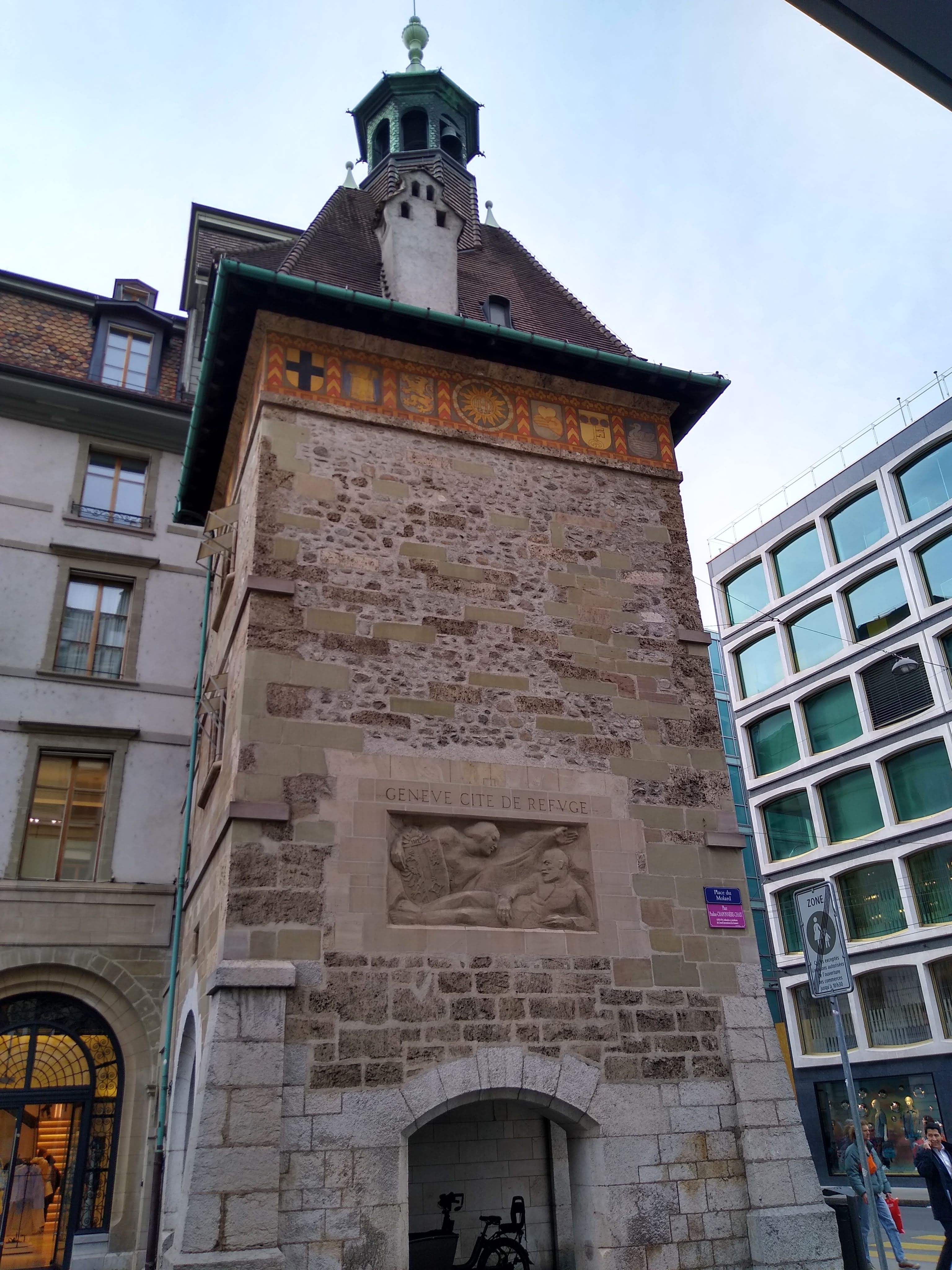
Geneva, the city of refuge and shelter for political exiles, only happens to be the largest settlement of many on the shores of this massive body of fresh water. Therefore, especially to a patriotic Française, it has no right to lay claim to the entire aqueous territory, which is equally French and Swiss.

I think that’s Lenin in the sculpted bit. Would make sense as he spent time in Swiss exile from the Tsarist regime.

The departement I was visiting la Haute-Savoie or Upper Savoy – it is one of two Savoys, as one of the postcards I was kindly gifted by my host’s mother informed me. The Savoy has at various points in its history been part of Lotharingia, the Kingdom of Burgundy and the Holy Roman Empire prior to its contemporary Frenchness.

I’d been on a class trip to Switzerland in secondary school where we’d visited the UN in Geneva and gone on the cable car up Mont Blanc from Chamonix. This stay, however, would be more shoreline and historical than Alpine and diplomatic.

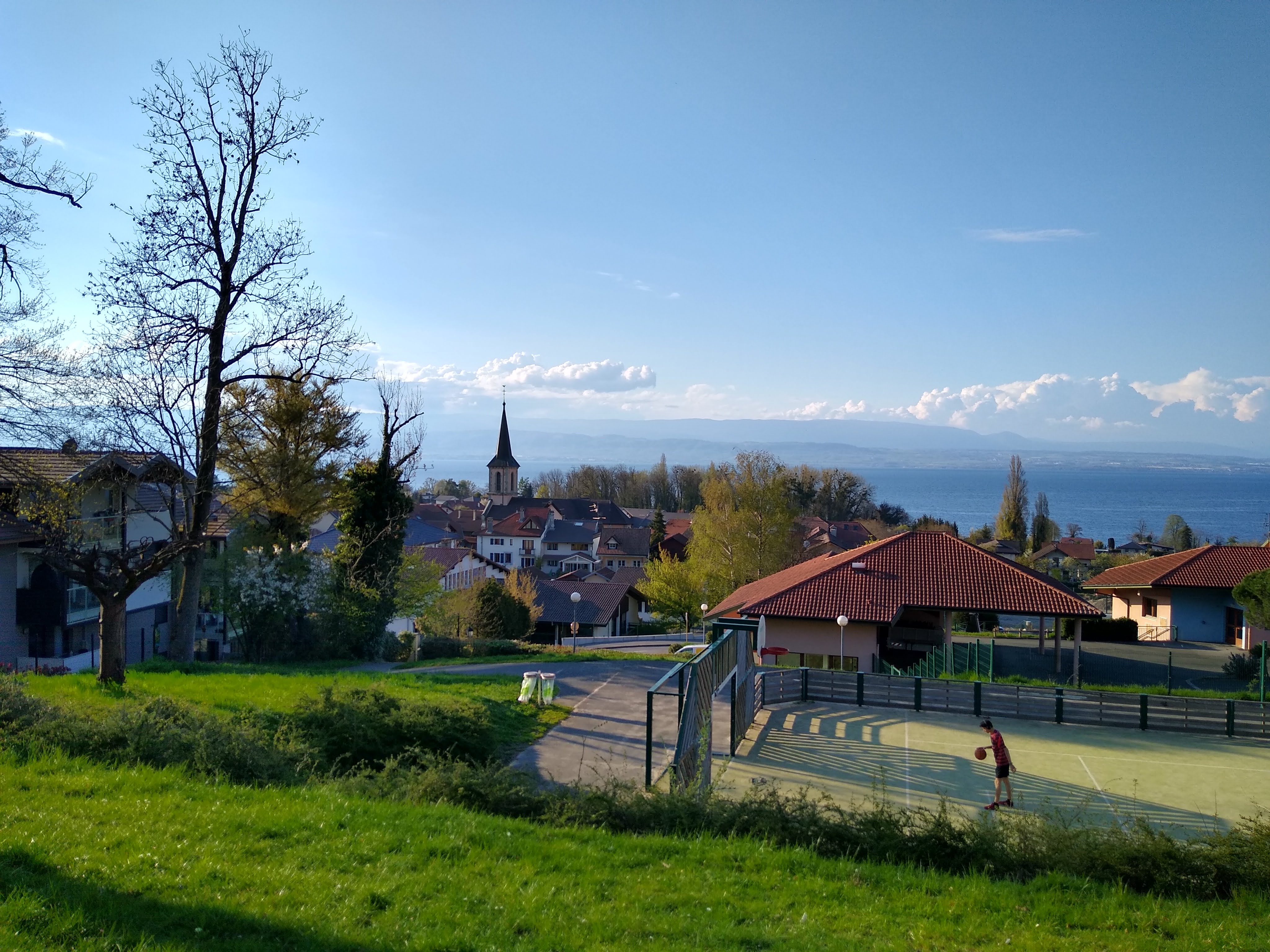
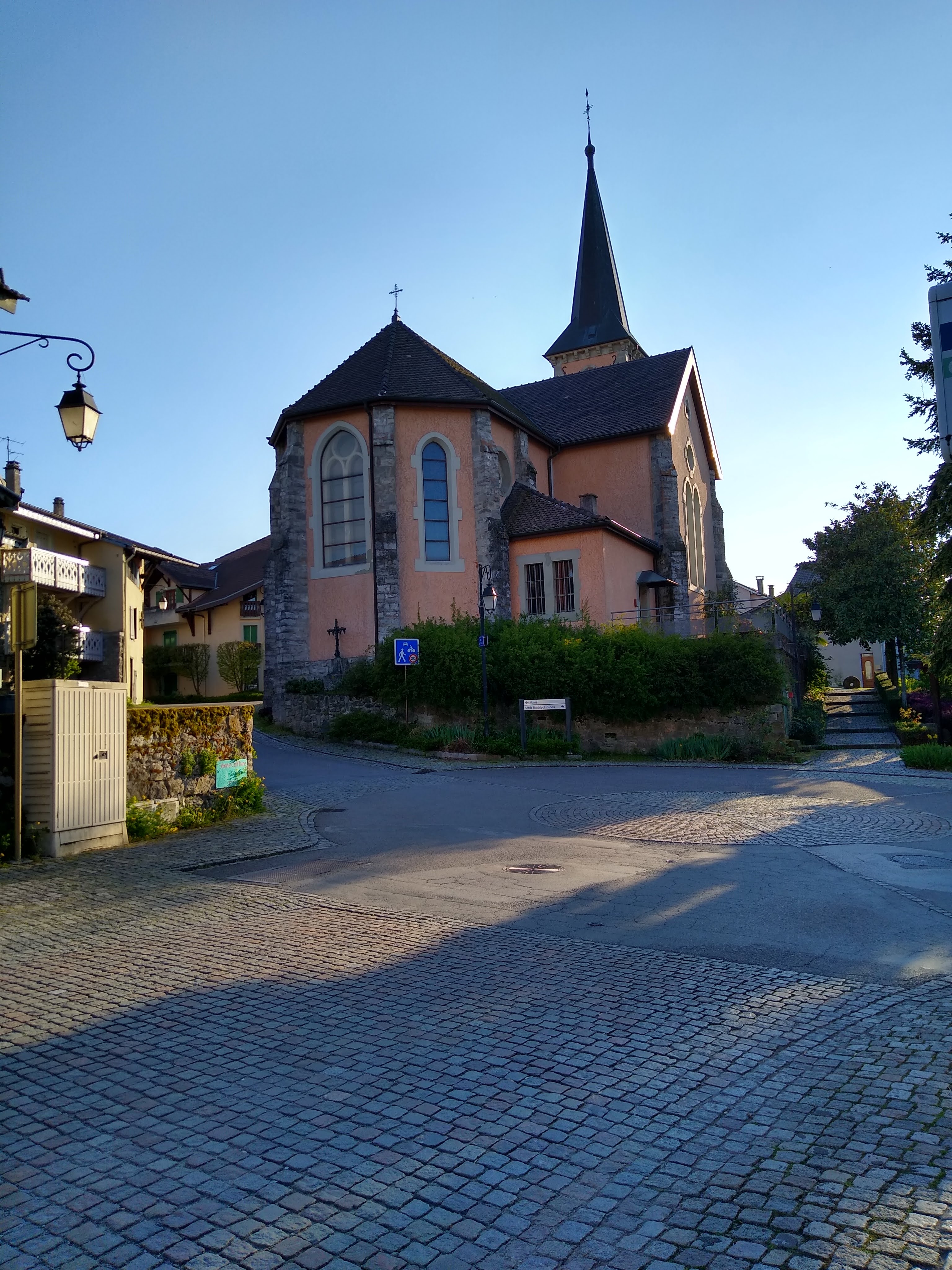
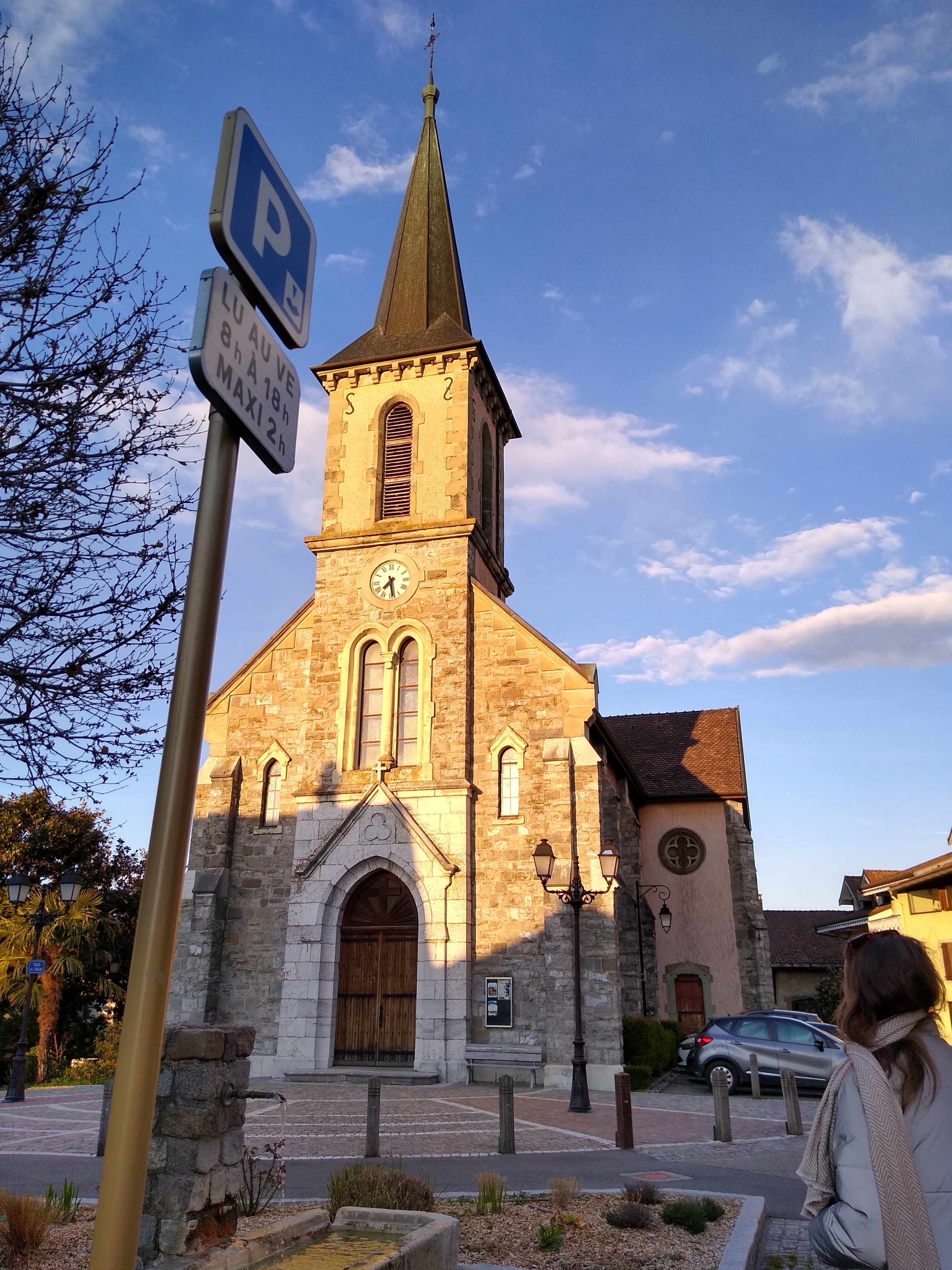
My base was the quiet village of Anthy-sur-Léman. It was, indeed, very quiet. There was no shop, just a couple of restaurants, only one of which was open, and a place to buy fish open on weekdays 9-12 (also closed).

I was informed that most people living there are what is known as frontaliers. They work in Switzerland where the wages are high and reside in France on the other side of the lake where living costs are comparatively low. My friend aspired to join this class and work for a Swiss law firm in Geneva. It makes economic sense, from an individual perspective.

People don’t just merely exist here though. Apart from hobbyist lake fishing, the area is a spa region. Its biggest town (barring the capital Annecy, further inland – more on that later) is Thonon-les-Bains, in other words “the baths”. In German it would be a prefix – “Baden-something” (even if that’s also Baden, see “Baden-Baden”).

Something I noticed in the semi-rural villages skirting the shore of the Lac Léman is the abundance of fountains. Most came with a warning affixed – “l’eau n’est pas potable”. The water’s not potable. In Germany where public taps appear it says simply, “Kein Trinkwasser”. Is there an ideological difference here? I feel as if the French is more informational – at your own risk, whereas the German, in referring to a verb, is more behaviourally proscriptive. It was from the fountains that I learnt some more French signage lore – SVP – s’il vous plait.

I’m new to this country’s abbreviations and shorthand. The last times I visited I was a complete cultural ignoramus. To be fair, I was a child when I was taken to Paris without a clue about its history. I knew nothing of the revolution! Then there was the aforementioned cable car where I think my knowledge of the French language extended to being very pleased with myself to be able to recognise that the hot chocolate I enjoyed at the summit of Mont Blanc was indeed “chaud”.

I get the impression that Chablais is not a particularly touristy region and I liked that because it made for a more culturally immersive experience. Regular readers will know that I do a fair bit of solo travelling and I enjoy it. When travelling alone, though, one is quite often in survival mode, constantly planning and working out how to acquire essentials in a non-embarrassing and semi-competent way. With a guide and companion, this base-level stress evaporates and you are enabled to experience things otherwise debarred.

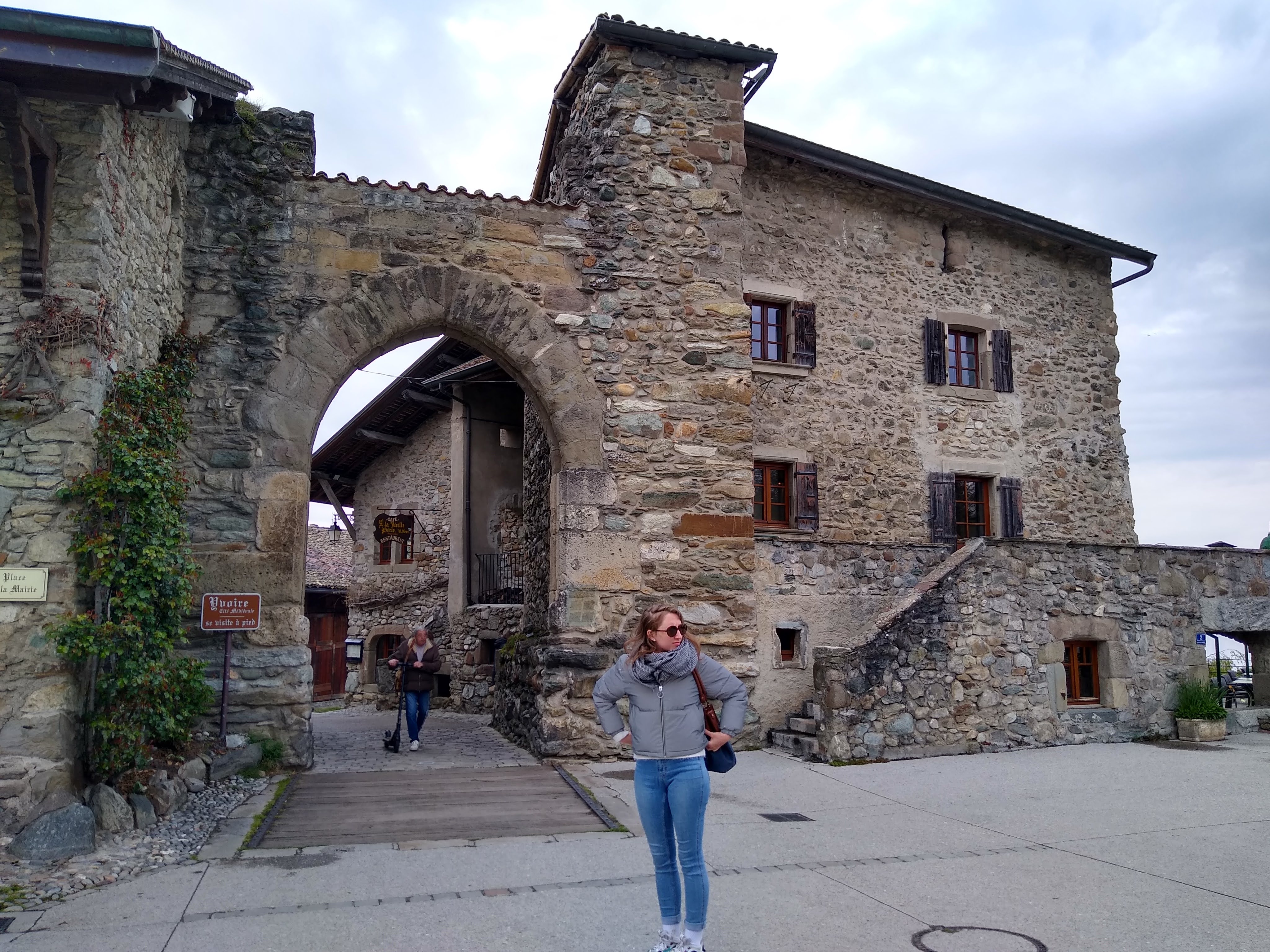
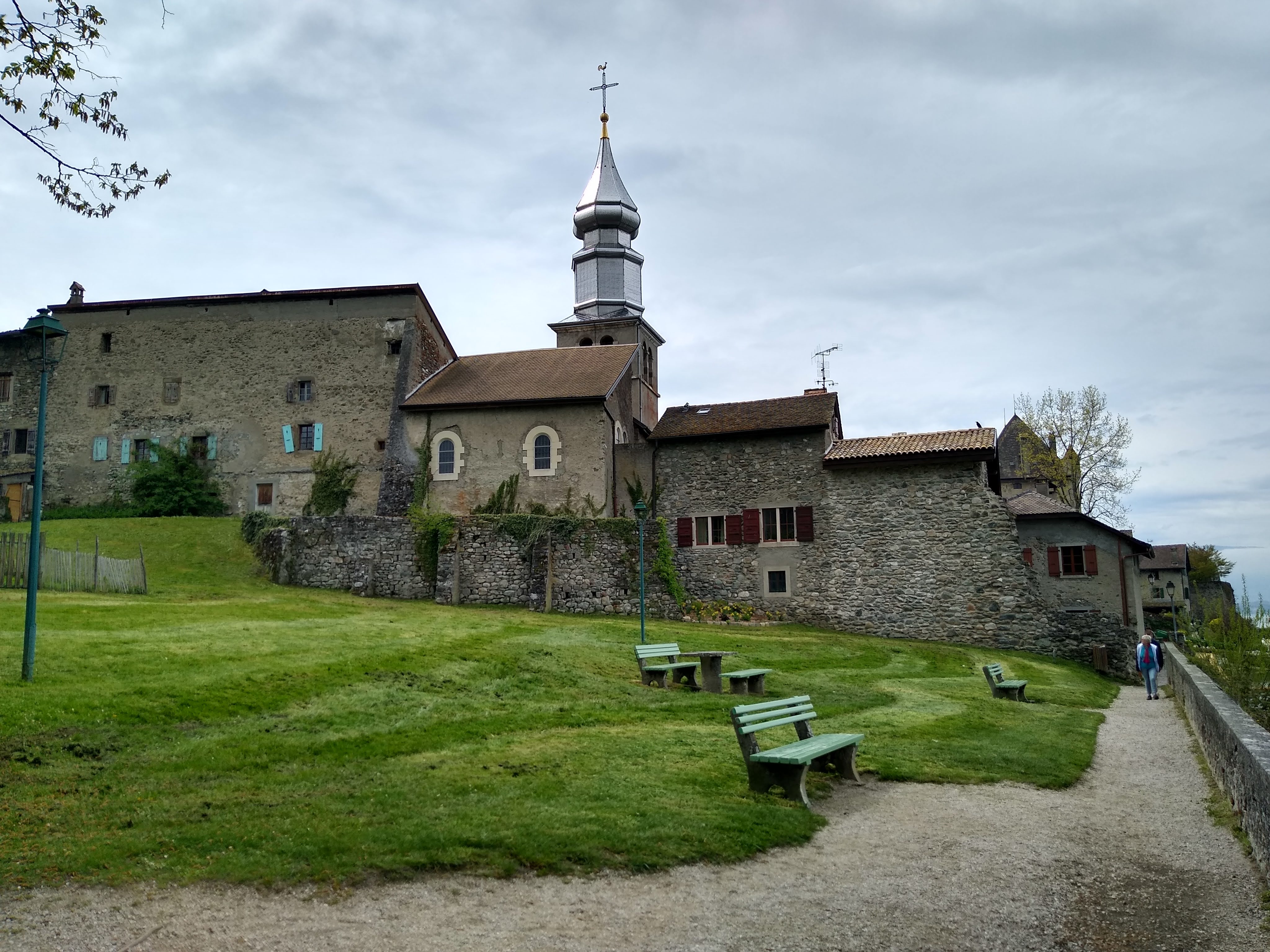
Previously I mentioned the capital of la Haute-Savoie – Annecy. I had looked it up beforehand in a bit of pre-trip googling. It looked gorgeous. Beautiful turquoise waters surge in between narrow medieval streets situated in an Alpine amphitheatre. Could we go there? I suggested tentatively on WhatsApp. It’s about an hour’s drive. The reply: a tourist trap, so cliché. Haunt of the Anglos. We’ll not go there. Instead – to Yvoire.

Another example of something I’d never have been or unlikely to have been, brave enough to do on my own was the meal out in a relatively fancy restaurant where the waiting staff only laughed at me at the very end when I came to pay on my way out. It basically comprised a glass cube stretching out over the lake, which was great for the first 40 minutes or so before it got dark.

I was fascinated by the tremendous-smelling baskets filled with unidentified battered objects being delivered to the surrounding tables. Can we have that? I suggested. They weren’t on the starters list; aperitifs – 9 euros. Okay then. We were presented with whitebait coated in the thinnest veneer of batter; the tiny fish’s eyes starting up at us was slightly off-putting. It seemed the smell had a more potent effect than the taste which was pretty much batter with a hint of fishy oil offset by a little ramakin of tartare sauce. Not something one can gorge on. Ironically, it seems what we ended up having was basically a fancy version of fish and chips, albeit freshly caught from le Lac Léman.

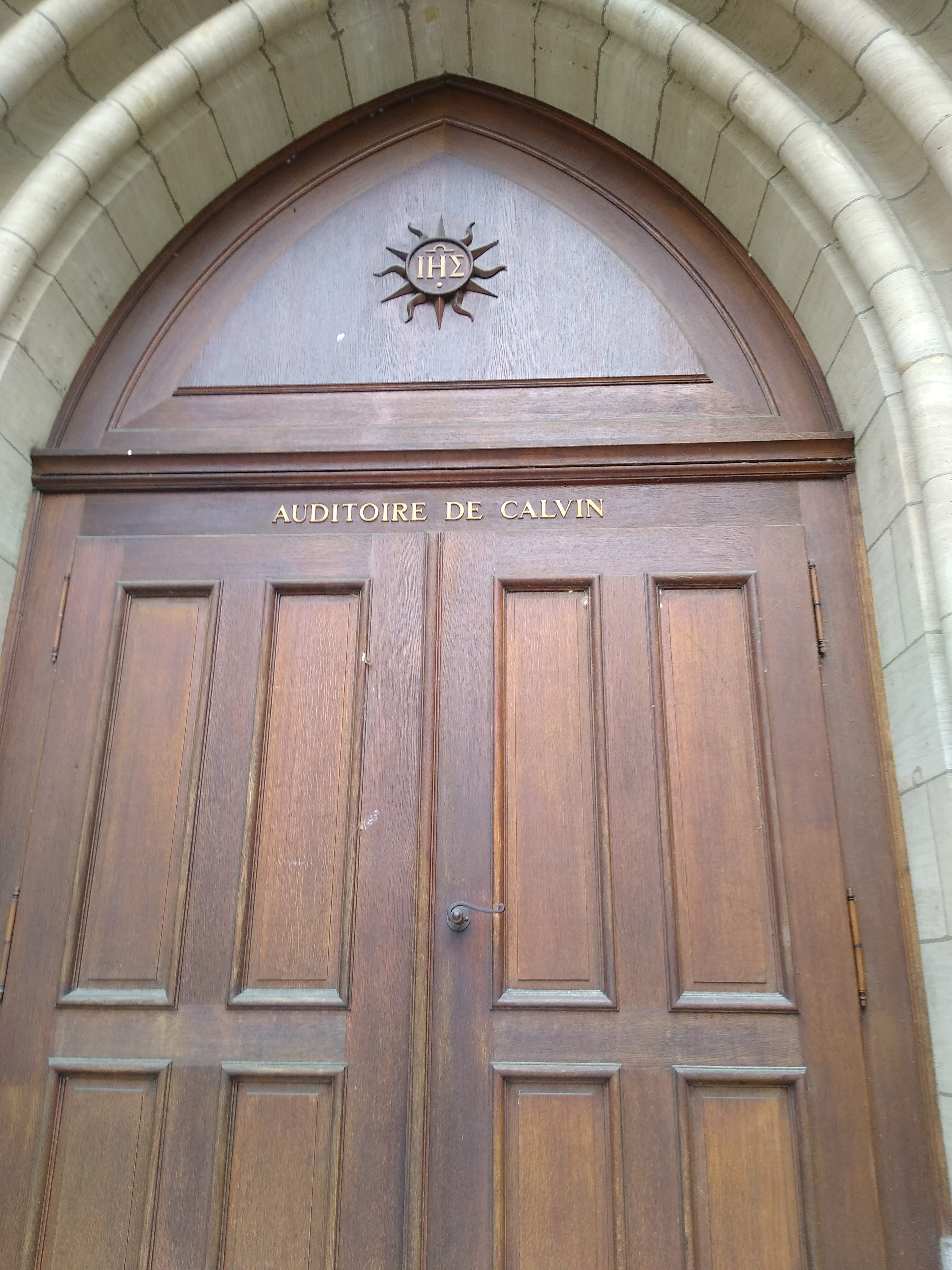
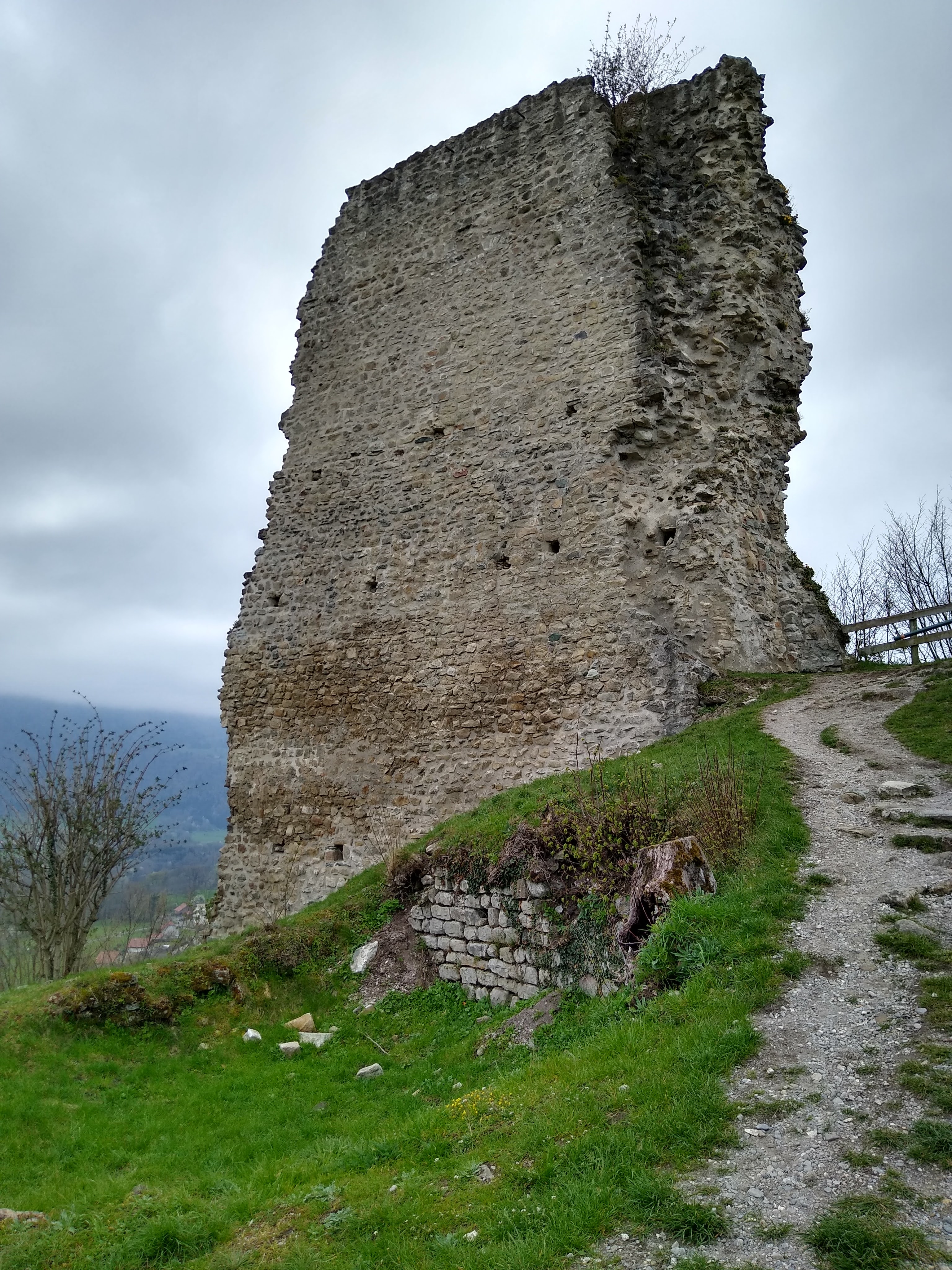
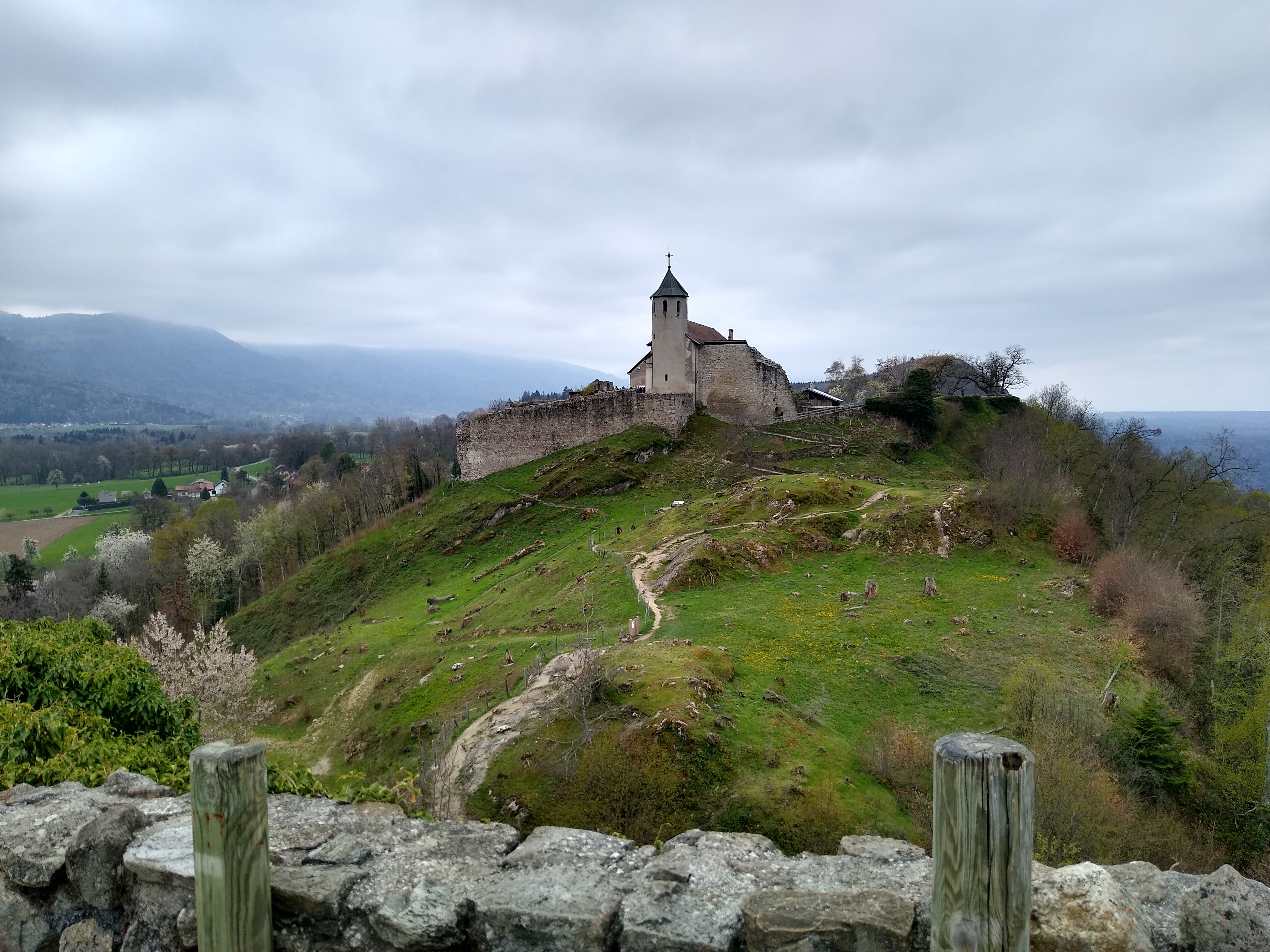
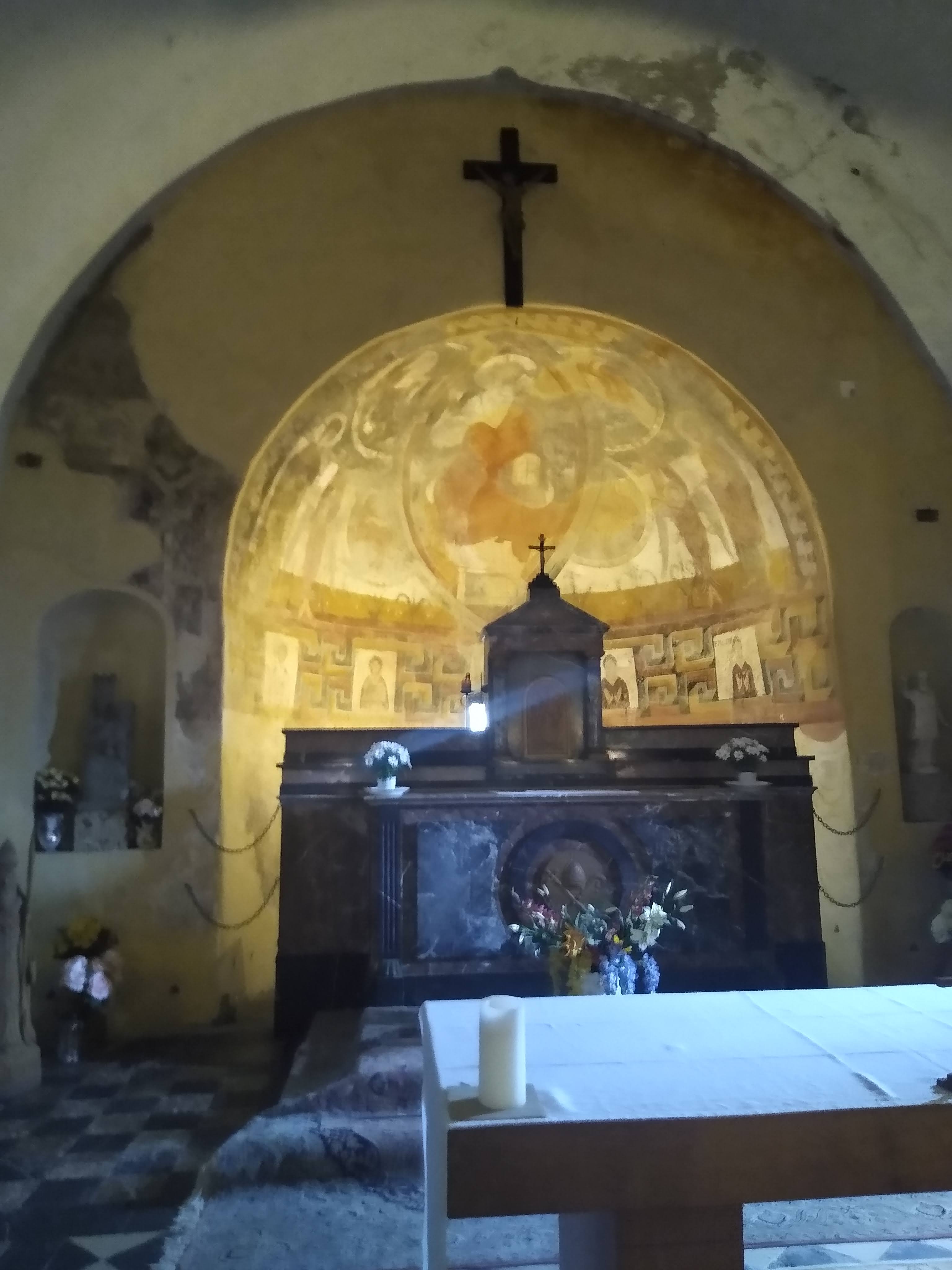
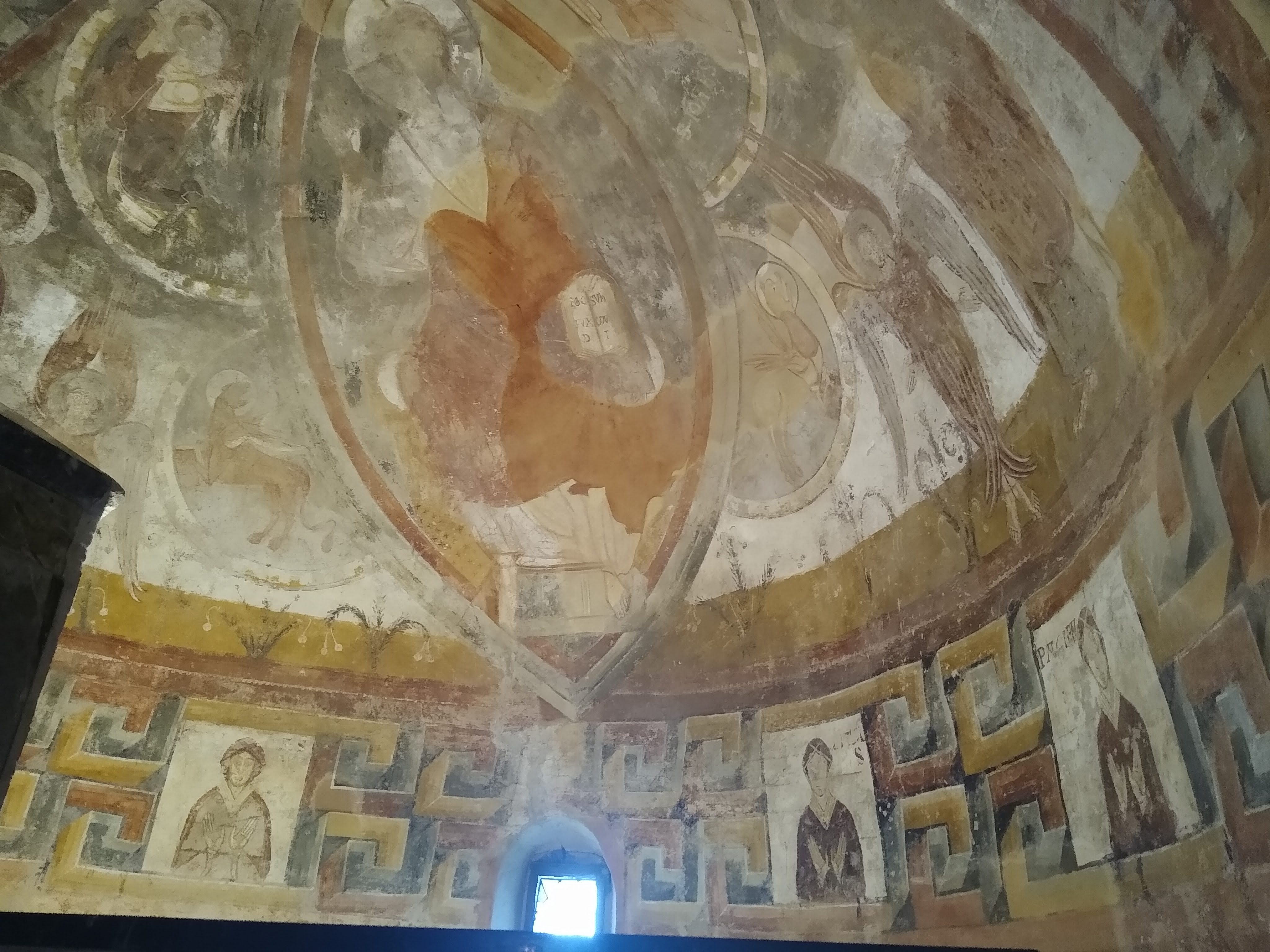
The highlight of the trip for me was the first full day. We began by taking in not one but two medieval castles – one each for adjacent summits, known collectively as the Châteaux des Allinges. These belonged to the Count of Savoy, a vassal of the Holy Roman Emperor in days gone by. They are named respectively, Château Vieux and Château Neuf. In the latter, there was a chapel containing a fresco from the 10th century, remarkably well-preserved. Its colour palette reminded me of our single painted stone fragment in Glasgow Cathedral’s lower church. It was special to have these heavily stylised, almost cartoonish depictions of the evangelists to ourselves for a good 10 minutes, even though there was what appeared to be a pilgrim group having lunch in the courtyard outside. The site is associated with St Francois de Sales who was a late 16th/early 17th-century churchman tasked with winning back the inhabitants of Chablais to Catholicism after they had been persuaded by the Calvinist teachings radiating from Geneva.

From this doubly fortified hilltop, we descended down the valley past cowbelled cattle and notices about forest hunting rules. That gave me the feeling of the type of holiday I seem to have developed a liking for of late. The kind where you just walk without knowing precisely what’s in front of you but with a definite ultimate destination. You notice the subtly alien nature in your vicinity – the rustle of the brush denoting neither lurking wrens nor nervous robins but flighty lizards. You seek strategically placed waypoints where an ambiguous fork appears.

Bliss.

This trip did not quite have the purpose of my Aachen visit, but being relieved of purpose, and surrendering to the curated itinerary of another has its appeal too. My typically serious travels will resume in the summer as I visit another kaiserliche Hauptstadt and embark on the English leg of the Camino de Santiago.

Posted in Life, Personal experience | Tagged , , , , , , , , , , , , | 2 Comments

A bestiary of Buendias

One Hundred Years of Solitude by Gabriel Garcia Marquez is unlike any other book I’ve read. It took me some time to get into though. I wasn’t hooked by the first page by any means. There was time to tune in, however, as it’s pretty substantial at about 450 pages in length. To be fair, it would be, as it’s meant to cover a century and spans multiple generations. It follows the story of a single family through fortune and misfortune, though mostly misfortune.

A central theme of the novel is the instances where branches of this particular family tree get tangled and intersect. In other words, there is a fair bit of incest in it. This isn’t totally gratuitous and has literary significance, perhaps political too, even if I can’t quite pin it down; my knowledge of 19th-century Latin American history is rather rudimentary. I would suggest that a possible interpretation is that as the family/village/town/country isolates itself and closes itself off to outside influence and new energy, it has to turn in on itself and cannibalise to perpetuate. Obviously, genetically this doesn’t work and politically has disastrous consequences too.

I have read family sagas before – and actual sagas for that matter! The best of the former, in my opinion, are the Edwardian novels of DH Lawrence. This is different, however, as it belongs to a genre I have not had much experience with – magical realism. The way I’d explain magical realism is that for the most part, the action takes place in the ordinary recognisable world of our reality but with fantastical elements sporadically interspersed. These are described in a sober, matter-of-fact sort of way – they don’t disturb the fabric of this reality and are not acknowledged by the characters as supernatural. This seems, in a postmodern way, to hark back to a premodern worldview of the kind shared by the protagonists of The Name of the Rose for whom mystical visions, divine revelation and scholastic study are all perfectly epistemologically valid. It’s a world where unicorns and dragons can exist side by side in bestiaries with beavers, badgers and boars.

Some of the things that happen are weird but not implausible such as a character who eats soil compulsively when she is distressed or several characters who live to a preternatural age. Others are more straightforwardly otherworldly – a character ascends to Heaven and in a late episode it rains for seven years non-stop.

Perhaps Alasdair Gray’s writing shares some of this approach to the paranormal in Lanark and Poor Things. In German, the stories of ETA Hoffmann come to mind.

What I liked about One Hundred Years though, apart from this unique combination of reality and hyperreality, was its sense of the grand sweep of history told through characters who are for the majority of the time explicitly not at the centre of the action. There are two exceptions to this. Firstly Colonel Aureliano Buendia bucks the trend of his decidedly apolitical family and decides to dedicate his life to overturning the conservative establishment, which at this time means the aristocracy and the Church. Again there is an element of the hyperreal here where there is repeated reference to the 32 wars he ends up fighting in the name of the Liberal cause. This is where the novel started to really grab my attention and I was firmly on the hook. No characters are explicitly political up until this point. A week after finishing the book I realised that Colonel Aureliano reminds me of, or is associated in my head with, Ewan Tavendale II from Grey Granite, which is a vivid and angry conclusion to Lewis Grassic Gibbon’s Scots Quair trilogy.

Marquez, I get the sense, is less involved in the urgent political issues of 19th-century South America. The indifference of other characters to the regime changes or their petty local concerns are less of a source of anger and treachery as they are when they are related by Gibbon in relation to 1930s Britain.

The second forthright and overtly political character of the novel, although more a militant trade unionist than a liberal militarist, is Jose Acardio Segundo. The betrayal he experiences – the banana company, virtually the sole employer of the town, uses an army of police to violently crush the strike he organises – is tragic but has both a weird inevitability and ambiguity about it. He, like his grandfather, Colonel Auerliano, is fixated on a number – 4000 dead (fired on by police at the mass demonstration). JAC is haunted by a memory/vision of bodies crammed into train carriages (which he somehow ends up on, having been wounded but not fatally) and being transported away from the scene of the massacre. I’ve called this a memory/vision because it’s unclear whether it truly happened in the way he describes and only one other character who lives his early years in a strange Stockholm-syndrome-sustained house arrest believes his account.

The novel’s ending is very satisfying, tying together several threads beautifully. We see the flowering of seeds planted on the first few pages, and spacetime is compressed so elegantly that we can pierce our way through 400 of them with striking clarity. At the same time, it’s not as if everything is explained. It’s not a whodunnit – rather, the themes that enter and retreat throughout the book coalesce beautifully. I am still unsure what it all means but I very much enjoyed the immersive journey it took me on.

Posted in Review | Tagged , , , , , | Leave a comment

Grey Granite: Grassic Gibbon revisited

I wrote this piece in early 2020 pre-lockdown and never published it at the time. Please enjoy this B-side from the Flett-cetera discography.

Lewis Grassic Gibbon was the short-lived novelist most famous for his Scots Quair trilogy. Sunset Song, the first in the series is the most well-known and catalogues the decline of Scottish rural life, torn apart by the First World War through the eyes of its female protagonist Chris Guthrie. It is in Grey Granite, however, the final book, that the author makes his firm stand against the political cowardice he saw all about him during the Great Depression of the 1930s.

There is a tension at the heart of the novel between a romantic longing for a non-existent Golden Age, the desire to get on in life, to prosper in the moment and the iron will that sees beyond itself, to which the individual is naught but the agent of history. Britain is in crisis. Italy and Germany in the grip of fascism. Europe rearming for the next Great War. Duncairn is the setting for Gibbon’s final work – an imagined industrial city; not Aberdeen, not Dundee, not Edinburgh, not Glasgow but all and none at once. This synthetic city, like Hugh MacDiarmid’s Synthetic Scots, impresses on his characters new forms of consciousness, unimaginable in the croft or toun Manse. Removed from the land, Chris and her young son Ewan Tavendale must confront the wealth, and poverty, of nations as it is forged before their eyes.

Industry is touched upon in Cloud Howe, the trilogy’s middle book, in the form of the spinners of Segget, who work in the mill owned by the local laird and participate in the failed General Strike of 1926. Only in Grey Granite, however, do we encounter the proletariat or “keelies” up close, and it turns out that they are far from hospitable – coarse, prejudiced and unwelcoming of the “toff” Tavendale. He is more interested in the abstract questions of archaeology and ancient society than football and “queans”. After being badly assaulted up by his fellow apprentices, Ewan makes common cause with the unemployed underclass and the “Reds” marching on the City Hall. Frustrated with the leaders’ insistence on holding back as not to aggravate the police, their reasoning quickly becomes apparent to Ewan when they are forcibly beaten back; the bumbling provincial officer, “Feet” cracks his truncheon over those scrambling to get away.

This moment is the first of several political awakenings for Ewan in which he witnesses class struggle in its crudest form; he instinctively takes a side by drawing the protestors attention to the open doors of a deliver van full of glass bottles in order to even the odds. The reactions to the incident are nuanced but universally negative. From the Labour man’s condemnation of “senseless marching” to the press’s analysis of “paid agitators trained in Moscow”. Alongside the brutal upheaval of industrialisation in the Soviet Union and Britain’s interwar decline was the image of America projected on screens during cinema’s Golden Age. Chris goes to see one of these “talkies” with her landlady and employer, Ma. Where the latter is titillated by the glamour and sexual licence on display, Chris is bored and glad to leave.

Ewan’s experience at the protest shapes his political consciousness and he begins to bond with his fellow workers, attempting to understand their interests instead of remaining aloof. His efforts culminate in the formation of “The League” – a progressive youth movement with the goal of acting as an intermediary between the cowardice of Labour and the “lies” of the Communists. The group reaches its peak at a New Year dance Ewan organises with fellow English lodger and schoolteacher, Ellen. It is a beautiful moment, full of optimism about a native democratic tradition intermingled with courtship and communal feeling. For Ellen, and Ewan in this moment, socialism means the freedom to dance and be merry; it means warm beds, good drink and eating well.

Just as the League is getting established, Ewan faces a test of faith – the boom and bust economy of capitalism. The yard has new orders and work is returning to Duncairn, only the contract is for gas cylinders, ostensibly for military use. This time Ewan attempts to reach across parties and helps organise a strike.

The relentless reality of Grey Granite is the inability to convince all the workers to do what is in their best interest – to transfer that unbending resolve into a collective consciousness. With the picket destroyed and the strikers throwing the breakers in the dock, Ewan is arrested and badly beaten in a police cell. Here he has the most important revelation in what is the book’s turning point – that unless the working class can meet like with like regarding state violence, they cannot win power. This is the novel’s hard truth. It is by no means easily swallowed. Ewan’s conclusion, then, is revolutionary vanguardism:

I am all the broken bodies […] The van of the hordes of the Last of the Classes, the Ancient Lowly trampling the ways behind it unstayable […] No retreat; no safety, no escape for them, no reward […] first glory, first death, first life as it never yet had been lived.

Without a job, without the hope of personal fulfilment, comfort, stability, marriage with Ellen whom he cruelly rejects, even of revolution itself within his own lifetime, with “History our master not the servant we supposed”, with only “the glint of grey granite” in his eye, Ewan trudges on. “Yeasty sentiment and blah about Justice” is banished; the conflict, generations ongoing, distilled to that between Freedom and God – the former furthered through any and all means.

Grassic Gibbon ultimately paints a disturbing picture of a young imagination crushed under the boot of capitalism. We sympathise with Tavendale’s conclusions but do not share them. Somewhere between Chris’s apolitical sense of justice and mercy, Ellen’s pragmatic utopianism and Ewan’s disinterested Marxism we find the truth of A Scots Quair.

Posted in Review | Tagged , , , , , , , , , , , | 1 Comment

Friends and Adversaries

Formal university education is finished for the foreseeable. Three years of study have culminated in two mediation Saturdays, a debate on interim interdict, an employment tribunal cross-examination, sorting out a casino licence, a personal injury claim negotiation and a mock trial in the Sheriff Court. It only remains for me to redeliver the jury speech I gave for formal assessment and I’ll be officially done with my diploma in professional legal practice.

The diploma has not been without challenges. It was something of an adjustment to go from luxurious theorising and expansive essays on legal minutiae to the unrelenting churn of practical deadlines, form-filling, tax calculation and quantification that apparently make up the day-to-day business of law. In the early days, I struggled with the relative intellectual deprivation of the course compared with the LLB, but I came to reconcile myself to the necessity of it and persevered bolstered by the commonality of hardship suffered by my peers.

Something I have valued highly is the continuity of studying at Strathclyde from the graduate entrant CLLB to the diploma. It meant that I already had a lot of friends and contacts from the accelerated undergrad. I was also able to continue with my Law Clinic work, so my encounters weren’t strictly limited to the perhaps otherwise cliquey diploma cohort.

Carrying over from my LLB experience is my continuing command of the Initial Advice Clinics. This is due to come to an end soon, however, as I will no longer be a student when the diploma is over. It will be weird not to be bound to every second Wednesday any longer. I might be able to go to some midweek gigs now I’d hitherto missed out on due to a sense of obligation. The duty has been gladly fulfilled, however, and it has brought me immense satisfaction to bring back the human connections of face-to-face meetings alongside Zoom calls in a hybrid format driven by client preference. I can also say I’ve increased the number of regular volunteer solicitors through my article in the Scottish Legal News and nurtured new student advisors such that I feel confident I’ll be able to leave it in capable hands.

Being so busy with the diploma recently, my opportunity for diversion has been relatively limited. In terms of gigs I’ve only been to the one this year so far – Dry Cleaning at Barrowlands – which was good, but I was quite tired after an hour and a half set that possibly could have been 50 minutes, considering they only have one album and a couple of EPs.

The Doublet and the Arlington have been the pubs I’ve ping-ponged between over the past few months. Those and the Press Bar after criminal advocacy on a Thursday. All three are what I’d describe as typically Scottish pubs. Not about food particularly; music is there but not front and centre. What’s key are chat and drink. In England, pubs are inns primarily and equal emphasis is given to ale and victuals. Press Bar is where I’ve got to know grad entrants from Glasgow uni. It was nice to have this post-class ritual end-of-week thing. Never overlong but usually longer than intended and inevitably curtailed by the hunger pangs inherent in a 6pm finish.

I’ve spent a long time in higher education. Seven years in all. I don’t think I’ll ever fully let go of the university spirit. Scholarliness. Pursuing knowledge for its own sake.

Alongside law, I’ve persisted in my nonfiction absorption by taking in ancient and modern history volumes. I’ve tried with middling success to give myself a grounding in French to supplement my German proficiency. Recently I’ve attempted to reignite my literary leanings by joining a classic book group which meets in the Mitchell Library on the first Monday of every month. We’re discussing one of my all-time favourites in April – Frankenstein.

Now we diplomats will be scattered to the wind. It won’t be quite the divergence of the MA, as Scotland limits our range by jurisdiction for most. Despite the scrappiness of the closely competitive scramble for traineeships at the diploma’s close, the fact remains that the profession here is relatively small. We will see each other again, whether as friends or adversaries or, as is the case in Scottish courtspeak, both.

Posted in Life, Personal experience | Tagged , , , , , | Leave a comment

(Re)tracing my steps

2022 has been an improvement on the success/happiness/fulfilment scale. In comparison with the slow awakening of 2021, this has been a year of activity and spontaneity. The fear of looming lockdown has dissipated and we are left with the legacy of ubiquitous hand sanitiser in all public places and restaurants with easy-to-navigate booking systems, which I think we can agree is both tolerable and, indeed, convenient. A positive legacy of Covid – there you go.

Midway through the year, I took over from Cara Hope as the Initial Advice Clinic coordinator for the Strathclyde Law Clinic, which I’m still involved with in my diploma year. Being in the Law Clinic is great and I’ve spent a lot more time in the actual building this year between classes as a place where like-minded people are likely to be at any given moment. Like the Ethics & Justice seminars of last year, it’s a chance to meet people at different stages in academic life, which can bring a fresh perspective on things. It also means that going into the diploma, there was a core of people I knew very well at the same time as encountering folk from different universities.

One thing I have felt has been slightly lacking this year was my creative output. A lot of my energy has gone into practical things, like the Law Clinic. I’ve written much less and didn’t really have a big project I was working on. Part way through the year I did have an idea to set up a kind of literary salon thing, inspired by the 18th-century coffee house culture, but that didn’t come to anything. For the most part, it’s been creative input rather than output. I’ve read quite a few good books and watched some (not in that way) inspiring TV in the form of Breaking Bad and Better Call Saul plus, in my view, the excellent 2000s Battlestar Galactica series. Next year I hope to find some consistent creative outlet that is more than just the occasional tweet or blog post.

In terms of my career, that was remarkably resolved right at the beginning of 2022 when I received an offer of a traineeship with Digby Brown in their Glasgow office. I am really enjoying the litigation subjects on the diploma, so look forward to starting with them in September.

Thus I have made two journeys this year. The first was the St Cuthbert’s Way, which I wrote about at length in another blog post. The second was my return to Europe after a four-year absence.

My journey was motivated negatively by my desire to get out of the UK and positively by a desire to use my German again in an immersive context and to live out my cultural identification with Europeanness by existing in as many parts of it as possible. The places I chose to visit were constrained by two factors. Firstly, my limited student budget and secondly, my need for some thematic cohesion. In terms of theme, the budgetary constraints guided me down the path of basing the trip mostly around the idea of Lotharingia – a book I’d read three years ago about the lesser-known third kingdom between West and East Francia that one of Charlamagne’s three grandsons was apportioned on his death. It was a polity containing much of modern-day the Netherlands, Belgium and Western Germany. Basically, cheap flights to Amsterdam followed by where you can get by train from there.

The thing I was most excited about in the trip I’d planned was my visit to Aachen, the seat of Charlemagne, the first Holy Roman Emperor. The cathedral at Aachen dates back to the Carolingian age (9th century) and its strange octagonal design has been the setting of imperial coronations from then until the 16th century. Parts of the Rathaus in the historic town centre also date back this far, and it was during my visit to this that I stumbled upon what I took to be the imperial crown itself.[1]

I wouldn’t have recognised it two years ago, but this was before I started playing Crusader Kings III. It is some utterly iconic headgear and I felt strangely emotional upon seeing it, especially since I didn’t expect it to be there. My thought was, this is unsere Welterbe, our collective inheritance as earth citizens. Die Welterbe – if nothing else, we succeed to this.

Polish tourists see my fascination as I spin around the 3D model next to its glass cabinet housing. They ask me if I want to buy it. I hesitate and say – I want to wear it.

Aachen to me represents the idea of a Kaiser as originally conceived and that object represents Civilisation; an aspiration to something higher than the time from which it came. A new Caesar out of the ruins of Rome. A republic-breaker forcing the wheel of history to turn against its nature. A new pole in a hitherto unipolar world.

And yet, it’s almost gaudy to look at. Over-elaborate, self-justifying. A crude kind of glory. A peasant’s idea of majesty.

A massive portrait of another Master of Europe hangs in the Rathaus – Napoleon in his imperial get-up. I remember when his countryman Macron was awarded the Charlemagne prize here a few years ago. Previous winners have included Tony Blair and Henry Kissinger. Illustrious company.

Great photography, I know

My other experiences included trying out my Duolingo French in Brussels and being mistaken for an Italian by the hostel receptionist in my attempts. The highlight of this particular European capital was the Museum of Fine Arts’ exhibition on the fin de siècle. The 1890s are my jam. There was a lot of freaky stuff in there, especially towards the end. The last room held: a massive transfixing triptych featuring a waterfall of cherubs rendered hyper-realistically, a portrait of a glamourous woman standing among a heard of swine and a huge focaccia slab of fiery women melting into each other meant to represent the temptations of Hell.

My takeaway from the holiday, however, was that I don’t want to do that type of holiday again. I spent an awfully long time just wandering about rather aimlessly, aside from these snapshotted highlights. I felt I had to cram a lot in. Always be moving, to make the most of my time, while simultaneously being quite purposeless. Although it was good to take in a couple of capitals, I think I prefer more regional, specific experiences and to have a definite goal, even if somewhat arbitrarily set, and make progress towards this. I suppose what I want is more of a quest than a holiday!

What I also found was that I was doing a lot of Exploring. I have enjoyed this in the past. Criss-crossing from point to point with no regard to the incidental retracing of steps. Somehow it was less enjoyable this time. I don’t want to be retracing, I want to be tracing. I suppose this is the difference between linear composition and free jazz. At this point in time, I favour the former. Room for the unexpected and the occasional remembrance of the main theme, but essentially forward-facing and generative, always building from what has gone before.


[1] Later turned out to be a replica of the crown jewels from 1915. You’d think that the Kaiser would have more pressing matters to attend to at that particular date. Apparently, the real thing is in the Wiener Schatzkammer, which maybe makes a bit more sense as their resting place following the HRE’s dissolution in 1806.

Posted in Life, Personal experience | Tagged , , , , , , , , | 1 Comment

The materiality of faith

Working in a Cathedral, I think, does push one to examine Christianity and its various forms more often than the average person. Probably I am the sort of person who thinks about Christianity on a level above average for the general population, especially for a non-religious person.

For context, I grew up in Orkney where the majority religion is Church of Scotland, although I didn’t really think of it as anything other than “going to the kirk” at the time. As a young child, you don’t have much of a sense that there are other forms of religion, apart from perhaps there was that church in Dounby we didn’t go to (United Free Church).  In mid-late primary school, I was invited to Christian Endeavour camps run by the church my neighbours went to. Apart from the activities and much more lively music, this seemed to be a much more activist, sincere sort of religion, which appealed to me more at the time versus the general morality of Sunday school. The leaders were willing to answer any questions, no matter how daft, and they usually had a coherent answer. This kind of Christianity seemed more real, not some elaborate metaphor or ur-parable. The problem was, I realised I didn’t like what it was saying about the majority of people being damned by default and that there was one quick fix to be un-damned, and then everything was fine. At that point, I just gave up on the whole thing because I don’t want to live in a world where that’s the case.

In retaliation, mostly against myself for being drawn in by it all, I got into the New Atheists in my early teenage years. From a young age, I could sense that most of the Old Testament stuff was untrue, but there was something about pitting the fundamentalists at their most fundamental against the rationalists at their most rational that was both exhilarating and affirmative.

Only in my mid-late teens did I start to think about Calvinism as a distinct flavour of Christianity. Before it had been the default setting. Barely detectable in a contemporary church service. My first encounter with it was in the world of literary criticism. Scottish literature was about Calvinism. The Prime of Miss Jean Brodie, Dr Jekyll and Mr Hyde, Confessions of a Justified Sinner: Calvinism.

This meant nothing to me. I didn’t know what Calvinism was and the essays didn’t seem to explain it satisfactorily either. It seemed like an inside joke. How could this be the key to understanding these bizarre stories? To me, it failed to make them any clearer.

One aspect did seem to transfer from what I’d previously learnt about Christianity – the division of people into the saved and the damned. Here, however, the saved were not called that – they were the Elect or as Muriel Spark has it, the crème de la crème. The novel element was that the Elect were chosen – they did not choose; and no one could remove them from that office, no matter how they behaved. Not nearly as hopeful, but at least intellectually consistent.

When I went to uni, I parked thinking about Calvinism philosophically for the most part and thought about it more politically and geo-politically in terms of the wars of religion in Europe and later the Wars of the Three Kingdoms in Britain. I was studying history and literature, not theology, and I’d decided I was an atheist anyway.

New forms of religion started entering my life in any case. My former first-year flatmate and friend, Charles, had gone from an abandonment of his childhood faith of an evangelical persuasion to an embrace of Anglican forms of worship. He was also inspired by Orthodox ideas about Christianity through his Russian studies. Charles talked about the materiality of faith in a way I had not considered before.

To me, the material spoke against faith. Hard facts against belief. Geology against creation. No definitive, real evidence of the truth of the scriptures. He had a different view. Communion as a physical manifestation of faith, the idea of doing Christianity as in some ways more important than belief, and the power of art and architecture not as folly and vanity compared with God, but living expressions of the faith of generations, embodying the argumentative power of thousands of souls.

These are medieval ideas, but they appear to have survived the Reformation. I started getting seriously into the medieval era after doing a semester of history, learning how to read Middle High German poetry in Leipzig and from there dipping my toe into Old Norse on my return to Edinburgh. After graduation, I seriously considered doing a masters in Viking and Medieval Studies at the University of Aberdeen. My feelings then were that the Reformers had essentially been right but that pre-Reformation Europe, or “Christendom” as it was, possessed a cohesion of Weltanschauung that will never be replicated, such that travel within its bounds was psychologically unproblematic.

Travel as an act of faith was something that was thrown out by the Reformation. The temporal and spiritual journeys were separated. Intellectual distances were the only ones to be travelled.

I don’t reject this logic and I would say that on balance it is far preferable to travel intellectual distance than betaking yourself endlessly without developing the mind. To militate against the temporal-spiritual journey, however, is a mistake. There is no guarantee that making one’s way from one place to another will result in psycho-intellectual progress, but the least we can say is that it works for some people and to attack the idea that it lends itself to being given meaning is counterproductive.

And so, this, I suppose is the “catholic” side of my spiritual nature. My belief in attempting to connect with the material pathways Christians have trod throughout the centuries. Not necessarily to share their worldview but to breathe the same air and see the same sights as they did in the places and (perhaps more importantly) in-betweens that were most significant to them.

Posted in Life, Personal experience | Tagged , , , , , , , , , , | Leave a comment