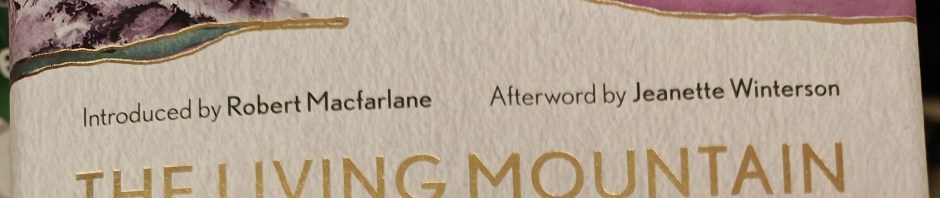
In The Living Mountain Nan Shepherd inverts her eye, but it’s not her mind we see but Mind itself. It is a theory of the mind from a particular mind mode. Mind minus ident and the idem from the idiosyncratic.
It is a book of perception. Perception and perceiving. It is not a lens through which to view the world but an endorsement of the unfiltered. It is a call to make conscious that which lurks, hums or bristles below consciousness. Not the unconsciousness internal that is the recess of the repressed but the body’s background; that which is ordinarily tuned out so we may engage with our assigned, necessary functions undisturbed and with minimal emotional or intellectual involvement. In Shepherd’s words:
“The body is not made negligible, but paramount. Flesh is not annihilated but fulfilled. One is not bodiless, but essential body.”[1]
Who is Nan Shepherd? It is hard to say. For a work so unique her own Self is hidden from us. There is a distinct voice but it is rarely personable or inclined to disclose much of her beyond what is necessary to bring her manifesto closer to clarity.
There is also little sense of Shepherd as a woman. Not that there need be, but there is a notable leaning-in to humanity in general as “man”, the general singular “he” invariably. Of course, this is a work first penned in the 1940s; a, thankfully, quite different time than our own. But can this be attributable solely to the era in which it was written?
It is not just the archetypal human being who is “he”. Most creatures are, which surely are divided in a roughly 50/50 split like us?
Crucially, too, is “the mountain” itself. When Shepherd speaks of the mountain, she does not describe a single peak but the entire range – “the plateau” as she calls it, which contains tops but in her conception represents a unified, unitary landscape. Shepherd’s relationship to and with the mountain appears to have a gendered aspect.
The book, indeed, has much latent, and frank, eroticism. The mountain’s maleness is one aspect of this. It reveals itself sporadically and urgently in places. Most vividly in the penultimate chapter ‘The Senses’, where she pronounces, unprovoked, “smells excite me”. She continues—
“On a hot moist midsummer day, I have caught a rich fruity perfume rising from the mat of grass, moss and wild berry bushes that covers much of the plateau. The earthy smell of moss, and the soil itself, is best savoured by grubbing. Sometimes the rank smell of deer assails ones nostril, and in spring the sharp scent of fire.”[2]
From the same chapter:
“after rain I run my hand through juniper or birches for the joy of the wet drops trickling over the palm, or walk through long heather to feel its wetness on my naked legs. […] The hands have an infinity of pleasure in them.”[3]
The Living Mountain is not a memoir. Its protagonist is the mountain or the mountain as experienced but the experiencer is almost invisible. The personal anecdotes are as impersonal as it is possible to be. People are to be observed, almost ethnographically and provide Shepherd with the technical vocabulary and knowledge that enhance her mountain worship. But she does not linger with them; human interactions are fleeting, even transactional. Yet she likens the mountain to a friend:
“often the mountain gives itself most completely when I have no destination, when I reach nowhere in particular, but have gone out merely to be with the mountain as one visits a friend with no intention but to be with him.”[4]
Though mentioning Buddhist pilgrimage at the conclusion of the book, Shepherd is an anti-summit sherpa. She eschews the peaks as incidental and not to be reified at the expense of the totality of the landscape. Note the use of the gendered personal pronoun here.
In the decade prior to Shepherd’s penning The Living Mountain memoir was turned to political ends in the works of George Orwell. Down and Out in Paris and London, The Road to Wigan Pier and Homage to Catalonia are all rooted in autobiography and deeply political. The Living Mountain is more treatise than memoir and in our age where over-disclosure is expected, refreshing and welcome. There is a lack of self-deprecation and irony; Shepherd is deadly serious. Her joys are sincere: worked at but not contrived.
Orwell certainly would have taken issue with Shepherd’s sentiment in this passage (he was virulently anti-bohemian!):
“Walking barefoot has gone out of fashion since Jeanie Deans trudged to London, but no country child grows up without its benediction. Sensible people are reviving the habit.”[5]
The Living Mountain is a political book, though probably not in a way that Orwell would have recognised. It is about how to be, how to observe closely, to trust one’s senses even if they do not accord with expectation (in this way the sky may be green, water essentially white and haze afford more definition than brilliant sunlight). Echoing, or rather anticipating, Jon Krakauer’s Into the Wild, it is also about respect for the brutality of nature with vivid descriptions of the discovery of hikers caught out in treacherous conditions and found days later abraded and frozen to death.
Shepherd wrote The Living Mountain during the Second World War. This context is not directly referred to and only seeps in at the edges of the text. The wrecked warplane, flying too low in the all-enveloping mist, and the redoubled forestry to supply the front with timber are two such incursions.
There is a plausible interpretation of The Living Mountain as Shepherd’s method of processing the horror and brutality of the total war. The mountain, here, is a synecdoche for the external, the beyond humanity. It bypasses and is distinct from the human day-to-day and interpersonal or political conflict. In a broader sense, it is the Not-We. The Not-We imbued with consciousness. God?
[1] The Living Mountain, p106
[2] The Living Mountain, p98
[3] The Living Mountain, p102
[4] The Living Mountain, p15
[5] The Living Mountain, p103

 Flett-cetera