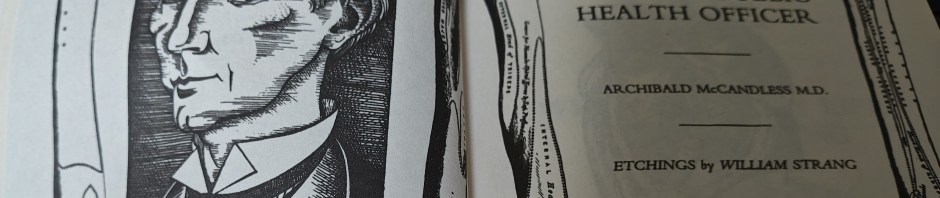
January led me to Poor Things four years ago. Public health was very much the order of the day back then as Covid restrictions, about which and around which novels are now written (see Caledonia Road by Andrew O’Hagan) still loomed large over economic and social life. Public Health Officer is how Archie McCandless, one of several of Poor Things’ narrators decides to designate himself as opposed to a member of the medical profession more generally.

I return to the novel as a resident of the West End proper of two and a half years and Glasgow for 4.5. Since then it is unlikely to have escaped your attention that a film has been released directed by Yorgos Lanthimos that came out around this time last year. Coming back to Poor Things, then, I am more embedded in the city and the specific milieu of the immediate vicinity of 18 Park Circus, as well as attaining the temporal vantage point of the novel gaining a far wider reception than it ever would have had it not graced the silver screen.
The following is not written as a film review, though inevitably comparisons will arise, but as a re-evaluation of the text compared with my first encounter, bringing all the knowledge and insight I have gained since that first reading to a fresh and, as is my aspiration, more correct interpretation.
Why write a novel about late 19th-century Glasgow? Several characters in Poor Things have boasts to make about its status as the second city of the empire and its contributions to science, economics and, particularly, medicine. I think primarily, though, bypassing the self-justification ventriloquised through its cast, the reason is that Glasgow remains a 19th-century city. No amount of mutilation by motorway can erase this fundamental essence. And yet, there is a lost city; a suggestion of what once was. Glasgow is psychogeographically splintered. It is a collage to be re-assembled, the voids imaginatively filled in.
There is no denying Glasgow’s heyday now lies at least a lifetime ago. A million souls once scurried through these streets; the apex of Rome in 0AD. Glasgow now supports less than two-thirds that. The million souls were highly concentrated too, with 19th century Glasgow one of the most densely populated places on earth. The microcosmological potential is in stark contrast to the disconnectedness of contemporary experience.
Population and progeny are central concerns in Poor Things. A “poor thing” is a helpless creature, incapable of self-redemption, the object of pity more than empathy. The archetypal “poor thing” is a child. A being in need of nurture who left to its own devices, will shrivel and waste away.
Lost children and lost childhoods haunt these pages despite the ostensible levity and humour (and it is frequently laugh-out-loud funny). The most obvious of these is the product of Victoria/Bella’s posthumous caesarean skipping birth for reincarnation as Bella/Victoria’s second lease of life. An unwanted child’s brain grants the body of Victoria Blessington a neurological blank slate in what is the central conceit of the novel. Abortion and resurrection disturbingly combine.
The work most readily associated with Alasdair Gray, Lanark – Poor Things is certainly more famous now but few would recall its authorship – also features a central character who undergoes a rebirth that severs the link between the new being and the past self. Each of the characters journeys to the new self by plunging. Lanark/Thaw slips in, feet first, representing a reluctance to be swallowed/rebirthed in quite a grotesquely literal sense. Victoria/Bella dives, pre-weighted with stones, headfirst with no “wish to return to the surface”.[1]
These stark images of childlike ignorance/innocence, rebirth and baptism borrow from and invoke a Christian tableau but Gray’s concerns are more akin to Miltonic innovations interpolated through Mary Shelley. There were no children in Eden. A child is not, in any sense, ideal. For Gray childhood is not primarily innocent, but vulnerable – a trauma factory from which most grown-ups never clock out.
Prelapsarian Eve in Milton’s vision is very much an adult human female with adult desires that are acted on without a hint of shame or repression. Eve had no childhood and manufacturing is an alien concept in the Garden of Eden. Milton is unequivocal that the knowledge she gains by eating the fruit is not carnal.
Milton in Paradise Lost is unfortunately constrained by the bald, bigoted statements of Genesis that leave little room for creative interpretation. Bringing forth in sorrow is the big one – God’s curse on women of painful childbirth. The 17th century was not quite ready to talk about menstruation, it seems, leaving later generations to challenge the lunacy (no pun intended) of Leviticus. Not so, Godwin Baxter of his creation, Bella:
Her menstrual cycle was in full flood from the day she opened her eyes, so she has never been taught to feel her body is disgusting or to dread what she desires. Not having learned cowardice when small and oppressed she only uses speech to say what she thinks and feels, not to disguise these, so she is incapable of every badness done through hypocrisy and lying – nearly every sort of badness.[2]
GB argues that BB exists for herself, freed from self-loathing, sexual repression and the burdens of having had a childhood. She is the Eva an sich, not Frankenstein’s bride – a treatise made flesh.
This is, however, only after Bella elopes with Duncan Wedderburn. Up until this point – a source of much of the novel’s comedy and delicious melodrama – Bella could very much have been created as Godwin’s bride.
A scene in the novel which does not make it to the screen in Lanthimos’s adaptation is where Bella announces her engagement to Archie McCandless by the fountain in West End Park (now Kelvingrove). Godwin is aged up in the Lanthimos version (played by Willem Dafoe), so it is quite ridiculous to view him and “Max” of the film as love rivals. In the novel, McCandless and Godwin are more like peers, although Godwin is slightly older having completed medical school (albeit denied graduation) whereas McCandless is still a student.
Godwin’s odd medical conditions are preserved in the film where he announces he must manufacture his own digestive juices and belches fantastical gas bubbles. In the book, he appears to be a kind of diabetic and eats only a proto-huel-like substance which disgusts McCandless with its awful smell and, in a moment of curiosity, briny taste. What is not preserved is his hideous voice; apparently so intolerable as to necessitate earplugs for prolonged periods in his company. Loud, grating and high-pitched – he has remained in a state of perpetuated prepubescence. That is until he hears that Archie and Bella are to be wed:
Then came the most terrifying experience of my life. The only part of Baxter which moved was his mouth. It slowly and silently opened into a round hole bigger than the original size of his head then grew larger still until his head vanished behind it. His body seemed to support a black, expanding, tooth-fringed cavity in the scarlet sunset behind him. When the scream came the whole sky seemed screaming. I clapped my hands on my ears before this happened so did not faint as Bella did, but the single high-pitched note sounded everywhere and pierced the brain like a dental drill piercing a tooth without any anaesthetic. I lost most of my senses during that scream. They returned so slowly that I never saw how Baxter came to be kneeling beside Bella’s body, beating the sides of his head with his fists and quivering with human-sounding sobs as he mounded in a husky baritone voice, “Forgive me Bellla, forgive me for making you like this.”
She opened her eyes and said faintly, “What’s that supposed to mean? You aren’t our father which art in Heaven, God. What a silly fuss to make about nothing Still, your voice has broken, there’s that to be grateful for.”[3]
This vivid magical realism is typical of Gray. It is something that is not quite captured in the film, which exists in much more of a dream-like, parallel universe. Lanthimos ups the magic over the realism with Godwin creating a self-propelled carriage contraption and a bestiary of chimaeras as opposed to just the swapped-torso-ed Flopsy and Mopsy. Gray’s world is rooted in real-life locations and history, which makes these breaks with reality all the more stark. For Lanthimos, late 19th-century Europe is more of an incidental backdrop – an aesthetic. Unforgivably, Glasgow is entirely absent except in Dafoe’s amusing attempt to approximate Gray’s own peculiar accent for Godwin.
The scene by the fountain marks a distinct transition for Godwin Baxter from father/would-be-groom to the settled role of disinterested (in terms of designs on marriage) patriarch. In this scene, Bella does not know what might need to be forgiven. That only comes at the heart-rending end of Chapter 18: The Return where she asks, “Where is my child, God?”[4]
Godwin’s interest as a father is a cause of regret for him on Bella’s return. The love of one’s child is by default selfish and to the exclusion of all other children. It diverts his attention away from charitable work—
I wanted to win your love far more than I care for the scorched and broken victims of heavy industry.[5]
Bella’s answer has a lot of resonance today in a world where people are deciding not to have children because of perceived overpopulation and concerns over carbon footprint per capita. She exclaims, “Dear God, what a lot of good I have prevented, just by existing!”
Godwin’s initial mistake is to expect something back from Bella for the gift of renewed life he has given her. He hopes to obtain a direct return from his efforts in educating her scientifically (his veterinary practice) and culturally (through his grand tour), to create the perfect daughter/bride who complements exactly his unprejudiced eccentricity and who will not shrink from his unconventional physical form. Adoration in return for devotion.
There are some things parents cannot teach, however, and Godwin limits Bella’s education such that she must learn these things unregulated in the company of Wedderburn and worldly-wise cruise ship passengers. The core of Poor Things is the childlike moral revulsion which, ironically, we lose through our experience of being a child and learning that, regrettably, the world isn’t fair by the time we reach maturity. Bella’s moral revulsion has the potency of a child’s but she has none of a child’s impotence. With her technical training and total immersion in European high and low society, she has the knowledge and the impetus to effect transformative change. Godwin’s Ausbildung will be reaped by the world at large, the fruits his to enjoy at an abstraction, while he sips briny huel.
One other thing the film leaves out is the novel’s polyphonic quality. Poor Things, the book has a long coda including a letter in riposte from Victoria McCandless, wife of Archie, writing after his death. She denies the resurrection narrative, framing her story as one of selective amnesia to escape from a brutal husband and unhappy upbringing. Gray, as “the editor” is firm in his belief in McCandless’ account, in a lengthy series of “proofs” of the events he describes. Of course, as above, Lanthimos does not attempt to pretend that his work takes place in anything approaching the real world. It is a different artistic vision, but to my mind a poorer one.
Gray describes Victoria’s life after the events of Archie’s memoir. She continues in her idealism, setting up her own clinic, joining the Fabians, campaigning for and enacting social justice.
The First World War deprives her of her three sons and this experience causes her to confront her own attitude towards parenthood. She publishes a pamphlet (as her husband does) at her own expense called A Loving Economy. In it, she recommends a one-child policy because she believes that she has failed to mother her sons sufficiently. Had she done so, she concludes, they would not have considered their lives so “valueless” as to throw them away in sacrifice to the derangements of the ruling class.
Victoria strikes a strongly anti-natal note to conclude this endlessly curious novel. Amid the polyphony one gets the sense that there should be some other way between Malthusian cynicism, anti-natal resignation and blind effective altruism of the “more life = more good” school. Godwin touches on it, I think. The coveting of mere life “bios” is inadequate and often actively detrimental to social life; the only legitimate reason for creating new life is the promise and intention to transform bios into zoe – a life lived in dedication to the betterment of others[6]; the raising of poor things from helpless creatures to a station of dignity, autonomy and empowerment.
[1] Poor Things, p32
[2] Poor Things, p69
[3] Poor Things, p52
[4] Poor Things, p191
[5] Poor Things, p195
[6] Difplag of C. S. Lewis, Mere Christianity

 Flett-cetera
Pingback: An update: professional and personal | Flett-cetera
Pingback: “Victor, you’re the monster!” Guillermo del Toro’s Frankenstein reviewed | Flett-cetera
Pingback: “Giant propensitites” and “Calvinistic doctrines”: Charlotte Brontë’s ‘Jane Eyre’ reviewed | Flett-cetera