I am nearing the end of a beginner’s course in Brazilian Jiu-Jitsu.
I decided to try it after watching many Breathe and Flow yoga videos on YouTube where the guy (Florian) frequently mentions how his yoga practice feeds into the isometric movement and flexibility needed for jiu-jitsu.
Jiu-jitsu requires strength, coordination, balance and flexibility. I would say that the first few classes reminded me of how far I have to go with the former two, but yoga has provided a good foundation for the latter. It’s good to be able to do something physical that also requires a bit of skill, thinking and strategy. I’ve not done a contact sport for ages, nor a team sport. Part of the reason for signing up was to force myself to break out of my chronic individualism. True, when you’re “rolling” you are relying solely on yourself (and you can’t drop the ball or you will lose) but it is impossible to train alone!
It’s good to be doing something physical and intuitive after a 9-5 desk job, which can frazzle the brain but leaves the body chronically underutilised.
My conversations with colleagues at the Cathedral were on the best days rather philosophical. The environment lent itself to that sort of thinking; and the stillness (underemployment). At my current work I find myself occasionally on topics of politics or history but mostly what’s talked about is work. So, perhaps consequently, I’ve been topping up on culture quite a lot of late with friends outwith. Specifically, film.
When I was living in Edinburgh I’d go to Filmhouse or Cameo every other week and see something interesting. I’ve started taking that approach here in Glasgow a bit more with the GFT (Glasgow Film Theatre). Last month I saw All of Us Strangers with Andrew Scott and Paul Mescal in the leads. From the promo, I thought it was a romance and I saw it *platonically* with a pal on Valentine’s Day. It was a romance, initially, but it swiftly plunged into an exploration of a particular grief that haunts Scott’s character from late childhood through to his 40s. My friend pointed out that the screenwriter’s Americanisms bled into the dialogue on occasion, jarring with the tale’s London setting. Another geographical dislocation was in accents where Scott’s wholly unaltered Irish inflection is explained in an unintentionally funny throwaway line about growing up with an aunt in Dublin.
This is to unfairly disparage what is overall an undeniably affecting piece despite some rather on-the-nose moments. The romance feels genuine and original, at least for a film of AoUS’ popularity even if the issues it re-litigates seem like the talking points of ten or twenty years ago rather than today. It’s not a film I would rush to go and see again primarily because I think it would lose emotional potency if you knew where it was going from the beginning. That said, because it has unexpected twists it’s definitely the kind of film that you would bring fresh interpretations to on second viewing.
Another February film I went to see was Zone of Interest. It’s one of the big films of 23/24, so you probably are already aware of the premise. It essentially follows the lives of an ostensibly normal German bourgeois family; except they live right beside Auschwitz and the dad is the commandant. In the film you never see the atrocities being perpetrated on the other side of the wall, but you hear them. The sound design is a supreme achievement and heightens the discomfort of the juxtaposition considerably. Martin Amis’s novel of the same name provides the starting point for the film, but apparently merely that as it draws more from the historical record than anything else beyond the core cast of characters and idea to focus on the domestic normality proximate to abject horror.
It was the second Sandra Hüller fronted picture I’d seen in as many months. The other was Frauke Finsterwalder’s Sisi und Ich on its UK premiere as part of the Goethe Institut’s German film festival in January. This was a quasi-comedy about the Austro-Hungarian Kaiserin and her lady-in-waiting. After the film, there was a talk by the director in which she declaimed historical fidelity in favour of artistic statement. Nevertheless, I looked up the story of Elisabeth Empress of Austria on Wikipedia a few days later and found that much of her eccentricities had been faithfully rendered. She had a punishing and painfully anti-nutritional dietary regime and exercised obsessively. Worse than that she expected those in her close and carefully vetted coterie to adopt her punitive programme with unflinching exactitude. She covers vast distances across Europe and Africa to avoid her husband, Kaiser Franz-Josef and Hüller’s character (her LIW) grows increasingly enamoured with her despite her evident cruelty and vanity. The film does well at depicting the absurdity of the Habsburg entity, the last of the great absolutist monarchies to expire, but it is more concerned with character than politics or such things as the grand sweep of history. It’s stayed with me longer than I thought it would when I first left the cinema in any case.
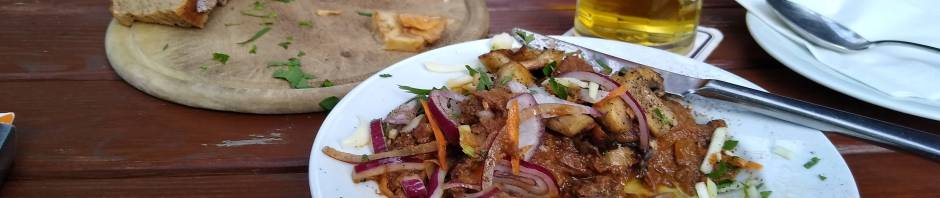
I am hoping to visit former Austria-Hungary in late summer. My interest was sparked by a novel I finished over Christmas – The Good Solider Švek by Jaroslav Hašek. It follows a Czech soldier who is fighting in the Austro-Hungarian army in the First World War. He makes a show of unquestionable loyalty to the Kaiser and Monarchy while being branded a malingerer, placed under constant threat of court marshal and interminably losing his way to the Eastern Front. The novel is literally interminable as the author died before he could finish the tale and so it ends abruptly around page 700. As a reader, you get just as frustrated as the officers around and above Švek but you also develop a fondness for his subversive total honesty, which demonstrates he is far more clever than the imbecile he proclaims to be. I like how it captures a world that has been totally lost now; the multi-ethnic empire, the ridiculous deference and identities that have all but evaporated. It reminded me of my experience reading Catch-22 as a teenager and I can see how it inspired Bertolt Brecht. It also gave me a craving for some good quality goulash like the stuff I tasted in the Bohemian restaurant in Nuremberg last summer.

Before the year is out you can expect me to bestride the squares of Bratislava, Budapest, Vienna and Prague. In any event, I need my Eurofix and I’m currently on a Central European vibe. Any recommendations are appreciated!

 Flett-cetera
Pingback: An update: professional and personal | Flett-cetera