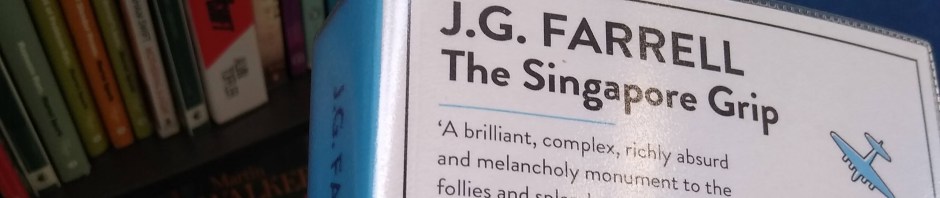
Last weekend I finished one of the best books I’ve read this year. This is The Singapore Grip by JG Farrell.

It is an epic novel and also a family saga of sorts. It’s about a business dynasty and a reluctant inheritance – not just of a business dynasty but a general Kulturerbe. Its characters are confronted with the challenge of preserving a way of life under rapidly changing and increasingly hostile circumstances. Will they persevere despite the hand they’ve been dealt by history and is it even worth fighting against the tide?
I had never heard of JG Farrell before. I had just finished reading another JG – JG Ballard – on similar subject matter – the war in the Far East. This time instead of Shanghai I was immersing myself in 1940s Singapore at the southern tip of Malaysia – then Malaya.
Now we have the idea of “Singapore on Thames”; then it was very much Thames on Singapore -transposing Anglo-capitalism into the remotest key possible.
JG Ballard’s novel, Empire of the Sun has little comedic about it whereas this, at least for most of the first half and a good bit of the second, is highly satirical and pretty funny. At The Singapore Grip’s conclusion, however, there is real pathos, and the characters are rarely anything other than 100 per cent in earnest. We laugh a lot more at them than with!
Whereas Empire of the Sun deals unflinchingly with the harshness of occupation and life in a Japanese prisoner-of-war camp, SG takes place in the run-up to the invasion and the setting of Singapore is vividly evoked as simultaneously unique and a synecdoche for the entire British imperial project.
To be British in 1941 was to be a citizen of the Empire. Its peak territorial extent was realised in the 1920s and over the preceding two centuries or so Britons had become accustomed to the idea of their invulnerability. Potential crises would be weathered or absorbed – it would all work out for the best. A last-minute deal could be struck. It’ll be fine. After all, we’re British. The echo of this attitude is a Johnsonian perspective on the Brexit negotiations.
Spoiler – then and now they would not work it out. And in Singapore’s case, the signs were there since the mid-1930s.
For the British in Singapore of the mid-20th century life was pleasant, full of perks, luxuries, servants, abundance and most importantly breathing space at the periphery, comfortably distant from the metropole, London. It is a lifestyle hard won – Walter reminds us – and against hostile conditions, geographically and demographically speaking. Singapore is sweltering, humid and at first, entirely lacking in the infrastructure necessary to do business.
The novel cycles through many third-person limited perspectives but its main protagonist is Matthew Webb, son of the recently deceased Mr Webb of the Blackett and Webb rubber company. He arrives in Singapore to pay his respects and claim his father’s legacy.
Except Matthew is not a typical “rubber baron”. He has spent formative years in Cambridge and began a diplomatic career lobbying for peace at the League of Nations HQ in Geneva. Matthew is unwaveringly idealistic and farcically impractical. He is a thinker, not a doer and in times of stress is given to intellectualise rather than confront immediate problems. In this sense, he takes on a Hamlet-like role and in fact, the plot can be mapped to the play in numerous ways.
Walter Blackett is the Claudius figure, set in antagonistic opposition to Matthew. He relishes in the role of capitalist overlord. His whole life has been dedicated to the business of business. The war and wars generally are an inconvenience for him but also an opportunity – not something to be overcome but negotiated with and managed. Difficult circumstances call for immediate practical solutions. A crisis may call for unconventional thinking and re-accommodating one’s principles to reach a beneficial outcome.
Like Claudius, Walter is a string-puller. His first thought on the death of Mr Webb is how to turn the situation to his advantage. With an attractive 20-something daughter, Joan and an eligible bachelor in Matthew he sees a chance to exert considerable influence on the Webb share of the company.
Joan has more mettle and cunning than her fundamentally uninterested brother, Monty, so in an inadvertently feminist way, this is her route to assuming worldly power. For Walter, this is making the best of a bad hand and he rails against the unfairness of his rival producing five competent sons to his two daughters and Monty.
Joan’s campaign of seduction is not without effect. The problem is that Matthew is being simultaneously courted by Vera Chiang – a “Eurasian” of uncertain heritage – whose wiles prove equally if not more enticing. Herein lies much of the humour of the novel’s first half.
The flirtation and wheeling and dealing are all heightened by the impending Japanese invasion. Where things may have taken a natural course, all operations are accelerated under this rapidly materialising threat. Thus, with the world as they know it coming to an end, Matthew resolves to take decisive action and propose to Joan’s father officially (the fact of his future marriage to her is already taken for granted by him in any case).
The whole situation is rather like Peep Show where Mark marries Sophie out of social embarrassment more than anything else. Thankfully, Matthew is saved by Walter getting distracted and he manages to miss his chance. He will get him when he is invited to dinner at the Blacketts later that week.
It is really this dinner and not when the first shell is fired when the novel turns and becomes much darker in tone. There is frenzied talk of the effects of the invasion to come; mostly on the business and the huge stores of rubber they have stockpiled that will likely be captured by the Japanese. Walter’s principal regret is that he has not been able to profit from this while at the same time he has deliberately stifled production to keep prices artificially high. Tension around the table, let alone around the globe, has reached an excruciating pitch. Matthew must say something, time is running out, the world is ending, and he must make his intentions clear. He says, “Although I like Joan very much, I don’t want to marry her”.
From here, the novel becomes more Ballardian in subject matter. The Dad’s Army that the men have been training for is mobilised. It is seriously impressive how a hundred pages of detailed description of fire-fighting can be so utterly compelling. Matthew finds spiritual purpose in this role and questions his abstract dedication to world peace, which, thankfully, ultimately does remain intact.
There is an underlying battle, separate from that against the Japanese bombardment, with the Singaporean authorities to procure travel documents to leave. This is particularly the case regarding Vera, whom Matthew ultimately chooses over Joan, and her abovementioned uncertain heritage. This battle is almost as heroic and one of my favourite scenes of the novel is where the middle-aged bachelor, and veteran of the Great War, known to everyone as The Major intervenes on her behalf. He uses his connections to secure a face-to-face meeting with the responsible official and when he refuses to grant her application challenges him to a fistfight.
Tragically, the novel ends in their failure to escape and alludes to their years-long internment up until the war’s conclusion. Having read Empire of the Sun and having spent over 600 pages with these characters this is a heart-rending ending. The only consolation is that in leaving us with this novel, the story of the last inhabitants of a destroyed culture, whether justly (likely) or otherwise, is subtly and faithfully monumentalised.

 Flett-cetera