
I’d always wanted to read Walter Scott. In fact, I’d attempted to before – embarking on a free Kindle version of Waverley which was abandoned for whatever reason; probably the dense prose style that strains the attention of a restless mind. Rob Roy is similarly encumbered but for my edification I had got through a couple of Henry James novels before, so for my own sake and the sake of my classic book group this time I persisted and reached the end.
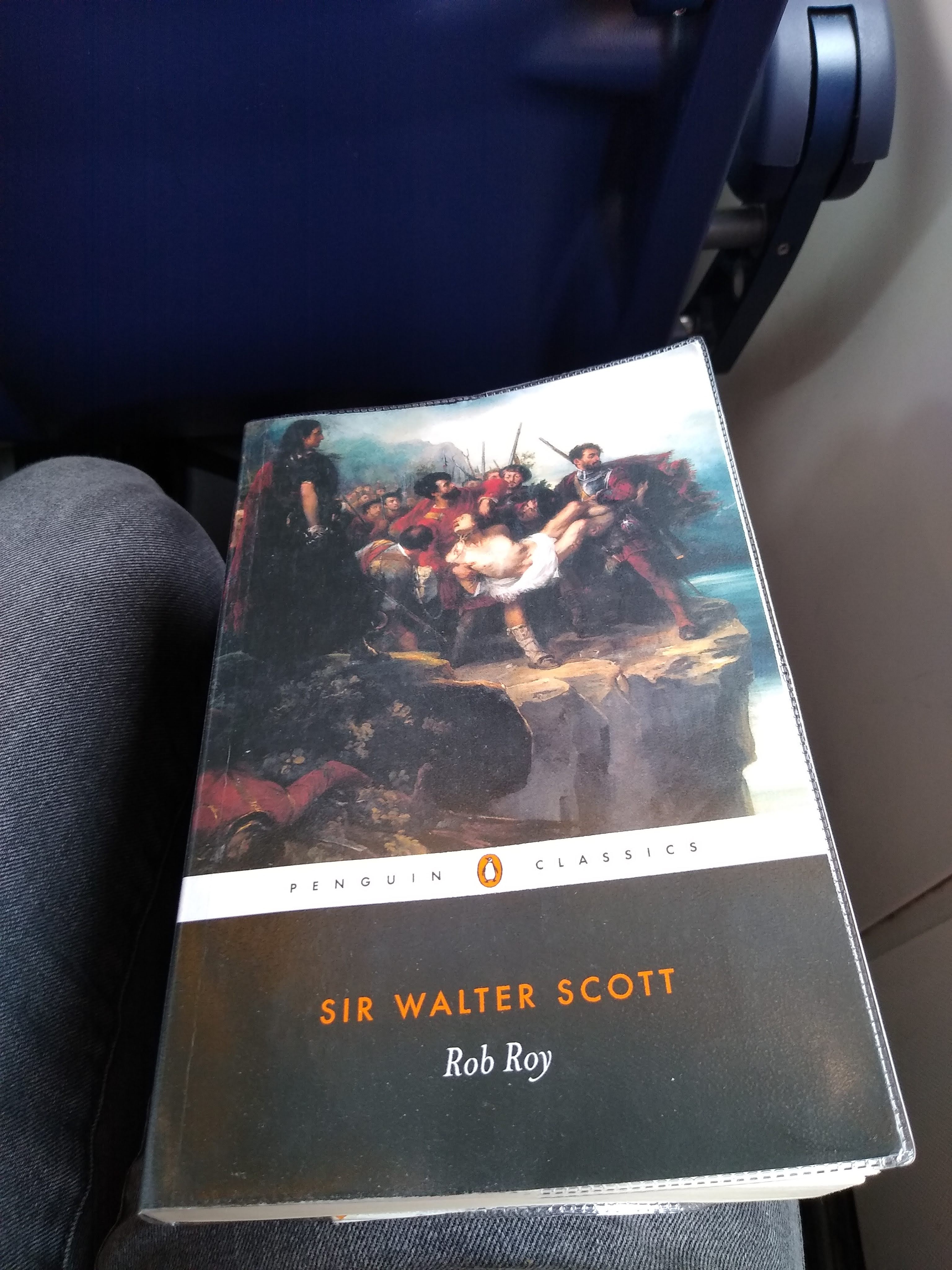
Something that is impossible to get away from when reading Rob Roy is its pervasive preoccupation with Scottishness. By name and by nature, Scott is creating and adding to a national myth. I’m not sure why he decided to write this tale at this particular time. In 1817 the Union was old news and Scotland a full and disproportionate participant in the British imperial project, as alluded to even in the conceit of a memoir written sometime after 1745 and about the failed Jacobite rising of 1715. Scotland and England’s shared political destiny would have seemed assured from this historical vantage point – no nascent nationalist movement existed. So why did Scott turn to mythmaking at this time?
Writing set in the past is almost never about the past as such. A novel is something new – novel. Bertolt Brecht theorised that the only way to speak truthfully about the present was to approach it from the perspective of the past. For him, historicisation was an important subcategory of his seminal Verfremdungseffekt. He was vigorously opposed to the idea of cyclical, recurring history and by placing his plays in the past he sought to show social conditions that the audience could see had been consigned to history, which had been overcome and thereby allow onlookers to conclude for themselves that their political situation could likewise be transcended. I don’t believe this is what Scott is attempting in his “historical fiction”; from what I know of him he is unlikely to have endorsed a Marxian theory of literature, notwithstanding that this is chronologically impossible. However, a consignation might be an apt way of looking at what is being attempted here; in other words, he is trying to consign a wilder, more politically volatile Scotland to the past and contain it there.
At the same time, my impression is that Scott has a benevolent preservation or conservation instinct. His use of Scots language, in particular, in the characters’ dialogue shows a genuine concern for accuracy and fidelity to its actual use in the early 18th century. This is one of the novel’s greatest strengths, even if it hinders accessibility to the modern reader. It depicts Scotland as a land of three languages – Gaelic, Scots and English – and the titular Rob Roy is a master of all three.
Scott is quite even-handed about the relative strengths and characteristics of Scotland and Scots vs England and the English. His protagonist is English and at times seems unnecessarily harsh on his Scottish servant Andrew Fairservice who is portrayed as proud to the point of overt bigotry and money-loving to the point of repeatedly practising false economy. On the other hand, Scotland itself is depicted as a vigorous country with fast-flowing, virile burns compared with England’s slow, lazy streams.
The Scotland of Rob Roy is not one homogenous polity, however. There is the “lawless” hinterland of the Highlands whose inhabitants are on multiple occasions compared with “desert” people:
It is always with unwillingness that the Highlander quits his deserts
And:
A people patriarchal and military as the Arabs of the desert were suddenly dragged into modern commercial and industrial society.
This was an image I also found in Mary Shelley’s Frankenstein, published in the same decade, where the Creature speaks this line:
I have dwelt many months in the heaths of England and among the deserts of Scotland.
An aspect of the novel I found interesting was Scott’s legal background coming through fairly strongly. He particularly highlights differences between English and Scots law, which survived the, at the time when the novel is set, recent Treaty of Union. Take this passage from Nicol Jarvie:
there’s nae bailie-courts amang them—nae magistrates that dinna bear the sword in vain, […] But it’s just the laird’s command, and the loon maun loup; and the never another law hae they but the length o’ their dirks—the broadsword’s pursuer, or plaintiff, as you Englishers ca’ it, and the target is defender; the stoutest head bears langest out;—and there’s a Hieland plea for ye.
The “lawless” Highlands are contrasted with the legal culture of the lowlands, whose terminology is helpfully translated for the benefit of our English protagonist and Scott’s English readership.
Osbaldinstone seems to have undue or naïve respect for the law and always cooperates with authority even where he is falsely charged or where doing so puts his friends in danger. His solution to his cousin Rashleigh’s treachery is not physical confrontation (apart from their drunken scuffle in the early part of the book) but a lawsuit against him.
In this way, Osbaldinstone is apolitical – cavorting with Jacobites and Hanoverians (the government) alike without seeming to be invested in any particular side. He is largely indifferent to the main political question of his time. The novel’s eponymous hero is another apolitical figure – Rob Roy recognises no authority but his own and uses extra-legal means to get his way. Perhaps he could be seen as an anarchist, albeit a violent one who uses violence to obtain what he wants.
If Osbaldinstone does possess a “political” opinion it might be anti-Catholicism, but this only really expresses itself for practical reasons as it complicates his desire to marry Diana who is being sent to a convent. Religion in Scotland is in focus for a couple of chapters which take place in Glasgow Cathedral and are a highlight for me for obvious reasons. Scottish religion is depicted as serious, intellectual and, once again, proud.
Overall, I enjoyed Rob Roy. Although its style can be off-putting at times, the Scots dialogue is good and the time period is interesting. I’m sure I’ll return to Scott’s other works in due course.
Oh, and Orkney gets a mention (well, two – St Magnus is mentioned as a pre-reformation survival alongside Glasgow Cathedral):
And in this country, and in the isles, whilk are little better, or, to speak the truth, rather waur than the mainland, there are about twa hunder and thirty parochines, including the Orkneys (sic), where, whether they speak Gaelic or no I wotna, but they are an uncivilised people.
Orcadians also receive similar treatment in Frankenstein:
The soil was barren, scarcely affording pasture for a few miserable cows, and oatmeal for its inhabitants […] whose gaunt and scraggy limbs gave tokens of their miserable fare.
[…]all the senses of the cottagers [had] been benumbed by want and squalid poverty.
Not a great tourist ad from the early 19th century!

 Flett-cetera