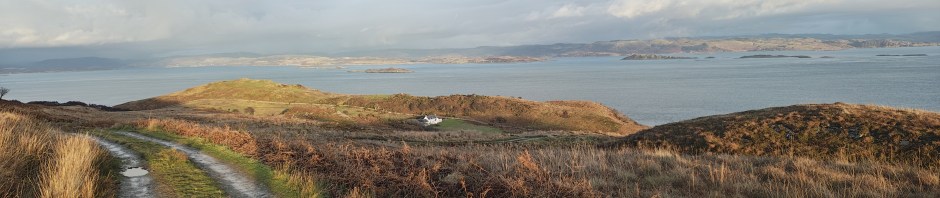
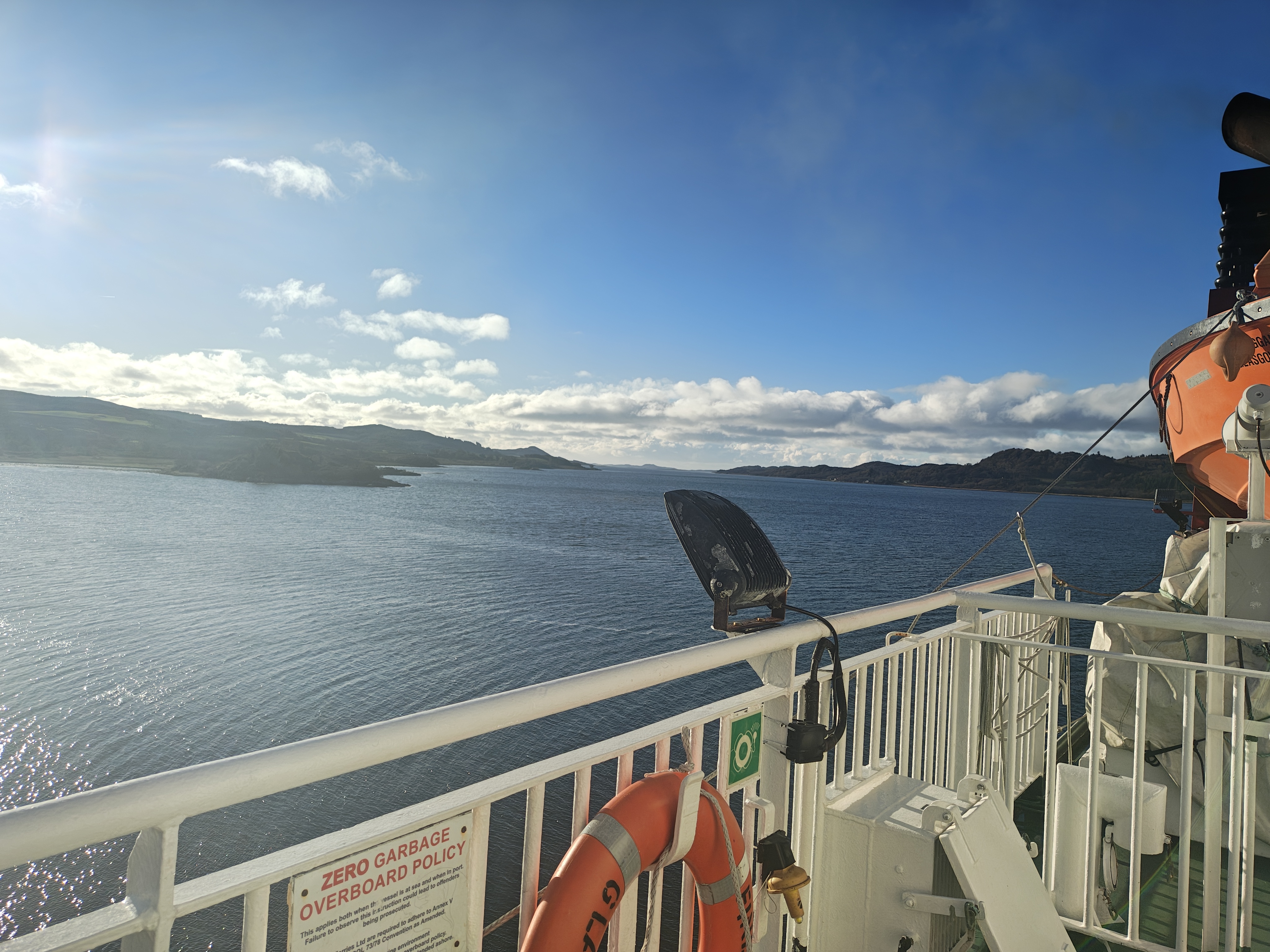
My first drive onto a ferry was not in Orkney but at Kennacraig. We were taking the boat to Port Askaig in Islay where we would be staying for three nights on a last gasp long weekend before the close of the year.
Much like the boat to Mull, the ferry traverses a sheltered stretch of sea, the first third being an estuary cutting into almost the full width of the Kintyre peninsula and the last third being the island’s sound, flanked by Jura to the north.
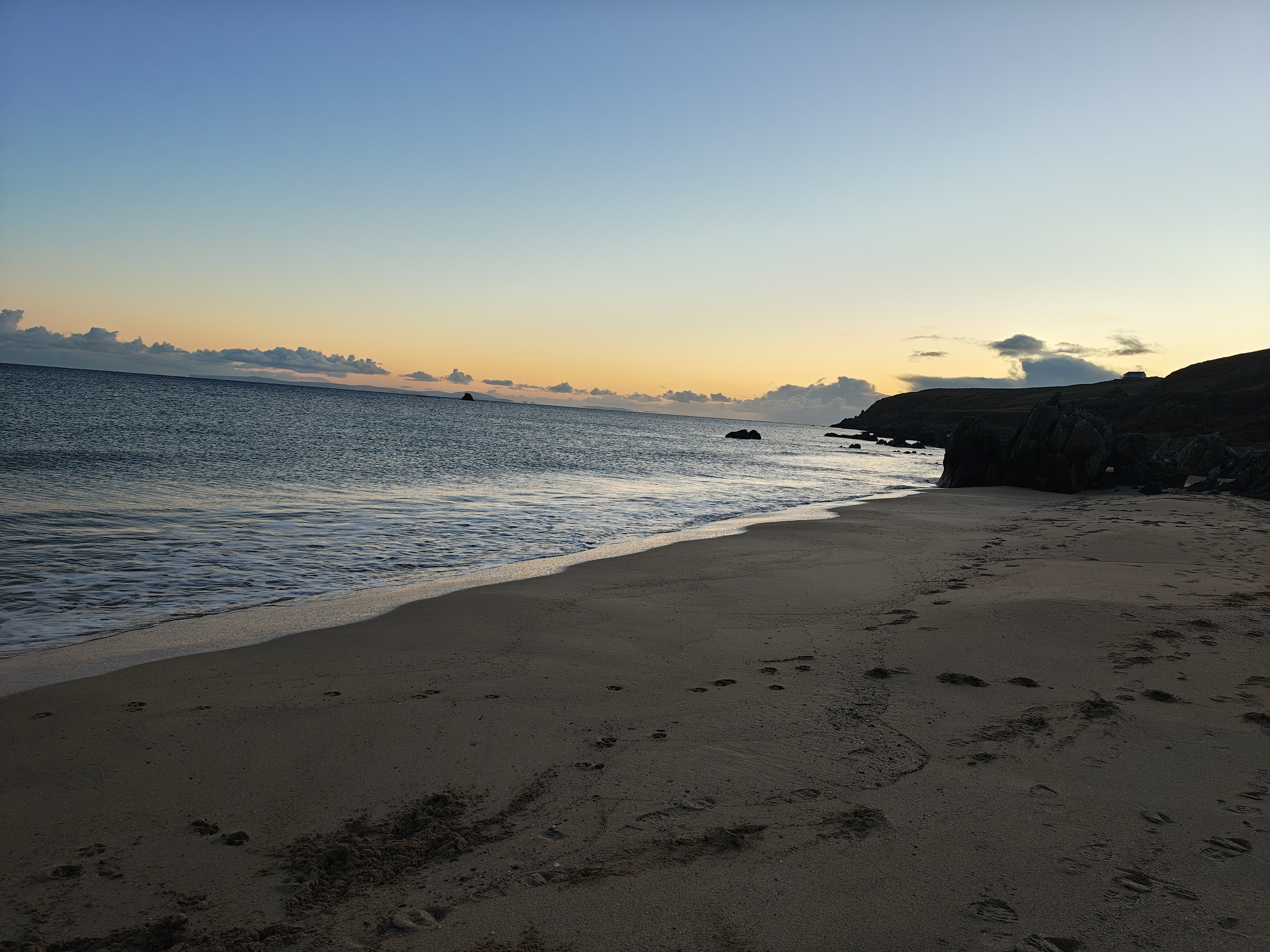
On disembarkation we were bound for the south of the isle to check into our log cabin accommodation. But before depositing ourselves there, a trip to Carraig Fhada lighthouse was in order, to make the most of the fast-fading sun. Pleasing parallels were drawn between our arrival in Jersey and Le Corbière of that late afternoon.
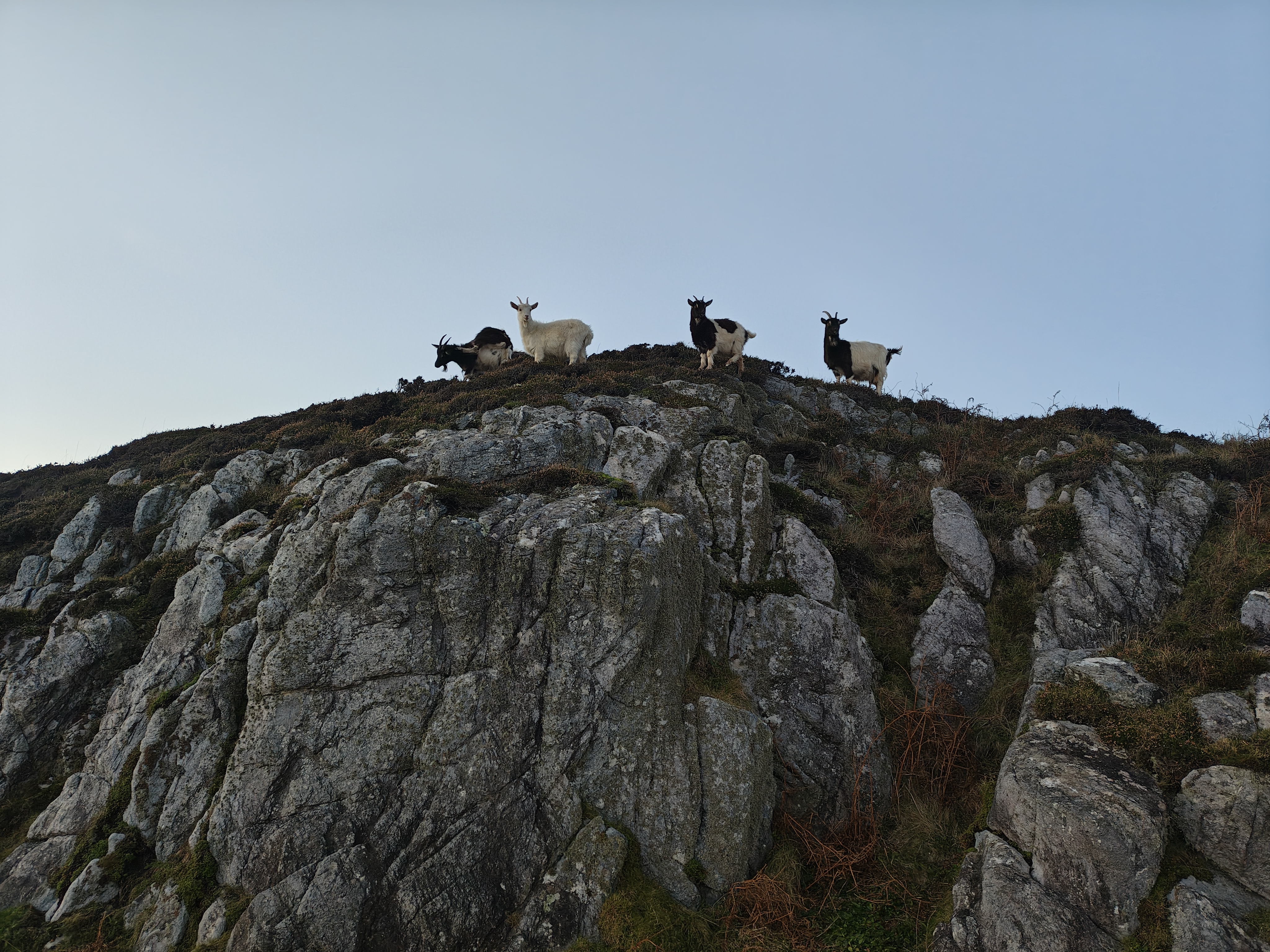
The lighthouse is not the typical round tower you would usually see, but a pleasing cuboid with an almost Aegean understated flair. Unexpected fauna populate the rocky beach foregrounding it – there is an abundance of free-roaming goats with impressively flamboyant horns.
Sirius, the dog, who is with us on this trip, worries them ineffectually and even squares up to the big billy goat, who is thankfully unbothered by his boyish enthusiasm.

Friday is our first full Islay day proper. This is really our first road trip and we share the driving. H— has been kind enough to allow me to be added to her insurance and to take control of the Vauxhall Moriva, known affectionately as Timothy. Although this holiday, he seems to have been rechristened “Timmo”. We’ve been watching the original Mad Max films and seem to be going through an Australian-inflected phase.
Perhaps arrogantly, I had assumed that this was tourist off-season and a distillery tour would be easy to hop onto at short notice. Not so. Laphraoig – our closest and most recognisable bet had only one spot free. Port Ellen, whose glass front exposed awe-inspiring stills and gadgetry, offered tours to people with too much money, starting from £750.
There was only one option open to us – Ardnahoe, located near Port Askaig and with a stunning view of Jura’s iconic Paps – two hills that dominate the landscape and which can be seen from anywhere on the east side of Islay. Much like I thought, the Hoy hills in Orkney’s West Mainland.
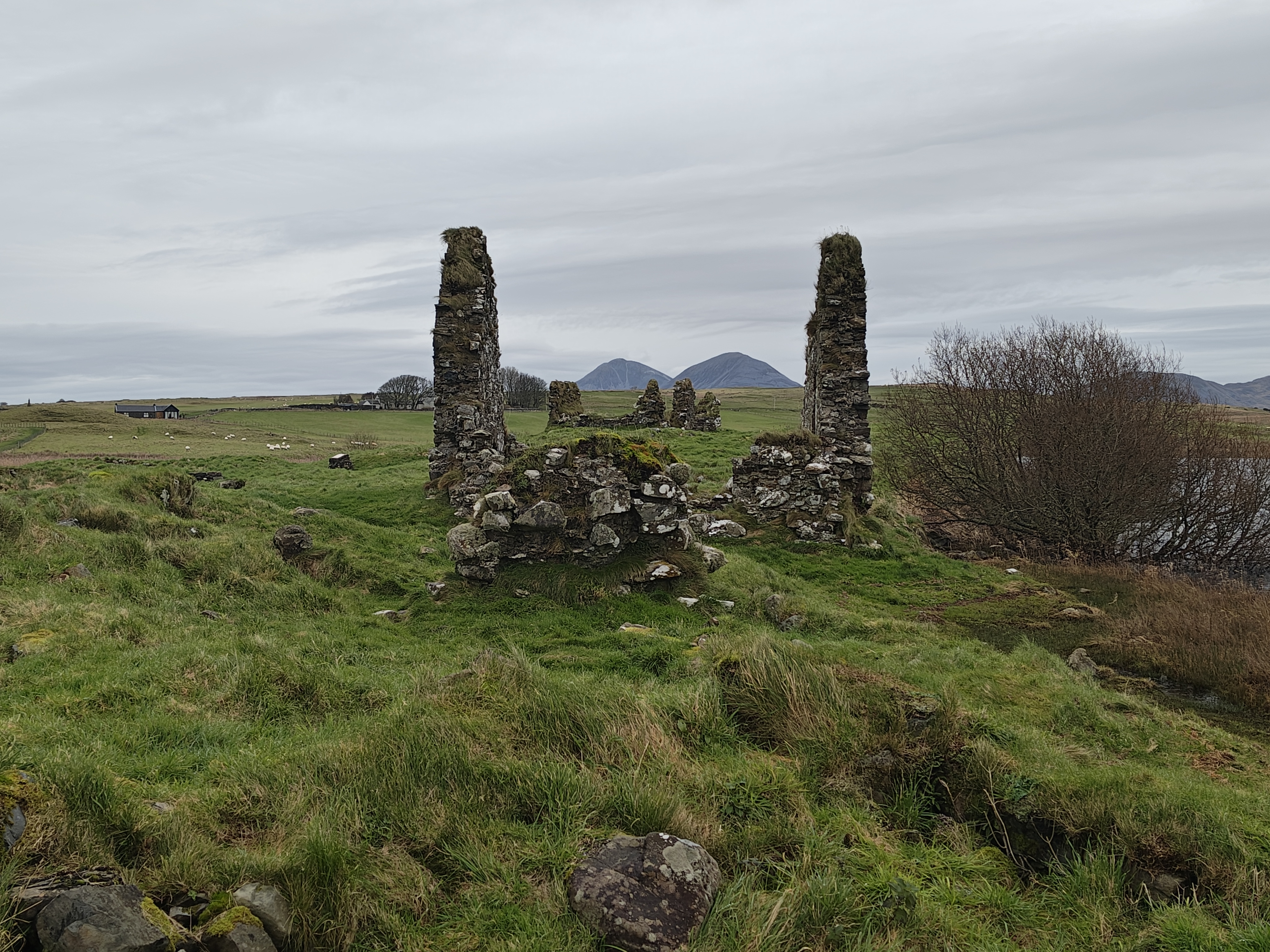
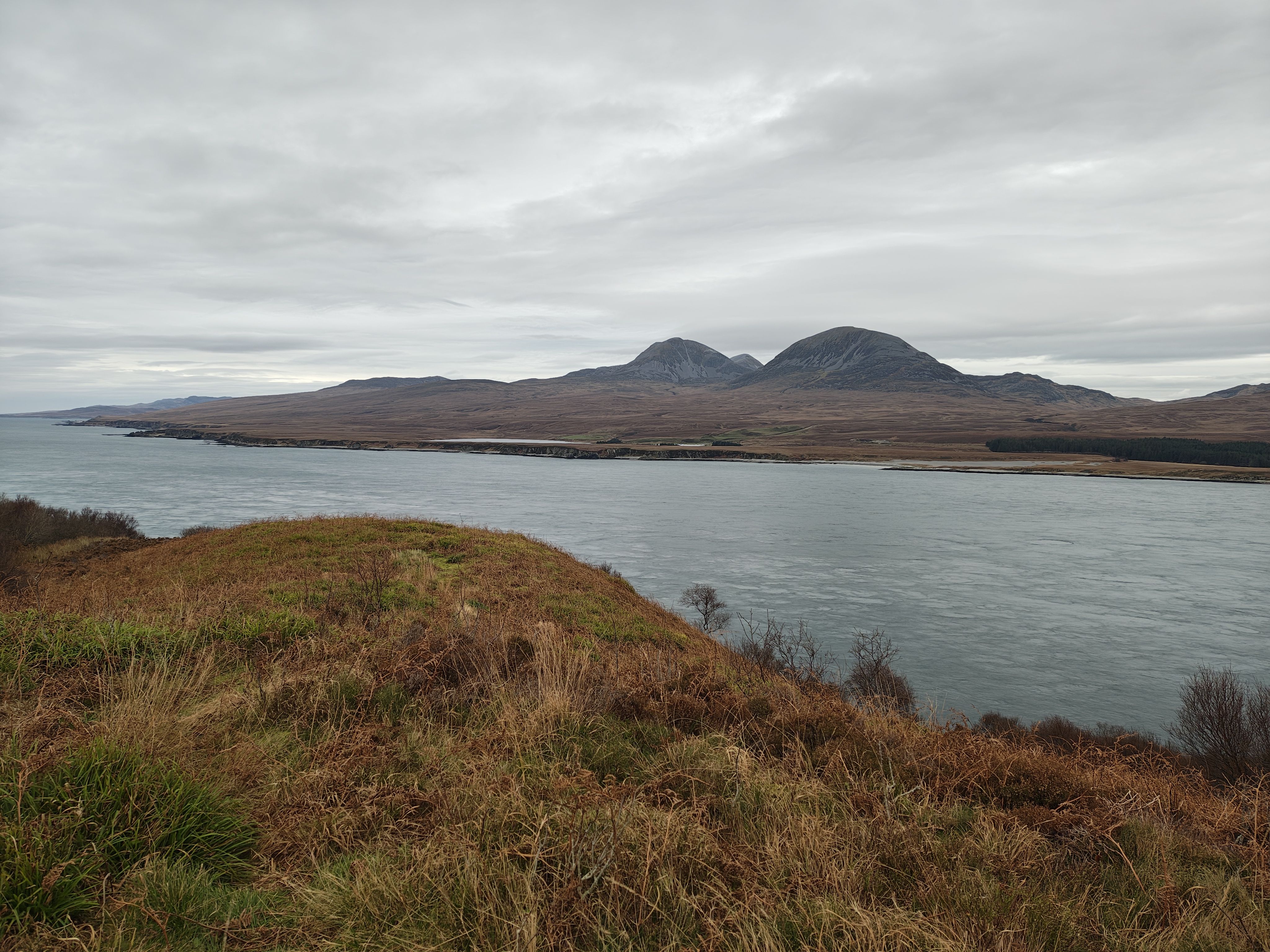
Before venturing to the very north, however, our first stop of the morning was Finlaggan, the ancient seat of the Lords of the Isles. This eyelet in the middle of a loch is accessed by a (modern) wooden causeway and is surrounded by an amphitheatre of heather-clad hills. The perfect place for a kingsmoot if ever there was one. Remaining are the ruins of a settlement inhabited up until the 16th century. The church still has medieval graves; the stone effigies of noble warriors are still clearly visible and covered only by a rain-bespattered pane of glass discreetly bolted atop. As we were to discover, these were not the sole medieval effigies exposed to the elements in Islay.
Packed lunches hurriedly consumed (i.e. stomachs lined), we descended from the Paps viewpoint to the Ardnahoe Distillery. We entered the seemingly deserted visitor centre. Our plans were almost dashed when the Geordie receptionist couldn’t see the booking. All the staff were out to lunch. No tour today.
Our hearts were teetering on the precipice. Were we to be defeated? Surely the last distillery in town would not refuse us?
The page refreshed. Praise be – our booking is there. We are the only two on the tour and are instructed to wait in the café for the guide.
Before we begin, yes, I am doing the whisky part of the whisky tour, toute seule. In my defence, I did the morning driving, AND this was implicitly on the proviso that a gin experience might be had in Jura the following day.
A few minutes later, our host appears. She is Rose from Chateau du Lait (Castlemilk). We are ushered into a small, windowless side room and given a potted history of the distillery. It’s pretty new – founded in 2016 by a Glaswegian who worked in the industry before starting his own venture. His ethos is to create something that people actually enjoy drinking. Sounds like a good plan to me.
There is also a brief overview of Islay’s whisky heritage with some amusing anecdotes about excisemen coming ashore and perennially dodged court citations. As a man of the law, I am bound to condemn such goings on, but I think enough time has passed to allow the faintest twitch of the lip.
The tour is relatively unscientific. Though started in 2016, they use a 100 year old machine to [insert process here]. Only one man knows how to fix it, and his arrival on the island is greeted with a reverent hush.
Next we got to what’s probably the best room, where the grains are fermented with yeast and water in four giant wooden barrels. Rosie lifts the lid at each stage. The liquid is fizzing with activity; almost boiling but with no mechanical excitation – only biological.
So far, so beer. Apparently, with each flip of the barrels’ lids a waft of overpowering aroma is produced. I say apparently because the trip began on my recovery from a bit of a nasty cold, the consequence of which was that I was almost totally deprived of my sense of smell for this frustratingly olfactory experience.
Next, the actual distilling process. Evaporation and condensation. Twice or thrice, I think. Here we get the classic stills as you can picture. Great copper kettles funnelled to a point. Leaning on them sort of feels wrong, like touching dalekanium, but lean we do. They are radiator warm on what has been a chilly day. Most enjoyable for me is the spectacular view of the Paps from the floor-to-ceiling window, which forms the distillery’s logo with the still nestled between.

Also highly enjoyable is the terminology. The condensers are known as wormtubs – a coil spiralling to a nub and dunked in two more massive barrels exposed to the heavens and constantly replenished with rainwater.
After this, the drams. A peaty one and a smoother sherry cask one, I think. I preferred the latter. Then a cask strength, which certainly was. I probably left the tour without the requisite knowledge to start a distillery of my own but it was a very enjoyable experience and a holiday highlight.
To round off the day we headed west to Machair Bay. All dunes, grass and sucking sand. A bracing stroll against the wild Atlantic. Nothing here between us and North America. Wind and wave were all we had to contend with for the majority of the excursion until the rain began to spit, then splutter and just before the car stab in hard, sharp pellets. Thus begins a night of heavy rain preceding the island Walk Highlands rates as having a 4/4 bog factor.
An 8.30 ferry takes us across the sound. Jura basically has one long road, and we drive half away along it to the foot of the Paps. It was hard walking. Bog all the way. Much dramatic leaping from grassy patch to patch. At one point, Sirius was fully submerged in a particularly deep slough.
To cut a long story short, we found ourselves on the wrong side of a river in full spate from last night’s rain, and our plan to summit had to be deferred to another day.
A pie and a toastie from the Antler’s Bakehouse revived me and H— respectively. We were ready to brave the next challenge – Barnhill, the house where George Orwell wrote 1984 from 1946 to 1948 while suffering from the tuberculosis which would eventually claim his life in 1950.
Barnhill is at the very north end of the island. To get there you need to drive to the end of the public road whose extremity becomes little better than a dirt track. It’s second gear all the way for the last few miles until you come to a big white sign saying NO MOTOR VEHICLES.

We dutifully did. So begins the four-mile walk along yet more dirt track to the remotest of literary residences. Of all my journeys to writerly shrines, this seems most like a pilgrimage.
Just as the sun’s decline casts the landscape in its most glorious gold we round the corner and behold the white harled homestead, perfectly situated in the embrace of the glen and overlooking its own private bay. It is the ideal writer’s retreat.
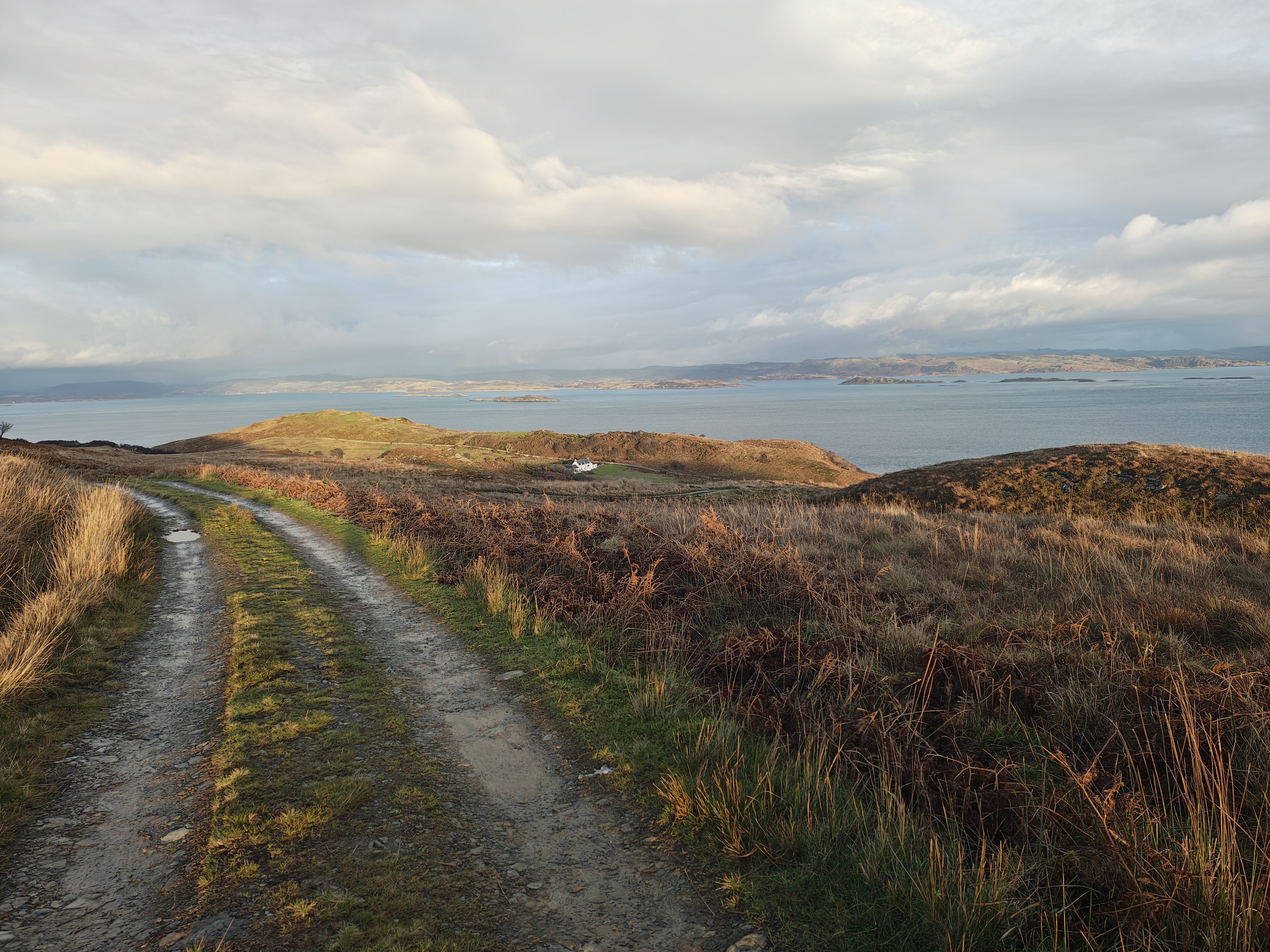
In comparison to its cultural significance, the conception of 1984 is of relatively minor note. Some texts do, however, enchant the landscape in which they came to be. For me, 1984 has that effect on this utterly secluded refuge from modernity. It is the same, or similar feeling I got when visiting the shores of Lake Geneva (Le Lac Lèman) and contemplating Mary Shelley’s Frankenstein.
H— and I ponder such writer’s retreats – Frankenstein famously being born out of one. Surrounded by stags and does, we consider the role of nature in Orwell’s vision, and the contempt he would no doubt have had for our contemporary world of social media and AI.
Before the ferry back, although the gin distillery is closed for the season, we stop off at a pub and H— samples the local Lussa – a hit. Back at the cabin, it’s pesto pasta followed by House of Guiness – a very enjoyable period drama/advert for the black stuff.
The final day squeezed in Kildaton Cross – an 8th-century Celtic stone crucifix within a kirkyard housing medieval graves and 20th-century headstones side by side; a book fair within a distillery (2 paperbacks for £2) and deep-fried oysters (only I partook).
Overall, Islay and Jura were fantastic off-season. While all the museums are closed in November, this is a small price to pay to have the place virtually to yourself. One tip would be to book the distillery tour in advance, and if you’re bringing a bike, Islay is doable and has the infrastructure, as does Jura, as long as you don’t have to go too far north.

 Flett-cetera
Pingback: Cultural Highlights of 2026 | Flett-cetera