
On the flight out, I had a window seat and could peer down at the port of Southampton and the Isle of Wight—the end goal of my August 2023 trek along the English leg of the Camino de Santiago from Reading Abbey. Going over Guernsey, I had a false alarm, having mistaken it for my ultimate destination, but soon, the sandy strip of Jersey’s “five miles by nine” came into view. The airport is large for its diminutive square mileage, but understandable given its population of over 100,000.
After landing, a half-hour walk took us to our accommodation in St Brelade, one of about a dozen settlements named for saints on the island. Having deposited luggage and sufficiently caffeinated, we set out for the itinerary’s first objective—the lighthouse of La Corbière.
Most of Jersey’s place names are in French. Well, in fact, a local language variant called Jerriais. Up until well into the 19th century, Jersey was francophone. La Corbière is Jerriais for “the crow” and is cognate with le corbeau en francais.
Le Corbiere is everything you want a lighthouse to be. Functional and beautiful, the rocks which enthrone it look particularly dashable upon as far as ships are concerned. It is actually situated on a tidal island and accessed by a causeway. My itinerary not having factored this into account, we were lucky to arrive at low tide.
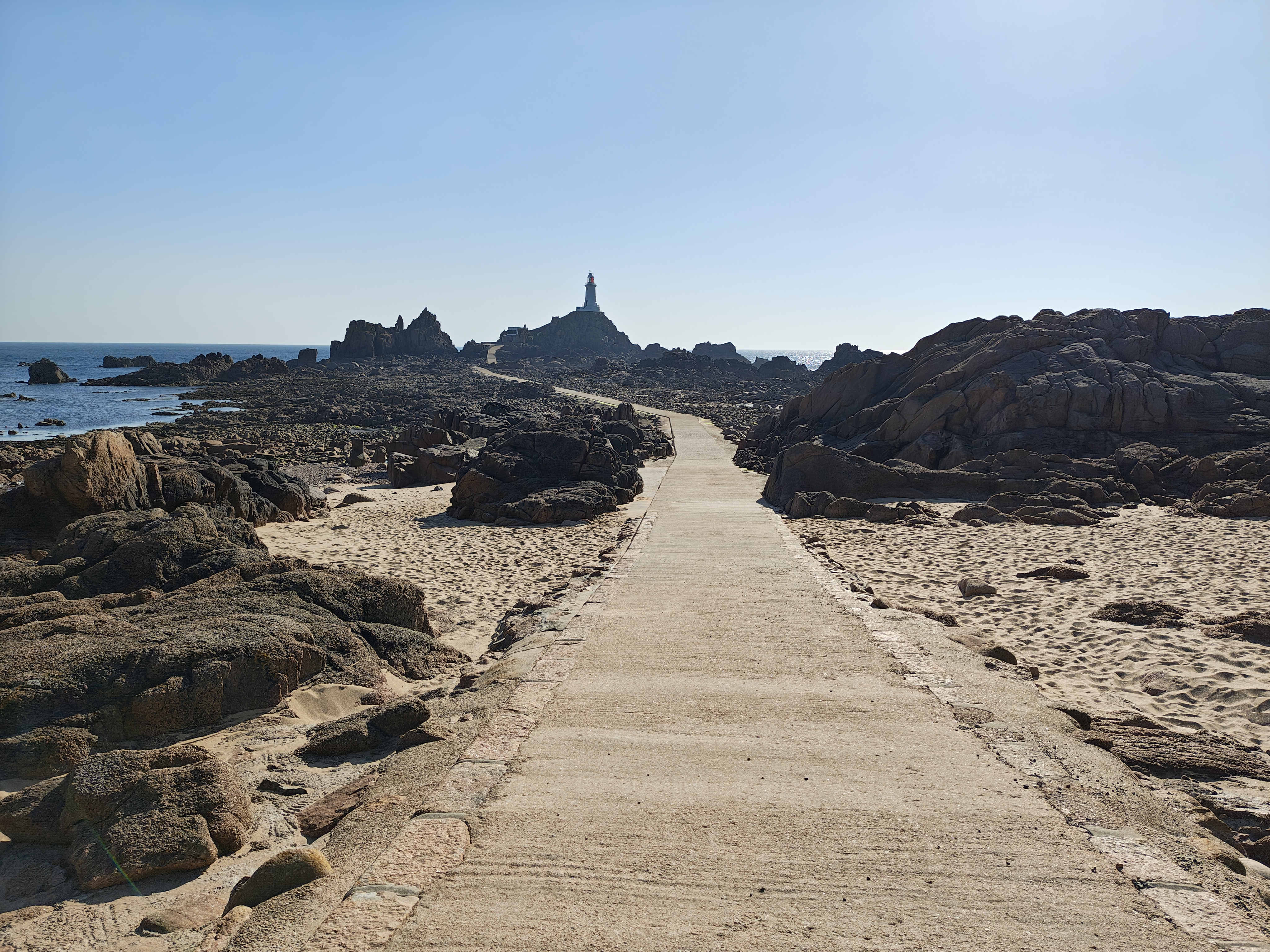
Along the way to the lighthouse are scattered outcrops within which are nestled German pillboxes from the Second World War. These are the first signs of Nazi occupation during the 1940s that we came across and set out a recurring theme over the rest of our trip. The D-Day landings passed Jersey by, and the island was only liberated after the unconditional surrender of Germany, on 9 May 1945. They had recently been celebrating the 80th anniversary of this and bunting was ubiquitous wherever we went. According to Jersey law, the union jack cannot be displayed without equal prominence being given to its own flag, hence alternating patriotic triangles/rectangles. It seems to me that this is more of an all-year-round thing, with even the public transport being named “Liberty Bus”.
By the time we start to head back, stomachs are rumbling and a slice of toast is required before venturing out again to La Brise at St Brelade’s Bay, another item on my list. The view is gorgeous, the salmon burger less so, but I enjoyed my first sip of Liberation Ale on the panoramic veranda.
On day 2, we hire bikes at St Aubin, pronounced like Oban according to our host, but no ferries these days, unlike its namesake – the capital, St Helier, which has taken over as the main port in modern times. The American émigré distributing the velos suspects us of being colleagues. He is not corrected as such; we just happen to share the same accommodation and have not requested that a second bed be made up.
It was to St Helier we were bound, at least at first, and we stopped on the seafront to enjoy some Co-op bought pastries. Sadly, a seagull snatched H—‘s pain au chocolat from her grasp before she could take a second bite. This was a low light from a day whose challenges were only about to begin.
On the outskirts of St Helier is the power station La Collette, and also a snack van where we sampled by far the best coffee of the trip at Henri’s.
Next stop was the Neolithic chambered cairn/passage grave and late medieval chapel of La Hougue Bie. This required a deviation from the cycle path and onto the winding, narrow lanes inland.
A clue was perhaps in the name La Hougue (meaning hill) that inclines would be involved. As the afternoon wore on, I began to feel slight guilt that I had strongarmed my companion into a cycling holiday (at least partly) when she hadn’t ridden a bike in a decade or more.
By the by, the summit was accomplished anyhow. Now for some more strongarming – we were convinced to get Jersey Heritage passes for a week. With me paying full at £48 and she half at £26 (student discount for continued veterinary studies at Liverpool, obtained sans carte). This was perhaps sore to part with, but in the end was just about worth its value as we ended up doing everything on the pass except the country life museum…or something of that ilk, which was essentially a petting zoo, so I am not too upset about that.
I may be biased (well, I am certainly), but Maeshowe for me is much superior. The Hougue is higher, I will grant it that, but inside the cairn is comparatively chaotic. It does not give off that eeriness evoked by Stenness’s symmetry and lacks the monoliths arranged cathedral-like and purposeful.
A bonus was the exhibition of a coin hoard discovered in 2012. 70,000 Roman coins were buried on the island in the first century AD. One theory was that these were interred for tax avoidance reasons; different millennia, same problems, amarite?
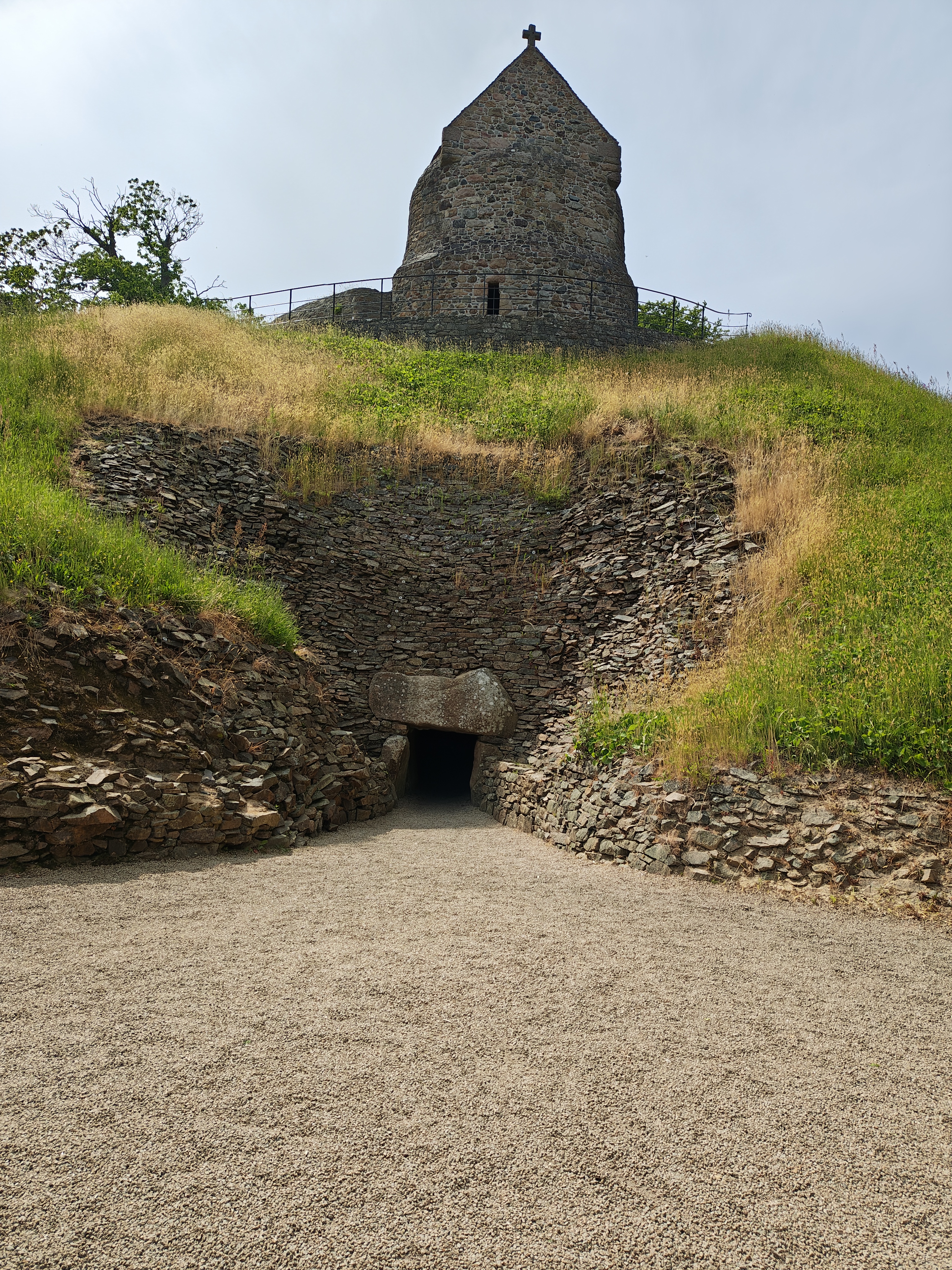
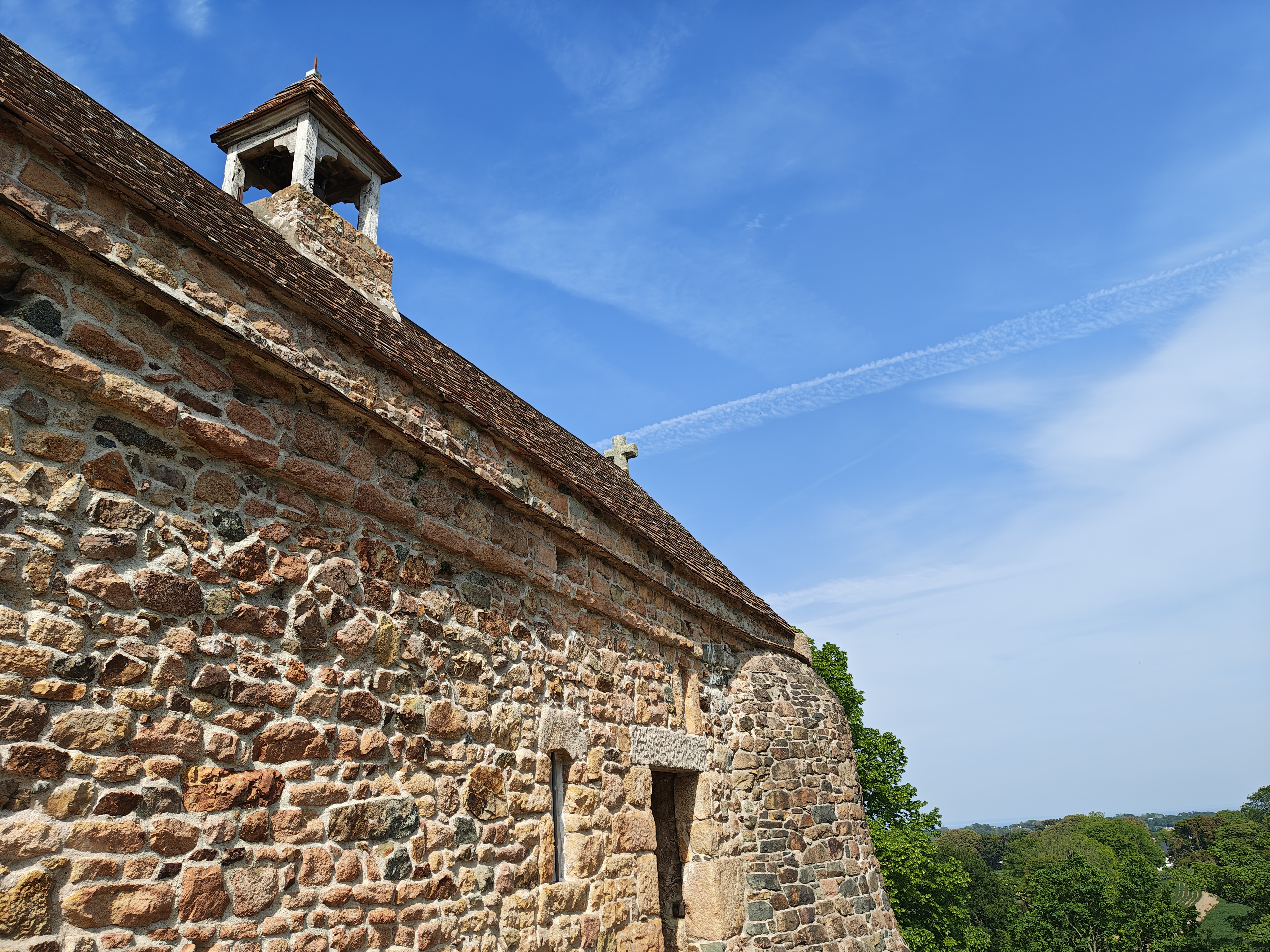
From La Hougue Bie we set out east, not quite catching Mount Orgueil castle’s last entry and thereafter taking in St Catherine’s Bay, pristine and strewn with scallop shells. Two were retrieved as souvenirs before we left for the breakwater, Jersey’s easternmost point.
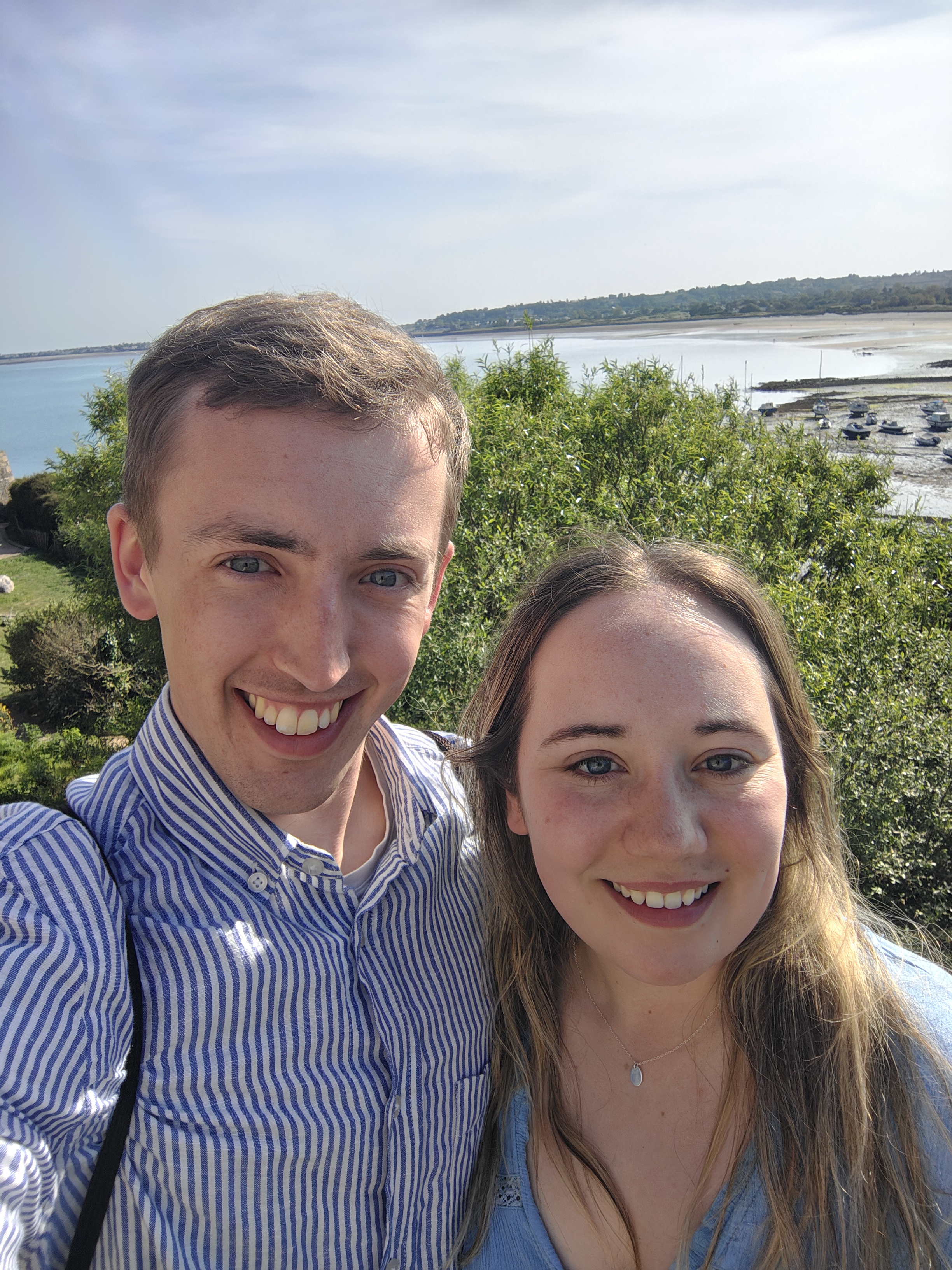
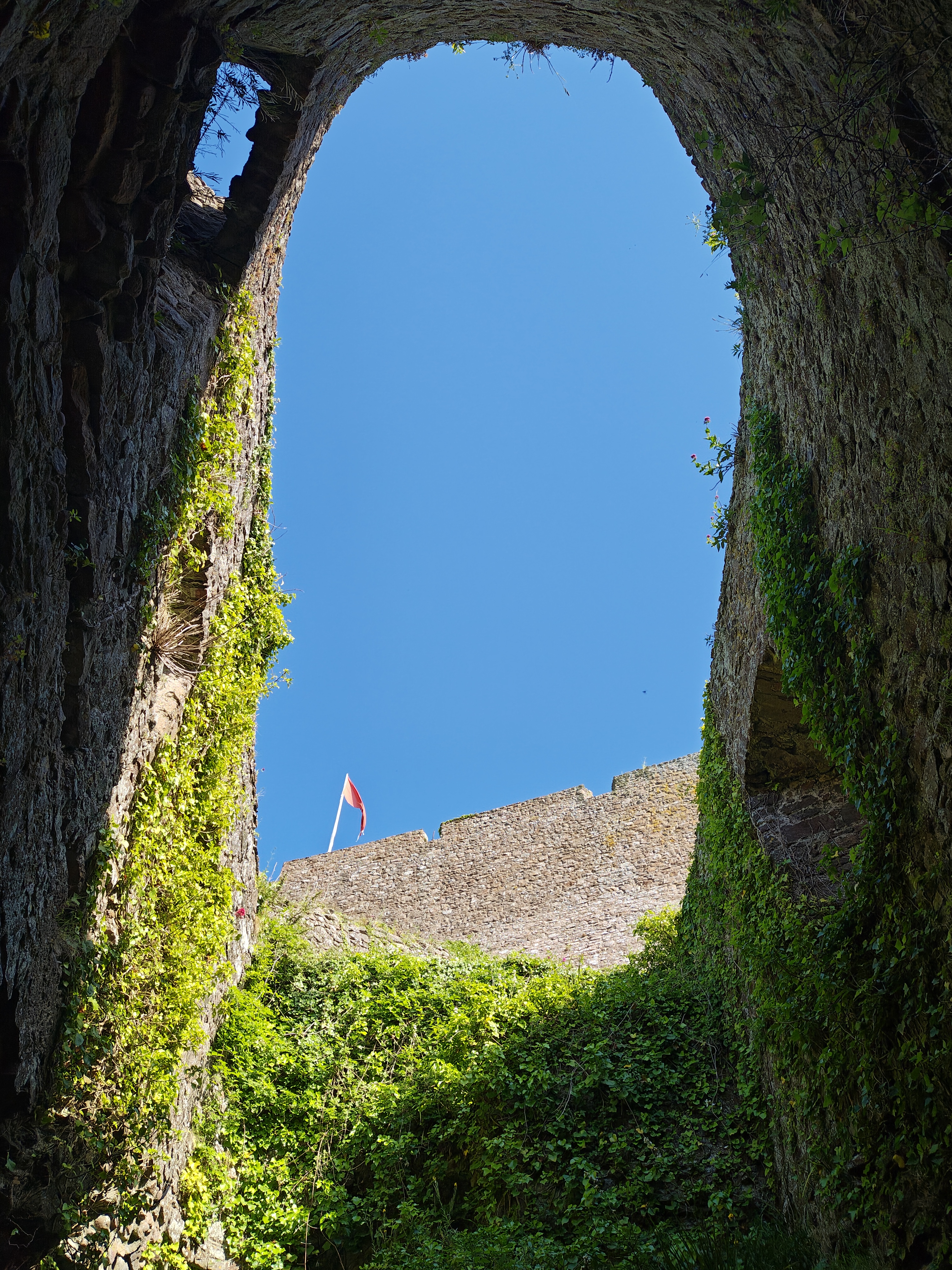
We had now put about as much distance between us and our accommodation as possible, and the sun was beginning to set. The pedal back to St Helier was probably the most challenging of the trip, involving some significant gradients and the busiest roads we were to encounter. We made it back, however, and collapsed into a pizzeria just before the kitchen closed. A slow winding up through an unlit cycle path in forest-shrouded darkness later, and the Airbnb was achieved.
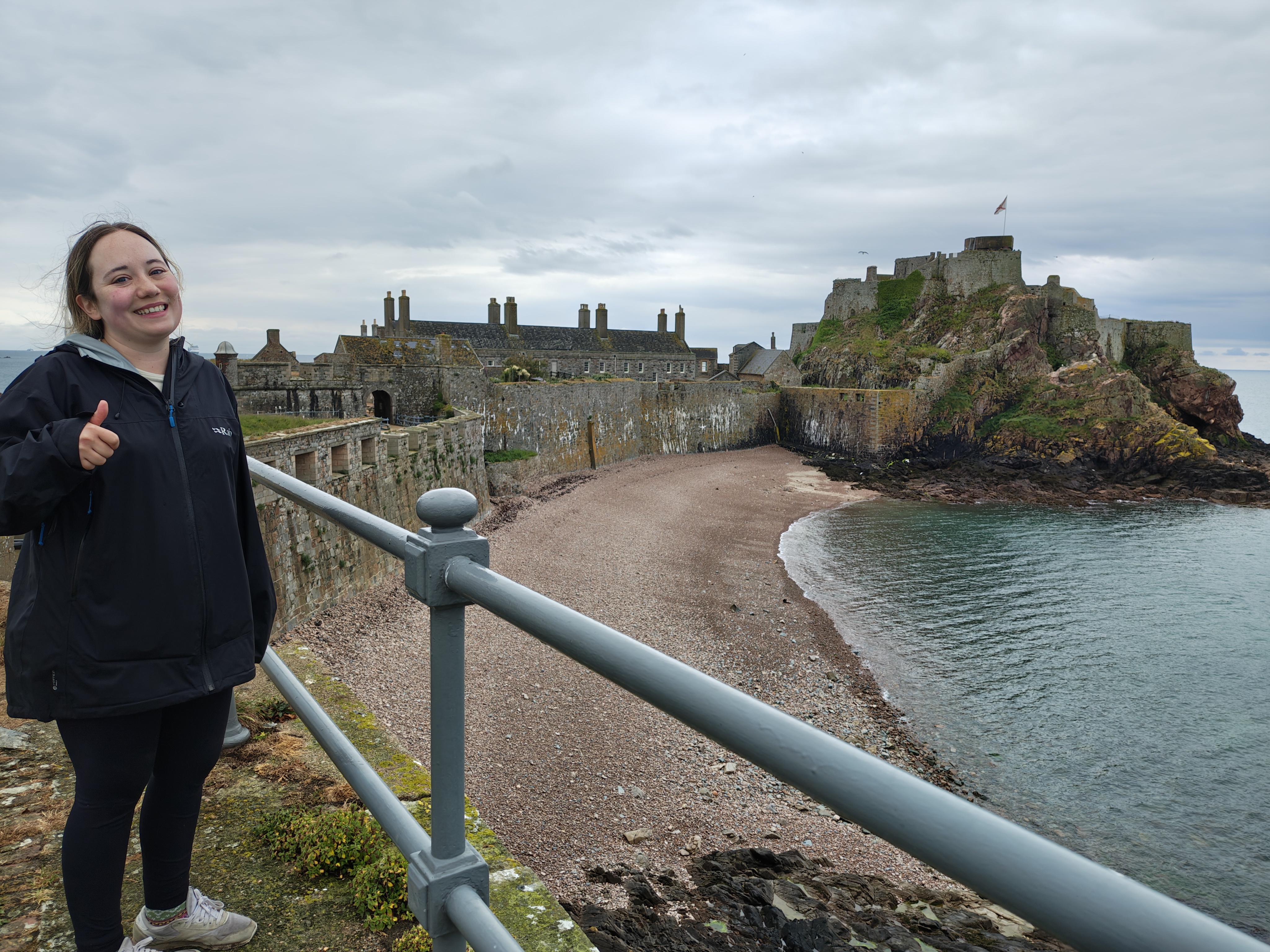
Wednesday was the worst weather day, but largely confined to the morning, and less travel was required as the capital was mandated by the itinerary. Elizabeth Castle was stop number one. Again, this was accessed by tidal causeway or, more significantly, by amphibious bus/ferry if the tide was in. Driving down the beach, its wheels retracted and a propeller began to spin, carrying us across the waves to the late 16th-century-built fortress. It was named for Elizabeth I of England, and Walter Raleigh served as its first governor, though he stayed there only 13 weeks.
On arrival, we were told that the musket demonstration would start in a quarter of an hour. A redcoat in full dress gave us the lowdown and fired warning shots across St Aubin’s Bay in anticipation of a French force landing in an attempt to take the island from the British in 1781.
As well as featuring its own WWII era defences, Elizabeth Castle has, sitting at the start of the breakwater, the hermitage of St Helier for whom the town is named. Specifically, it has a medieval chapel constructed on top of the rocky outcrop from which the 6th-century saint devoted himself to prayer and fasting, alongside providing a community function in warning islanders of any approaching raiders. It is said he succumbed to such a raiding party in 555 AD when they beheaded him, giving rise to St Helier’s double-axed coat of arms.
After finishing Dickens’s A Tale of Two Cities on the flight over, I began Victor Hugo’s Hunchback of Notre-Dame, which remained my companion for the rest of the trip. At the museum that afternoon, before buying some reblochon at the Normandy market, accepting only Euros, I discovered that Hugo was briefly a citizen of Jersey. He had come to the then-French-speaking island as an exile from the Second Empire of Napoleon III. His stay was short-lived, however, as he was swiftly booted out and had to commence a further exile in Guernsey after publishing a critical piece on Queen Victoria.
The next morning, we killed an hour or so in the excellent Jersey Maritime Museum, which features a hyperabundance of animatronic contraptions and interactive exhibits, and then departed on a DFDS ferry for St Malo, Brittany. I am introduced to the card game cribbage, which I consistently lose at for the remainder of the trip.
Coming into port, we have little time to linger as we must make la gare in time for our train to Caen, which will be used as a point de depart for our stay in Normandy. The lady at the desk is very proactive in explaining the delay to us when we arrive in rapid French and advises us not to stray too far when it increases to 25 minutes. Luckily, it’s a regional service that stops a while at every station, so it makes up the time, and we get in before 10. Not many places are open for food at this hour, but in another turn of fortune, there is a kebab shop round the corner where we have our first experience of cuisine a la Normande. With our level of hunger and travel fatigue, this ends up being a culinary highlight!
On Friday, we pick up a croissant at the boulangerie before boarding the train to Bayeux. Today we will take in the tapestry and, I hope, manage to commemorate my great, great uncle’s involvement in the D-Day landings of 1944.
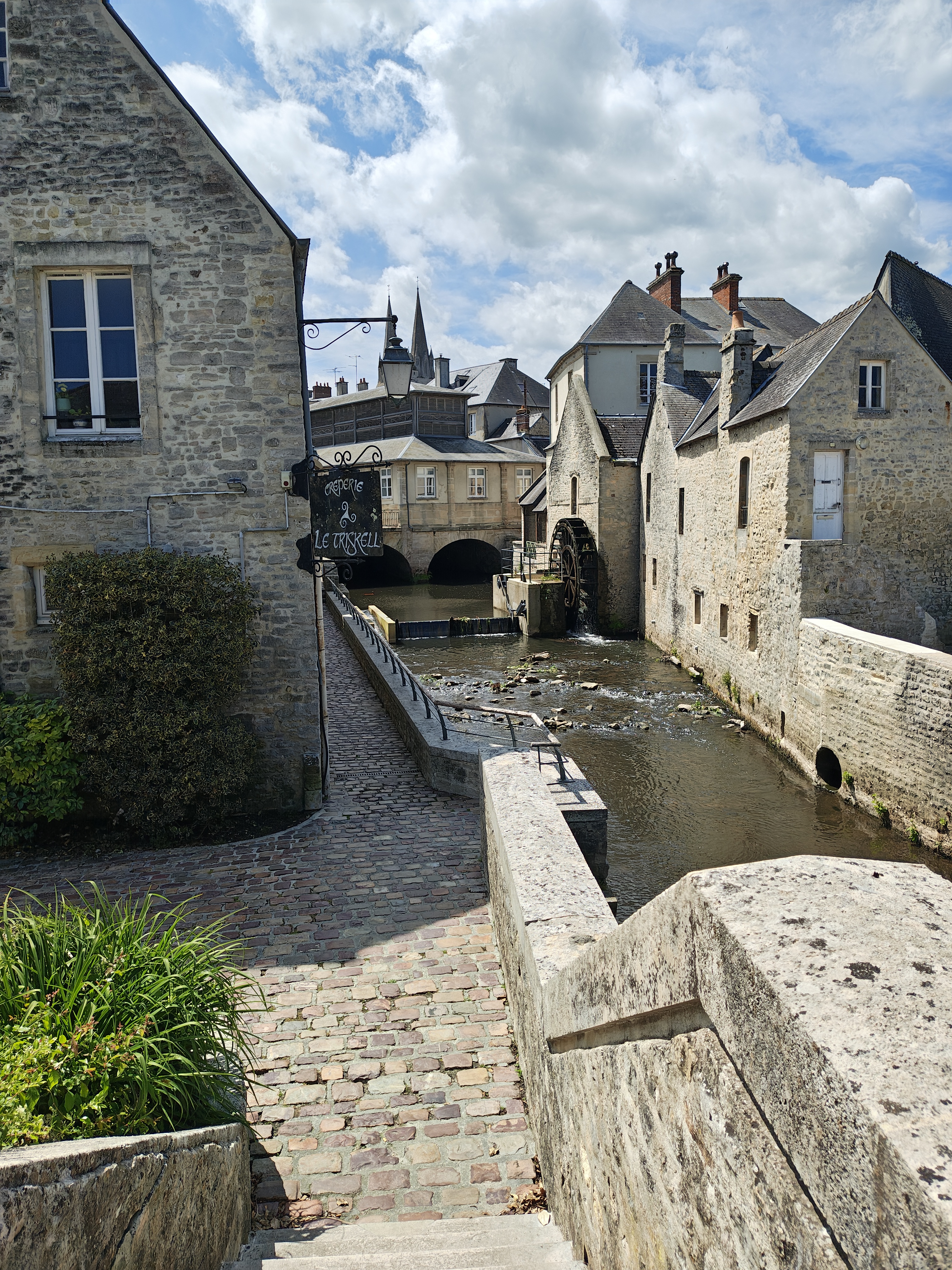
Arriving in Bayeux, the first thing you see upon leaving the train station are two Norman cavalrymen astride a roundabout on the short walk into the historic town. Already, the high medieval tone is set. Paired with Lübeck in Germany, it rivals its Teutonic counterpart for charm and beauty, though here is more Harold and Hastings than harbours and Hansas.
I encounter French customer service at the ticket booth for the Bayeux Tapestry when my attempt to pay over the asking price for the ease of change is scoffed. We pick up our two audio guides en anglais and begin the tour. The contemporaneous depiction of the story of the Battle of Hastings remains a powerful piece of Norman propaganda that leaves you thinking that perhaps William the Conqueror did have a point. It has been theorised, nevertheless, that it contains subversive messages, woven in under the radar, about the brutality of the fighting – beheaded horses, ransacked corpses, etc.

It is in Bayeux that we discover that Normandy is a cider region and have two glasses with, respectively, a crepe and a galette for lunch, dining out on the street below the streaming sun. Having accomplished the tapestry, we plan to catch a bus to the beaches of the debarquement. The scheduled bus never arrives. A minor crisis precipitates until I check my phone and find that my ancestor is, in fact, according to the Commonwealth Graves website, buried on the outskirts in the specially dedicated military cemetery.
The first thing you see as you approach on foot from the town centre is the sandstone monument to the 1,800 Commonwealth soldiers, sailors and airmen whose remains were untraced. Their names are inscribed under their regiments.
Across the road is an arc of headstones of simple white marble. 4,648 in total. The ends of the arc are flanked by two enclosed shelters, each containing a folder with the name and address of the interred. Flicking past Fletcher, we find Lance Corporal John Norman Johnston Flett of Quoyloo, Orkney, who died aged 25 on 19 July 1944.
Our final full day in France sees us depart Caen by Flixbus for the Mont St Michel. As someone who is interested in pilgrimage, this seemed like an appropriate continuation of my Camino journey, which ended, as stated above, in Southampton.
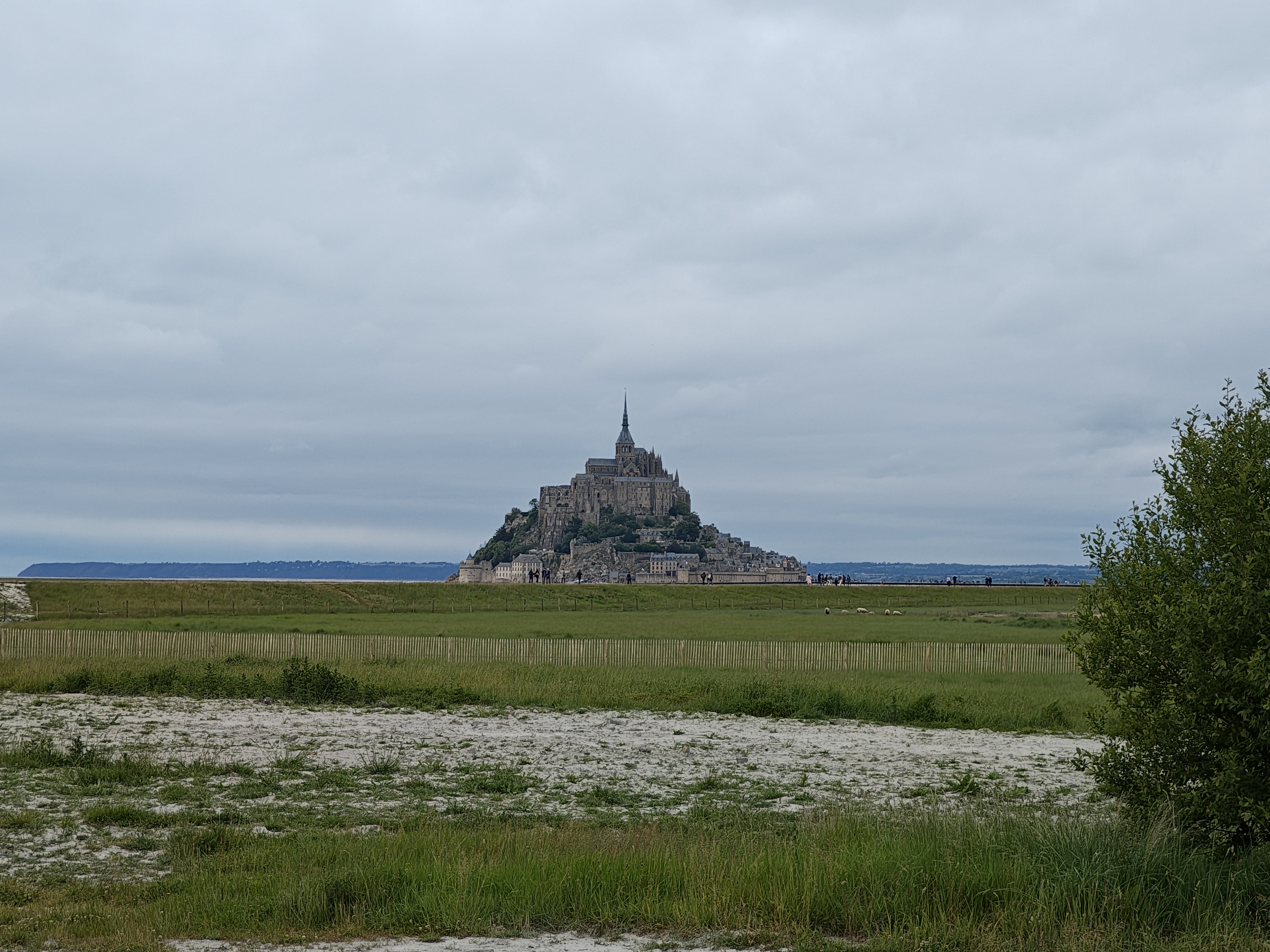
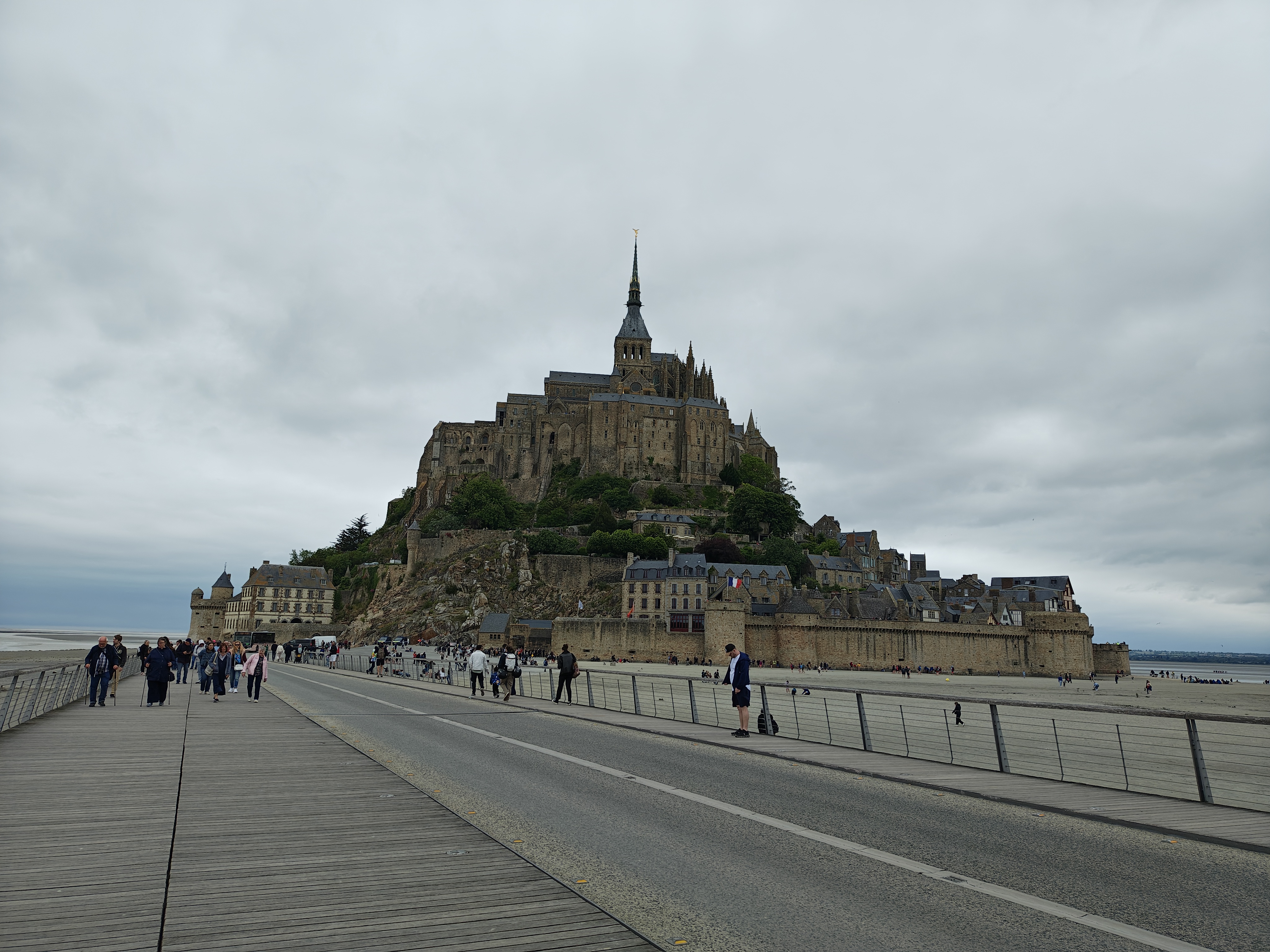
The Mont St Michel is not a port, however, but is situated in a pristine estuary landscape whose lack of features makes the Mont all the more impressive, standing alone on the flats, a walled city carved into the granite tidal island with the dizzying abbey spire at its apex.
A shuttle bus is available, but who would, having legs to walk on, deny themselves the glory of the approach?
Le Mont throngs with tourists. Perhaps, in hindsight, scheduling this for a Saturday was a poor idea. Nevertheless, the bustle adds something to the chaotic yet picturesque density of the narrow streets within.
Forgoing the audio guide this time, we circulate through the abbey sans interpretation. By the time we’ve rounded the last bus to Pontorson is unobtainable. Milder panic than the Bayeux crisis descends, but we resign ourselves to the remarkably indirect route back to port via Rennes, and bag another regional capital while we are at it.
After a night in St Malo, we reverse our progress and return by ferry to St Helier, then fly home that afternoon, but not before making use of the full gamut of our Jersey Heritage pass and paying a visit to the interior of Mont Orgueil to top up our earlier exclusion.
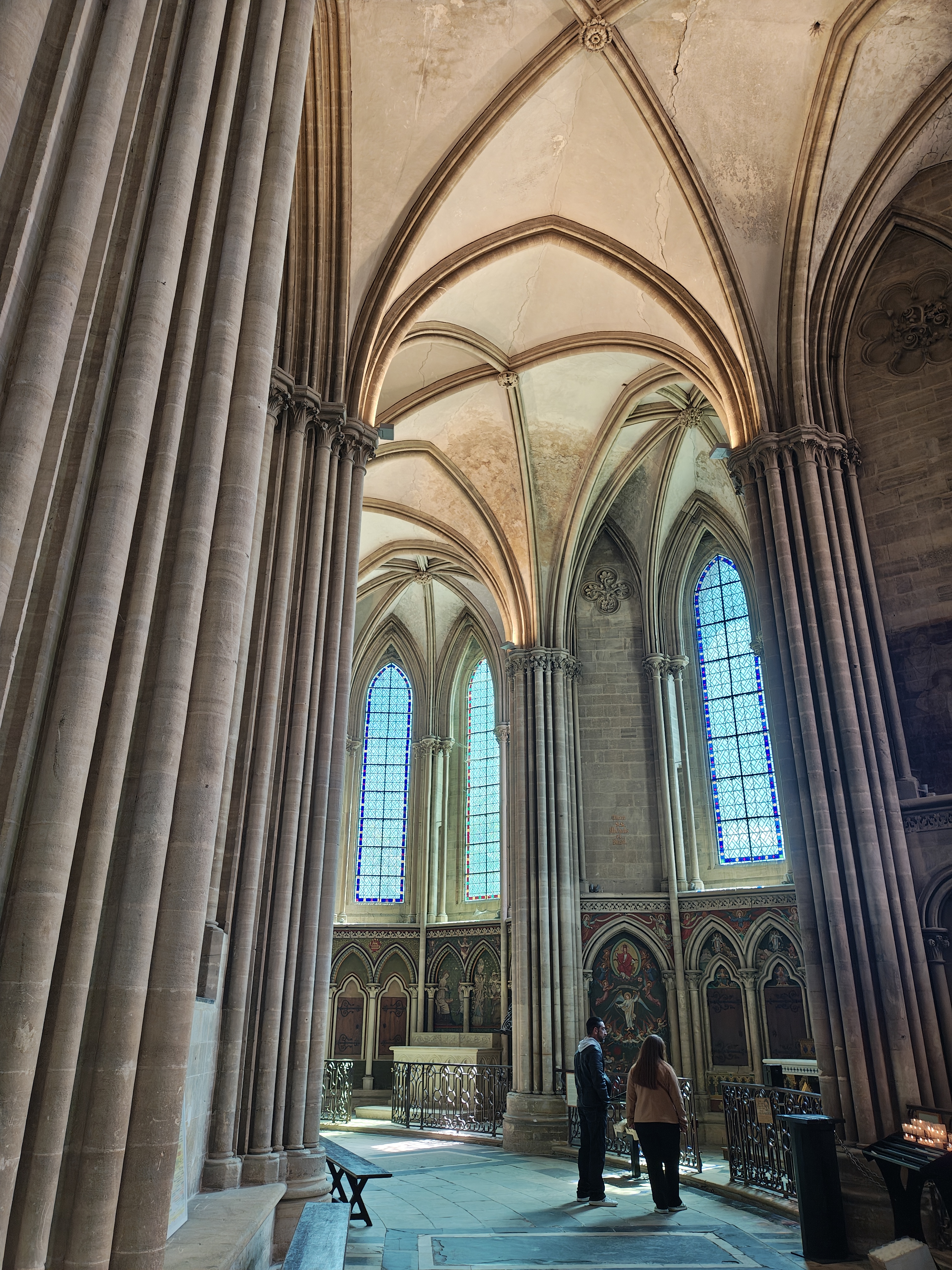
I would thoroughly recommend Bayeux as a pretty and authentic-feeling medieval town with an outstandingly ornate cathedral. As for St Michel, it is a must-see, but I would try to avoid the weekends if at all possible.
Jersey is a fascinating place with its own distinct culture, if having a bit of an unreconstructed affection for the British Empire.
If you can get past the sort of hyperreal UK-ism, there is a wealth of history to discover and beaches aplenty. If you’re looking to truly “get away from it all”, I wouldn’t pick Jersey, however, as its dense population and urbanisation don’t as such lend themselves to escape, albeit affording more choice than you’d usually get with an island holiday.

 Flett-cetera
Pingback: Cultural Highlights of 2026 | Flett-cetera